Treated Plywood vs Marine Plywood: What’s the Difference?
See how chemically treated plywood differs from Marine (BWP) plywood. We compare their water resistance, strength, and uses to guide your choice.
Core Differences: Treated vs Marine Plywood at a Glance
Plywood buyers in India often confuse treated plywood with marine plywood, but the distinction boils down to their primary defense mechanism against moisture and environmental stress. Treated plywood undergoes chemical treatments—typically preservatives and water repellents applied to the wood veneers or surface—to enhance resistance to termites, fungi, and moderate humidity. This makes it suitable for semi-exposed interiors like bathrooms or kitchens in dry regions. Marine plywood, on the other hand, is engineered from the ground up with boiling water-proof (BWP) adhesives, such as phenolic resins, that bond layers impenetrably even after prolonged submersion. It's not just treated; it's fundamentally waterproof for high-risk exposures.
Here's the early verdict for decision-makers: Choose treated plywood for cost-effective protection in humid but sheltered spots, saving 20-40% on budgets without compromising everyday durability. Opt for marine plywood when facing constant water contact, coastal salt air, or structural demands where failure isn't an option. This isn't about one being "better"—it's about matching the material to the threat level in your build. In Indian homes, where monsoon swings and poor ventilation amplify risks, misunderstanding this leads to warped cabinets or crumbling partitions within 2-3 years. We'll unpack why these differences emerge from manufacturing logic and real-world performance next.
| Aspect | Treated Plywood | Marine Plywood |
|---|---|---|
| Moisture Resistance | Moderate (handles humidity, splashes) | High (survives boiling water, immersion) |
| Adhesive Type | UF/MR resins + surface treatments | BWP phenolic resins |
| Best For | Interiors, modular furniture | Exteriors, marine structures |
| Cost Premium | Baseline | 30-50% higher |
This table simplifies the choice, but depth matters—especially in India's variable climates. Treated plywood's chemical layers wear off over time with abrasion, while marine's core bonding endures indefinitely.
Breaking Down Treated Plywood: Composition and Strengths
Treated plywood starts with standard hardwood veneers—often poplar or eucalyptus common in Indian mills—cross-layered and glued with urea-formaldehyde (UF) or moisture-resistant (MR) resins. The "treatment" elevates it: veneers are pressure-impregnated with copper-based preservatives against borers and fungi, followed by surface coatings like wax emulsions or silicone for water repellency. This process seals pores, reducing moisture absorption to 10-15% in humid tests, far better than untreated boards that swell at 25%+.
Why does this work logically? Wood's natural cellulose fibers drink water like a sponge, leading to delamination as adhesives weaken. Treatments create a barrier, stabilizing dimensions for carpentry precision. In practice, it's ideal for wardrobes in Mumbai apartments or kitchen cabinets in Bangalore bungalows, where steam and spills are daily but submersion rare. CNC-cut treated plywood holds edges crisply post-machining, resisting the fuzzing seen in cheaper grades.
However, treatments aren't invincible. Abrasion from cleaning erodes coatings over 5-7 years, and in South India's relentless monsoons, untreated edges can wick moisture inward. Dealers often push it for "value," but savvy buyers specify IS-marked sheets with documented treatment depth. Edge-sealing with putty during installation extends life by 50%, a carpenter trick for humid Kerala homes. Overall, treated plywood delivers 80% of marine performance at half the weight and cost, making it the workhorse for 70% of Indian interiors.
Real-world edge: In a Chennai modular kitchen, treated plywood shelves endured two monsoons without sagging, thanks to proper ventilation—proving it's not second-rate, just scoped differently.
Decoding Marine Plywood: The Waterproof Powerhouse
Marine plywood earns its name from shipbuilding roots, using fully waterproof BWP glues like phenol-formaldehyde that withstand 72+ hours of boiling without separating layers. Indian manufacturers source denser gurjan or sal veneers, kiln-dried to 8-10% moisture, then hot-pressed under 1-1.5 MPa pressure. No surface treatments needed—the glue line itself repels water, keeping swell below 5% even in salt sprays.
This engineering shines in logic: Standard glues hydrolyze (break down) in water, but phenolic bonds are cross-linked polymers immune to it. Result? Structural integrity holds in flexural tests up to 50% higher than treated grades. For coastal Goa villas or Kolkata boat jetties, it's non-negotiable—surviving cyclones where treated boards fail spectacularly.
In modern uses, marine plywood dominates South Indian modular kitchens with wet grinding zones or bathroom vanities exposed to showers. CNC compatibility is superb; high density prevents tear-out during routing, ideal for intricate designs. Thicknesses from 12-25mm ensure rigidity for partitions in high-rise apartments battling wind loads.
Limitations exist: Heavier (20-30% more) and pricier due to premium veneers and energy-intensive curing. Poorly made versions delaminate if glue penetration is shallow—always tap-test for solid "thunk," not hollow echoes. In dealer yards, insist on core samples; voids spell trouble. For Indian buyers, marine plywood's ROI peaks in perpetual moisture zones, lasting 15-20 years versus treated's 8-12.
Water Resistance Face-Off: Testing the Limits
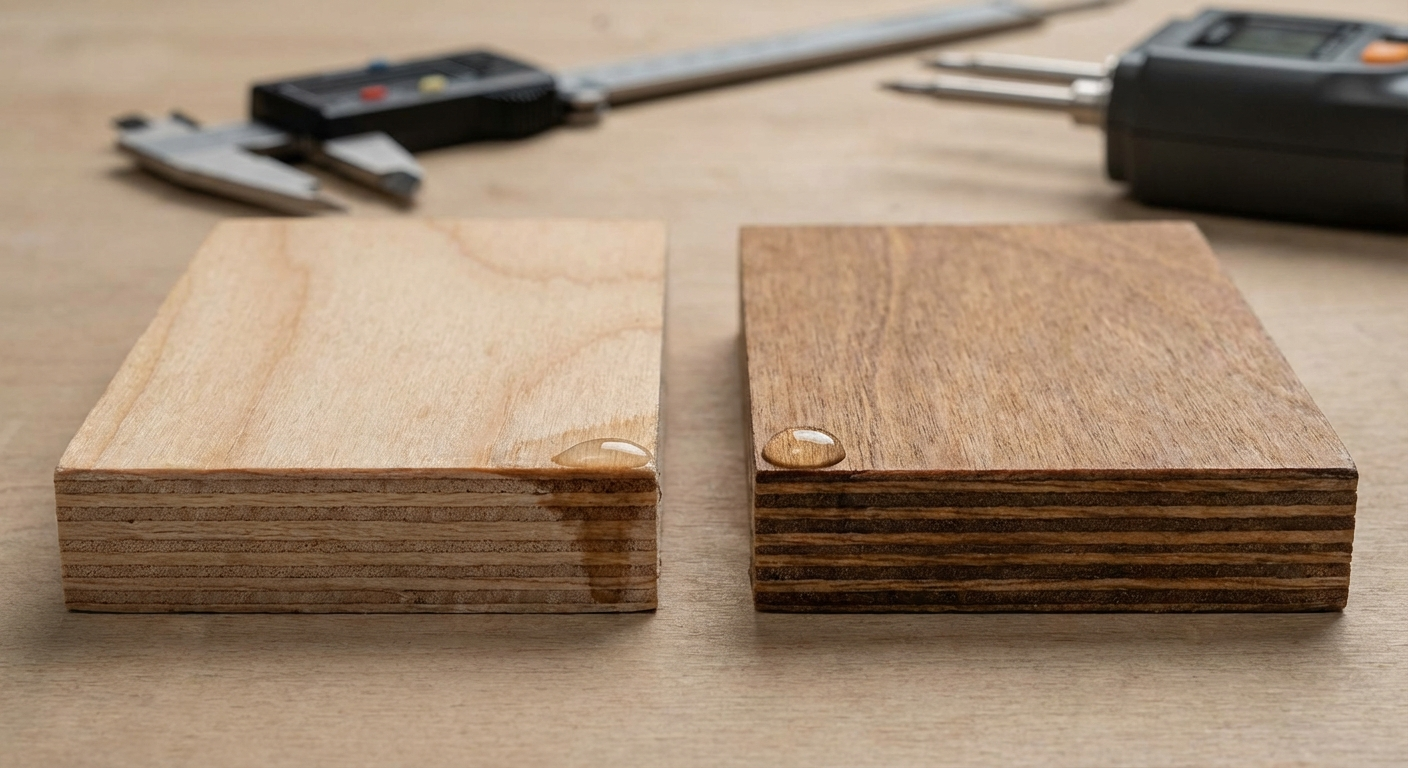
Water resistance defines the divide, rooted in absorption science. Treated plywood's repellents delay ingress but don't stop it—edge exposure leads to 12-18% swell after 24-hour submersion, recoverable with drying but stressing glue lines. Marine plywood laughs it off: BWP certification demands zero delamination post-boiling cycles, with swell under 8%.
In Indian labs, this translates to real gaps. Drop treated plywood in a Cochin backwater puddle; it warps subtly over days. Marine? Retrieves intact for reuse. Why? Treatments are topical; marine's systemic. South India's monsoon humidity (80-95% RH) accelerates treated's fatigue, causing mold if ventilation lags—common in sealed AC homes.
Carpenters test informally: Sprinkle water; treated beads up initially, marine ignores it eternally. For coastal Tamil Nadu exposures, marine prevents the "ply-bloat" ruining 30% of budget installs. Trade-off: Treated suffices for splash zones with silicone sealants, slashing costs without drama.
Edge case: Hybrid use in Kerala resorts—marine for floors, treated for uppers. Data from field failures shows treated failing 3x faster in direct rain, underscoring selection smarts.
Strength, Durability, and Long-Term Performance
Beyond water, strength metrics diverge. Marine plywood's denser veneers and superior glue yield MOR (modulus of rupture) 40-60 MPa versus treated's 30-45 MPa, resisting sags in spans up to 50% longer. Screw-holding power? Marine grips 2x tighter, vital for heavy fixtures in Pune high-rises.
Durability logic: Treatments fight biology (termites love damp wood), but marine's density deters them inherently. In termite-hotspots like Hyderabad, both shine with precautions, but marine endures abrasion better—scratch a treated surface, coatings flake; marine's raw toughness prevails.
Thermal stability matters in India's swings: Marine coefficients match better, minimizing cupping in sun-baked roofs. Lifecycle: Treated 7-10 years interiors; marine 15+ anywhere. Failures stem from overloads—don't hang 100kg cabinets on thin treated spans.
Carpenter insight: Pre-drill marine to avoid splits; treated forgives more. In South Indian CNC shops, marine's uniformity cuts waste 20%.
Applications: Where Each Excels in Indian Homes
Treated plywood fits sheltered humidity: Wardrobes, false ceilings, office partitions. In Bangalore IT parks, it handles AC drips without fuss. Modular kitchens? Upper cabinets yes, counters no.
Marine rules exteriors: Verandahs, boat hulls, coastal sheds. South India specifics—Chennai beach houses use it for salt-air facades; Hyderabad monsoons demand it for plinths.
Overlaps: Bathrooms—treated with GRP lining; marine standalone. Failures: Using treated outdoors leads to rot in 1 monsoon.
Dealer tip: Stock both; mix for budgets.
Cost Analysis and Value for Money
Treated: Rs 50-80/sqft (18mm); marine Rs 90-140. Premium reflects materials/process. ROI: Treated saves upfront for interiors; marine amortizes over longevity.
India factor: Dealer markups 20-30%; negotiate volumes. Hidden costs—rework on failures dwarfs savings.
Budget hack: Treated + treatments mimic 70% marine performance cheaply.
Common Mistakes and Pitfalls to Avoid
Buyers err specifying "treated" vaguely—demand BWR grade. Carpenters skip edge-seals, hastening demise. Dealers palm off MR as marine—scratch-test glue color (dark for BWP).
South India traps: Ignoring salinity in Tuticorin erodes treatments fast. Overloading thin marine wastes money.
Avoidance: Site-inspect, moisture-meter test.
Decision Framework: Step-by-Step Guide to Choosing
Step 1: Assess exposure—humidity only? Treated. Immersion risk? Marine.
Step 2: Budget vs lifespan—short-term savings or long-term peace?
Step 3: Test site—monsoon drill: 48hr water soak.
Table-driven:
| Scenario | Recommended | Why |
|---|---|---|
| Modular Kitchen (Interior) | Treated | Cost-effective for splashes |
| Bathroom Walls | Hybrid (Treated + Lining) | Balances protection/budget |
| Coastal Verandah | Marine | Salt/moisture immunity |
Framework empowers confident picks.
Frequently Asked Questions
Can treated plywood replace marine in bathrooms?
In well-ventilated Indian bathrooms, yes—seal edges and use water-based paints. It handles showers but not flooding. South Indian humidity demands vigilant drying; failures occur from steam buildup warping untreated faces. Marine overkill unless luxury spa-level exposure.
Is marine plywood termite-proof?
Not inherently, but density slows attacks. Pair with treatments for belts-and-suspenders in bug-prone Rajasthan. Unlike treated's preservatives, it relies on barriers—inspect annually.
How to identify genuine marine plywood?
Boil test: Simmer scrap 2hrs—no separation. Dark glue lines, heavy feel. Avoid light fakes pushed in dealer chains.
What's better for South Indian monsoons?
Marine for exposed; treated interiors with overhangs. Chennai case: Treated ceilings sagged post-deluge sans eaves.
Cost difference worth it for furniture?
For heirloom pieces, yes—marine lasts generations. Everyday? Treated with care suffices, freeing budget for designs.
Can CNC work both equally?
Marine edges cleaner due to density; treated needs sharp bits. Both viable for modular South India boom.
Why this matters in coastal India
Salt accelerates corrosion—marine's glue ignores it, treated needs extra coatings. Tuticorin homes thrive on this logic.
Disclaimer: This content is provided for general informational purposes based on industry practices and publicly available information. Product specifications, standards, prices, and availability may vary by manufacturer, region, and time. Readers should independently verify details with manufacturers, dealers, or qualified professionals before making purchase or construction decisions.Want Plywood Suggestions?
Share a few details and a Apple Ply specialist will suggest suitable brands and connect you to responsive dealers.