Plywood vs MDF vs Particle Board: A Complete Comparison
Compare plywood, MDF and particle board by cost and strength. This guide helps you pick the right material for your furniture or interior projects.
Understanding the Core Differences in Composition
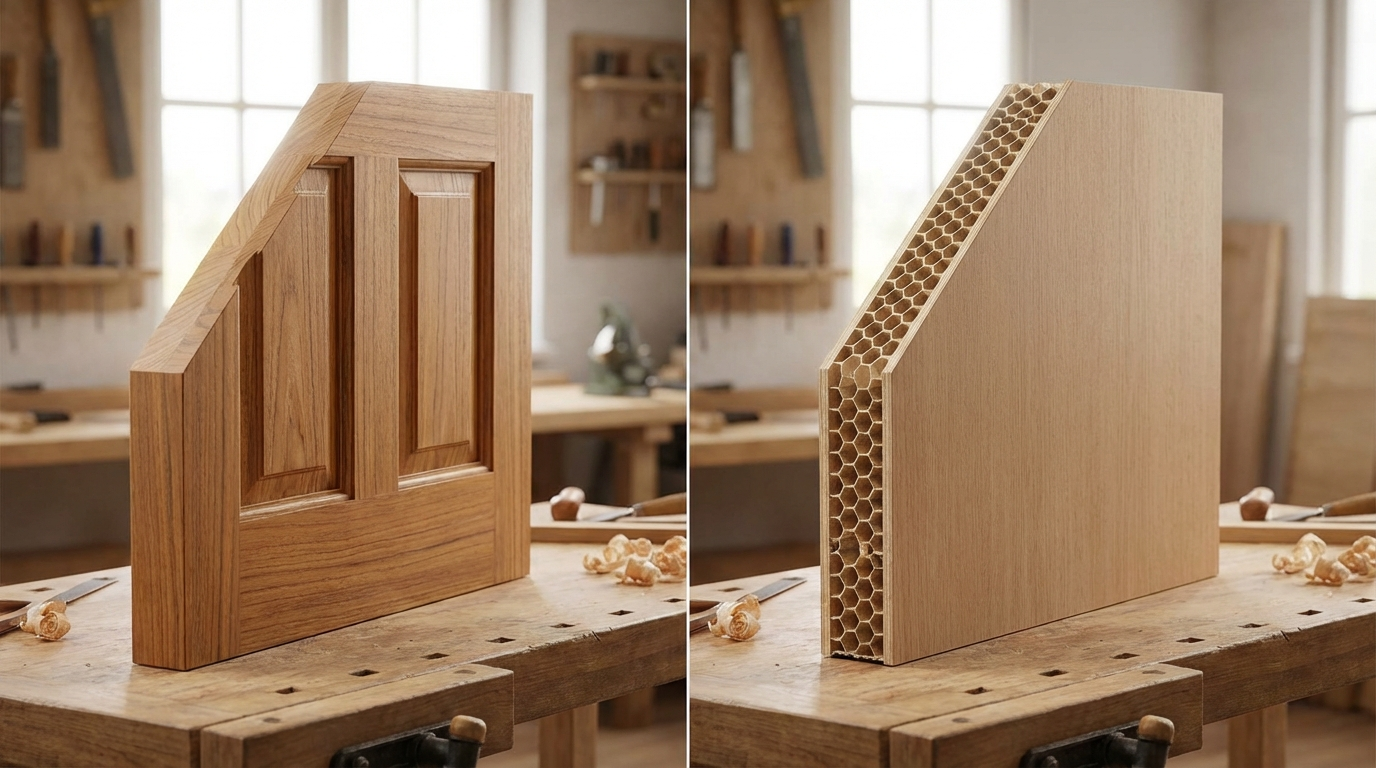
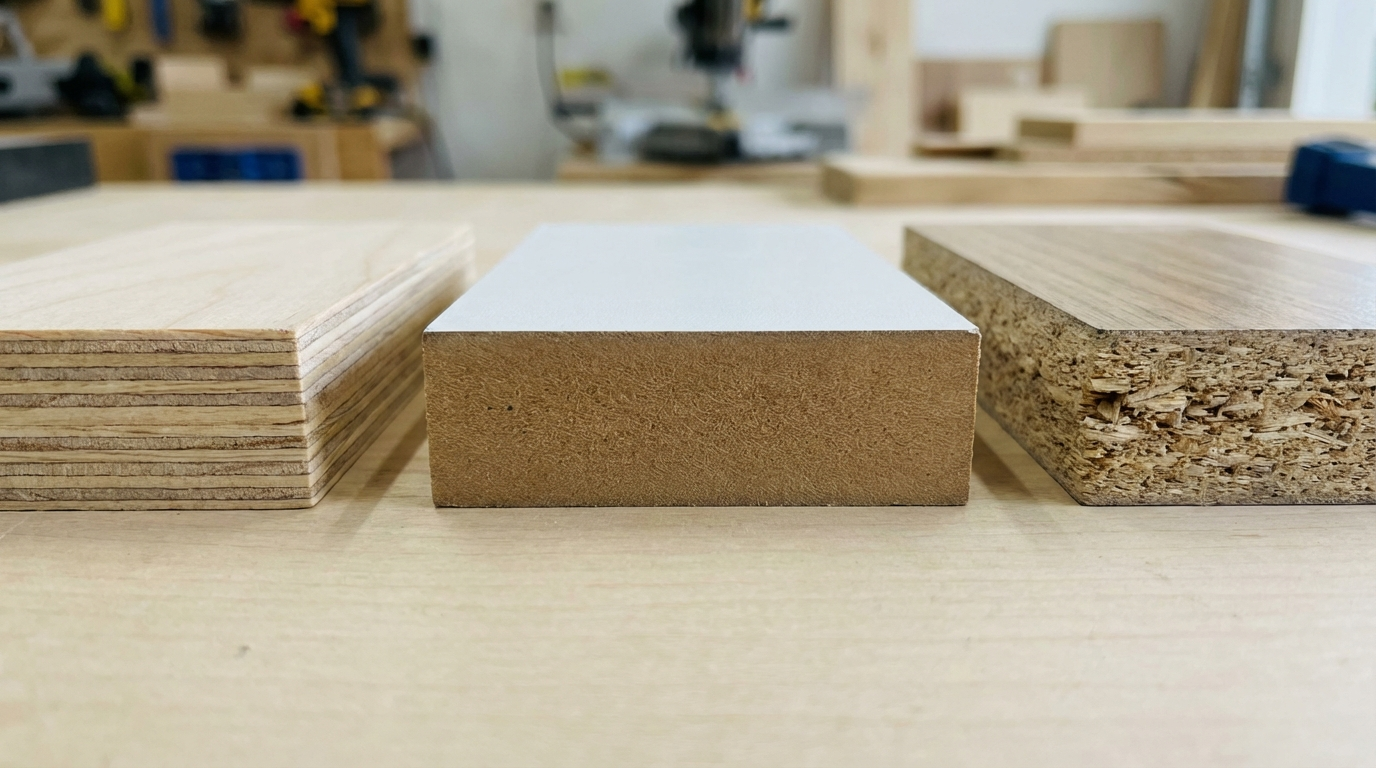
Plywood, MDF, and particle board represent three foundational engineered wood options widely used in Indian furniture and interior projects. Each starts from wood fibers or veneers but diverges sharply in how they are assembled, directly impacting their performance in everyday use. Plywood layers thin wood veneers—typically 7 to 13 plies—cross-grained and glued under high pressure and heat. This creates a stable, anisotropic structure where strength comes from alternating grain directions, mimicking natural wood's resilience while minimizing warping.
MDF, or medium-density fiberboard, grinds wood into fine fibers, mixes them with resins and wax, then compresses them into dense sheets. Uniform density throughout—no grain direction—makes it smooth and isotropic, ideal for painting but prone to sagging under uneven loads. Particle board, the most basic, uses wood chips, shavings, or sawdust bonded with urea-formaldehyde resin under pressure. Larger particles create a coarser texture, lower density, and visible grain patterns if unfinished.
These differences explain why plywood feels solid and heavy, MDF slices like butter, and particle board crumbles at edges. In India, where wood quality varies by region, understanding composition helps avoid subpar imports disguised as premium grades. For instance, cheap particle board often hides low-resin content, leading to delamination in humid storage. Plywood's multi-ply build resists this better, while MDF's fiber uniformity demands higher-quality resins to prevent swelling. Early decision point: if structural integrity tops your list, plywood wins; for budget flat-pack furniture, particle board suffices; smooth laminates favor MDF.
Real-world logic: veneers in plywood come from fast-growing species like poplar or eucalyptus, common in North India, while MDF and particle board recycle mill waste, keeping costs low but consistency variable. This manufacturing gap sets the stage for all comparisons ahead.
Why Grain Direction Matters for Longevity
Cross-graining in plywood distributes stress evenly, preventing splits along a single plane—crucial for shelves holding heavy kitchenware. MDF and particle board lack this, so loads cause internal shear, explaining frequent sagging in Indian wardrobes overloaded with clothes.
Resin Types and Their Indian Relevance
Urea-formaldehyde dominates particle board for affordability, but phenolic resins in quality plywood elevate boil-proof grades. MDF often blends both, balancing machinability with edge strength.
Strength and Load-Bearing Capacity Breakdown
Strength defines the battleground for these materials, especially in India where furniture endures heavy use—from stacking steel utensils in kitchens to propping up air conditioners on racks. Plywood excels here, with compressive strength often 2-3 times higher than MDF or particle board due to its layered reinforcement. A standard 18mm BWR plywood shelf can support 100-150 kg per linear meter without deflection, while equivalent particle board buckles at half that.
MDF offers moderate strength—around 30-40 MPa modulus of rupture—but its uniformity means it compresses evenly until failure, no warning cracks. Particle board lags at 10-20 MPa, with internal voids from uneven particles amplifying weakness. Screw-holding power follows suit: plywood grips fasteners deeply into plies, MDF relies on edge banding, and particle board strips easily without pilot holes.
In practical tests, like cantilevered cabinets, plywood holds firm; MDF warps under torque; particle board shatters. Indian carpenters swear by plywood for beds and almirahs because it spans wider without mid-supports, saving on framing costs. Why this matters in India: overloading is cultural—think Diwali stockpiles or monsoon laundry piles—plywood's forgiveness prevents collapses.
Edge cases: thin laminates hide particle board's frailty until overloaded. Always test by pressing center; plywood rebounds, others dent permanently. For modular racks, plywood's superior bending strength reduces bracket needs by 20-30%.
Bending and Shear Strength Nuances
Plywood's cross-plies handle shear forces from drawers sliding out fully loaded. MDF shears cleanly but lacks recovery; particle board delaminates under repeated stress.
Impact Resistance in Daily Use
Doors slammed shut? Plywood absorbs shocks via ply flex; MDF dents; particle board chips. Coastal South India sees more impacts from salty winds rattling shutters—plywood endures.
Cost Analysis for Indian Buyers
Cost drives 80% of Indian decisions, with particle board cheapest at ₹25-40 per sq ft for 18mm, MDF at ₹45-70, and plywood ₹60-120+, varying by grade (MR to BWR). Particle board's low price stems from waste wood and minimal processing; MDF adds fiber refinement; plywood demands quality veneers and glues. Bulk dealer buys drop 10-20%, but hidden costs emerge: particle board's short lifespan doubles replacement expenses over 5 years.
ROI logic: plywood's durability pays back in 7-10 years via fewer repairs. MDF suits painted panels where smoothness cuts finishing labor by 30%. In tier-2 cities like Coimbatore, particle board floods markets for rental furniture, but premium projects favor plywood. Why this matters in India: inflation-sensitive budgets mean upfront savings tempt, yet termite-infested particle board fails prematurely, hiking costs 2x.
Trade-offs: buy MR-grade plywood for dry interiors (cheaper than BWR); laminate MDF to mask edges. Carpenter tip: negotiate slab wastage—particle board cuts wastefully due to swelling. Long-term: plywood holds resale value in resale homes.
Hidden Costs: Repairs and Replacements
Particle board edges crumble during assembly, needing extra banding (₹5-10/sq ft add-on). MDF's dust requires masks, MDF's dust requires masks, raising labor.
Regional Price Variations
South India premiums 10-15% higher due to transport from northern mills, but local MDF plants in Kerala balance this.
Moisture Resistance and Humidity Performance
India's tropical climate—90% humidity in monsoons—exposes material flaws. Plywood grades like BWR (boiling water resistant) and BWP (boiling water proof) use phenolic glues, swelling <5% after 24-hour soak. MR plywood absorbs 10-15%, suitable indoors only. MDF swells 20-30% without moisture-resistant variants, fibers disintegrating. Particle board fares worst at 50%+ swelling, delaminating instantly.
South India context: coastal Kerala or Chennai homes battle salt-laden humidity; BWP plywood prevents bubbling laminates in modular kitchens. Why this matters in India: monsoon leaks ruin 40% of budget furniture—particle board warps irreversibly, MDF sags, plywood recovers. Termites favor particle board's resins.
Practical insight: expose samples to steam; plywood holds shape, others balloon. For bathrooms, plywood only—seal edges religiously. Failures abound: swollen particle board cabinets in Mumbai rains.
Termite and Pest Resistance Factors
Plywood's solid plies deter borers better; treat particle board liberally, as voids harbor nests.
Recovery After Wetting
Dry plywood post-soak regains 90% strength; MDF loses 50%; particle board none.
Workability, Machining, and Finishing Qualities
CNC carpentry booms in urban India—Bengaluru workshops churn modular units. MDF reigns for machinability: no tear-out, perfect for intricate cuts, V-grooves. Plywood splinters on veneers unless taped; particle board frays terribly. Sanding: MDF dusts finely for paint; plywood needs care on faces; particle board gums paper.
Finishing: MDF takes laminates seamlessly; plywood requires putty for veneer flaws; particle board demands thick edging. Glue adhesion strongest on plywood, weakest on particle board. Dealer insight: CNC bits last 3x longer on MDF.
South India edge: humid workshops swell particle board pre-cut, ruining tolerances. Plywood's stability suits handwork in villages.
Edge Banding and Laminating Success
MDF edges seal invisibly; particle board chips; plywood hides with veneer matching.
Carpenter Labor Savings
MDF cuts assembly time 20%; plywood needs clamps for screws.
Best Applications and Real-World Scenarios
Plywood dominates load-bearing: kitchen cabinets, wardrobes, beds—handles 50-100kg shelves. MDF for non-structural: TV units, partitions, painted furniture—smoothness shines. Particle board for economy: false ceilings, back panels, disposable rental pieces.
Indian scenarios: modular kitchens (plywood for humidity); office desks (MDF for clean lines); hostel bunks (particle board budgets). Failures: particle board flooring buckles; MDF outdoors rots. South India: coastal villas use BWP plywood for verandas.
Edge cases: mix—plywood frames with MDF panels. Carpenter view: never particle board for kids' rooms—heavy play destroys it.
Kitchen and Bathroom Use
Plywood only; others fail moisture tests.
Furniture vs Interiors
MDF for aesthetics; plywood for function.
Common Mistakes Indian Buyers and Carpenters Make
Top error: choosing particle board for kitchens, ignoring humidity—swells in monsoons, costing ₹20,000+ replacements. Dealers push cheap stock; buyers skip grades, getting MR plywood for wet areas. Overlooking thickness: 12mm particle board sags anywhere useful.
Carpenter pitfalls: screwing MDF without plugs—strips out; ignoring plywood alignment, causing veneer peels. South India: CNC shops laminate uncoated particle board, bubbling in salt air. Bulk buys without moisture tests lead to warped deliveries.
Fix: demand samples, press-test, check resin smell (strong = poor quality). Why repeated: trust over logic, short-term savings. Narrative: Chennai buyer saved ₹5,000 on particle board almirah—replaced twice in 3 years.
Dealer-Driven Buying Traps
"Same quality" claims hide grades; verify plies visually.
Assembly Oversights
No edge sealing = early failure.
Trade-Offs, Limitations, and When NOT to Choose Each
Plywood: premium cost, veneer matching tricky, heavy transport. Avoid if budget <₹50/sq ft or pure aesthetics. MDF: moisture weak, heavy, dust hazard—skip humid/coastal. Particle board: all-round weak—never structural, outdoors, or kids' use.
Trade-offs: plywood strength vs weight; MDF finish vs durability; particle board price vs lifespan. India-specific: termite belts favor treated plywood; CNC favors MDF despite humidity fixes.
Limitations: none fireproof without treatments; all expand/contract thermally. Balance: hybrid panels (plywood core, MDF face).
Decision Framework: Step-by-Step Guide to Choosing
Step 1: Define load—>50kg/m? Plywood. Aesthetic priority? MDF. Budget-only? Particle board. Step 2: Humidity check—monsoon/coastal? BWP plywood only. Step 3: Work type—CNC? MDF; hand? Plywood. Step 4: Lifespan goal—10+ years? Plywood.
| Factor | Plywood | MDF | Particle Board |
|---|---|---|---|
| Strength | High | Medium | Low |
| Moisture Resistance | High (BWP) | Low-Medium | Very Low |
| Cost (₹/sq ft, 18mm) | 60-120 | 45-70 | 25-40 |
| Machinability | Good | Excellent | Poor |
| Best For | Structural | Smooth Finish | Budget Non-Load |
| Avoid In | Ultra-Budget | High Humidity | Everything Else |
Indian tweak: add termite factor—treat all, prioritize plywood. Test locally: load shelf prototype.
Frequently Asked Questions
Which is strongest: plywood, MDF, or particle board?
Plywood stands out as the strongest due to its cross-layered plies that distribute loads evenly, making it ideal for heavy-duty furniture like kitchen platforms or bunk beds in Indian homes. MDF provides decent uniform strength for panels but fails under point loads, while particle board crumbles quickly. In practice, a plywood shelf holds twice the weight of MDF and four times that of particle board before deflecting noticeably. For Indian buyers stacking pressure cookers or books, this translates to safer, longer-lasting builds without mid-supports.
Is MDF better than plywood for painting?
Yes, MDF's ultra-smooth, grainless surface accepts paint flawlessly with minimal primer, saving 20-30% on finishing time compared to plywood's veneered face needing putty fills. However, in humid Indian interiors, painted MDF swells at edges unless sealed perfectly, whereas plywood's stability holds finishes better long-term. Choose MDF for bedroom headboards or office partitions where aesthetics trump strength.
Can particle board be used for wardrobes?
Only for budget, low-use wardrobes in dry climates—not recommended for monsoon-prone India. It handles light clothes but sags under linen stacks or jeans piles, with doors warping within a year. Better for back panels; front-facing demands plywood or MDF to avoid embarrassment at housewarmings.
How does moisture affect these materials in South India?
Monsoon humidity and coastal salt air devastate particle board (50%+ swelling) and standard MDF (20-30%), causing laminate bubbles in modular kitchens. BWP plywood resists with <2% absorption, essential for Chennai apartments or Kerala villas. Seal all edges; untreated fails fast.
Which is best for CNC modular furniture?
MDF dominates CNC work for tear-free cuts and precise nesting, suiting Bengaluru's factory setups. Plywood works with carbide bits but splinters; particle board jams machines. Hybrid: MDF faces on plywood cores for kitchens.
Does plywood warp less than the others?
Significantly—cross-grains stabilize it against humidity swings, unlike MDF's even expansion or particle board's delamination. In AC-dry bedrooms, all hold; remove AC, and plywood alone survives.
Are there eco-friendly options among them?
All use fast-grow woods/recycled waste, but low-formaldehyde plywood edges out for lower emissions. Particle board's urea resins off-gas more; choose E0/E1 grades verified by smell test.
What's the ideal thickness for shelves?
18-25mm plywood for spans over 60cm; 19mm MDF for shorter; avoid particle board over 12mm as it won't help. Indian overloads demand thicker plywood margins.
Disclaimer: This content is provided for general informational purposes based on industry practices and publicly available information. Product specifications, standards, prices, and availability may vary by manufacturer, region, and time. Readers should independently verify details with manufacturers, dealers, or qualified professionals before making purchase or construction decisions.Want Plywood Suggestions?
Share a few details and a Apple Ply specialist will suggest suitable brands and connect you to responsive dealers.