Plywood for Wardrobes: Which Type is Best for Cupboards?
Find the best plywood for wardrobes and cupboards. Compare grades, thickness recommendations & design options for long-lasting furniture.
Quick Answer
The best plywood for wardrobes in Indian homes is BWR (Boiling Water Resistant) grade plywood in 18mm thickness for carcass and 12mm for back panels. For humid regions or bathrooms-adjacent wardrobes, BWP (Boiling Water Proof) marine-grade offers superior durability. Choose calibrated plywood for modular fittings and ensure IS 303 or IS 710 certification for quality assurance.
At a Glance
- Recommended Grade: BWR (MR Plus) for most wardrobes; BWP for high-humidity areas
- Ideal Thickness: 18mm for carcass, 12mm for shelves, 4-6mm for back panels
- Core Type: Hardwood core outperforms softwood for screw retention
- Budget Range: ₹55–₹120 per sq ft depending on grade and brand tier
- Certification Check: Look for BIS stamp (IS 303 for MR, IS 710 for BWP)
- Calibration: Essential for modular wardrobes with soft-close fittings
Understanding Plywood for Wardrobes: What Actually Matters
Wardrobes represent one of the most demanding furniture applications for plywood in Indian households. Unlike decorative pieces or occasional furniture, wardrobes must withstand daily mechanical stress from opening-closing cycles, bear significant static loads from stored clothing and accessories, and maintain dimensional stability across seasons—particularly challenging during monsoon months when humidity levels swing dramatically.
The plywood used for cupboards and wardrobes needs to balance three critical properties: structural rigidity to prevent sagging shelves, moisture resistance to avoid swelling at joints, and consistent density for reliable hardware mounting. In practical Indian market terms, this translates to choosing between MR (Moisture Resistant), BWR (Boiling Water Resistant), and BWP (Boiling Water Proof) grades based on your specific placement and budget.
Why Wardrobe Applications Are Demanding
A typical bedroom wardrobe in India faces unique stresses. The carcass panels must support 15-25 kg per running meter of shelf space. Hinges undergo 8-12 open-close cycles daily, meaning over 3,000 cycles annually—each one stressing the screw holes. In coastal cities like Mumbai, Chennai, or Kochi, ambient humidity regularly exceeds 75%, causing inferior plywood to swell at edges and warp at center panels.
Additionally, Indian wardrobes often incorporate loft sections that remain closed for months, creating micro-environments where trapped moisture accelerates fungal growth in poor-quality plywood. The interior darkness also means termite or borer infestations go unnoticed until structural damage becomes visible—making the choice of properly treated plywood critical rather than optional.
Types of Plywood Suitable for Cupboards
Not all plywood grades perform equally in wardrobe applications. Understanding the practical differences helps you avoid both overspending on unnecessary specifications and underspending on inadequate materials.
MR Grade (Commercial Plywood)
MR (Moisture Resistant) plywood, conforming to IS 303, uses urea-formaldehyde adhesive that withstands humidity but not direct water contact. For wardrobes in dry, air-conditioned bedrooms in metros, MR grade offers acceptable performance at the lowest cost. However, it remains unsuitable for wardrobes in non-AC rooms, coastal regions, or locations adjacent to bathrooms. The adhesive bond can weaken over 4-5 years in high-humidity environments, leading to layer separation at edges.
BWR Grade (MR Plus)
BWR plywood represents the practical sweet spot for most Indian wardrobe applications. Using phenolic adhesive with improved formulation, it handles humidity fluctuations significantly better than standard MR. Most reputable Indian manufacturers position BWR as their volume product for furniture applications, offering calibrated options suitable for modular fittings. This grade handles the monsoon-summer humidity cycles typical across most Indian cities without the premium cost of marine-grade boards.
BWP Grade (Marine Plywood)
BWP (Boiling Water Proof) marine plywood, conforming to IS 710, uses phenol-formaldehyde resin throughout and typically features hardwood cores. For wardrobes in coastal cities, basement bedrooms, or rooms with attached bathrooms, BWP provides the moisture protection that prevents long-term degradation. The higher cost—typically 40-60% more than BWR—justifies itself in these specific applications through extended lifespan and maintained structural integrity.
Blockboard Alternative
For extremely tall wardrobes exceeding 8 feet or very wide panels, blockboard offers superior warp resistance due to its solid timber core. However, blockboard has limited screw-holding capacity at edges—a significant drawback for hinge mounting. In Indian carpentry practice, blockboard works well for large wardrobe shutters when combined with plywood carcass construction.
Plywood Thickness Guide for Wardrobe Components
Selecting appropriate thickness for each wardrobe component prevents both structural failures and unnecessary material costs. Indian market practice has established clear conventions based on decades of furniture manufacturing experience.
| Wardrobe Component | Recommended Thickness | Acceptable Alternative | Why This Thickness |
|---|---|---|---|
| Side Panels (Carcass) | 18mm | 19mm (trade size) | Bears vertical load, anchors all hardware |
| Top and Bottom Panels | 18mm | 16mm (budget option) | Structural stability, prevents racking |
| Fixed Shelves | 18mm | 16mm for short spans | Load-bearing, sag prevention |
| Adjustable Shelves | 12mm | 15mm for heavy loads | Lighter weight, adequate for clothes |
| Shutter/Door Panels | 18mm | 12mm with frame | Warp resistance, hinge stability |
| Back Panel | 6mm | 4mm (cost saving) | Dust barrier, minor structural support |
| Drawer Components | 12mm | 9mm for small drawers | Balance of strength and weight |
| Internal Partitions | 12mm | 9mm for light division | Space division without excess weight |
The 18mm vs 19mm Confusion
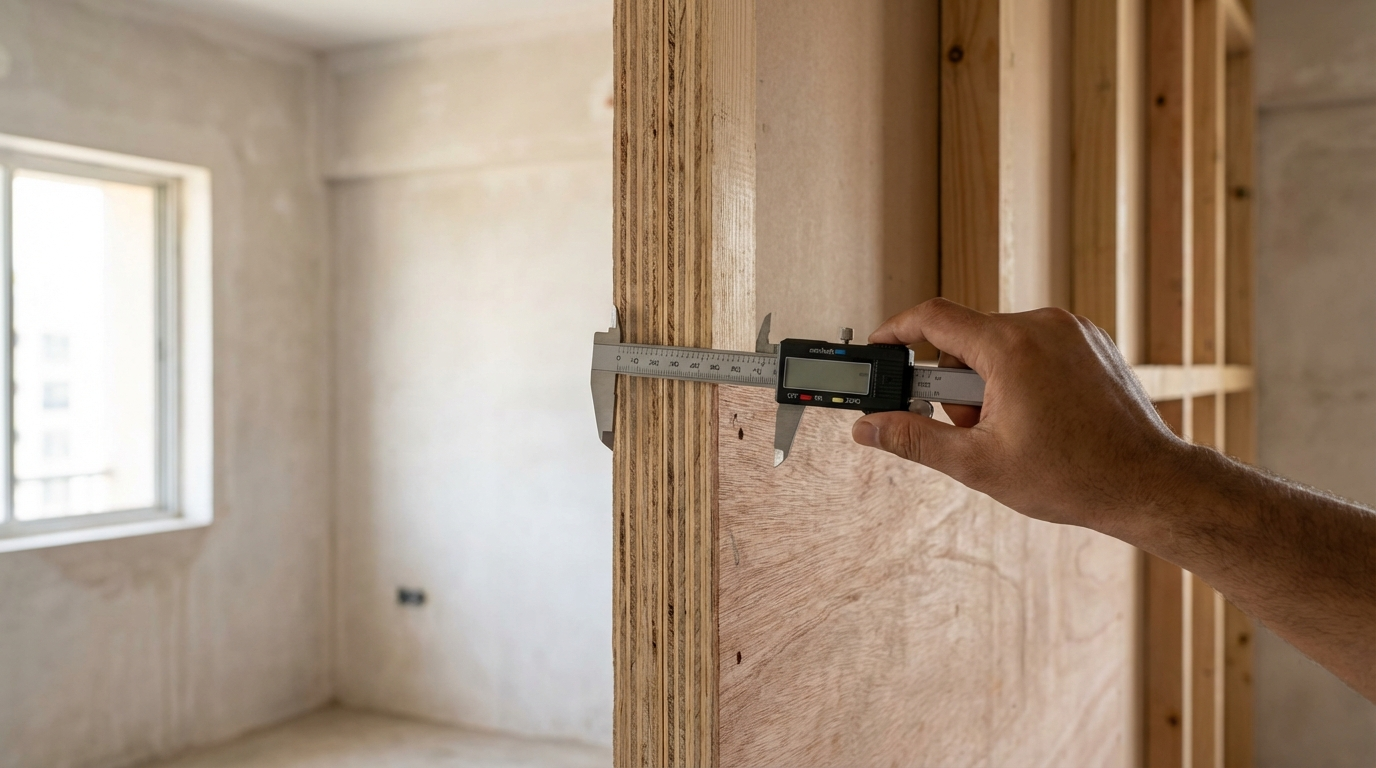
Indian plywood markets often create confusion between 18mm and 19mm thickness designations. In practical terms, most "19mm" plywood measures 18mm to 18.5mm after sanding. The 19mm designation typically refers to pre-sanded thickness. For wardrobe construction, this distinction matters primarily for modular systems with precise tolerance requirements. Always verify actual thickness with a caliper before purchasing—reputable dealers allow this verification.
Comparison: Plywood Grades for Wardrobes
A direct comparison of plywood options helps clarify which grade suits your specific wardrobe requirements and budget constraints.
| Parameter | MR Grade (IS 303) | BWR Grade | BWP/Marine (IS 710) | Calibrated BWR |
|---|---|---|---|---|
| Moisture Resistance | Moderate | Good | Excellent | Good |
| Price Range (₹/sq ft) | 45–65 | 55–85 | 85–120 | 70–100 |
| Best Application | AC bedrooms only | Most wardrobes | Coastal/humid areas | Modular systems |
| Expected Lifespan | 8–12 years | 12–18 years | 20+ years | 15–20 years |
| Screw Holding | Average | Good | Excellent | Good |
| Termite Treatment | Usually basic | Standard included | Comprehensive | Standard included |
| Surface Consistency | Variable | Good | Very Good | Excellent (±0.2mm) |
| Modular Suitability | Poor | Acceptable | Good | Excellent |
Regional Recommendations
Location significantly influences the optimal plywood choice. In Delhi NCR, Rajasthan, and other dry-climate regions, BWR grade handles the moderate humidity adequately. For Mumbai, Chennai, Kolkata, and Kerala—where humidity consistently exceeds 70%—BWP marine grade prevents the moisture-related failures common with lesser grades. Hill stations with consistent cool temperatures can often use MR grade successfully, but monsoon exposure remains a consideration.
How to Choose the Right Plywood for Your Wardrobe
Selecting wardrobe plywood involves evaluating your specific requirements against available options. This decision framework helps navigate the choices systematically.
Decision Criteria Checklist
- Location Assessment: Is the wardrobe in a coastal city, near a bathroom, or in a basement? These demand BWP grade minimum.
- Budget Reality: Calculate total sheet requirement and compare grade costs—the difference between BWR and BWP for a standard 6x8 ft wardrobe is typically ₹2,500–₹4,000.
- Construction Method: Modular wardrobes with European hinges and soft-close channels require calibrated plywood; traditional carpentry tolerates standard boards.
- Expected Lifespan: If planning to stay 10+ years, investing in BWP grade offers better value than potential replacement costs.
- Brand vs Local: Branded plywood offers consistency and warranty backup; local mills offer cost savings but require careful quality verification.
- Finish Compatibility: Laminate finishing requires smoother surfaces; veneer finishing needs stable substrates—both favor calibrated boards.
- Hardware Investment: Expensive soft-close hardware deserves quality plywood that maintains screw retention over years of use.
When NOT to Choose Economy Options
Certain situations demand premium plywood regardless of budget pressure. Wardrobes in rental properties intended for long-term ownership should use BWR minimum—tenant misuse combined with cheap materials accelerates failure. Walk-in closets with limited ventilation need BWP grade to prevent moisture accumulation issues. Wardrobes housing expensive clothing or accessories deserve protection from the humidity damage that inferior plywood cannot prevent.
Additionally, if your carpenter suggests using commercial-grade (MR) plywood for wardrobe carcass to reduce costs, understand that savings of ₹1,500–₹2,000 on a wardrobe risk failures costing ₹15,000–₹25,000 in repairs within 5-7 years. The economics strongly favor adequate specification from the outset.
Common Mistakes When Selecting Plywood for Cupboards
Years of Indian market observation reveal recurring errors that compromise wardrobe longevity. Avoiding these mistakes protects both your investment and peace of mind.
Mistake 1: Ignoring Core Quality
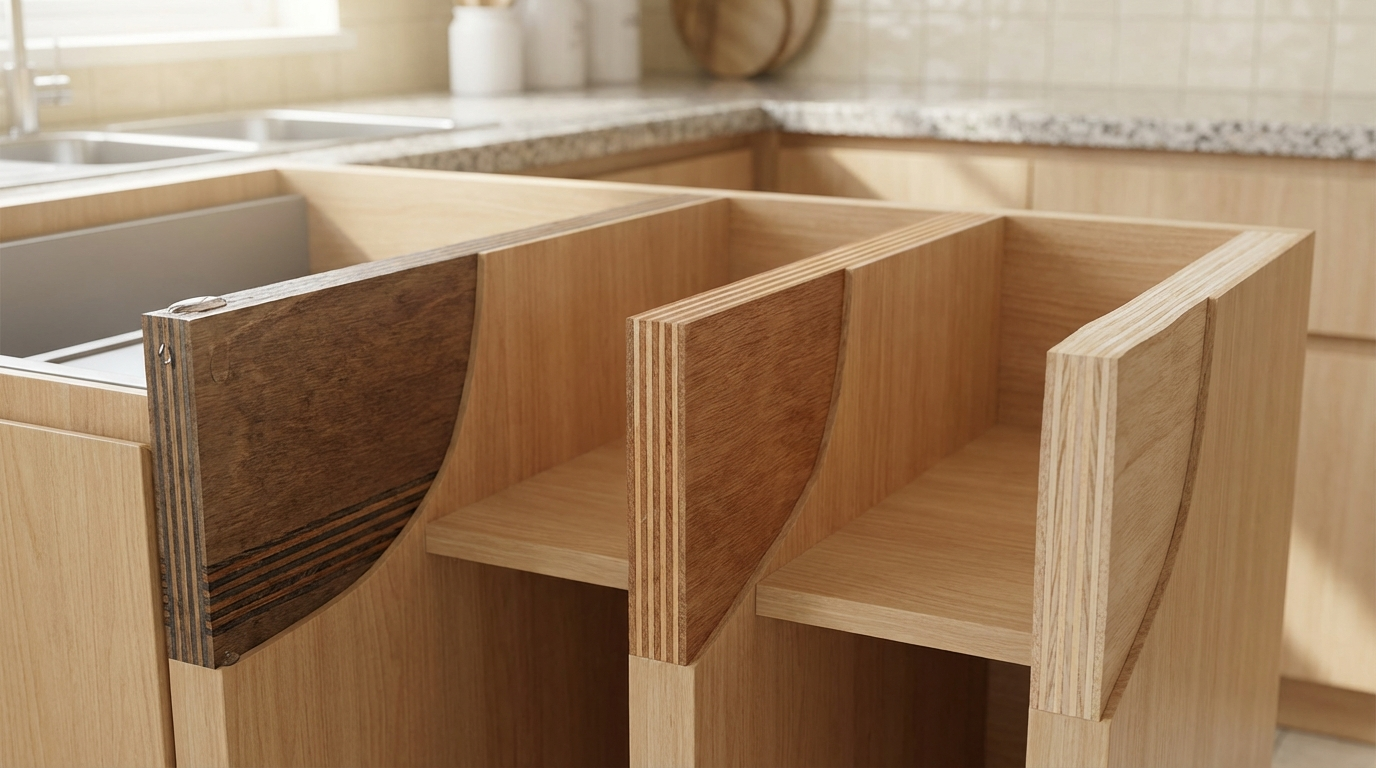
Buyers often focus exclusively on surface appearance and grade certification while ignoring core construction. A BWR-grade board with softwood (poplar or similar) core holds screws poorly compared to hardwood-core alternatives. For wardrobe applications where hinges and channels undergo repeated stress, hardwood cores provide measurably superior performance. Check cross-section cuts at the dealer to verify core material.
Mistake 2: Skimping on Back Panels
The wardrobe back panel seems inconsequential, leading many to specify 3mm or 4mm low-grade plywood. However, this panel contributes significantly to structural rigidity—preventing the parallelogram effect that causes doors to misalign. Specify minimum 6mm BWR grade for back panels, and ensure the carpenter properly grooves and glues (not just nails) the back panel installation.
Mistake 3: Inconsistent Grade Selection
Using different plywood grades within one wardrobe creates differential expansion problems. When BWP carcass meets MR shelves, humidity changes cause misalignment at joints. Maintain consistent grade throughout the wardrobe for dimensional stability.
Mistake 4: Neglecting Thickness Verification
Nominal thickness rarely matches actual thickness in Indian markets. An 18mm board measuring 16.5mm fails to provide specified load-bearing capacity. Always verify thickness with a digital caliper before purchase—reputable dealers expect this.
Quick Inspection Checks
- Edge Examination: Look for gaps, voids, or overlapping veneers in the core layers visible at cut edges
- Weight Test: Lift a sample sheet—properly dense plywood feels heavier than hollow-core alternatives of same size
- Flex Test: Slight flexing should not produce cracking sounds indicating dry or brittle adhesive
- Surface Tap: Tap across the face—hollow sounds indicate voids or delamination beneath surface veneer
- Moisture Check: Request moisture meter reading—anything above 12% indicates improper curing or storage
Price Guide for Wardrobe Plywood in India
Plywood prices in India vary significantly based on grade, brand tier, thickness, core material, and regional market dynamics. The following ranges reflect typical 2025-26 market conditions.
| Plywood Type | Thickness | Economy Brands (₹/sq ft) | Premium Brands (₹/sq ft) | Metro Premium |
|---|---|---|---|---|
| MR Commercial | 18mm | 42–52 | 55–68 | +8–12% |
| BWR Standard | 18mm | 55–70 | 75–90 | +10–15% |
| BWR Calibrated | 18mm | 68–82 | 88–105 | +10–15% |
| BWP Marine | 18mm | 85–100 | 105–125 | +8–12% |
| BWR Standard | 12mm | 38–48 | 52–65 | +10–15% |
| BWR Standard | 6mm | 22–28 | 30–38 | +8–12% |
What Drives Price Variation
Several factors explain the wide price ranges in Indian plywood markets. Core wood species creates the largest variation—gurjan and eucalyptus hardwood cores command 20-35% premiums over poplar softwood alternatives. Brand positioning accounts for another 15-25% difference between economy and premium segments. Geographic factors matter too: transport costs add ₹3-8 per sq ft in locations distant from manufacturing hubs in Yamuna Nagar, Gandhidham, or Kerala.
Seasonal demand influences availability and pricing—the October-February construction season typically sees 5-10% higher prices than lean periods. GST at 18% applies uniformly, but some dealers quote pre-GST prices requiring clarification. Always confirm whether quoted prices include GST and delivery to avoid budget surprises.
Budget vs Premium: Which Makes Sense?
For a typical 8x7 ft bedroom wardrobe requiring approximately 120-140 sq ft of plywood, the material cost difference between economy BWR and premium BWP totals ₹4,000–₹6,000. Against total wardrobe costs of ₹45,000–₹80,000 including hardware, laminate, and labor, this represents under 10% variation. Given that plywood quality directly determines structural longevity, the premium investment typically offers favorable economics for primary bedroom wardrobes expected to last 15+ years.
Economy options make practical sense for temporary accommodations, rental properties where recovery is uncertain, or children's room wardrobes likely to be replaced as needs evolve.
Carpenter's Perspective on Wardrobe Plywood
Experienced carpenters offer practical insights that technical specifications cannot capture. Their preferences emerge from handling thousands of sheets across various brands and grades.
Most seasoned carpenters prefer calibrated plywood for wardrobe work despite the cost premium. The reason is practical: consistent thickness allows accurate cutting lists, eliminates shimming during assembly, and ensures hardware alignment without adjustment. A carpenter's labor cost for working around thickness variations often exceeds the calibrated board premium.
Screw holding capacity matters enormously in daily carpentry practice. Hinges failing within warranty periods almost always trace to poor core density rather than hardware defects. Carpenters working with branded BWR or BWP plywood report significantly fewer callback issues compared to economy alternatives—a factor worth considering when choosing materials.
Edge banding adhesion also varies with plywood quality. Premium boards with denser surface veneers bond better with PVC edge bands, reducing delamination complaints. For wardrobes where edge appearance matters, this practical consideration favors quality boards.
Frequently Asked Questions
What is the best thickness of plywood for wardrobe carcass?
For wardrobe carcass (side panels, top, and bottom), 18mm thickness represents the industry standard across India. This thickness provides adequate load-bearing capacity for typical clothing storage while offering reliable screw retention for hinges and mounting hardware. Thinner 16mm panels can work for smaller wardrobes under 5 feet width, but 18mm remains the safe specification for structural integrity. The so-called 19mm boards in Indian markets typically measure 18-18.5mm actual thickness, so both designations effectively indicate the same product.
Which is better for wardrobes: plywood or MDF?
Plywood outperforms MDF for wardrobe carcass construction due to superior screw-holding capacity, better moisture resistance, and higher structural strength. MDF works acceptably for shutter panels where CNC routing creates decorative patterns, or for painted finish wardrobes where MDF's smooth surface offers advantages. However, MDF swells irreversibly when exposed to moisture, making it unsuitable for Indian conditions except in fully climate-controlled environments. A hybrid approach—plywood carcass with MDF shutter panels—combines the strengths of both materials.
Is BWR plywood waterproof for bathroom-adjacent wardrobes?
BWR (Boiling Water Resistant) plywood is moisture-resistant, not waterproof. For wardrobes sharing walls with bathrooms or located in high-humidity environments, BWP (Boiling Water Proof) marine-grade plywood provides superior protection. BWR handles normal humidity fluctuations adequately but cannot resist the consistent moisture exposure common near bathroom walls. If budget constraints require BWR in such locations, ensure excellent ventilation, use moisture-barrier paint on internal surfaces, and expect reduced lifespan compared to BWP alternatives.
What is the price of 18mm BWR plywood for wardrobes in India?
18mm BWR plywood prices in India typically range from ₹55-90 per square foot depending on brand tier and city. Economy brands in tier-2 cities start around ₹55-70 per sq ft, while premium brands in metros command ₹75-95 per sq ft. For a standard 8x7 ft wardrobe requiring approximately 130-150 sq ft of plywood, expect material costs between ₹8,000-₹14,000 for BWR grade. These prices assume standard gurjan or hardwood core—softwood core variants cost 10-15% less but offer inferior performance.
How to check plywood quality before buying for cupboards?
Quality verification involves multiple checks. First, examine the edge cross-section for void-free, tight core construction without gaps between layers. Second, verify actual thickness with a caliper—it should match stated dimensions within 0.5mm. Third, check the BIS certification stamp on each sheet confirming IS 303 or IS 710 compliance. Fourth, lift the sheet to assess density—quality plywood feels heavy relative to its size. Finally, tap the surface listening for hollow sounds indicating internal voids. Reputable dealers allow these inspections and provide test certificates upon request.
Is marine plywood necessary for bedroom wardrobes?
Marine (BWP) plywood is not necessary for all bedroom wardrobes—it represents overspecification for dry, well-ventilated rooms in low-humidity regions. BWR grade suffices for most standard bedroom applications in northern and central Indian cities. However, marine plywood becomes advisable for coastal cities (Mumbai, Chennai, Kochi, Kolkata), basement bedrooms, rooms with attached bathrooms, or non-air-conditioned spaces in humid climates. The 40-50% cost premium over BWR justifies itself through extended lifespan and reliability in these specific conditions.
What is calibrated plywood and do wardrobes need it?
Calibrated plywood undergoes additional sanding to achieve consistent thickness across the entire sheet, typically within ±0.2mm tolerance. This precision matters significantly for modular wardrobes using European hinges, soft-close channels, and drawer systems that require exact alignment. For traditional carpentry-built wardrobes, standard plywood works adequately as carpenters can adjust for minor thickness variations. If investing in quality hardware like Hettich or Hafele fittings, calibrated plywood prevents the alignment issues and premature hardware wear that thickness inconsistency causes.
Which plywood brands are best for wardrobes in India?
Several established manufacturers offer reliable wardrobe-grade plywood in India. Premium tier brands widely available include Century, Greenply, Kitply, and Austin—these maintain consistent quality with proper BIS certification and dealer networks for warranty support. Regional brands like Archid, Sarda, and National offer good value in their respective markets. Rather than brand loyalty, focus on verifying BIS certification, checking physical quality indicators, and purchasing from authorized dealers who provide genuine products with proper documentation. Brand reputation matters less than individual sheet inspection for ensuring quality.
Disclaimer: This content is provided for general informational purposes based on industry practices and publicly available information. Product specifications, standards, prices, and availability may vary by manufacturer, region, and time. Readers should independently verify details with manufacturers, dealers, or qualified professionals before making purchase or construction decisions.Want Plywood Suggestions?
Share a few details and a Apple Ply specialist will suggest suitable brands and connect you to responsive dealers.