Plywood for Kitchen Cabinets: BWP vs BWR vs MR Guide
Find the best plywood for kitchen cabinets. Compare BWP, BWR & MR grades, recommended thickness & material for modular kitchen interiors.
Quick Answer
The best plywood for kitchen cabinets in India is BWP (Boiling Water Proof) grade, particularly for areas exposed to moisture like sink units and base cabinets. BWP plywood offers superior water resistance essential for Indian kitchens where steam, spills, and monsoon humidity are constant challenges. For wall-mounted cabinets with minimal moisture exposure, BWR grade offers a cost-effective alternative.
At a Glance
- BWP grade is mandatory for sink cabinets, base units, and coastal/humid regions
- BWR grade works for wall cabinets and dry storage areas in moderate climates
- MR grade should be avoided for kitchen cabinetry due to poor water resistance
- 18mm thickness is standard for cabinet carcasses; 12mm for back panels
- Always verify IS 710 (BWP) or IS 303 (BWR/MR) stamps on actual sheets
- Price difference between BWR and BWP is typically ₹15–25 per sq ft—worth the investment for longevity
Understanding Plywood Grades for Kitchen Cabinets
Kitchen environments in India present unique challenges that standard furniture plywood cannot handle. Between daily cooking steam, water splashes near sinks, occasional spills, and the relentless humidity during monsoon months, kitchen cabinets face more moisture exposure than any other furniture in your home. This is precisely why understanding plywood grades becomes critical before investing in modular or semi-modular kitchen cabinetry.
The three primary grades available in the Indian market—BWP, BWR, and MR—differ fundamentally in their adhesive composition and water resistance capabilities. These aren't marketing terms but standardized classifications governed by the Bureau of Indian Standards (BIS). The adhesive used to bond the wood veneers determines how the plywood will perform when exposed to moisture over months and years of kitchen use.
What BWP, BWR, and MR Actually Mean
BWP (Boiling Water Proof) plywood uses phenol formaldehyde resin as its bonding agent. This synthetic adhesive creates bonds that remain intact even under prolonged water exposure. The name comes from the BIS testing protocol where samples must survive extended boiling without delamination. In practical kitchen terms, this means the plywood won't swell, warp, or separate when exposed to years of steam, humidity, and occasional water contact.
BWR (Boiling Water Resistant) plywood uses melamine urea formaldehyde resin, offering moderate water resistance. It can handle humidity and brief moisture contact but will eventually deteriorate under sustained wet conditions. The adhesive provides resistance, not immunity—an important distinction for kitchen applications.
MR (Moisture Resistant) plywood uses urea formaldehyde resin, offering the lowest water resistance among the three. Despite the "moisture resistant" label, MR grade is designed for dry interior applications like bedroom wardrobes and living room furniture. It will swell and delaminate when exposed to the moisture levels typical in Indian kitchens.
BWP vs BWR vs MR: Detailed Comparison
Choosing between these grades requires understanding not just their technical specifications but how those specifications translate to real-world kitchen performance. Many homeowners make the mistake of viewing this as a simple quality hierarchy when it's actually about matching the right grade to specific cabinet locations and regional conditions.
| Parameter | BWP Grade | BWR Grade | MR Grade |
|---|---|---|---|
| Full Form | Boiling Water Proof | Boiling Water Resistant | Moisture Resistant |
| BIS Standard | IS 710 | IS 303 Type I | IS 303 Type II |
| Adhesive Type | Phenol Formaldehyde | Melamine Urea Formaldehyde | Urea Formaldehyde |
| Water Resistance | Excellent (prolonged exposure) | Good (intermittent exposure) | Poor (minimal tolerance) |
| Typical Lifespan in Kitchen | 15–20+ years | 8–12 years | 3–5 years (not recommended) |
| Price Range (18mm, per sq ft) | ₹85–140 | ₹60–95 | ₹45–70 |
| Best Application | Sink units, base cabinets, coastal areas | Wall cabinets, tall units in dry zones | Bedroom furniture only |
| Termite Treatment | Usually included | Sometimes included | Rarely included |
Performance Under Indian Kitchen Conditions
The practical difference between these grades becomes apparent within the first monsoon season. In cities like Mumbai, Chennai, Kolkata, and coastal Karnataka, ambient humidity regularly exceeds 80% for months. MR grade plywood in such conditions begins showing edge swelling within 6–12 months, even without direct water contact. BWR grade performs adequately in wall cabinets but struggles in base units where floor mopping and sink splashes create persistent moisture.
BWP grade's phenolic resin bonds actually strengthen slightly when cured under heat and moisture, making it uniquely suited for the hot, humid conditions near cooktops and dishwashing areas. This explains why experienced kitchen contractors in coastal regions refuse to use anything below BWP grade for any cabinet component.
How to Choose the Right Plywood Grade for Your Kitchen
The decision framework for kitchen plywood isn't simply "buy the best grade everywhere." A strategic approach considers cabinet location, regional climate, budget constraints, and realistic usage patterns. Many premium modular kitchen brands use BWP for base units and BWR for wall cabinets—a balanced approach that optimizes cost without compromising durability.
Decision Framework by Cabinet Type
Sink Base Unit: Non-negotiable BWP grade. This cabinet faces the highest moisture load—pipe condensation, splashes, leak risks, and wet vessel storage. Even in dry regions like Rajasthan or inland Maharashtra, BWP is essential here. The cost difference of ₹500–800 per sink unit between BWR and BWP is insignificant against potential replacement costs.
Other Base Cabinets: BWP recommended, BWR acceptable in dry climates. Base cabinets face floor-mopping moisture, occasional spills, and higher humidity accumulation (warm air rises, moisture settles). In coastal areas and high-humidity zones, stick with BWP.
Wall Cabinets: BWR is typically sufficient. These cabinets rarely face direct water contact. However, the cabinet directly above the cooktop experiences significant steam exposure—consider BWP for this specific unit if budget allows.
Tall Units and Pantry Cabinets: BWR grade works well for most regions. These units store dry goods and utensils, facing minimal moisture. Exception: if the tall unit houses a built-in microwave or oven, heat cycling can affect adhesive performance, making BWP a safer choice.
Buyer Checklist Before Purchase
- Verify BIS certification stamp (IS 710 for BWP, IS 303 for BWR/MR) on each sheet
- Check the core—gurjan or hardwood core indicates better quality than poplar or softwood
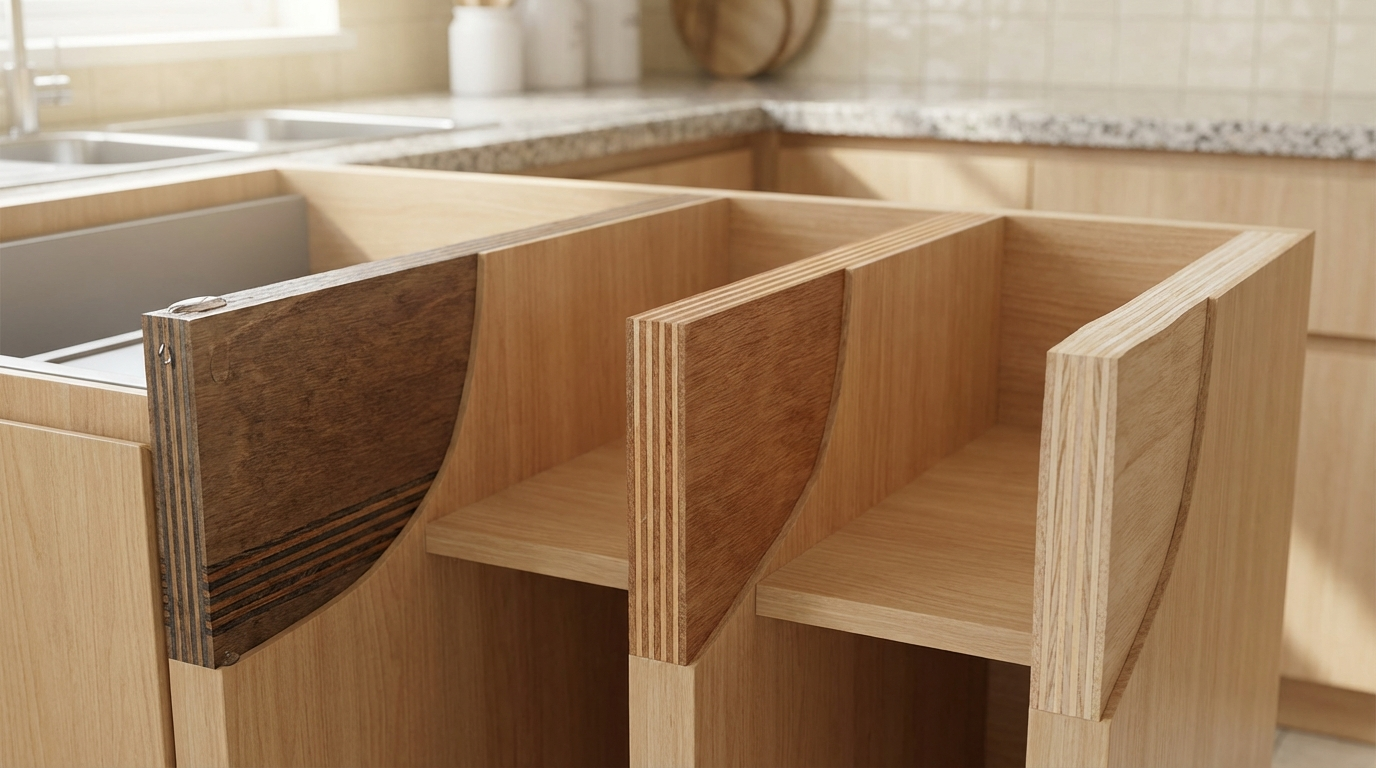
- Inspect edges for gaps, voids, or inconsistent veneer thickness
- Request the boiling water test certificate from the dealer for BWP claims
- Confirm termite and borer treatment, especially for non-BWP grades
- Match sheet dimensions to your cutting plan—minimize wastage at purchase
- Insist on calibrated (sanded) sheets if using laminate or veneer finish
When NOT to Choose BWP Grade
Despite being the premium option, BWP isn't always necessary. For bedroom wardrobes, living room TV units, study tables, and other dry-area furniture, BWP represents unnecessary expenditure. BWR or even commercial-grade plywood serves adequately for these applications. Additionally, if you're building temporary furniture for a rented apartment with a 2–3 year horizon, investing in BWP throughout may not justify the cost premium.
Recommended Thickness and Material for Kitchen Cabinets
Beyond grade selection, thickness and core material significantly impact cabinet durability, screw-holding strength, and overall structural integrity. Indian market conventions around thickness can confuse first-time buyers, particularly the 18mm versus 19mm trade size discrepancy.
| Cabinet Component | Recommended Thickness | Minimum Acceptable | Notes |
|---|---|---|---|
| Cabinet Sides (Carcass) | 18mm | 16mm | Structural integrity, hinge mounting |
| Top and Bottom Panels | 18mm | 16mm | Load-bearing capacity |
| Shelves (Fixed) | 18mm | 15mm | Prevents sagging under vessel weight |
| Back Panel | 6mm | 4mm | Can use 12mm for premium builds |
| Shutter/Door | 18mm | 16mm | Critical for hinge durability |
| Drawer Sides | 12mm | 9mm | 12mm for tandem box systems |
| Drawer Bottom | 6mm | 4mm | MDF acceptable for drawer bottoms |
The 18mm vs 19mm Confusion
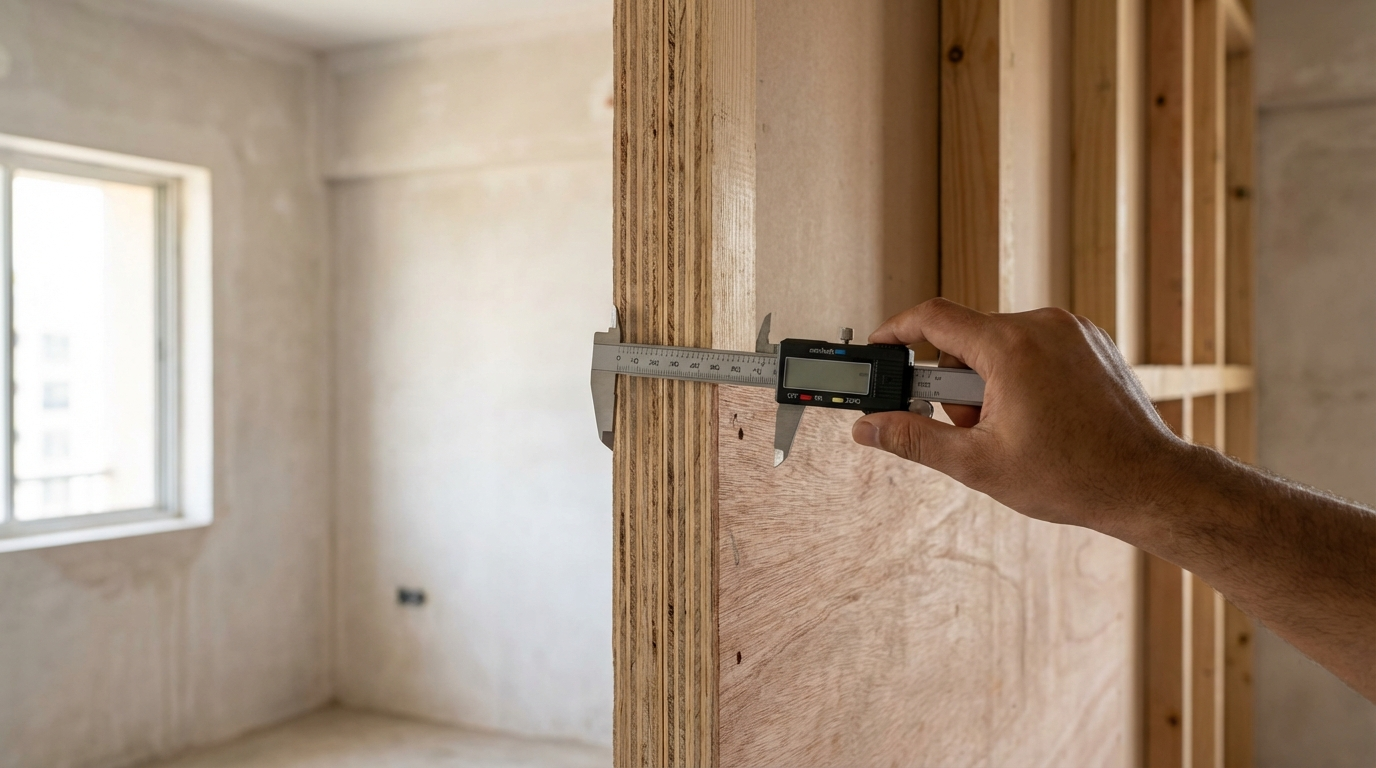
In Indian plywood trade, you'll hear both 18mm and 19mm used interchangeably. The reality is most "18mm" plywood measures between 17.5mm and 18.5mm depending on manufacturing tolerances and calibration. Premium brands offer calibrated plywood sanded to precise 18mm thickness, essential for CNC-machined modular kitchens where dimensional accuracy matters. Traditional carpenter-built kitchens are more forgiving of thickness variations.
Core Material Considerations
The wood species used for core veneers affects strength, weight, screw-holding capacity, and cost. Gurjan (Keruing) hardwood core is the industry benchmark for kitchen-grade plywood—dense, stable, and durable. Eucalyptus core offers a cost-effective alternative with reasonable performance. Poplar and other softwood cores should be avoided for kitchen applications despite lower prices, as they offer poor screw retention and are more susceptible to moisture damage even with BWP-grade adhesive.
Common Mistakes to Avoid
Kitchen cabinetry represents a significant investment, typically ₹1.5–4 lakh for a standard Indian kitchen. Understanding common pitfalls helps protect this investment and ensures your cabinets perform as expected for years.
Grade-Related Mistakes
Using MR grade anywhere in the kitchen: This remains the most common and costly mistake. Dealers sometimes push MR grade as "interior grade suitable for kitchens" to offer lower quotes. Within two monsoon seasons, MR-grade cabinets show visible swelling at edges, particularly around sink units and near the floor.
Assuming all BWP is equal: BWP certification ensures adhesive quality, but core material, veneer quality, and manufacturing standards vary dramatically between brands and price points. A budget BWP sheet with softwood core and poor calibration won't match premium BWP performance despite identical grade classification.
Skipping verification: Many buyers rely on dealer claims without checking actual BIS stamps on sheets. The stamp should be clearly visible on each sheet—not just mentioned in invoices or marketing materials.
Thickness and Construction Mistakes
Using 12mm for carcass construction: Budget-focused modular kitchen providers sometimes use 12mm plywood for cabinet sides to reduce costs. This compromises screw-holding strength for hinges and handles, leading to loose doors within 2–3 years of regular use.
Ignoring back panel quality: The 4mm or 6mm back panel seems insignificant but plays a crucial role in maintaining cabinet squareness and preventing dust and pest entry. Using cardboard or extremely thin MDF for backs leads to structural issues and hygiene problems.
Quick Inspection Checks
- Edge tap test: Tap the plywood edge firmly—a solid, dense sound indicates good core bonding; a hollow sound suggests voids or delamination
- Flex test: Slight flex across an 8-foot sheet is normal; excessive bending indicates low-density core
- Visual check: Look for consistent veneer thickness on edges, no gaps between plies, and uniform color across the sheet
- Weight check: Quality BWP plywood should feel noticeably heavier than MR grade of the same thickness
- Smell test: Strong chemical odor may indicate inferior adhesives or recent manufacture—allow off-gassing before installation
Price Guide for Kitchen Plywood in India
Plywood pricing in India varies significantly based on grade, core material, brand tier, and geographic location. Metro cities typically see 10–15% higher prices than Tier-2 cities due to retail overhead, while transport costs to remote locations add further variation. The following ranges reflect 2025–26 market rates for 8×4 feet sheets.
| Thickness | MR Grade (₹/sq ft) | BWR Grade (₹/sq ft) | BWP Grade (₹/sq ft) |
|---|---|---|---|
| 6mm | ₹22–35 | ₹30–45 | ₹40–55 |
| 12mm | ₹35–52 | ₹48–70 | ₹62–90 |
| 16mm | ₹42–62 | ₹55–82 | ₹75–110 |
| 18mm/19mm | ₹48–72 | ₹65–98 | ₹88–145 |
Assumptions: Prices reflect commercial to premium brand range, gurjan/hardwood core, Tier-1/Tier-2 city dealer rates. Branded BWP with calibration and certifications falls in the upper range. Prices exclude GST (18%).
What Drives Price Variation
Brand tier: Established brands like Greenply, Century, Kitply, and similar nationally distributed manufacturers command 20–40% premium over regional or unbranded options. This premium reflects quality consistency, warranty support, and verified BIS compliance.
Core material: Gurjan hardwood core adds ₹8–15 per sq ft over eucalyptus or poplar core. For kitchen applications, this premium is justified by superior screw-holding and moisture resistance.
Calibration: Factory-calibrated (precision-sanded) plywood costs 5–10% more but is essential for CNC-machined modular kitchens where dimensional accuracy affects fit and finish.
Certification: Genuinely BIS-certified plywood from audited manufacturing units costs more than "claimed" grades from unverified sources. The certification adds accountability and testing compliance.
Budget vs Premium: What Makes Sense
For a typical 100 sq ft kitchen requiring approximately 350–400 sq ft of plywood across all components, the cost difference between budget BWR and premium BWP works out to ₹12,000–18,000. Against a total kitchen investment of ₹2–3 lakh including hardware, countertop, and labor, this represents a 5–7% premium for substantially better durability. Most industry professionals recommend investing in BWP grade for at least base cabinets and sink units while using quality BWR for wall cabinets—a balanced approach costing approximately ₹6,000–10,000 extra over all-BWR construction.
Regional Considerations Across India
India's diverse climate zones create vastly different demands on kitchen cabinetry. A specification suitable for Jaipur may fail prematurely in Mangalore. Understanding regional factors helps tailor material selection appropriately.
Coastal and High-Humidity Zones
Cities like Mumbai, Chennai, Kolkata, Kochi, Goa, and the entire coastal belt experience sustained humidity above 70% for 4–6 months annually. Salt-laden air in areas within 5–10 km of the sea accelerates corrosion of metal components and stresses adhesive bonds. For these regions, BWP grade throughout the kitchen is the practical minimum standard. Additionally, marine-grade stainless steel hardware and proper ventilation design become equally critical.
Dry and Semi-Arid Regions
Cities like Jaipur, Ahmedabad, Nagpur, and interior Deccan plateau areas face a different challenge—extreme temperature variation and low humidity causing wood movement and potential cracking. Here, BWR grade performs adequately for most applications, with BWP reserved for sink units. The greater concern in these regions is termite risk, making verified borer treatment more critical than moisture resistance for wall cabinets.
Northern Plains and Moderate Climates
Delhi NCR, Lucknow, Chandigarh, and similar cities experience seasonal extremes—humid monsoons followed by dry winters. A mixed approach using BWP for base cabinets and BWR for wall units offers optimal cost-performance balance. Winter months bring minimal moisture risk, but monsoon preparation remains important.
Frequently Asked Questions
What is the full form of BWP plywood?
BWP stands for Boiling Water Proof plywood. This grade is manufactured using phenol formaldehyde resin as the bonding agent, which creates waterproof bonds between veneer layers. The name derives from the BIS testing protocol where sample pieces must survive extended boiling without delamination or bond failure. BWP plywood conforms to IS 710 standards and is the recommended grade for applications involving prolonged moisture exposure, including kitchen cabinets, bathroom vanities, and exterior-adjacent furniture.
Which is better for kitchen: BWP or BWR plywood?
BWP plywood is better for kitchen applications, particularly for base cabinets, sink units, and any cabinet near water sources. BWR (Boiling Water Resistant) offers moderate moisture resistance suitable for wall cabinets in dry climates but lacks the durability for high-moisture zones. The phenolic resin in BWP provides permanent water resistance, while BWR's melamine-based adhesive degrades over years of humidity exposure. For coastal cities and humid regions, BWP throughout the kitchen is advisable. The 20–30% price premium of BWP over BWR is justified by its significantly longer lifespan in kitchen conditions.
Can MR grade plywood be used for kitchen cabinets?
MR (Moisture Resistant) grade plywood should not be used for kitchen cabinets. Despite the "moisture resistant" terminology, MR plywood is designed for dry interior applications like bedroom wardrobes and office furniture. The urea formaldehyde adhesive in MR grade cannot withstand the humidity levels, steam exposure, and occasional water contact typical in Indian kitchens. Using MR grade in kitchens typically results in visible edge swelling within 1–2 monsoon seasons and potential delamination within 3–5 years, making it a false economy despite lower upfront cost.
What thickness plywood is best for modular kitchen?
For modular kitchen construction, 18mm thickness is the industry standard for cabinet carcasses (sides, top, and bottom panels), shelves, and shutter doors. This thickness provides adequate structural strength, proper screw-holding capacity for European hinges, and stability against warping. Back panels typically use 6mm plywood, while drawer sides can use 12mm for standard applications. Some premium modular kitchen manufacturers use 16mm for carcasses to reduce weight and cost, but this compromises long-term hinge durability and load-bearing capacity. Always verify thickness specifications in your modular kitchen quote.
How to check if plywood is genuine BWP grade?
Verify genuine BWP grade through multiple checks: First, look for the IS 710 certification stamp printed directly on each sheet—this should include the manufacturer's license number. Second, request the test certificate from the dealer showing boiling water test results. Third, perform a simple water drop test—BWP surface should show minimal absorption after 30 minutes while lower grades absorb quickly. Fourth, check the edge color—phenolic resin typically gives BWP plywood edges a slightly reddish-brown tint compared to the pale color of MR grade. Finally, purchase from authorized brand dealers who maintain documentation trails.
What is the price difference between BWR and BWP plywood?
BWP plywood typically costs 25–40% more than BWR grade for equivalent thickness and brand tier. In practical terms, for 18mm thickness, expect BWR to range from ₹65–98 per sq ft while BWP ranges from ₹88–145 per sq ft depending on brand and core material. For an average Indian kitchen requiring approximately 200 sq ft of 18mm plywood for carcasses and shutters, the total cost difference between all-BWR and all-BWP construction works out to ₹8,000–15,000. Many buyers opt for a mixed approach—BWP for base cabinets and BWR for wall units—reducing the premium while protecting critical moisture-prone areas.
Is calibrated plywood necessary for kitchen cabinets?
Calibrated plywood is essential for CNC-machined modular kitchens where precise dimensional accuracy ensures proper fitting of components, hardware, and edging. Non-calibrated plywood can vary by 0.5–1mm in thickness across a single sheet, causing misalignment issues during assembly. For traditional carpenter-built kitchens, calibration is less critical as craftsmen can adjust during construction. Calibrated plywood costs approximately 5–10% more but eliminates fitting issues, reduces installation time, and ensures consistent laminate or veneer application. If your kitchen involves soft-close mechanisms, tandem drawers, or lift-up systems, calibrated plywood is strongly recommended.
How long does BWP plywood last in kitchen conditions?
Quality BWP plywood in kitchen applications typically lasts 15–20 years or longer with proper installation and basic maintenance. The phenolic resin bonds don't degrade under normal kitchen humidity and temperature cycles. However, longevity depends on several factors: core material quality (gurjan lasts longer than poplar), proper edge sealing to prevent moisture ingress, adequate ventilation in base cabinets, and avoidance of prolonged standing water. Premature failure usually results from installation defects—improper sealing around sink cutouts, insufficient gap from flooring, or using unverified "BWP-claimed" products. Branded BWP with verifiable certification offers the best durability assurance.
Disclaimer: This content is provided for general informational purposes based on industry practices and publicly available information. Product specifications, standards, prices, and availability may vary by manufacturer, region, and time. Readers should independently verify details with manufacturers, dealers, or qualified professionals before making purchase or construction decisions.Want Plywood Suggestions?
Share a few details and a Apple Ply specialist will suggest suitable brands and connect you to responsive dealers.