Plywood Design Ideas for Bedroom: Wardrobe & Almirah Styles
Stunning plywood design ideas for bedrooms. Explore wardrobe designs, almirah styles & room interiors using plywood & laminates.
Quick Answer
Plywood design ideas for bedroom wardrobes and almirahs revolve around selecting the right core material, finish, and configuration that balances aesthetics with Indian humidity conditions. Whether you prefer sleek sliding wardrobes, traditional hinged almirahs, or space-saving loft designs, commercial or marine-grade plywood with quality laminates delivers the best long-term value for bedroom furniture in India.
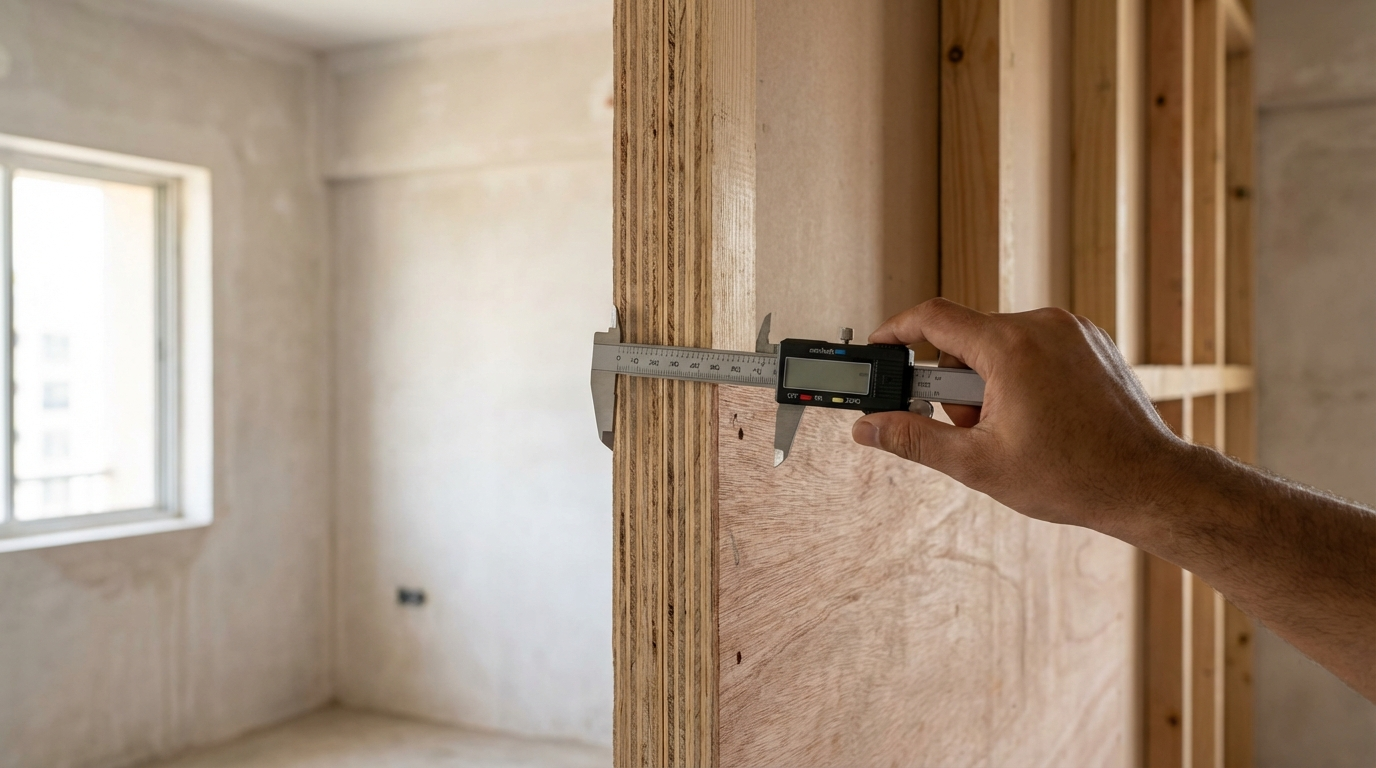
At a Glance- Use 18mm or 19mm BWR-grade plywood for wardrobe carcass and 12mm for back panels
- Laminate finishes outperform paint for durability and moisture resistance
- Sliding wardrobes suit compact bedrooms; hinged designs offer better access
- Budget ₹1,200–₹2,500 per sq ft for complete wardrobe with hardware and finish
- Pre-laminated boards reduce on-site work but limit customization
- Always specify edge-banding to prevent moisture ingress in humid regions
Understanding Plywood Design Ideas for Bedroom Furniture
When we discuss plywood design ideas for bedrooms, we are essentially exploring how engineered wood can be shaped, finished, and configured to create wardrobes, almirahs, bed frames, side tables, and dressing units that match both your aesthetic preferences and practical needs. Unlike solid wood, plywood offers dimensional stability, resistance to warping, and consistent quality that makes it the preferred choice for bedroom furniture across India.
The core principle behind successful bedroom plywood design lies in understanding three interconnected factors: the grade of plywood suitable for indoor bedroom conditions, the finish that delivers the desired look while protecting the wood, and the structural configuration that maximizes storage within your available space. Indian bedrooms typically range from 100 to 180 square feet, making efficient wardrobe design critical for maintaining livable floor space.
Why Plywood Dominates Bedroom Furniture in India
Plywood's popularity for bedroom applications stems from its cross-laminated construction that resists seasonal expansion and contraction—a significant concern in India's varied climate zones. Solid wood almirahs from previous generations often developed cracks and warped doors within years, problems that quality plywood largely eliminates. Additionally, plywood accepts laminates, veneers, PU polish, and paint finishes equally well, giving homeowners extensive design flexibility.
The Indian market has also developed a robust ecosystem of modular furniture manufacturers who work exclusively with plywood, creating standardized designs that local carpenters can customize. This blend of factory precision and on-site adaptability makes plywood the practical backbone of modern bedroom interiors.
Core vs Finish: The Design Equation
Every plywood bedroom design involves two distinct decisions: what goes inside (the core) and what shows outside (the finish). The core—typically MR-grade for normal bedrooms or BWR-grade for ground-floor or humid-zone installations—provides structural integrity. The finish, whether laminate, veneer, acrylic, or lacquer, determines the visual impact and maintenance requirements. Understanding this separation helps buyers allocate budgets wisely rather than overspending on invisible structural elements or underspending on visible surfaces that define the room's character.
Wardrobe Design Styles Using Plywood
Modern bedroom wardrobes have evolved far beyond the simple rectangular boxes of earlier decades. Today's plywood-based wardrobe designs incorporate specialized zones for different clothing types, integrated lighting, soft-close mechanisms, and finishes that complement overall bedroom themes. Understanding the major style categories helps narrow down options before engaging with carpenters or modular furniture providers.
Sliding Door Wardrobes
Sliding wardrobes have become the preferred choice for bedrooms under 150 square feet where traditional hinged doors would obstruct movement space. The plywood carcass remains identical to hinged designs, but the door mechanism uses aluminum or steel channels with roller systems. Design-wise, sliding wardrobes offer larger uninterrupted surface areas that showcase bold laminate patterns, mirror panels, or combination treatments. The typical configuration uses two or three sliding panels, with the center panel overlapping alternately with side panels.
From a practical standpoint, sliding wardrobes cannot provide full-width access simultaneously—you can only access one section at a time. This limitation affects how you organize contents. However, the clean lines and space efficiency make sliding designs particularly popular in metro apartments where compact master bedrooms are common.
Hinged Door Wardrobes
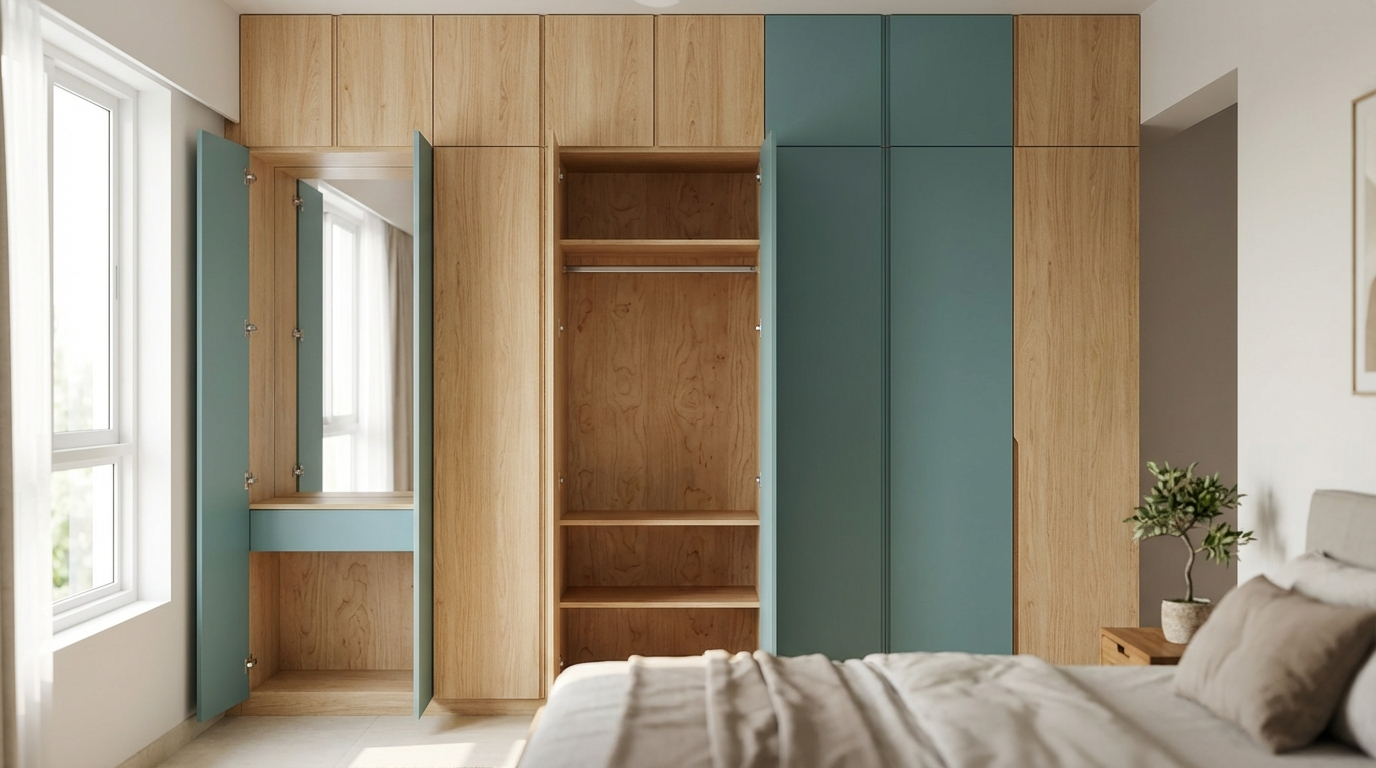
Traditional hinged wardrobes remain the default choice in larger bedrooms and Tier-2/Tier-3 city homes where space constraints are less severe. Hinged designs allow full-width access when all doors are open, simplifying organization and retrieval. The door construction typically uses 18mm plywood with a laminate or veneer finish, hung on European-style concealed hinges that allow adjustment even after installation.
Design variations in hinged wardrobes include shaker-style panels created through CNC routing, glass or mirror inserts, louvered sections for ventilation, and combination doors that mix materials. The key advantage for Indian conditions is simpler maintenance—hinged doors have fewer moving parts than sliding systems and are easier for local carpenters to repair.
Walk-In Closet Designs
For bedrooms exceeding 200 square feet or homes with attached dressing areas, walk-in closets represent the premium wardrobe solution. These designs use open plywood shelving and hanging systems without full enclosure, sometimes with a curtain or sliding partition separating the closet zone from the main bedroom. The reduced door requirement lowers costs while increasing accessibility.
Almirah Styles: Traditional to Contemporary
While "wardrobe" typically refers to built-in or wall-mounted storage, "almirah" in Indian usage often denotes freestanding units that can be relocated. Plywood almirahs bridge traditional furniture sensibilities with modern material advantages, offering a middle ground for households that prefer movable furniture over permanent installations.
Classic Three-Door Almirah
The three-door almirah remains India's most recognized bedroom storage format. Constructed from 18mm plywood with a 6mm back panel, this design typically includes two hanging sections flanking a central shelf-and-drawer column. Height usually ranges from 6.5 to 7 feet, with width between 5 and 6 feet. Finishing options range from simple melamine laminates to high-gloss acrylics, with veneer finishes offering a wood-grain appearance that many buyers prefer over solid colors.
When designed for Indian conditions, quality almirahs incorporate a 3–4 inch raised base that protects the bottom from mopping water and allows air circulation to prevent moisture accumulation. This seemingly minor detail significantly extends lifespan in ground-floor installations or humid coastal regions.
Two-Door Compact Almirah
Compact two-door almirahs suit children's rooms, guest bedrooms, or as secondary storage in master bedrooms. The reduced footprint—typically 4 feet wide—accommodates smaller rooms without overwhelming the space. Design options include integrated mirrors on one door, combination loft sections above the main unit, and side-mounted open shelving for books or display items.
Modern Minimalist Almirah
Contemporary Indian bedrooms increasingly favor handleless almirah designs that use push-to-open mechanisms or J-profile channels cut directly into the plywood door edges. These minimalist styles eliminate visible hardware, creating clean surfaces that align with modern interior aesthetics. The absence of handles also simplifies cleaning and reduces snag points for clothing.
Comparison Table: Wardrobe Design Configurations
| Design Type | Ideal Room Size | Typical Width | Price Range (₹/sq ft) | Best For |
|---|---|---|---|---|
| Sliding 2-Door | 100–150 sq ft bedroom | 6–8 feet | ₹1,400–₹2,200 | Space-constrained master bedrooms |
| Sliding 3-Door | 120–180 sq ft bedroom | 8–10 feet | ₹1,500–₹2,400 | Couples with extensive clothing |
| Hinged 2-Door | Any size | 4–5 feet | ₹1,200–₹1,800 | Guest rooms, children's rooms |
| Hinged 3-Door | 150+ sq ft bedroom | 5–7 feet | ₹1,300–₹2,000 | Traditional family bedrooms |
| Hinged 4-Door | 180+ sq ft bedroom | 7–9 feet | ₹1,300–₹2,000 | Large master bedrooms |
| Walk-In Open System | 200+ sq ft with dressing zone | Variable | ₹900–₹1,500 | Luxury bedrooms, attached dressing |
| Freestanding Almirah | Any size | 4–6 feet | ₹1,100–₹1,800 | Rental homes, relocatable needs |
How to Choose the Right Plywood Wardrobe Design
Selecting a wardrobe design involves balancing spatial constraints, storage needs, budget, aesthetic preferences, and long-term durability requirements. A structured decision process prevents the common outcome of beautiful but impractical wardrobes that frustrate daily use.
Decision Framework for Indian Bedrooms
Start with room dimensions and door swing clearances. Measure not just the wall space where the wardrobe will sit, but also the floor area in front—hinged doors need 18–24 inches of clear space when open. Next, inventory your storage needs: hanging length for Indian ethnic wear differs significantly from Western clothing, with sarees requiring either horizontal drawer storage or specialized hanging systems. Third, consider your finish preference relative to existing room elements—should the wardrobe blend with wall colors or serve as an accent feature?
Buyer Checklist
- Confirm plywood grade specification in writing: IS 303 for MR-grade, IS 710 for BWR-grade
- Verify 18mm thickness for carcass and doors—never accept 16mm as equivalent
- Insist on edge-banding for all exposed plywood edges, especially in coastal or humid cities
- Check laminate brand and thickness: 0.8mm or 1mm laminates outlast 0.6mm versions
- Specify soft-close hinges and drawer channels by brand (Hettich, Hafele, or equivalent)
- Confirm the inclusion of adjustable shelf pins for future flexibility
- Request a sample or existing installation visit before confirming the order
When NOT to Choose Plywood Wardrobes
Plywood wardrobes are not ideal in every situation. If you're in a rental property and expect to relocate within 2–3 years, ready-made steel almirahs or knockdown furniture may offer better portability value. For extremely humid conditions without air conditioning—such as ground-floor coastal rooms—consider marine plywood with solid PU coating, which significantly increases cost. If budget constraints are severe, pre-laminated particle board wardrobes from branded manufacturers may deliver acceptable performance at lower price points, though lifespan will be reduced.
Laminate and Finish Options for Bedroom Plywood
The finish applied to plywood wardrobes determines the visual impact, maintenance requirements, and durability of the final product. Indian market options have expanded significantly, with choices ranging from economical to ultra-premium price bands.
High-Pressure Laminates (HPL)
HPL remains the most practical choice for bedroom wardrobes, offering excellent scratch resistance, easy cleaning, and thousands of color and pattern options. Standard 0.8mm laminates suit most residential applications, while 1mm versions provide additional impact resistance for children's rooms. Matte and suede-finish laminates hide fingerprints better than glossy variants, making them practical for frequently touched surfaces.
Acrylic and PU Lacquer Finishes
For premium bedrooms, high-gloss acrylic panels or polyurethane lacquer finishes create mirror-like surfaces that dramatically elevate interiors. These options cost 40–60% more than standard laminates but deliver showroom-quality appearance. The tradeoff involves increased visibility of scratches and fingerprints, requiring more frequent cleaning. PU lacquer applied on-site by skilled painters allows exact color matching but depends heavily on application quality.
Veneer and Wood-Grain Effects
Natural wood veneer over plywood creates an authentic timber appearance at a fraction of solid wood cost. Teak, walnut, oak, and ash veneers remain popular choices for bedrooms aiming for warm, natural aesthetics. Alternatively, synchronized wood-grain laminates replicate wood patterns with textured surfaces that closely mimic real veneer at lower cost and better durability.
Common Mistakes to Avoid in Bedroom Wardrobe Design
Years of observing Indian wardrobe installations reveal recurring errors that compromise both functionality and longevity. Avoiding these pitfalls protects your investment and ensures daily satisfaction with the finished product.
Mistake 1: Ignoring Internal Configuration
Many buyers obsess over external finish while neglecting internal layout. A beautiful wardrobe with poorly planned shelving heights, inadequate hanging space, or no drawer organization creates daily frustration. Always plan internal configuration based on your actual clothing inventory before finalizing designs.
Mistake 2: Skipping Edge Protection
Exposed plywood edges absorb moisture and swell over time, particularly during monsoon months. Edge-banding using PVC strips or ABS edging costs minimally but provides crucial protection. This step is frequently skipped by cost-cutting carpenters, leading to swollen, delaminated edges within two to three years.
Mistake 3: Accepting Lower Plywood Grades
Some dealers substitute commercial-grade (MR) plywood where moisture-resistant (BWR) grades are specified, pocketing the price difference. For ground-floor bedrooms or homes in Mumbai, Chennai, Kolkata, and other humid cities, BWR-grade plywood is essential for wardrobe longevity. Always verify the grade stamp on plywood sheets before cutting begins.
Mistake 4: Overlooking Hardware Quality
Cheap hinges sag within months, drawer channels bind and stick, and low-quality soft-close dampers fail quickly. Hardware represents 8–12% of total wardrobe cost but determines daily use experience. Specifying branded hardware like Hettich, Hafele, or Ebco prevents disappointment.
Quick Inspection Checks
- Tap the plywood surface—hollow sounds indicate voids or inferior core material
- Check edge banding adhesion by pressing firmly—lifting indicates poor bonding
- Test hinges by opening and closing repeatedly—quality hinges feel smooth without grinding
- Verify drawer alignment by sliding in and out—wobbling indicates poor installation
- Look for laminate bubbles or peeling at corners—indicates application problems
Price Guide: Bedroom Wardrobe Costs in India
Wardrobe pricing in India varies significantly based on material grade, finish quality, hardware specification, and local labor rates. Understanding the cost structure helps set realistic budgets and identify areas for value optimization.
Cost Components Breakdown
A typical bedroom wardrobe budget divides roughly as follows: plywood and boards (40–45%), laminates and finish (20–25%), hardware (10–15%), labor and installation (15–20%), and accessories like mirrors, lighting, or organizers (5–10%). Metro cities like Mumbai, Delhi, and Bangalore command 15–25% higher labor rates than Tier-2 cities, affecting total project cost.
| Wardrobe Category | Plywood Grade | Finish Type | Price Range (₹/sq ft) | Typical 6ft x 7ft Unit |
|---|---|---|---|---|
| Economy | Commercial MR | Basic laminate | ₹950–₹1,200 | ₹40,000–₹50,000 |
| Mid-Range | BWR-grade branded | Quality laminate | ₹1,300–₹1,800 | ₹55,000–₹75,000 |
| Premium | BWR-grade premium | High-gloss/Acrylic | ₹1,900–₹2,500 | ₹80,000–₹1,05,000 |
| Ultra-Premium | Marine-grade | Veneer + PU finish | ₹2,600–₹3,500 | ₹1,10,000–₹1,50,000 |
These figures assume standard configurations with soft-close hardware. Sliding mechanisms add ₹150–₹300 per sq ft to comparable hinged designs. GST at 18% applies to most modular furniture, though local carpenter-made wardrobes may quote inclusive rates with less transparent tax treatment.
Budget vs Premium: Which Makes Sense?
For primary bedrooms in owned homes with 10+ year occupancy expectations, mid-range to premium specifications deliver superior value over time. Economy constructions often require replacement or major repair within 5–7 years in typical Indian conditions. However, for rental properties, guest bedrooms, or temporary housing, economy specifications provide adequate functionality without overinvestment.
Frequently Asked Questions
Which plywood is best for bedroom wardrobe in India?
For most Indian bedrooms, BWR-grade (boiling water resistant) plywood from established brands offers the optimal balance of moisture resistance and cost. This grade handles humidity fluctuations during monsoons without swelling or delaminating. Commercial MR-grade is acceptable for upper-floor, air-conditioned bedrooms in dry climate zones. Always verify the IS 710 stamp for BWR or IS 303 for MR grade on the plywood sheets before fabrication begins.
What is the ideal plywood thickness for wardrobe construction?
Standard practice uses 18mm or 19mm plywood for wardrobe carcass (sides, top, bottom, and shelves) and door shutters. Back panels typically use 6mm plywood, though 9mm provides better rigidity for larger units. For internal partitions and drawer construction, 12mm plywood is common. Never accept substitution of 16mm as "equivalent" to 18mm—this compromise significantly reduces structural integrity and shelf load capacity.
Is plywood better than particle board for bedroom furniture?
Plywood outperforms particle board in screw-holding strength, moisture resistance, and longevity—all critical factors for bedroom furniture that sees daily use. Particle board can sag under load over time and swells irreversibly when exposed to moisture. However, high-density particle board with quality lamination from branded manufacturers offers acceptable performance at 30–40% lower cost, suitable for budget-conscious buyers in dry climate zones with limited lifespan expectations.
How much does a plywood wardrobe cost in Indian cities?
A standard 6-foot wide, 7-foot tall hinged wardrobe costs between ₹45,000 and ₹1,00,000 depending on plywood grade, finish type, hardware quality, and city location. Metro cities run 15–25% higher than Tier-2 cities for equivalent specifications. Sliding wardrobes add ₹8,000–₹15,000 to comparable hinged designs. These ranges assume complete installation with soft-close hardware and quality laminates—basic specifications with economy materials may cost less.
Can plywood wardrobes withstand monsoon humidity?
Properly specified and finished plywood wardrobes handle monsoon conditions well. The key requirements include BWR-grade plywood core, complete edge-banding on all exposed edges, and quality laminate application without gaps. Ground-floor bedrooms and coastal city installations benefit from marine-grade plywood, which offers superior moisture resistance. Ventilation inside the wardrobe—through louvered sections or air gaps—helps prevent musty odors during humid months.
What laminate finish is best for bedroom wardrobes?
Matte and suede-finish laminates work best for bedroom wardrobes as they hide fingerprints, minor scratches, and dust better than glossy surfaces. For children's rooms, anti-scratch laminates with 0.8mm or 1mm thickness provide additional durability. High-gloss and acrylic finishes suit premium master bedrooms where aesthetic impact outweighs maintenance considerations. Wood-grain synchronized laminates offer the warmth of natural wood without veneer costs or maintenance requirements.
How long does a plywood wardrobe last in India?
A well-constructed plywood wardrobe using BWR-grade core, quality hardware, and proper finishing typically lasts 15–20 years in normal Indian bedroom conditions. Hardware components like hinges and drawer channels may require replacement after 8–10 years of daily use. Economy constructions using commercial plywood and basic hardware often show significant wear within 5–7 years. Annual inspection of hinges, edge-banding, and laminate adhesion helps identify maintenance needs before major failures occur.
Should I choose modular or carpenter-made plywood wardrobe?
Modular wardrobes from established manufacturers offer factory precision, consistent quality, professional installation, and after-sales support, but at higher cost and limited customization flexibility. Carpenter-made wardrobes allow complete size and configuration customization, often at lower cost, but depend heavily on individual carpenter skill and lack formal warranties. For standard room dimensions and buyers preferring hassle-free execution, modular options work well. For unusual spaces or specific requirements, skilled carpenters using quality materials deliver excellent results at better value.
Disclaimer: This content is provided for general informational purposes based on industry practices and publicly available information. Product specifications, standards, prices, and availability may vary by manufacturer, region, and time. Readers should independently verify details with manufacturers, dealers, or qualified professionals before making purchase or construction decisions.Want Plywood Suggestions?
Share a few details and a Apple Ply specialist will suggest suitable brands and connect you to responsive dealers.