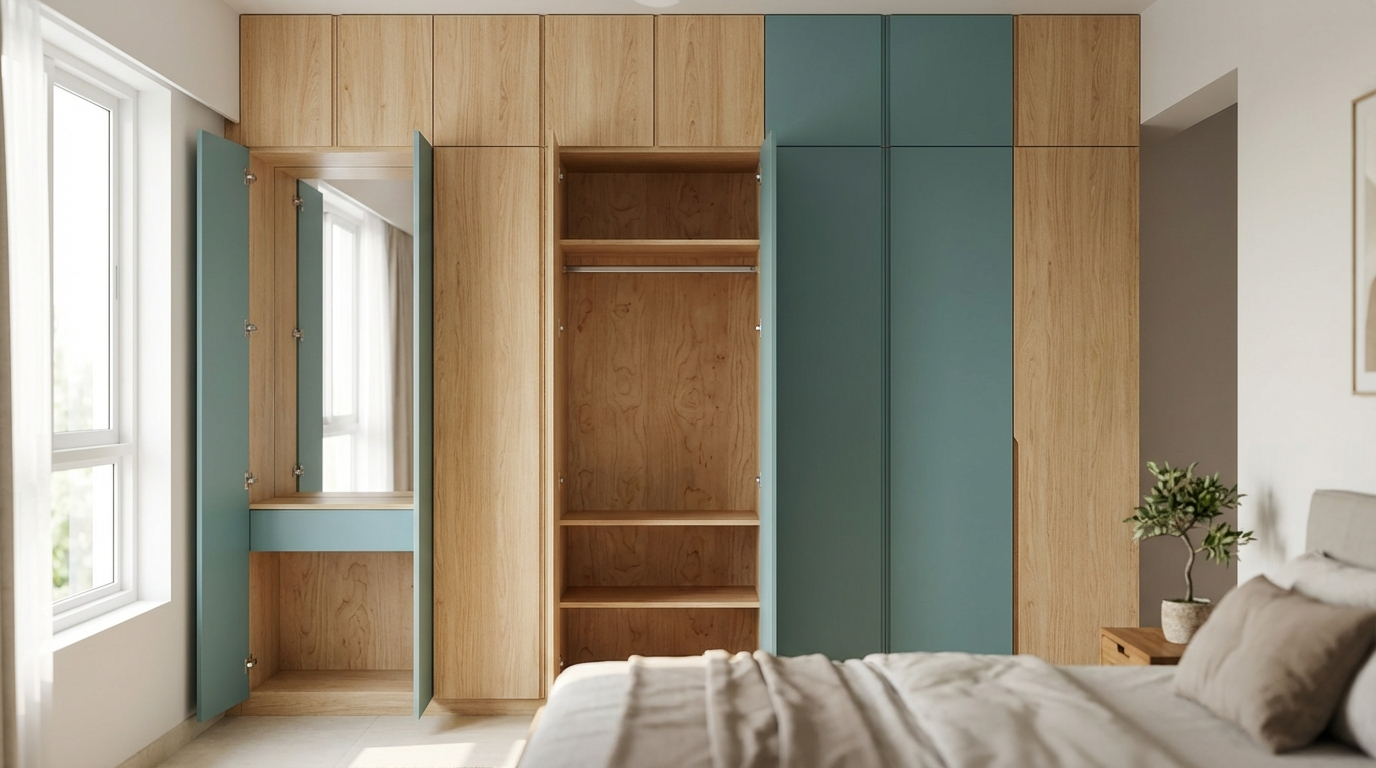
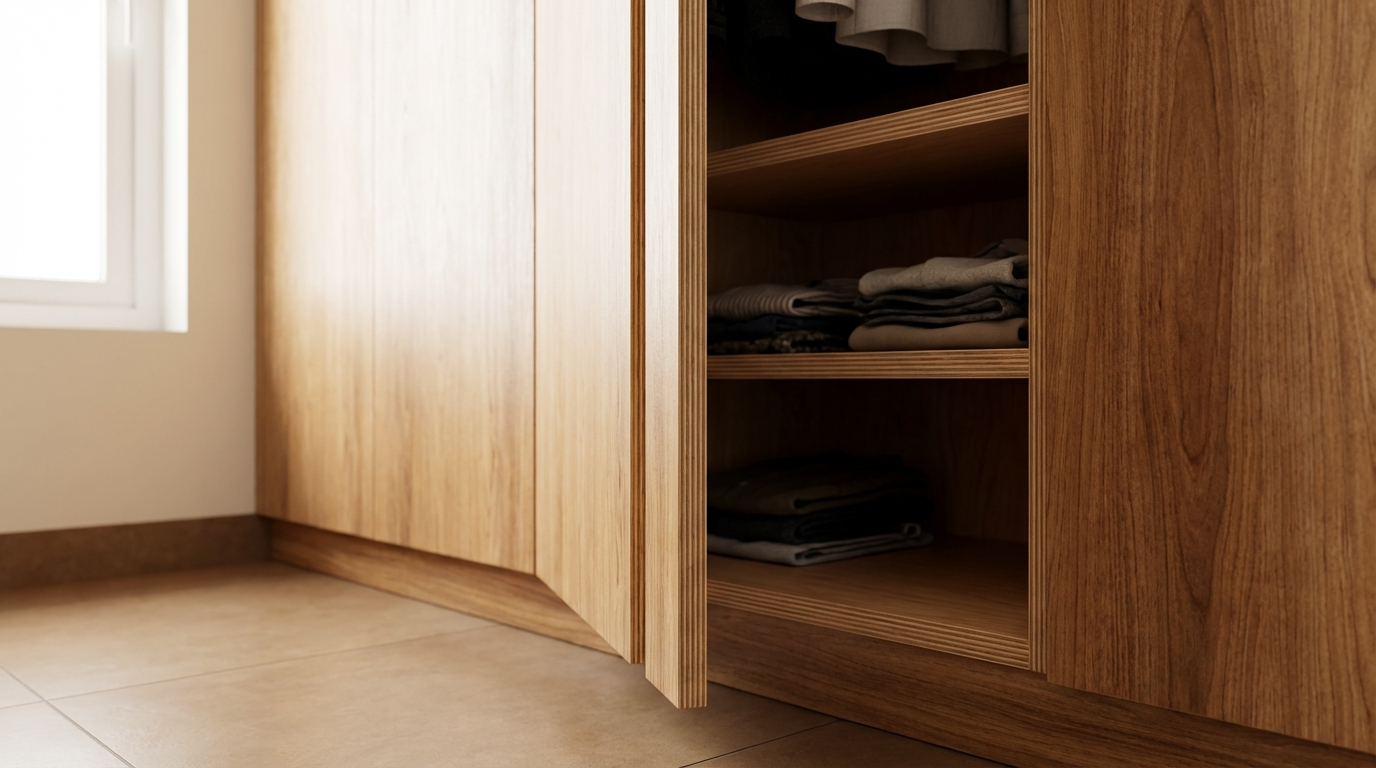
Plywood for Partitions: Best Type & Thickness Guide
Find the best plywood for room partitions. Compare grades, recommended thickness & installation methods for durable partition walls.
Quick Answer
The best plywood for partitions in Indian homes is commercial-grade (MR) plywood in 12mm thickness for standard room dividers, or 18mm for partitions that will bear shelves or cabinets. For humid areas like bathrooms or coastal regions, upgrade to BWR or marine-grade plywood to prevent warping and delamination over time.
At a Glance:- Standard partition thickness: 12mm for lightweight dividers, 18mm for load-bearing partitions
- Recommended grade: MR (Commercial) for dry interiors, BWR for humid zones
- Frame spacing: 16–24 inches on center for structural stability
- Price range: ₹45–₹120 per sq ft depending on grade and brand tier
- Laminate or veneer finish adds 1–2mm; factor this into thickness calculations
- Always use ISI-marked plywood for partitions—non-certified sheets often warp within months
Understanding Plywood for Partitions: Why It Matters
Plywood partitions have become the dominant choice for room dividers in Indian homes, offices, and commercial spaces, largely replacing traditional brick walls for interior separation. The reason is practical: plywood partitions are faster to install, lighter on building structures, easier to modify or relocate, and significantly more cost-effective than masonry work.
A partition wall differs fundamentally from furniture-grade applications. Unlike a wardrobe back panel that simply closes a box, a partition must stand vertically unsupported over longer spans, resist flex when doors are mounted, handle impact from daily use, and maintain dimensional stability across seasons—particularly during India's monsoon months when humidity swings dramatically.
How Partition Walls Are Constructed
The typical Indian partition uses a wooden or metal frame (usually 2×2 inch or 2×3 inch sections) with plywood sheets fixed on one or both sides. Single-skin partitions use plywood on one face only; double-skin partitions sandwich the frame between two plywood layers, sometimes with insulation or soundproofing material in the cavity. Double-skin construction is standard for bedroom separations where acoustic privacy matters.
This frame-and-sheet construction means the plywood doesn't bear structural load the way a table would—the frame handles that. However, the plywood must resist bowing, maintain flat surfaces for finishing, hold screws at edges without splitting, and survive years of temperature and humidity cycling without delaminating.
Why Thickness and Grade Selection Matters More for Partitions
Choosing the wrong plywood for partitions creates problems that surface months or years later. Undersized thickness leads to visible waviness between frame supports—a common complaint in budget office fitouts. Wrong grade selection (using MR plywood in a bathroom partition, for instance) causes swelling at edges, bubbling laminate, and eventual structural failure. These aren't theoretical concerns; they're the reality Indian carpenters see routinely when called to fix poorly specified partition work.
Types of Plywood Suitable for Partition Walls
Not all plywood grades suit partition applications equally. The choice depends on location, humidity exposure, budget, and whether the partition will support additional loads like shelving or wall-mounted fixtures.
MR Grade (Commercial Plywood)
MR (Moisture Resistant) plywood, commonly called commercial ply in the Indian market, is the standard choice for interior partitions in dry areas. The adhesive used offers moderate moisture resistance—sufficient for air-conditioned offices, bedrooms, and living room dividers. MR grade typically conforms to IS 303 standards. For partitions that won't face direct water exposure or extreme humidity, MR grade offers the best value proposition.
BWR Grade (Boiling Water Resistant)
BWR plywood uses phenolic resin adhesives that withstand higher moisture exposure. This grade suits partitions in areas adjacent to bathrooms, kitchens with cooking steam exposure, or homes in high-humidity regions like coastal Karnataka, Kerala, or Mumbai. BWR plywood conforms to IS 303 BWR specifications. The price premium of 15–25% over MR grade is justified for any partition within two meters of water sources.
Marine Grade Plywood
Marine plywood, conforming to IS 710, uses waterproof adhesives and typically better-quality core veneers with fewer voids. While technically suitable for partitions, marine grade is overkill for most residential applications. It makes sense only for partitions in consistently wet environments—poolside changing rooms, industrial washrooms, or outdoor covered partition applications. The significant cost premium rarely justifies itself for standard home partitions.
Calibrated Plywood for Partition Work
Calibrated plywood undergoes thickness sanding to achieve uniform dimensions across the sheet. For partitions where flush finishing matters—especially with high-gloss laminates or thin veneers—calibrated sheets prevent visible undulations. Many premium brands offer calibrated variants at ₹5–₹15 per sq ft premium over standard sheets of the same grade.
Plywood Thickness Guide for Different Partition Applications
| Partition Application | Recommended Thickness | Frame Spacing | Skin Configuration | Remarks |
|---|---|---|---|---|
| Lightweight room divider (no fixtures) | 9mm | 12–16 inches | Single skin | Budget option, visible flex possible |
| Standard bedroom/living room partition | 12mm | 16–18 inches | Double skin preferred | Most common residential specification |
| Partition with shelves/cabinets | 18mm | 18–24 inches | Double skin | Required for screw-holding strength |
| Office cabin partitions | 12mm | 16–18 inches | Double skin with insulation | Acoustic performance priority |
| Bathroom/wet area adjacent partition | 12mm BWR minimum | 16 inches | Double skin | Edge sealing critical |
| Full-height partition (9ft+) | 18mm | 16 inches | Double skin | Taller spans need rigidity |
| Partition with heavy door | 18mm | 12 inches near door frame | Double skin | Reinforce door jamb area |
The 18mm vs 19mm Confusion in Indian Markets
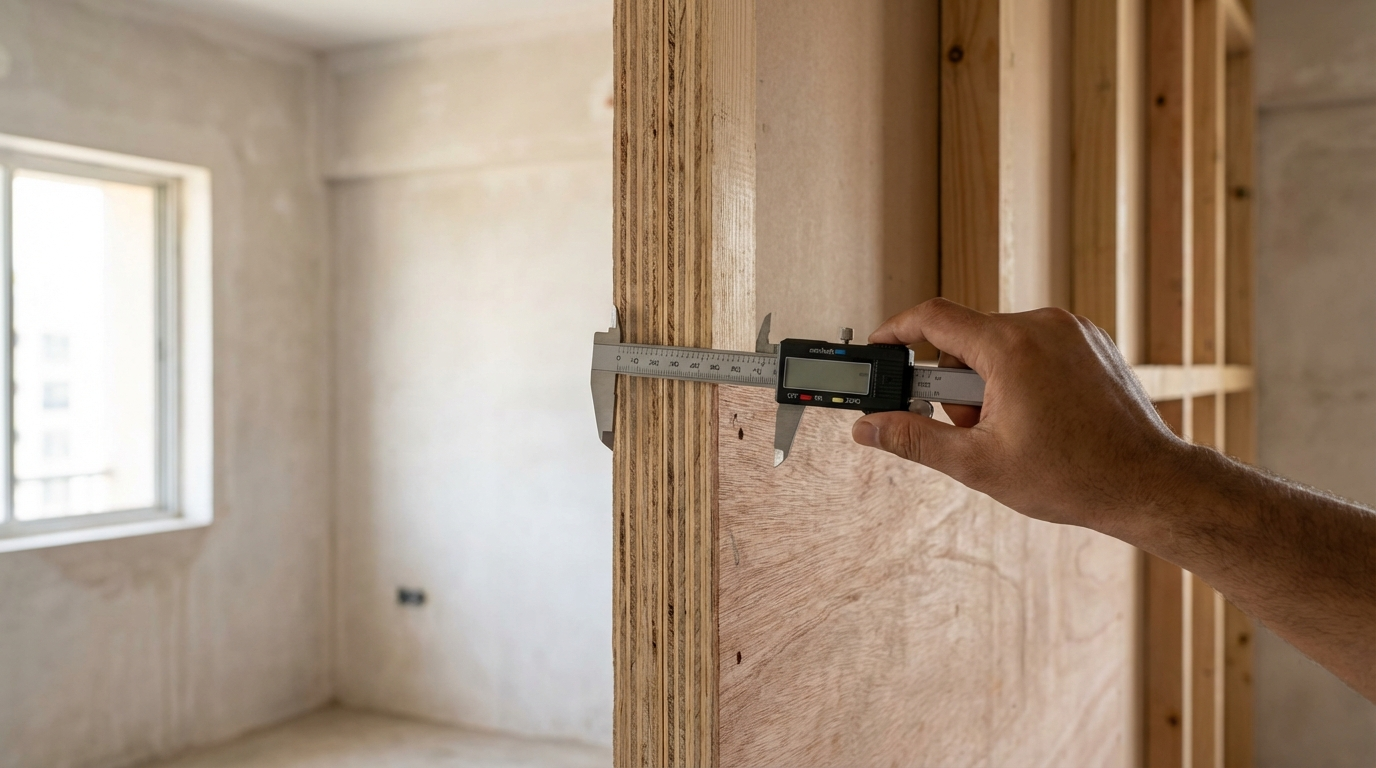
A common source of confusion: dealers often quote "19mm plywood" which is actually 18mm nominal thickness. This trade naming convention exists because plywood sheets shrink slightly after manufacturing. Reputable brands maintain 18mm as the finished calibrated thickness, while some budget manufacturers deliver actual 17–17.5mm sheets sold as "18mm." For partition work where two sheets meet at a frame member, even 1mm variance causes visible misalignment. Always verify actual thickness with a caliper before purchase, especially for double-skin partitions.
Comparison: Plywood Grades for Partition Applications
| Parameter | MR Grade (Commercial) | BWR Grade | Marine Grade | Block Board |
|---|---|---|---|---|
| IS Standard | IS 303 MR | IS 303 BWR | IS 710 | IS 1659 |
| Moisture Resistance | Moderate | High | Very High | Moderate to High |
| Typical Price (12mm, ₹/sq ft) | ₹45–₹70 | ₹55–₹85 | ₹90–₹140 | ₹50–₹80 |
| Best Partition Use | Dry interiors, bedrooms | Near bathrooms, kitchens | Wet areas, outdoor covered | Wide-span partitions |
| Screw Holding | Good | Good | Excellent | Good on face, poor on edge |
| Surface Flatness | Variable by brand | Generally better | Excellent | Good |
| Availability in Tier-2 Cities | Excellent | Good | Limited | Good |
| Termite Resistance | Requires treatment | Often pre-treated | Usually treated | Requires treatment |
When Block Board Makes Sense for Partitions
Block board—a core of softwood strips sandwiched between veneer faces—offers better rigidity-to-weight ratio than plywood for large partitions. For partitions spanning over 4 feet between vertical supports, 19mm block board may outperform 18mm plywood in terms of sag resistance. However, block board holds screws poorly at edges, making it unsuitable for partitions where electrical boxes, switch plates, or fixtures mount near sheet boundaries. In practical Indian market terms, block board serves best for partition panels that won't receive any face-mounted hardware.
How to Choose the Right Plywood for Your Partition
Selecting partition plywood requires evaluating multiple factors beyond just price per square foot. A systematic approach prevents expensive mistakes that surface months after installation.
Decision Framework
Start by answering these questions: Will the partition face humidity above 60% regularly? Will it support shelves, cabinets, or wall-mounted TVs? Is acoustic privacy required? What's the finish material—laminate, veneer, or paint? What's the ceiling height and unsupported span? Your answers determine thickness, grade, and skin configuration before price even enters discussion.
Buyer Checklist for Partition Plywood
- Verify ISI mark and ensure it matches the grade claimed—IS 303 for MR/BWR, IS 710 for marine
- Check sheet flatness by sighting along the surface; reject visibly warped sheets
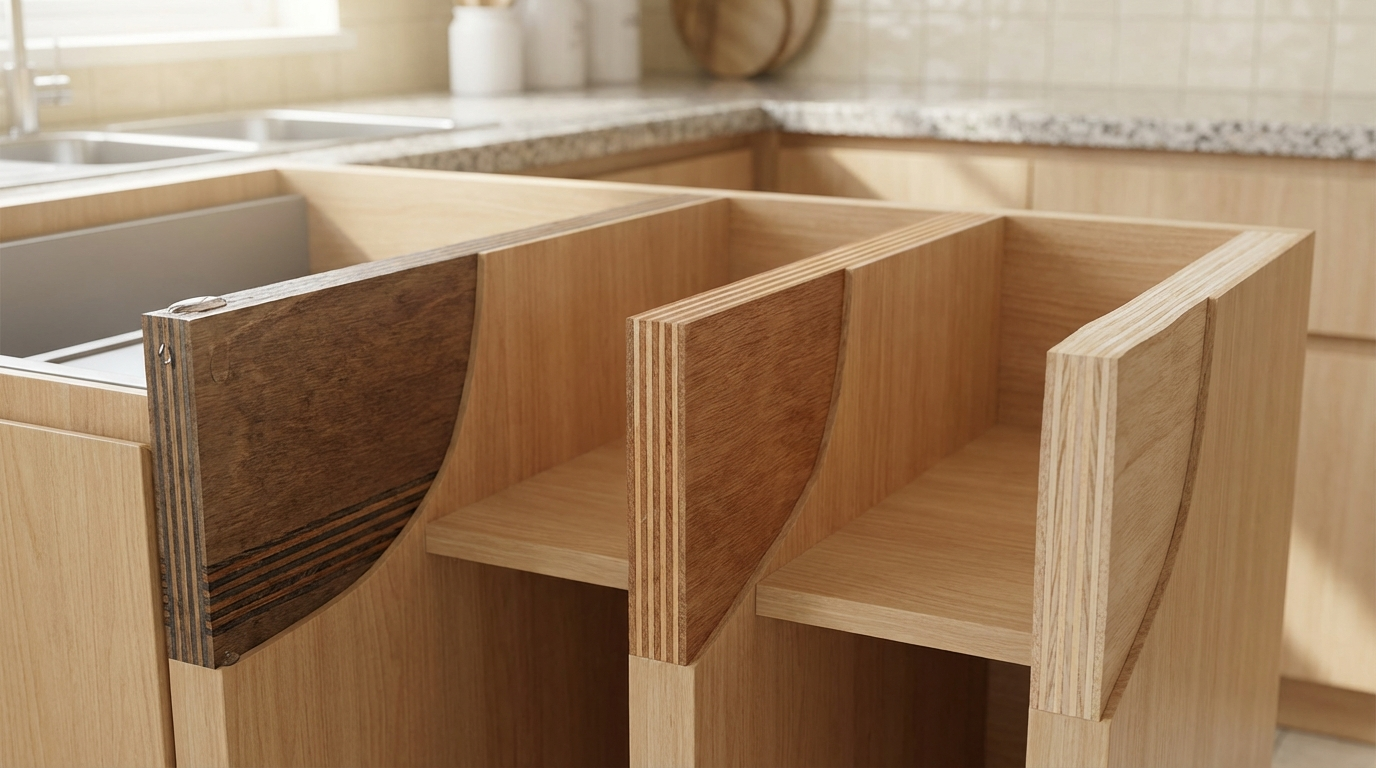
- Inspect edges for voids, overlaps, or core gaps that weaken screw holding
- Measure actual thickness with a caliper; reject sheets more than 0.5mm under stated size
- Confirm termite/borer treatment, especially for ground-floor installations in humid regions
- Request calibrated sheets if using thin veneers or high-gloss laminates as finish
- Buy 10% extra to account for cutting waste and potential rejects discovered during work
When NOT to Choose Plywood for Partitions
Plywood partitions aren't universally ideal. Avoid plywood for partitions requiring fire rating—gypsum board systems serve better for fire-rated assemblies. In industrial settings with chemical exposure, plywood deteriorates faster than metal or cement board alternatives. For outdoor partitions exposed to rain, even marine plywood fails eventually without extensive edge sealing and maintenance. Ground-floor partitions in flood-prone areas should use cement board or brick rather than any wood-based panel.
Common Mistakes to Avoid with Partition Plywood
Years of market observation reveal recurring errors that compromise partition quality and longevity. Understanding these failures helps specify and inspect partition work correctly.
Mistake 1: Using MR Plywood in Humid Zones
The most common failure: specifying MR grade for partitions adjacent to bathrooms or in non-air-conditioned spaces in coastal cities. Within one monsoon season, such partitions show edge swelling, laminate bubbling, and in severe cases, layer separation. The initial savings of ₹10–₹15 per sq ft over BWR grade results in complete partition replacement within 2–3 years.
Mistake 2: Inadequate Frame Spacing
Budget contractors often space frame members 24+ inches apart with 12mm plywood, causing visible panel flex and eventual waviness. For 12mm sheets, 16–18 inch spacing is maximum; for 9mm sheets, 12 inches. Skimping on frame lumber creates problems no plywood quality can overcome.
Mistake 3: Ignoring Edge Sealing
Plywood absorbs moisture primarily through edges. Partitions with exposed edges—at floor junctions, ceiling joints, or where electrical cutouts were made—swell and delaminate from edges inward. Sealing all edges with PU sealer, edge banding, or at minimum, two coats of primer is non-negotiable for partition longevity.
Mistake 4: Specification Mismatch with Finish Material
Applying high-gloss laminates over non-calibrated plywood telegraphs every surface imperfection through the finish. Similarly, using 6mm plywood as a cost-cutting measure, then trying to achieve flat painted finishes, always disappoints. Match plywood quality to finish expectations.
Quick Inspection Checks
- Tap test: Solid core sounds dull; voids and delamination produce hollow sounds
- Flex test: Slight hand pressure shouldn't produce crackling sounds
- Edge inspection: Core veneers should be uniform without gaps exceeding 2mm
- Smell test: Strong chemical odor suggests uncured adhesive or low-grade manufacturing
- Weight comparison: Heavier sheets of same size/grade usually indicate denser, better-quality cores
Price Guide for Partition Plywood in India
Partition plywood pricing varies significantly based on grade, thickness, brand tier, and regional factors. The following ranges assume purchases from authorized dealers in major cities; Tier-2 and Tier-3 city prices typically run 5–15% higher due to transport costs and thinner dealer competition.
| Grade & Thickness | Economy Brands (₹/sq ft) | Mid-Tier Brands (₹/sq ft) | Premium Brands (₹/sq ft) |
|---|---|---|---|
| MR Grade 9mm | ₹32–₹40 | ₹42–₹52 | ₹55–₹68 |
| MR Grade 12mm | ₹42–₹52 | ₹55–₹68 | ₹72–₹90 |
| MR Grade 18mm | ₹58–₹70 | ₹75–₹92 | ₹98–₹120 |
| BWR Grade 12mm | ₹52–₹65 | ₹68–₹82 | ₹88–₹110 |
| BWR Grade 18mm | ₹70–₹85 | ₹90–₹110 | ₹115–₹140 |
| Marine Grade 12mm | ₹85–₹100 | ₹105–₹125 | ₹130–₹160 |
What Drives Price Variation
Core veneer quality accounts for the largest price differential between economy and premium brands. Premium manufacturers use hardwood cores with consistent thickness and minimal voids; economy producers use softer species with more gaps. Face veneer quality, adhesive formulation (affecting moisture resistance longevity), calibration precision, and treatment quality all contribute to the spread.
GST at 18% applies to plywood; prices above include GST as typically quoted at retail. Transport adds ₹3–₹8 per sq ft for Tier-2/3 locations depending on distance from manufacturing hubs in Gujarat, Karnataka, or Kerala.
Budget vs Premium: Which Makes Sense for Partitions?
For rental properties or temporary office fitouts expected to last 3–5 years, economy-tier MR plywood often delivers acceptable performance. For owner-occupied homes where partitions should last 15+ years, mid-tier or premium brands justify their cost through better dimensional stability, superior screw holding over time, and more consistent surfaces for finishing. The premium of ₹20–₹30 per sq ft translates to just ₹2,000–₹3,000 extra for a 100 sq ft partition—a small price for avoiding premature failure.
Installation Methods for Plywood Partitions
Proper installation technique matters as much as material selection for partition performance. Even premium plywood fails when installed incorrectly.
Frame Construction
Wooden frames typically use seasoned hardwood battens of 2×2 inch or 2×3 inch section. The frame anchors to floor and ceiling with appropriate fasteners—Hilti-type anchors for concrete, screws for false ceiling members. Vertical studs space at 16–18 inches on center; horizontal noggins provide additional fixing points for electrical boxes and shelf brackets. Metal stud framing (using light-gauge steel sections) offers better straightness and termite immunity but requires specific screw types and installation knowledge less common among traditional Indian carpenters.
Panel Fixing
Plywood fixes to frames using wood screws—typically #8 gauge, 1.5 inch length for 12mm plywood into 2-inch battens. Screws place 6 inches apart along edges and 12 inches apart at intermediate supports. Countersinking screws below surface allows for filling before painting. For laminate-finished partitions where screw heads can't be hidden, adhesive-plus-pin fixing offers cleaner results but complicates future panel replacement.
Joint Treatment
Where plywood panels meet, joints should fall over frame members. V-jointing (beveling panel edges before butting) creates a deliberate detail that moves with humidity changes without showing cracks. Flush joints require taping and filling similar to gypsum board—a technique that works only with paint finishes, not laminate. For double-skin partitions, stagger joints between inner and outer skins to prevent alignment of weak points.
Acoustic Considerations
Standard plywood partitions offer minimal sound isolation—roughly STC 25–30, meaning normal conversation passes through audibly. Improving acoustic performance requires double-skin construction with air gap, cavity insulation (glass wool or acoustic foam), and avoiding rigid connections between skins. Properly detailed, double-skin plywood partitions can achieve STC 40+, adequate for bedroom privacy.
Regional Considerations for Partition Plywood Selection
India's climate diversity demands region-specific plywood selection. A specification that works in Rajasthan fails in Kerala.
Coastal and High-Humidity Regions
Mumbai, Chennai, Kolkata, Kochi, and the entire western and eastern coastlines experience humidity above 70% for months. Here, BWR grade is the minimum specification even for interior partitions. Marine-grade becomes practical for ground-floor applications or spaces without air conditioning. Edge sealing and termite treatment are non-negotiable—coastal moisture combined with warm temperatures creates ideal conditions for wood decay and insect attack.
Northern Plains and Dry Regions
Delhi, Jaipur, Ahmedabad, and similar locations experience wide humidity swings—dry winters (30% RH) to monsoon peaks (80%+). This cycling stresses plywood joints more than consistent humidity. Calibrated plywood performs better under these conditions, and allowing 3–5mm expansion gaps at floor and ceiling prevents buckling. MR grade suffices except for bathroom-adjacent partitions.
South Indian Specificities
Bangalore's moderate climate suits MR grade well, but the city's water scarcity drives extensive water tank installations that create localized humidity zones—factor this when specifying partitions near overhead tanks. Hyderabad's hot, dry climate allows MR grade broadly, but termite pressure remains high; always specify treated plywood.
Frequently Asked Questions
What is the best thickness for plywood partitions in homes?
For standard residential partitions in India, 12mm plywood offers the optimal balance of strength, weight, and cost. This thickness provides adequate rigidity when frame members space at 16–18 inches and handles normal household use well. However, upgrade to 18mm if the partition will support shelves, cabinets, wall-mounted TVs, or heavy picture frames. For purely decorative room dividers with no fixtures, 9mm can work with closer frame spacing, but the minimal cost savings rarely justify the increased fragility.
Which is better for partitions: plywood or gypsum board?
Plywood offers superior impact resistance, better screw holding for fixtures, and easier modification—you can nail, screw, or cut into plywood partitions without special techniques. Gypsum board costs less, installs faster, provides better fire resistance, and delivers smoother paint finishes. For residential spaces where partitions may support shelving or experience physical impact, plywood wins. For commercial spaces prioritizing fire rating and paint-finish quality, gypsum board often makes more sense. Many Indian projects combine both—plywood where fixtures mount, gypsum elsewhere.
Can MR plywood be used for bathroom partitions?
MR grade plywood should not be used for bathroom partitions due to its limited moisture resistance. Bathrooms maintain high humidity consistently, and water splashes onto partition surfaces regularly. MR plywood in such conditions swells at edges, delaminates at core, and fails within 2–3 years typically. For bathroom partitions, BWR grade is the minimum specification. Marine grade offers better longevity but at significant cost premium. Additionally, seal all edges thoroughly and ensure adequate ventilation to maximize partition life.
How much does partition plywood cost in India?
Partition plywood prices in India range from ₹45 to ₹140 per square foot depending on grade, thickness, and brand tier. MR grade 12mm—the most common partition specification—costs ₹45–₹90 per sq ft across economy to premium brands. BWR grade commands a 15–25% premium. These prices assume purchase from authorized dealers in metros; add ₹5–₹15 per sq ft for Tier-2/3 cities. The total installed cost including frame, labor, and basic finish runs ₹120–₹200 per sq ft for standard double-skin partitions.
Is termite treatment necessary for partition plywood?
Termite treatment is strongly recommended for partition plywood throughout India, and essentially mandatory for ground-floor installations and regions with high termite activity—which includes most of the country. Even upper-floor partitions benefit from treated plywood since termites can travel through building structures. Most premium brands offer pre-treated plywood; verify this before purchase. For untreated plywood, apply borate-based wood preservative to all surfaces and edges before installation. The ₹5–₹10 per sq ft treatment cost is insignificant compared to replacement costs after termite damage.
How to check partition plywood quality at the dealer?
At the dealer, perform these checks: First, sight along the sheet surface to detect warping—reject visibly bowed sheets. Second, inspect edges for core voids, gaps between veneer layers, or overlapping cores. Third, tap multiple areas and listen for hollow sounds indicating internal voids. Fourth, measure actual thickness with a caliper and compare to stated specification. Fifth, verify the ISI mark matches the claimed grade. Finally, check that the manufacturing date (printed on most branded sheets) is recent; plywood stored over 6 months in poor conditions may have degraded adhesive bonds.
What is the lifespan of a plywood partition?
A properly specified and installed plywood partition lasts 15–25 years in typical Indian residential conditions. Lifespan depends heavily on grade-to-exposure match, installation quality, and maintenance. BWR or marine grade in appropriate applications with sealed edges and termite protection reaches the upper end. MR grade in humidity-controlled environments also delivers long service. Conversely, MR plywood in humid areas fails within 3–5 years, and any grade with untreated edges in termite-prone regions may fail sooner. Periodic inspection and prompt attention to any water damage extends partition life significantly.
Can we fix heavy shelves on plywood partitions?
Yes, plywood partitions can support heavy shelves when properly specified. Use 18mm thickness minimum for load-bearing applications. Ensure screws anchor into frame members, not just plywood alone—standard plywood holds roughly 30–40 kg per screw into frame versus 10–15 kg into plywood face alone. For very heavy loads (TV mounts, book-laden shelves), install additional frame blocking behind the plywood at mounting points. Distribute load across multiple fixing points rather than concentrating on few screws. With these precautions, plywood partitions support shelving loads comparable to masonry walls with proper anchors.
Disclaimer: This content is provided for general informational purposes based on industry practices and publicly available information. Product specifications, standards, prices, and availability may vary by manufacturer, region, and time. Readers should independently verify details with manufacturers, dealers, or qualified professionals before making purchase or construction decisions.Want Plywood Suggestions?
Share a few details and a Apple Ply specialist will suggest suitable brands and connect you to responsive dealers.