Particle Board: Types, Uses, Price & Buying Guide 2026
Complete particle board guide covering types, properties, price & applications. Learn when to use particle board for furniture & interiors.
Quick Answer
Particle board is an engineered wood product made by compressing wood chips, sawdust, and sawmill shavings with synthetic resin adhesive under heat and pressure. It is the most affordable core material in the Indian interior and furniture market, typically priced between ₹12 to ₹35 per square foot depending on thickness, grade, and surface finish. Particle board is ideal for budget-conscious projects such as wardrobes, office furniture, shelving, and modular kitchen carcasses in dry areas.
At a Glance
- Full form: Particle board is also called chipboard or low-density fiberboard
- Price range: ₹12–₹35 per sq ft for plain; ₹28–₹55 per sq ft for pre-laminated (8×4 sheets)
- Common thicknesses: 8mm, 11mm, 17mm, 18mm, and 25mm
- Best for: Interior furniture, wardrobes, office partitions, false ceilings, and shelving
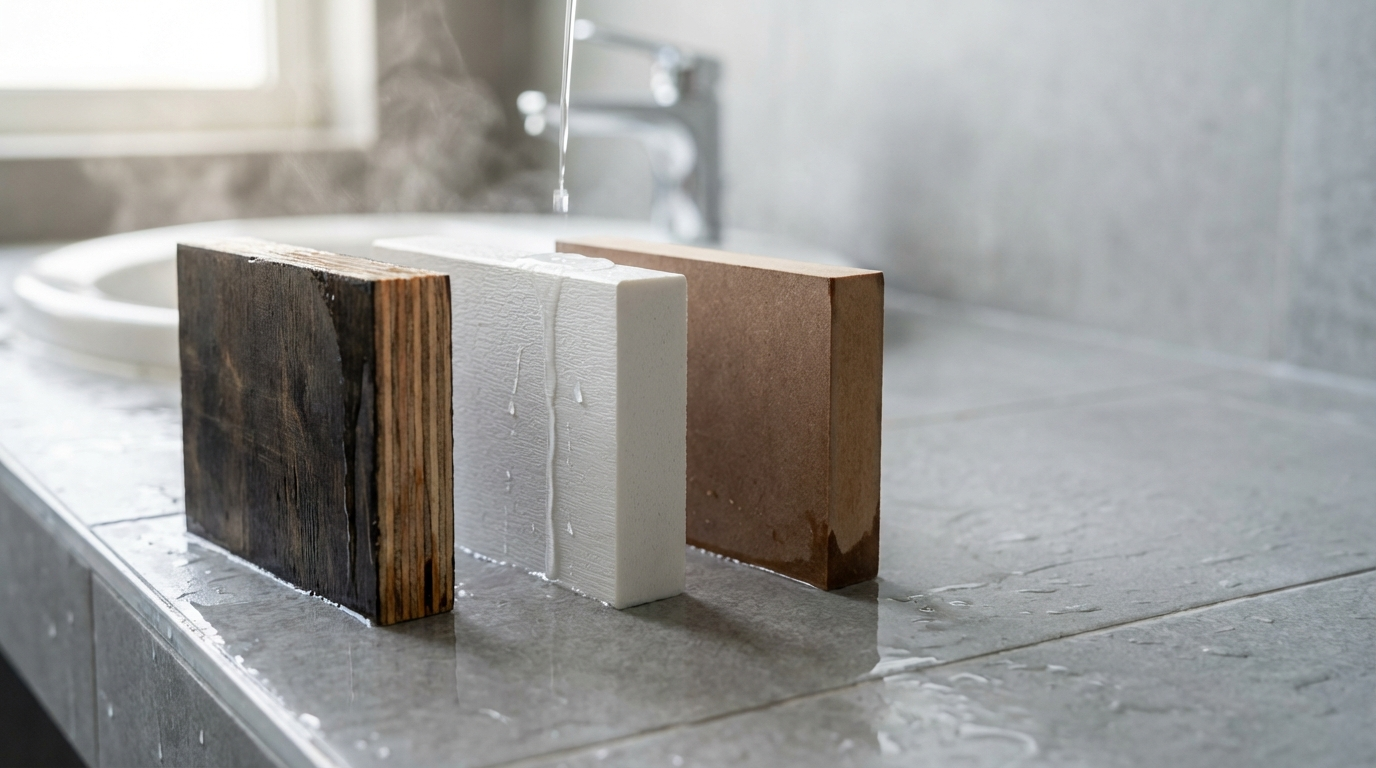
- Avoid for: Outdoor use, wet areas like bathrooms, or heavy load-bearing applications
- Key caution: Highly susceptible to moisture damage and swelling if edges are unsealed
Particle Board Explained: What Is It and How Is It Made?
Particle board belongs to the engineered wood family and serves as an economical alternative to plywood and solid wood for interior applications across India. Understanding its composition helps buyers make informed decisions about where and when to use this material.
Manufacturing Process
The production of particle board follows a systematic industrial process. Wood is first reduced to chips and transformed into particles of various sizes, which are then dried and mixed with synthetic resin—typically urea-formaldehyde. This mixture is placed in a press where heat and pressure bind everything into a uniform panel. The density of the final board depends on the wood species used and the compression applied during manufacturing.
Key Physical Properties
Particle boards are manufactured in density ranges of 0.4 to 0.85 g/cm³ depending on their intended application and thickness. Boards with density lower than 0.59 g/cm³ are classified as low-density, those between 0.45 and 0.8 g/cm³ are medium-density, and those above 0.8 g/cm³ are high-density variants. In practical terms, particle board is the lightest core material when compared to MDF and HDHMR boards, which impacts both handling and structural capacity.
Why Particle Board Matters in India
The Indian furniture and construction industry has witnessed tremendous growth in particle board usage over the last five to six years. Several factors drive this acceptance: rising timber costs, growing modular furniture demand, and the material's sustainability credentials as it uses recycled wood waste. Major manufacturers like CenturyPly and Greenlam have invested in mega production plants, enhancing both quality standards and consumer awareness in the domestic market.
Types of Particle Board Available in India
The Indian market offers several particle board variants, each engineered for specific applications and performance requirements. Selecting the right type prevents premature failure and ensures value for money.
Standard (Plain) Particle Board
This is the most basic and affordable type, made from wood chips, sawmill shavings, and resin. It offers decent strength and stability but remains unsuitable for areas with high moisture or heavy load-bearing requirements due to its lower density. Standard particle board is ideal for budget furniture, temporary fixtures, and hidden structural components like wardrobe backs and drawer bottoms.
Pre-Laminated Particle Board (PLPB)
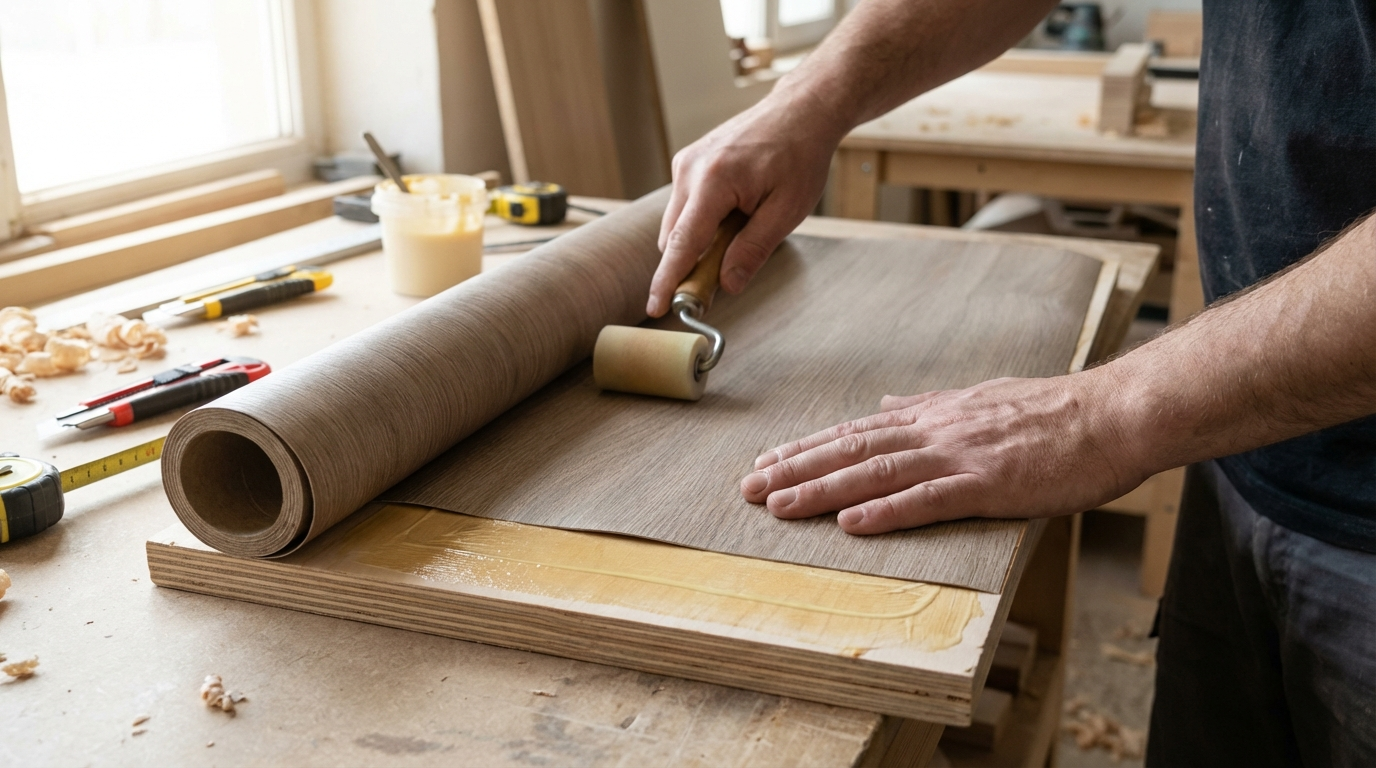
Pre-laminated particle board comes with a decorative melamine-impregnated paper already applied on both surfaces. This eliminates the need for separate lamination, making it a quick and easy option for finished projects. The Indian Standard IS 12823 classifies pre-laminated boards into Grade I and Grade II, with four types based on abrasion resistance—Type I for flooring, Type II for horizontal surfaces like restaurant table tops, and Type III for normal applications like office table tops.
Moisture-Resistant (MR/HMR) Particle Board
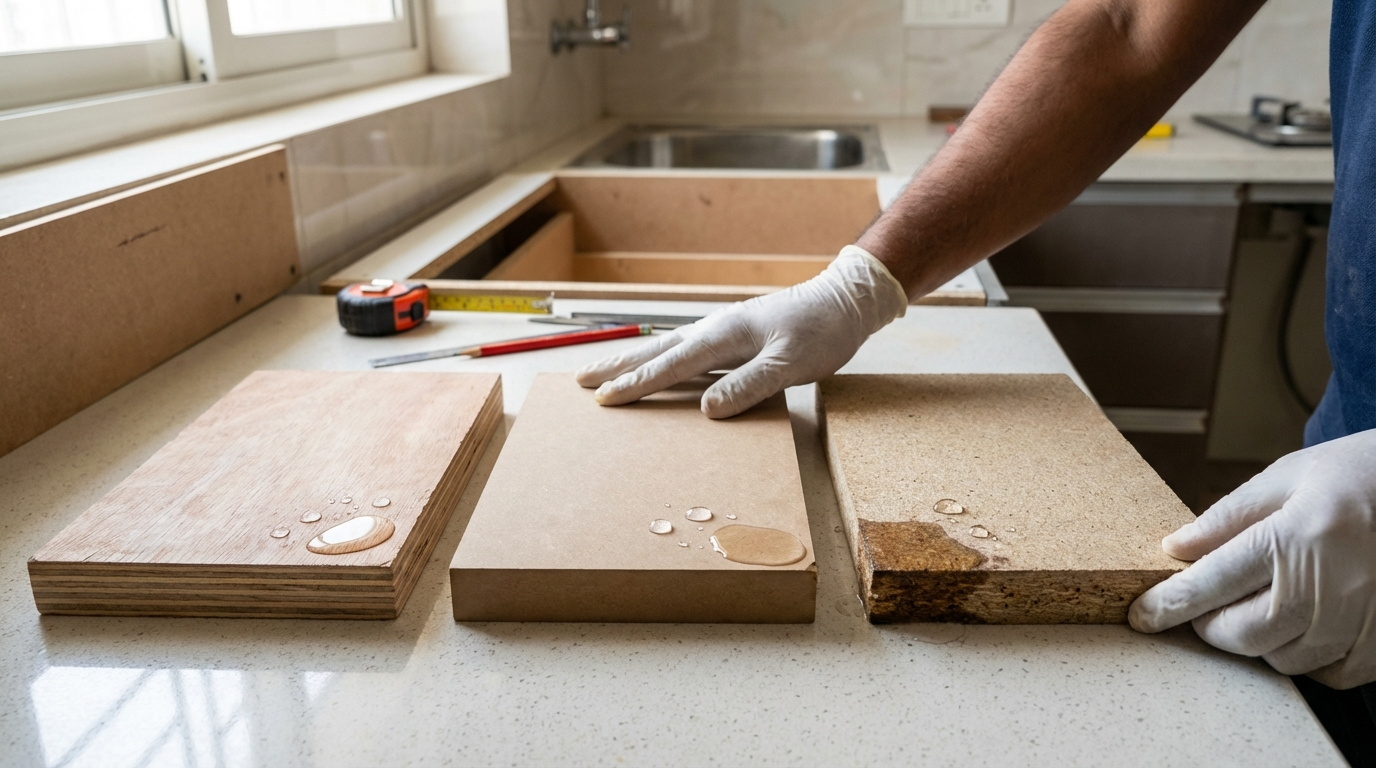
Treated with water-repellent chemicals during manufacturing, moisture-resistant particle board offers better performance in humid conditions compared to standard variants. However, it may still swell or warp with prolonged moisture exposure. These boards are suitable for kitchens and areas with ambient humidity but should not contact water directly.
Fire-Resistant Particle Board
Fire-rated particle board incorporates fire-retardant chemicals to reduce flammability and slow flame spread. Commercial and institutional projects often mandate this variant for safety compliance, particularly in office partitions, false ceilings, and public spaces.
Graded-Density Particle Board
This variant features a layer of coarse wood particles sandwiched between two layers of fine particles. The graded construction provides a smoother surface for lamination while maintaining core strength. It is commonly used for cabinet and furniture manufacturing where surface quality matters.
Cement-Bonded Particle Board
Using Portland or magnesium-based cement as the bonding agent (approximately 60% cement, 20% wood particles, 20% water), cement-bonded boards offer superior resistance to moisture, fire, termites, and rot. These specialized boards suit false ceilings, wall cladding, and permanent floor coverings in high-humidity zones.
Particle Board vs MDF vs Plywood: Comparison Table
Choosing between particle board, MDF, and plywood requires understanding how each performs across critical parameters. This comparison helps Indian buyers match material to application.
| Parameter | Particle Board | MDF | Plywood |
|---|---|---|---|
| Composition | Wood chips and sawdust bonded with resin | Fine wood fibers with resin and wax | Thin wood veneer layers glued cross-grain |
| Density | Lowest (lightest) | Medium-high (heavier) | Varies by grade |
| Strength | Lowest; prone to damage under heavy loads | Better than particle board; moderate | Highest; excellent load-bearing |
| Moisture Resistance | Poor; swells and deteriorates quickly | Moderate; better than particle board | Best with MR/BWP grades |
| Screw Holding | Weak; loosely packed structure | Moderate | Excellent |
| Surface Finish | Rough; requires lamination | Smooth; ideal for painting | Varies; can be rough or smooth |
| Price (₹/sq ft) | ₹12–35 (cheapest) | ₹25–55 (mid-range) | ₹40–120+ (highest) |
| Durability | 5–8 years typically | Up to 10 years with maintenance | 15–25+ years possible |
| Best For | Budget furniture, temporary fixtures, wardrobe backs | Painted cabinets, decorative elements, CNC work | Kitchen cabinets, bed frames, structural use |
| Avoid For | Wet areas, outdoor use, heavy load-bearing | Outdoor use, structural applications | Cost-sensitive projects |
Key Takeaway for Indian Buyers
In the tropical Indian climate where most structures face moisture and heat exposure, particle board works well only for completely dry interior applications. For modular kitchens, experts typically recommend BWP plywood for the carcass, while particle board or MDF may suffice for wardrobes and bedroom furniture where water contact is minimal.
Common Applications and Uses of Particle Board
Particle board's affordability and uniform surface make it suitable for a wide range of interior applications across residential and commercial projects in India.
Furniture Manufacturing
The furniture industry accounts for approximately 60-67% of total particle board consumption globally. In India, particle board is extensively used for wardrobes, study desks, bookshelves, cabinets, and ready-to-assemble (RTA) furniture. The material's uniform density allows for consistent machining and edge-banding, which is critical for modular furniture production.
Kitchen and Bathroom Cabinets
While standard particle board is unsuitable for wet zones, pre-laminated and moisture-resistant grades find application in kitchen cabinet carcasses where direct water contact is avoided. However, the sink base cabinet and areas near water sources typically require plywood or HDHMR for longevity in Indian kitchens where wet mopping is common.
Office Interiors and Partitions
Commercial spaces extensively use particle board for office dividers, workstation furniture, storage systems, and wall paneling. The material's acoustic properties—offering decent thermal and soundproof benefits—make it popular for creating private work areas within open-plan offices.
Wall and Ceiling Panels
Particle board serves as wall cladding and false ceiling substrate in residential and commercial buildings. Its lightweight nature eases installation overhead, though proper ventilation must be ensured to prevent moisture accumulation.
Flooring Underlayment
In temporary structures and as underlayment beneath hardwood floors, particle board provides a smooth, level substrate. However, flooring-grade boards with specific abrasion resistance (Type I as per IS 12823) should be selected for such applications.
How to Choose the Right Particle Board
Selecting appropriate particle board requires matching specifications to your project requirements. This decision framework helps avoid common purchasing mistakes.
Thickness Selection Guide
Particle board commonly comes in thicknesses ranging from 8mm to 25mm. Choose based on application:
- 8mm–11mm: Backing panels, drawer bottoms, light partitions
- 17mm–18mm: Wardrobe shutters, cabinet carcasses, general furniture (most commonly used thickness)
- 25mm: Tabletops, countertops, heavy-duty shelving requiring additional rigidity
Grade and Type Selection
Match the grade to environmental conditions:
- Interior-grade (Grade II): For standard indoor applications with controlled humidity
- Exterior-grade (Grade I): For semi-exposed areas, though true outdoor exposure still degrades particle board
- MR/HMR grade: For kitchens and areas with ambient moisture (not direct water)
- E1/E2 certification: For projects requiring low formaldehyde emission, particularly relevant for export or health-conscious clients
Buyer Checklist
- Verify ISI/BIS certification stamp on the board
- Check surface for smoothness, consistency, and absence of visible defects
- Inspect edges for even particle distribution (no gaps or voids)
- Confirm moisture content (should typically be below 6-10%)
- Match thickness accurately—trade sizes like 17mm may vary from stated 18mm
- For pre-laminated boards, check laminate adhesion and edge finish
- Verify density by weight—heavier boards within same thickness indicate better compression
When NOT to Choose Particle Board
Avoid particle board in these scenarios:
- Bathrooms and wet areas: Even MR-grade swells with prolonged humidity exposure
- Outdoor furniture or semi-covered areas: Monsoon exposure will destroy it within weeks
- Heavy load-bearing shelves: Books, utensils, and heavy items cause sagging over time
- Coastal and high-humidity regions: The salt-laden air accelerates deterioration
- Floor-mounted cabinets prone to water seepage: Especially in Indian homes with wet mopping practices
- Long-term rental investments: The 5-8 year lifespan may not justify costs versus plywood
Common Mistakes to Avoid When Buying Particle Board
Understanding frequent buyer errors helps prevent costly failures. Indian market conditions present unique challenges that require awareness.
Mistake 1: Using Standard Board in Humid Areas
Many buyers select plain particle board for kitchen cabinets to save costs, only to face swelling and disintegration within months. In India's tropical climate, ambient humidity alone can damage unprotected particle board. Always specify MR-grade minimum for any kitchen application and ensure edges are properly sealed.
Mistake 2: Ignoring Edge Sealing
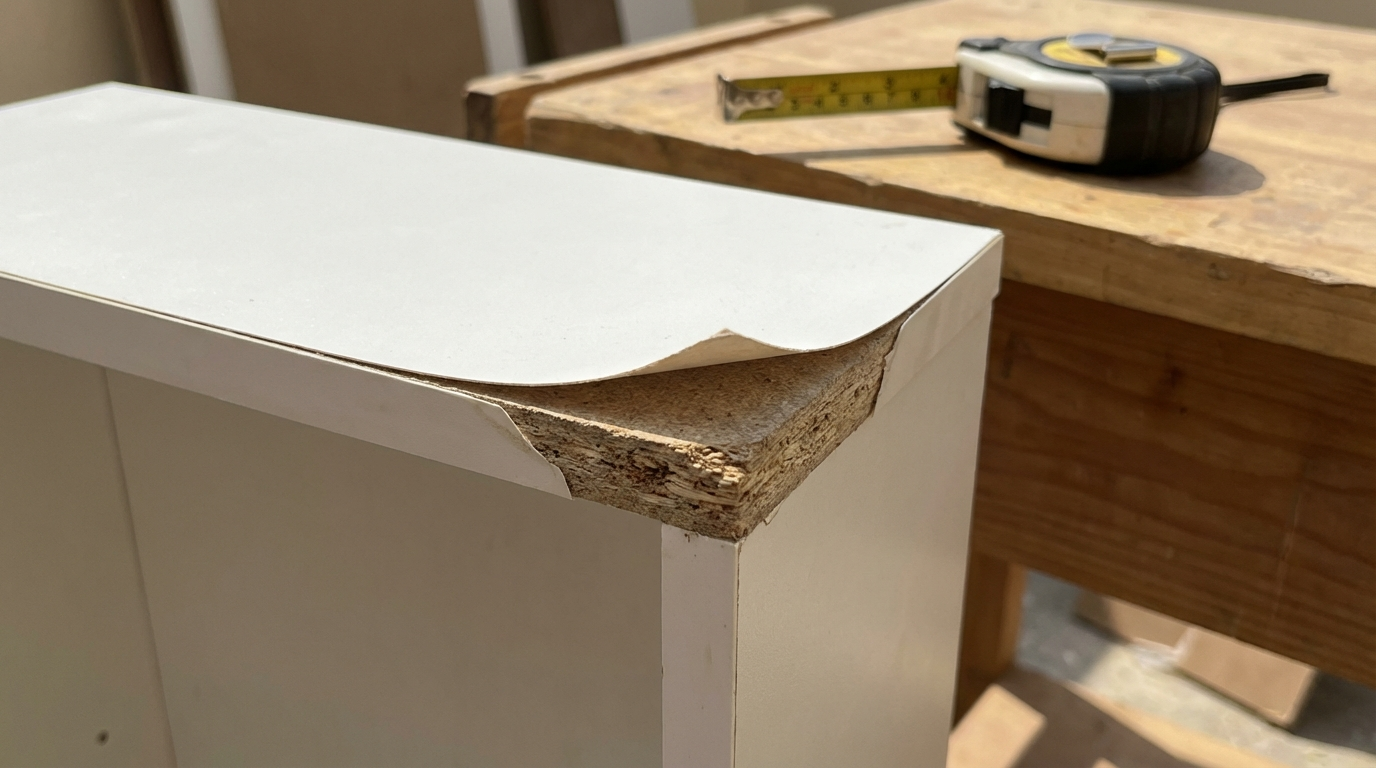
Particle board absorbs moisture primarily through exposed edges. Many carpenters skip edge-banding to save time, leaving boards vulnerable. Insist on PVC or ABS edge-banding on all exposed edges, particularly on horizontal surfaces where spills may occur.
Mistake 3: Overloading Shelves
The loose particle structure limits load capacity. Heavy items on wide-span shelves without intermediate support cause permanent sagging. For bookshelves or storage units, limit spans to 60cm for 18mm boards, or add center supports for wider shelves.
Mistake 4: Buying Unbranded Loose Stock
Local dealers often offer unmarked sheets at lower prices. These may lack proper compression, have inconsistent density, or use inferior adhesives. Branded boards from established manufacturers (Action Tesa, Century, Greenply, Merino) offer more consistent quality and better post-sale support.
Mistake 5: Confusing Thickness Standards
Trade thickness (17mm vs 18mm, 16mm vs 15mm) causes confusion. A board marked 18mm may actually measure 17mm or even 16.5mm. Always measure before purchase if precise fitting is required, especially for modular furniture with tight tolerances.
Quick Inspection Checks at the Dealer
- Visual check: Look for surface cracks, chips, warping, or laminate bubbles
- Edge inspection: Check for voids, uneven particle distribution, or crumbling edges
- Weight test: Compare similar-sized boards—heavier usually indicates better compression
- Tap test: A solid, dull sound suggests good density; hollow sound indicates poor compression
- Flex test: Slight flex is normal; excessive bending indicates weak core
- Smell test: Strong chemical odor may indicate high formaldehyde content
Price Guide: Particle Board Costs in India 2026
Particle board pricing varies significantly based on type, thickness, brand, and location. This guide provides indicative ranges for budget planning.
Plain Particle Board Prices
| Thickness | Price Range (₹/sq ft) | Price per 8×4 Sheet (₹) | Typical Use |
|---|---|---|---|
| 8mm | ₹12–18 | ₹380–580 | Backing panels, light partitions |
| 11mm–12mm | ₹15–22 | ₹480–700 | Internal components, drawer sides |
| 17mm–18mm | ₹20–30 | ₹640–960 | General furniture, cabinet carcass |
| 25mm | ₹28–40 | ₹900–1,280 | Tabletops, counters, heavy shelving |
Pre-Laminated Particle Board Prices
| Thickness | Price Range (₹/sq ft) | Price per 8×4 Sheet (₹) | Notes |
|---|---|---|---|
| 8mm | ₹28–38 | ₹900–1,220 | Light applications |
| 17mm–18mm | ₹33–55 | ₹1,050–1,760 | Most common; varies by laminate finish |
| 25mm | ₹45–70 | ₹1,440–2,240 | Premium finishes cost more |
Factors Affecting Particle Board Prices
- Brand tier: Premium brands (Action Tesa, Century, Merino) command 15-30% higher prices than unbranded boards
- Laminate finish: Glossy, textured, and matte finishes have different pricing; special textures cost more
- Density grade: Higher-density boards with better screw-holding cost more
- City tier: Metro cities typically have competitive pricing; Tier-2/3 cities may see 10-15% higher costs due to transport
- Order quantity: Bulk orders (50+ sheets) often qualify for dealer discounts of 5-12%
- GST impact: 18% GST applies; verify whether quoted prices are inclusive
- Moisture-resistant grade: MR/HMR variants cost 15-25% more than standard grades
Regional Price Variations
Manufacturing hubs in Gujarat, Tamil Nadu, and Himachal Pradesh offer lower prices due to reduced transport costs. The introduction of BIS standards has created a favorable environment for domestic manufacturers by posing challenges for imported products, helping stabilize and sometimes reduce prices for quality-certified boards.
Frequently Asked Questions
What is the full form of particle board?
Particle board does not have an acronym—the name itself describes the product's composition. It is sometimes called chipboard (particularly in European terminology) or low-density fiberboard due to its construction from wood particles. In India, you may also encounter the term "pressed board" or "composite board" in trade discussions. The material falls under the engineered wood category because it is manufactured from recycled timber waste including wood chips, sawdust, and sawmill shavings bonded together with synthetic resin adhesive under heat and pressure.
Which is better: particle board or plywood?
Plywood outperforms particle board in strength, moisture resistance, screw-holding capacity, and longevity—lasting 15-25+ years compared to particle board's 5-8 years. However, particle board costs 50-70% less than comparable plywood, making it suitable for budget-conscious projects in dry areas. For Indian homes, use plywood for kitchen cabinets, bed frames, and any furniture exposed to moisture or heavy loads. Reserve particle board for wardrobes in bedrooms, study tables, office furniture, and hidden components like drawer backs where moisture exposure is minimal and budget is primary concern.
Is particle board good for kitchen cabinets in India?
Standard particle board is not recommended for Indian kitchen cabinets due to high humidity, wet mopping practices, and water splashes common in our cooking environments. However, pre-laminated moisture-resistant (MR) grade particle board can work for upper cabinets and internal shelving with proper edge sealing. For sink base cabinets and areas near water sources, always use BWP plywood or HDHMR. The key is understanding that even MR-grade particle board swells with prolonged moisture exposure, so careful placement and waterproofing are essential for kitchen use.
What is the price of particle board in India per square foot?
Plain particle board typically costs ₹12-35 per square foot depending on thickness and brand, while pre-laminated particle board ranges from ₹28-55 per square foot. A standard 8×4 feet (32 sq ft) plain sheet of 18mm thickness costs approximately ₹640-960, while a pre-laminated 18mm sheet costs ₹1,050-1,760. These prices vary based on city location (metro vs Tier-2), brand (premium vs economy), laminate finish quality, and dealer margins. Always confirm whether quoted prices include 18% GST.
How can I check particle board quality before buying?
Inspect particle board quality through multiple checks: examine the surface for smoothness, consistency, and absence of cracks or bubbles; check edges for even particle distribution without voids or gaps; compare weight between similar boards (heavier indicates better compression); tap the surface—a solid dull sound suggests good density while hollow sounds indicate poor compression; verify the ISI/BIS certification stamp; and smell for strong chemical odors indicating high formaldehyde content. For pre-laminated boards, also check laminate adhesion by gently pressing edges and verify color consistency across the surface.
Can particle board be used in bathrooms?
Particle board should not be used in bathrooms under any circumstances. Even moisture-resistant (MR) grades cannot withstand the constant humidity, water splashes, and steam exposure typical in bathrooms. Within weeks, particle board in bathroom environments swells, delaminates, and develops mold. The only exception is cement-bonded particle board for false ceilings in well-ventilated bathrooms, but wall cabinets and vanity units require marine plywood (BWP) or PVC boards for durability in Indian bathroom conditions.
What thickness of particle board should I use for wardrobes?
For wardrobes, use 18mm particle board for shutters and carcass sides, 17mm for internal partitions, and 8-11mm for back panels. The 25mm thickness suits heavy-duty shelving for folded clothes and accessories. When selecting thickness, consider shelf spans—limit 18mm shelves to 60cm width without support, or add center rails for wider spans to prevent sagging. Pre-laminated boards in 17mm or 18mm offer ready-to-use finishes for visible surfaces, eliminating additional lamination costs and simplifying edge-banding requirements.
How long does particle board furniture last in Indian conditions?
Well-maintained particle board furniture typically lasts 5-8 years in standard Indian residential conditions with controlled humidity. This lifespan reduces significantly in coastal areas, near kitchens, or in poorly ventilated rooms. Proper care extends life: keep away from water, use coasters under wet items, seal all exposed edges, ensure good room ventilation, and avoid excessive weight. For rental properties or frequently moved furniture, the shorter lifespan may actually suit the purpose. For long-term family homes, investing in plywood-based furniture provides better value despite higher initial costs.
Disclaimer: This content is provided for general informational purposes based on industry practices and publicly available information. Product specifications, standards, prices, and availability may vary by manufacturer, region, and time. Readers should independently verify details with manufacturers, dealers, or qualified professionals before making purchase or construction decisions.Want Plywood Suggestions?
Share a few details and a Apple Ply specialist will suggest suitable brands and connect you to responsive dealers.