Carcass for Kitchen: Material Selection Guide
Complete guide to kitchen carcass materials. Compare plywood vs HDHMR vs particle board for modular kitchen cabinets & durability.
Quick Answer
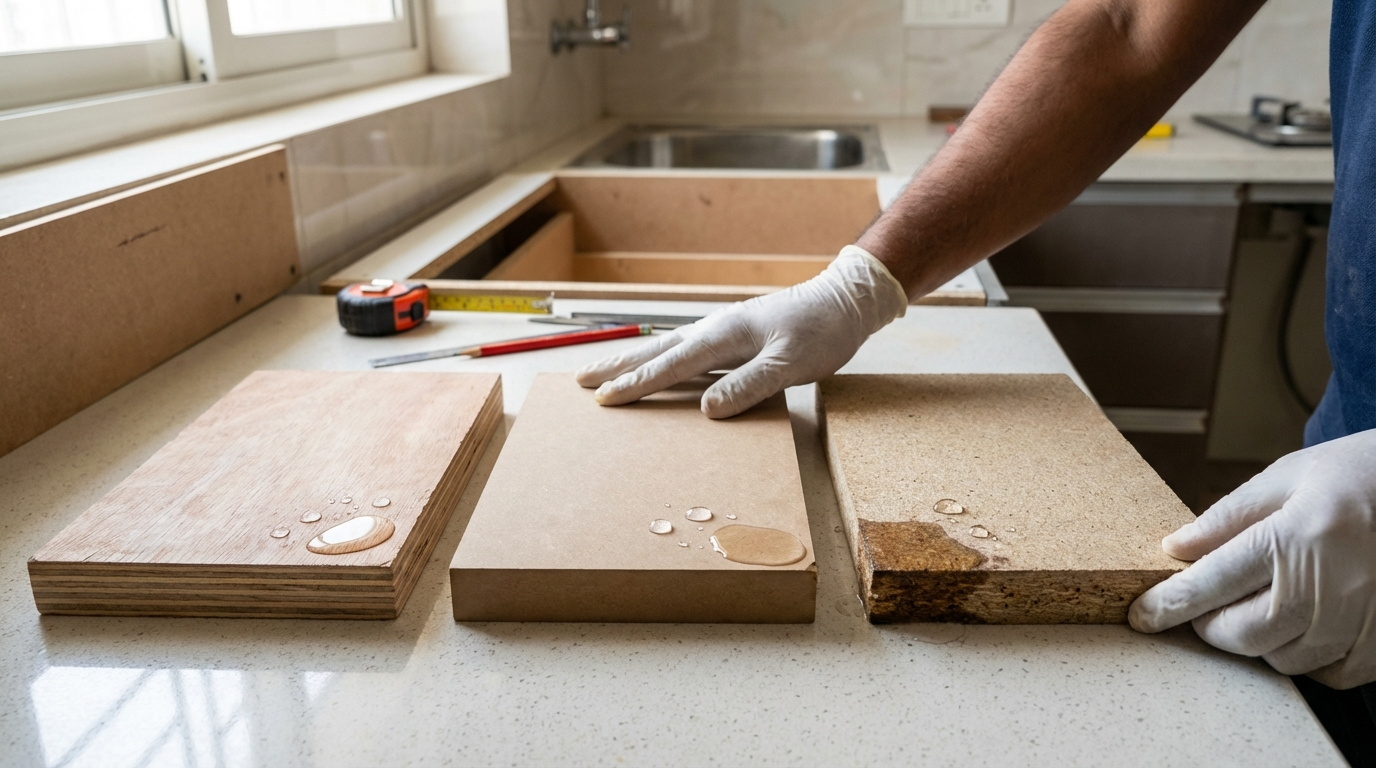
A carcass for kitchen refers to the structural box or framework of modular kitchen cabinets, excluding doors and hardware. The material you choose for kitchen carcass directly determines cabinet lifespan, moisture resistance, and load-bearing capacity. In the Indian context, plywood, HDHMR, and particle board dominate the market, each with distinct trade-offs between cost, durability, and water resistance.
At a Glance
- BWR or BWP grade plywood remains the gold standard for kitchen carcass durability in humid Indian conditions
- HDHMR offers excellent moisture resistance with superior screw-holding at a lower price than marine plywood
- Particle board is budget-friendly but unsuitable for sink units or areas with direct water exposure
- Typical carcass thickness in India ranges from 16mm to 19mm, with 18mm being the most common trade size
- Material selection should account for regional humidity, especially in coastal cities like Mumbai, Chennai, and Kolkata
- Edge banding quality matters as much as core material—poorly sealed edges cause most carcass failures
Kitchen Carcass Materials Explained
The kitchen carcass forms the invisible backbone of your modular kitchen. While buyers often focus on shutter finishes and hardware brands, the carcass material determines whether your cabinets will last 5 years or 25 years. In practical Indian market terms, this distinction becomes critical because kitchen environments face unique stresses: steam from pressure cookers, water splashes near sinks, and humidity fluctuations during monsoons.
A standard kitchen carcass consists of five panels—top, bottom, two sides, and a back panel—assembled using cam locks, dowels, or screws. The base units also include adjustable PVC legs that allow height correction on uneven flooring. Upper wall units require sturdy carcass material since they must support the weight of stored utensils, provisions, and appliances without sagging over time.
Why Carcass Material Matters More Than Shutters
Many Indian buyers spend heavily on acrylic or lacquer finishes for shutter doors while accepting whatever carcass material the modular kitchen company offers by default. This approach is fundamentally flawed. A premium shutter mounted on a weak particle board carcass will fail within 3-4 years as the screw holes enlarge, hinges loosen, and panels warp. Conversely, a good-quality plywood or HDHMR carcass with budget laminate shutters can easily serve 15+ years with proper maintenance.
The carcass also carries the entire load of countertops in base units. Granite and quartz countertops common in Indian kitchens weigh 15-20 kg per running foot. A weak carcass material cannot distribute this weight properly, leading to gradual sagging and eventual structural failure at joints.
Indian Kitchen-Specific Challenges
Indian cooking patterns create harsher conditions than Western kitchens. Deep frying, tempering spices, and extended pressure cooking generate significant heat and steam. Areas around the hob and chimney experience temperature fluctuations that stress adhesive bonds in engineered wood products. The sink zone faces constant water exposure, making moisture resistance non-negotiable for base units in this area.
Types of Kitchen Carcass Materials Available in India
Understanding the fundamental differences between carcass materials helps you make informed decisions rather than relying solely on dealer recommendations. Each material has distinct manufacturing processes that determine its performance characteristics.
Plywood for Kitchen Carcass
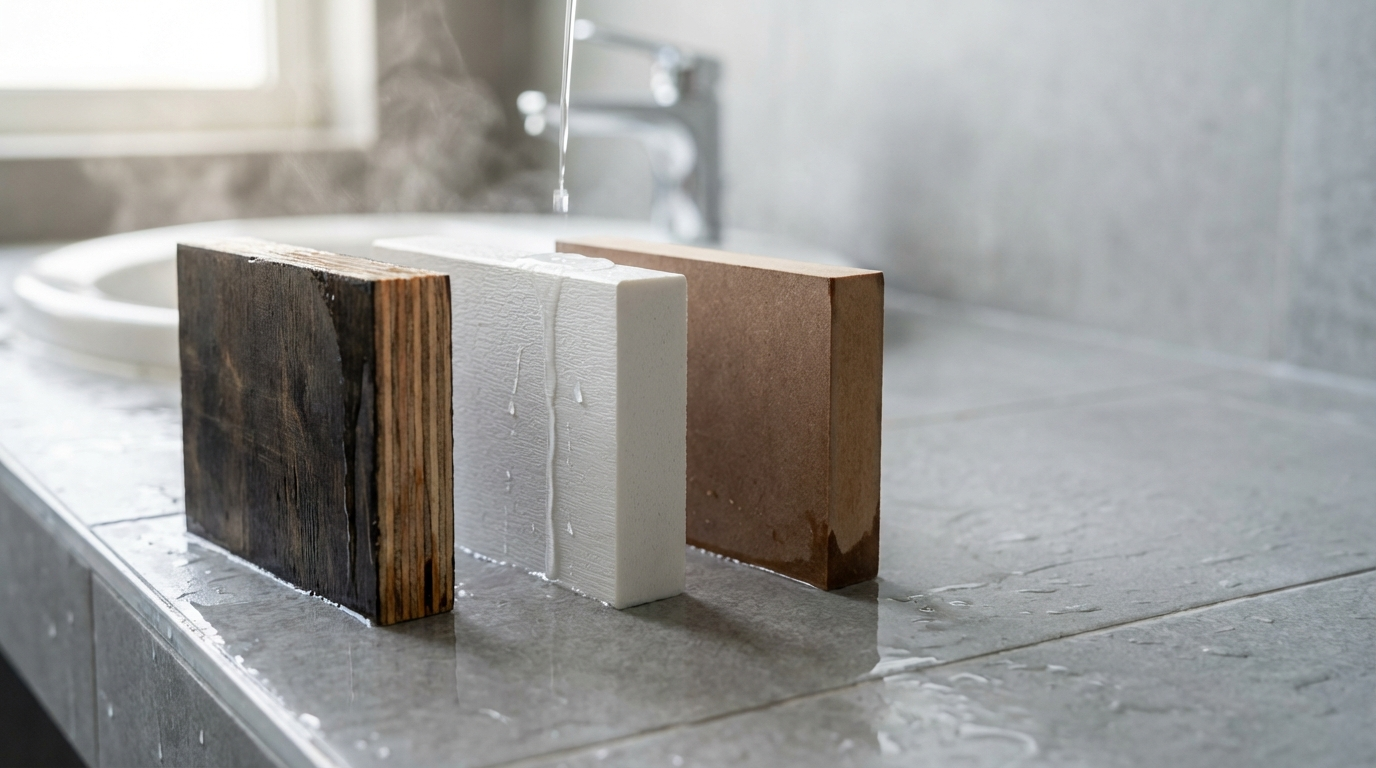
Plywood consists of thin wood veneers bonded together with adhesive, with grain directions alternating between layers. This cross-laminated structure provides excellent strength-to-weight ratio and superior screw-holding capacity. For kitchen applications, BWR (Boiling Water Resistant) grade plywood offers adequate protection for most areas, while BWP (Boiling Water Proof) grade suits sink units and areas with direct water contact.
In India, plywood is available from numerous manufacturers across different quality tiers. Premium brands offer IS 710 certified BWP plywood tested for 72 hours of boiling water immersion. The practical reality is that even BWR grade plywood performs adequately in most kitchen zones when combined with proper edge banding and ventilation.
HDHMR Boards
High-Density High Moisture Resistant (HDHMR) boards represent a significant advancement over traditional MDF. These engineered wood products combine hardwood fibers with moisture-resistant resins under high-pressure compression, achieving densities of 850-900 kg/m³. The manufacturing process creates a homogeneous material with consistent properties throughout, unlike plywood which can have internal voids or weak veneers.
HDHMR has gained substantial market share in Indian modular kitchens over the past decade. Its smooth surface accepts laminate and veneer finishes excellently, and CNC machines can cut precise profiles without edge chipping—a significant advantage for modern modular kitchen factories.
Particle Board and Pre-Laminated Particle Board
Particle board uses wood chips, sawdust, and resin compressed into sheets. Pre-laminated particle board (PLPB) comes with factory-applied melamine surfaces in various colors and textures. This material dominates the budget modular kitchen segment due to its low cost and ready-to-use convenience.
However, particle board has inherent limitations. Its density (typically 650-700 kg/m³) is lower than HDHMR, resulting in weaker screw-holding capacity. More critically, standard particle board absorbs moisture readily—exposed edges can swell noticeably within months in humid environments.
MDF (Medium Density Fibreboard)
Standard MDF finds limited use in kitchen carcass construction due to poor moisture resistance. However, it remains popular for shutter manufacturing where its smooth surface and excellent machining properties matter more than water resistance. Some manufacturers offer moisture-resistant MDF (MR-MDF), but this product occupies a middle ground that neither matches HDHMR's water resistance nor plywood's structural strength.
Comparison Table: Kitchen Carcass Materials
| Parameter | BWR/BWP Plywood | HDHMR | Particle Board | MR-MDF |
|---|---|---|---|---|
| Density (kg/m³) | 550-650 | 850-900 | 650-700 | 700-750 |
| Moisture Resistance | Excellent (BWP) / Good (BWR) | Very Good | Poor | Moderate |
| Screw Holding | Excellent | Very Good | Fair | Good |
| CNC Machining | Good | Excellent | Fair | Excellent |
| Price Range (₹/sq ft, 18mm) | 85-150 | 55-80 | 28-45 | 45-65 |
| Termite Resistance | Requires treatment | Naturally resistant | Requires treatment | Naturally resistant |
| Weight (per 8x4 sheet, 18mm) | 32-38 kg | 48-55 kg | 38-42 kg | 42-48 kg |
| Best For | All kitchen zones | Complete modular kitchens | Dry storage only | Shutters, not carcass |
Note: Prices reflect 2024-25 dealer rates in metro cities for mid-tier brands. Actual prices vary by brand, location, and purchase volume.
How to Choose the Right Carcass Material for Your Kitchen
Selecting kitchen carcass material requires balancing multiple factors specific to your situation. A systematic approach prevents both overspending on unnecessary specifications and cutting corners that lead to premature failure.
Decision Framework Based on Kitchen Zones
Not all kitchen areas face equal stress. A practical approach segments the kitchen into zones with different material requirements:
High-moisture zones (under sink, near dishwasher connection): These areas demand BWP plywood or premium HDHMR with properly sealed edges. Water contact is inevitable, and material failure here causes maximum damage.
Steam-exposure zones (cabinets above hob and adjacent to chimney): Heat and steam stress adhesive bonds. BWR plywood or HDHMR performs adequately, but ensure adequate ventilation gaps.
Standard storage zones (pantry units, overhead cabinets away from hob): Even quality particle board can function here if edges are sealed and the area stays dry.
Buyer Checklist for Carcass Material Selection
- Verify material grade markings—genuine IS-certified plywood carries permanent stamps, not just stickers
- Check edge thickness consistency across the sheet
- Request core samples if buying in bulk—cut sections reveal internal quality
- Confirm edge-banding specifications separately from carcass material
- Ask about warranty terms specifically for carcass material failure
- Consider regional humidity—coastal cities need higher moisture resistance
- Factor in installation quality—the best material fails with poor workmanship
When NOT to Choose Each Material
Avoid plywood when: Budget is extremely constrained and you're building dry storage units only, or when CNC precision is essential and your fabricator cannot source consistently flat sheets.
Avoid HDHMR when: Your carpenter lacks experience with engineered boards and prefers traditional construction methods, or when you need visible wood grain aesthetics.
Avoid particle board when: Building any unit near water sources, when you expect cabinets to last beyond 5-7 years, when heavy loads like mixer-grinders will be stored, or in coastal or high-humidity regions.
Common Mistakes to Avoid When Selecting Kitchen Carcass
Years of observing kitchen failures reveal predictable patterns. Most carcass problems stem from avoidable errors during material selection and installation.
Mistake 1: Ignoring Edge Banding Quality
Many buyers fixate on core material while ignoring edge treatment. The reality is that 80% of moisture ingress happens through exposed edges, not panel faces. A particle board carcass with 2mm PVC edge banding often outperforms BWR plywood with poor-quality paper tape edging. Always specify edge banding separately and verify application quality during installation.
Mistake 2: Using Uniform Material Throughout
Cost-conscious buyers sometimes use the same budget material everywhere, while others overspend on premium specifications for dry storage areas. The zone-based approach mentioned earlier optimizes both cost and performance. Spending on BWP plywood for a pantry unit wastes money; using particle board under the sink wastes the entire cabinet.
Mistake 3: Neglecting Ventilation Provisions
Indian kitchens generate significant steam that gets trapped inside closed cabinets. Without ventilation holes or gaps, even moisture-resistant materials gradually absorb humidity. Insist on ventilation cutouts in back panels of cabinets near cooking zones.
Mistake 4: Trusting Brand Names Without Verification
The Indian market faces issues with counterfeit and substandard plywood bearing fake stamps of reputed brands. Always purchase from authorized dealers, verify batch numbers when possible, and physically inspect material before acceptance. Genuine IS 710 BWP plywood undergoes specific tests—ask dealers for test certificates if buying premium grades.
Quick Inspection Checks You Can Perform
- Weight test: Quality plywood feels heavier than it looks; unusually light sheets suggest low-density core veneers
- Edge inspection: Check for voids, gaps, or overlapping veneers at cut edges
- Flex test: Gently flex a sheet—excessive bending indicates weak internal layers
- Surface check: Run your hand across the surface feeling for bumps, depressions, or rough patches
- Smell test: Strong chemical odors may indicate low-quality adhesives
Mistake 5: Choosing Based on Shutter Aesthetics Alone
Modular kitchen showrooms emphasize shutter finishes because they're visually apparent. Many buyers select packages based on door aesthetics without questioning carcass specifications. Always ask specifically about carcass material during quotation discussions—reputable companies provide this information clearly.
Price Guide for Kitchen Carcass Materials in India
Understanding price structures helps you evaluate quotations and identify unreasonable markups. Prices vary significantly based on multiple factors that dealers don't always explain clearly.
Current Market Price Ranges (2024-25)
| Material Type | Thickness | Budget Brands (₹/sq ft) | Mid-Tier Brands (₹/sq ft) | Premium Brands (₹/sq ft) |
|---|---|---|---|---|
| Commercial Plywood | 18mm | 45-55 | 55-70 | 70-85 |
| BWR Plywood (IS 303) | 18mm | 65-80 | 80-100 | 100-125 |
| BWP Plywood (IS 710) | 18mm | 90-110 | 110-135 | 135-160 |
| HDHMR | 18mm | 48-58 | 58-72 | 72-85 |
| Pre-laminated Particle Board | 18mm | 28-35 | 35-45 | 45-55 |
Assumptions: Prices for 8×4 feet sheets in metro cities, including GST, excluding transportation. Tier-2 and Tier-3 cities may see 5-15% higher prices due to logistics costs.
Factors Affecting Carcass Material Pricing
Brand tier: Premium brands command 30-50% premiums over budget alternatives. This premium partially reflects better quality control and consistency, though diminishing returns apply beyond mid-tier brands for most applications.
Certification status: Genuinely certified IS 710 or IS 303 plywood costs more than uncertified alternatives. The certification process requires investments in testing and quality systems that manufacturers recover through pricing.
Location and logistics: Manufacturing hubs like Yamunanagar, Perumbavoor, and Gujarat offer lower prices than distant markets. Coastal cities face higher plywood prices due to transportation costs from inland manufacturing zones.
Purchase volume: Bulk purchases for complete kitchens command 10-15% discounts from dealers. Single-sheet purchases for repairs pay retail premiums.
Hidden Costs to Factor In
Material cost represents only part of total carcass expense. Edge banding typically adds ₹15-30 per running foot depending on material (PVC, ABS, or acrylic). Hardware cutouts and CNC processing add fabrication costs. Installation labor varies significantly—skilled carpenters charge ₹350-600 per square foot for complete modular kitchen installation in metros.
Regional Considerations for Indian Kitchens
India's geographic diversity creates vastly different requirements across regions. A material performing excellently in Jaipur may fail prematurely in Chennai.
Coastal and High-Humidity Regions
Cities like Mumbai, Chennai, Kolkata, Kochi, and Visakhapatnam experience relative humidity exceeding 80% for extended periods. Salt-laden air in coastal areas accelerates degradation of poorly protected materials. For these regions, BWP plywood or premium HDHMR becomes essential even for overhead cabinets. Particle board should be completely avoided regardless of cost pressures.
Northern Plains and Dry Regions
Delhi, Jaipur, Lucknow, and similar cities face hot summers but lower average humidity. Standard BWR plywood performs adequately for most kitchen zones here. The primary concern shifts to termite protection—ensure any wood-based product includes anti-termite treatment, especially for ground-floor kitchens.
Hill Stations and Cold Regions
Locations like Shimla, Darjeeling, and parts of Northeast India face different challenges. Temperature fluctuations between heated interiors and cold exteriors stress adhesive bonds. Plywood generally handles these stresses better than particle board or MDF due to its cross-laminated structure providing dimensional stability.
Carpenter's Perspective on Carcass Materials
Understanding how carpenters view different materials helps you communicate requirements effectively and evaluate workmanship claims.
Why Many Carpenters Prefer Plywood
Traditional carpenters trained on plywood often resist engineered boards. Their concerns have some validity: plywood allows edge-screwing without splitting, accepts nails for temporary assembly, and forgives minor measurement errors during on-site cutting. For site-made kitchens, plywood's flexibility matters.
Factory Production Favors HDHMR
Modern modular kitchen factories prefer HDHMR for valid reasons. Its consistent density ensures predictable CNC cutting results. The smooth surface bonds excellently with laminates and veneers. Standardized sheet sizes reduce waste. For factory-produced modular kitchens, HDHMR often makes more practical sense than plywood.
Skill Dependency Factor
The Indian market reality is that installation quality varies enormously. A skilled carpenter working with quality BWR plywood produces better results than an unskilled worker with premium BWP material. When evaluating modular kitchen companies, assess their installation teams alongside material specifications.
Frequently Asked Questions
What is the full form of HDHMR used in kitchen carcass?
HDHMR stands for High-Density High Moisture Resistant. It refers to engineered wood boards manufactured by compressing hardwood fibers with moisture-resistant resins under high pressure. The "high density" indicates its compressed structure (850-900 kg/m³) which provides superior strength compared to standard MDF. The "high moisture resistant" distinguishes it from regular MDF that swells rapidly when exposed to water. HDHMR has become increasingly popular in Indian modular kitchens as a cost-effective alternative to BWR plywood.
Which is better for kitchen cabinets: plywood or HDHMR?
The choice depends on your priorities and kitchen configuration. BWR or BWP plywood offers superior moisture resistance for sink units and areas with direct water contact, plus better screw-holding for heavy-use cabinets. HDHMR provides excellent value for money with good moisture resistance, superior surface smoothness for laminate finishes, and consistent quality across sheets. For most Indian kitchens, a practical approach uses BWP plywood for sink-area base units and HDHMR for remaining cabinets, balancing performance with budget.
Is particle board good for modular kitchen carcass?
Particle board suits only specific, limited applications in kitchen carcass construction. It works acceptably for overhead cabinets in dry zones away from the cooking area and for pantry units that remain moisture-free. However, particle board should never be used for base units near sinks, under countertops supporting heavy loads, or in any area with potential water exposure. In humid Indian climates, especially coastal cities, particle board tends to fail within 3-5 years even in relatively dry zones. Budget constraints make it tempting, but long-term costs often exceed initial savings.
What is the ideal thickness for kitchen carcass in India?
The standard thickness for kitchen carcass panels in India is 18mm, which provides adequate strength for most residential applications. Some manufacturers use 16mm for back panels and internal shelves to reduce costs. Premium installations may use 19mm panels for heavy-duty base units supporting granite countertops. Note that trade sizes create confusion—plywood labeled as 18mm often measures 17.5mm or 17mm actual thickness, while 19mm boards may measure 18mm. Always verify actual thickness when comparing quotations, and ensure load-bearing panels meet minimum 17mm actual thickness.
How to check quality of kitchen carcass material?
Quality verification involves multiple checks. For plywood, examine cut edges for voids between veneers, verify IS certification stamps are permanent markings (not stickers), and check weight—quality plywood feels heavier than expected. For HDHMR, inspect edge density uniformity and surface smoothness. General checks include flexing sheets gently to detect excessive bending, smelling for strong chemical odors indicating poor adhesives, and requesting test certificates from dealers. During installation, inspect edge banding adhesion and verify all exposed edges are sealed properly.
What is the price difference between plywood and HDHMR for kitchen?
In current Indian market conditions, HDHMR costs approximately 25-35% less than equivalent-grade BWR plywood for kitchen applications. For a typical 100 square foot kitchen, using mid-tier HDHMR instead of mid-tier BWR plywood saves roughly ₹15,000-25,000 on carcass material alone. However, this comparison requires matching grades appropriately—premium HDHMR costs similar to budget BWR plywood. The cost calculation should also include edge banding and fabrication, where HDHMR's smoother surface may reduce finishing costs slightly.
Can kitchen carcass be repaired if damaged by water?
Repair feasibility depends on damage extent and material type. Minor surface swelling in plywood can sometimes be addressed by drying, sanding, and resealing. HDHMR damage typically requires panel replacement as the swelling cannot be reversed effectively. Particle board damage is almost always irreparable—once moisture penetrates, the board disintegrates progressively. For all materials, the practical approach focuses on prevention: ensuring proper edge sealing, maintaining plumbing connections, and addressing leaks immediately. Severely damaged panels should be replaced rather than repaired to prevent mold growth and further structural deterioration.
Which brands offer the best HDHMR sheets for kitchen in India?
Several established manufacturers produce quality HDHMR boards for kitchen applications in India. Action Tesa, Green Panel, Century Sainik, and Merino are among the commonly available brands with dealer networks across major cities. Brand selection should consider local availability, as logistics costs add significantly in areas far from manufacturing hubs. Rather than focusing solely on brand names, verify actual product specifications—density, moisture resistance ratings, and surface finish quality. Request samples and compare physical properties before committing to large orders. Authorized dealers provide better recourse for quality issues than secondary market sources.
Disclaimer: This content is provided for general informational purposes based on industry practices and publicly available information. Product specifications, standards, prices, and availability may vary by manufacturer, region, and time. Readers should independently verify details with manufacturers, dealers, or qualified professionals before making purchase or construction decisions.Want Plywood Suggestions?
Share a few details and a Apple Ply specialist will suggest suitable brands and connect you to responsive dealers.