MDF vs HDHMR: Complete Comparison for Interior Design
MDF vs HDHMR - detailed comparison of properties, moisture resistance, price & durability. Find out which board is best for your furniture project.
Quick Answer
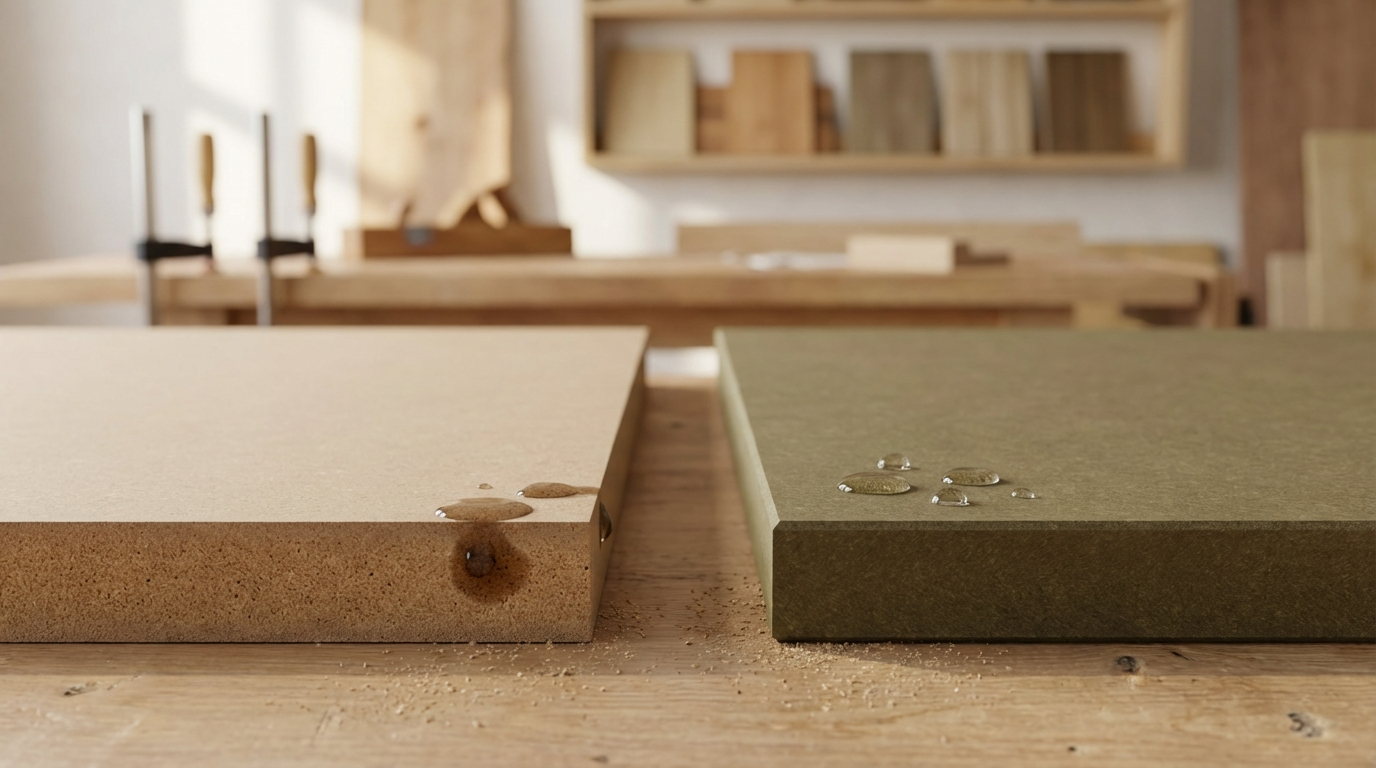
The key difference between MDF and HDHMR is moisture resistance—MDF swells and warps when exposed to humidity, while HDHMR is specifically engineered with moisture-resistant resins to withstand damp environments. For Indian kitchens, bathrooms, and coastal areas, HDHMR is the safer choice despite costing 50-70% more than standard MDF.
At a Glance: MDF vs HDHMR Key Differences
- Moisture Resistance: HDHMR resists humidity and water exposure; MDF absorbs moisture and swells quickly
- Density: HDHMR has higher density (800-900 kg/m³) compared to MDF (600-700 kg/m³)
- Price Range: MDF costs ₹35-50/sqft; HDHMR costs ₹80-120/sqft for 18mm thickness
- Best Use: MDF suits dry interiors; HDHMR excels in kitchens, bathrooms, and humid climates
- Durability: HDHMR lasts 15-20 years in moisture-prone areas; MDF may fail within 3-5 years
- Screw Holding: HDHMR offers superior screw retention due to higher density
Understanding MDF and HDHMR: What These Boards Actually Are
Both MDF (Medium Density Fiberboard) and HDHMR (High Density High Moisture Resistant) belong to the engineered wood family, but their manufacturing differences create vastly different performance characteristics. Understanding these fundamentals helps buyers make informed decisions rather than relying solely on dealer recommendations.
How MDF is Manufactured
MDF is produced by breaking down hardwood or softwood residuals into fine wood fibers, which are then combined with wax and urea-formaldehyde resin binder. This mixture is pressed under high heat and pressure to create uniform, dense panels. The result is a smooth, homogeneous board with no grain direction, making it excellent for painting and detailed router work. Standard MDF typically achieves a density of 600-700 kg/m³, which provides decent strength but limited moisture resistance.
How HDHMR is Manufactured
HDHMR starts with a similar base process but incorporates critical modifications. The wood fibers are combined with melamine-urea-formaldehyde (MUF) resin instead of standard UF resin, and wax additives are included to create a moisture barrier within the board structure. The pressing process uses higher pressure, achieving densities of 800-900 kg/m³. This combination of advanced resin chemistry and increased density creates a board that resists water penetration far better than standard MDF or even HDF (High Density Fiberboard).
Why This Matters in Indian Conditions
India's climate varies dramatically—from the humid coastal regions of Kerala and Mumbai to the dry interiors of Rajasthan. During monsoon season, humidity levels can exceed 85% for weeks, creating conditions that destroy standard MDF furniture. HDHMR's moisture-resistant properties make it particularly relevant for Indian homes where air conditioning is not constant and humidity fluctuates significantly throughout the year.
MDF vs HDHMR Comparison Table
| Property | MDF | HDHMR | Winner |
|---|---|---|---|
| Full Form | Medium Density Fiberboard | High Density High Moisture Resistant | — |
| Density Range | 600-700 kg/m³ | 800-900 kg/m³ | HDHMR |
| Moisture Resistance | Poor—swells within hours | High—resists prolonged humidity | HDHMR |
| Price (18mm, per sqft) | ₹35-50 | ₹80-120 | MDF |
| Screw Holding Capacity | Moderate—edges can split | Excellent—holds screws firmly | HDHMR |
| Surface Smoothness | Excellent | Excellent | Tie |
| CNC Machining | Very good | Very good (dulls tools faster) | MDF (marginally) |
| Weight (18mm sheet) | 35-40 kg | 45-55 kg | MDF (easier handling) |
| Termite Resistance | Low | Moderate to good | HDHMR |
| Ideal Environment | Dry, air-conditioned spaces | Kitchens, bathrooms, humid climates | Application-dependent |
| Lifespan (proper use) | 8-12 years (dry areas) | 15-20 years (all conditions) | HDHMR |
Types and Grades Available in the Indian Market
The Indian market offers several variants of both MDF and HDHMR, and understanding these grades helps buyers match products to their specific requirements. Dealer terminology can be confusing, so knowing what to ask for prevents costly mistakes.
MDF Grades and Variants
Standard MDF (Interior Grade): The most common and affordable option, suitable only for completely dry interior applications. This is what most dealers stock as their default MDF product. It works well for wardrobes in bedrooms, study tables, and decorative wall panels in air-conditioned spaces.
Moisture Resistant MDF (MR-MDF): An intermediate option with some water-resistant additives, but nowhere near HDHMR performance. It handles occasional humidity better than standard MDF but will still fail in sustained damp conditions. Often marketed as "green MDF" due to dye added during manufacturing to distinguish it.
Pre-laminated MDF: Factory-finished MDF with melamine or decorative paper already applied. Saves finishing time but limits customization. The laminate layer provides some additional moisture protection to the surface, though edges remain vulnerable.
HDHMR Grades and Variants
Standard HDHMR: The baseline moisture-resistant board meeting density and moisture specifications. Major brands like Action Tesa, Greenpanel, and Century offer this grade with similar performance characteristics.
Pre-laminated HDHMR: Factory-finished with decorative laminates, offering both moisture resistance and a ready-to-install surface. Popular for modular kitchen installations where speed matters.
Fire Retardant HDHMR: Specialty grade with added fire-resistant properties, typically used in commercial installations, hospitals, and buildings with strict fire safety codes. Costs 30-40% more than standard HDHMR.
Thickness Availability and Trade Sizes
Both MDF and HDHMR commonly come in 8mm, 12mm, 17mm/18mm, and 25mm thicknesses. The 17mm vs 18mm confusion exists because some manufacturers produce 17.5mm boards marketed as 18mm—always verify actual thickness when ordering. Standard sheet sizes in India are 8x4 feet (2440x1220mm), though some brands offer 8x6 feet sheets for reduced wastage in large projects.
How to Choose Between MDF and HDHMR for Your Project
Choosing between these materials requires honest assessment of your specific conditions, budget constraints, and expected furniture lifespan. Neither material is universally "better"—the right choice depends entirely on application context.
Decision Framework: Key Questions to Ask
Before finalizing your material choice, answer these questions honestly:
- Will this furniture face any moisture exposure? Even indirect humidity from nearby bathrooms or kitchens counts.
- Is air conditioning running 24/7? If yes, MDF may survive. If not, reconsider for humid climates.
- What is your expected furniture lifespan? For 15+ year installations, HDHMR's higher cost often provides better value.
- What is your total project budget? Material cost typically represents 30-40% of total furniture cost including labor and hardware.
- Are you in a coastal or high-humidity region? Chennai, Mumbai, Kolkata, and Kerala almost always warrant HDHMR.
Buyer's Checklist
- Verify actual board density by checking manufacturer specifications
- Request test certificates showing moisture resistance ratings
- Inspect board edges for uniformity and absence of voids
- Confirm thickness with a caliper—never trust labels alone
- Check for IS/BIS certification marks on products
- Compare prices across at least three dealers before purchasing
- Ask about warranty terms and what conditions void coverage
When NOT to Choose MDF
Avoid standard MDF in these situations regardless of budget constraints:
- Kitchen cabinets, especially sink units and areas near dishwashers
- Bathroom vanities, mirror frames, or any bathroom furniture
- Coastal homes or regions with average humidity above 70%
- Ground floor furniture in areas prone to dampness or flooding
- Any application where the furniture cannot be easily replaced if damaged
When NOT to Choose HDHMR
HDHMR may be unnecessary expense in these scenarios:
- Bedroom wardrobes in dry, air-conditioned homes in North India
- Study tables and bookcases in humidity-controlled environments
- Temporary furniture or rental property installations
- Projects where plywood would be more appropriate (heavy loads, structural applications)
Common Mistakes to Avoid When Buying MDF or HDHMR
Years of observing Indian furniture markets reveal recurring mistakes that cost buyers money and result in premature furniture failure. Understanding these pitfalls helps make better purchasing decisions.
Mistake 1: Trusting Dealer Claims Without Verification
Many dealers sell standard MDF as "moisture resistant" or rebrand regular HDF as HDHMR. Always ask for the manufacturer's technical data sheet and verify the board carries proper certification. Genuine HDHMR should have density above 800 kg/m³ and specific moisture resistance test results.
Mistake 2: Ignoring Edge Sealing Requirements
Even HDHMR boards are vulnerable at exposed edges where the core is directly exposed to moisture. Proper edge banding with PVC or ABS strips is essential for both materials. Skipping this step—common when working with budget carpenters—dramatically reduces furniture lifespan.
Mistake 3: Using MDF for Sink Units to Save Money
The most common and costly mistake in Indian kitchens is using MDF for sink base units. Water exposure from minor leaks, splashes, and condensation from plumbing causes MDF to swell irreversibly within months. This false economy often requires complete cabinet replacement within 2-3 years.
Mistake 4: Overlooking Regional Climate Variations
Furniture that survives perfectly in Delhi may fail quickly in Mumbai. Buyers often reference projects in different cities without accounting for humidity differences. Always base material decisions on your specific location's climate patterns.
Mistake 5: Choosing Based on Price Alone
The 50-70% price difference between MDF and HDHMR seems significant upfront but becomes negligible when spread over 15-20 years of use. For a ₹3-4 lakh modular kitchen, the material upgrade from MDF to HDHMR typically adds ₹30,000-40,000—a worthwhile investment against premature failure.
Quick Inspection Checks You Can Perform
- Weight Test: HDHMR should feel noticeably heavier than MDF of the same size
- Edge Examination: Look for consistent, void-free edges without visible gaps
- Surface Check: Run your hand across the surface—it should be uniformly smooth
- Water Drop Test: Place a water drop on an unlaminated surface; HDHMR should resist absorption longer
- Flex Test: HDHMR should feel more rigid when flexed compared to MDF of same thickness
Price Guide: MDF vs HDHMR Costs in India (2025-26)
Pricing for engineered boards varies significantly based on brand, thickness, city, and dealer margins. The ranges below represent typical market prices across Indian metros and Tier-2 cities, assuming standard sheet size of 8x4 feet.
MDF Price Ranges
| Thickness | Standard MDF (₹/sqft) | MR-MDF (₹/sqft) | Pre-laminated MDF (₹/sqft) |
|---|---|---|---|
| 8mm | ₹22-30 | ₹28-35 | ₹35-45 |
| 12mm | ₹28-38 | ₹35-45 | ₹45-55 |
| 18mm | ₹35-50 | ₹45-60 | ₹55-70 |
| 25mm | ₹48-65 | ₹60-78 | ₹70-90 |
HDHMR Price Ranges
| Thickness | Standard HDHMR (₹/sqft) | Pre-laminated HDHMR (₹/sqft) | Fire Retardant HDHMR (₹/sqft) |
|---|---|---|---|
| 8mm | ₹55-70 | ₹70-85 | ₹80-100 |
| 12mm | ₹65-85 | ₹80-100 | ₹95-120 |
| 18mm | ₹80-120 | ₹100-140 | ₹120-160 |
| 25mm | ₹100-150 | ₹125-175 | ₹150-200 |
What Causes Price Variation
Brand Premium: Established brands like Greenpanel, Action Tesa, and Century command 15-25% higher prices than regional manufacturers. This premium typically reflects better quality control and more reliable warranty support.
City Tier: Metro city prices are generally 10-15% higher than Tier-2 cities due to higher operating costs, but availability of premium grades is better. Tier-3 towns may have limited HDHMR options, requiring transport from larger cities.
Transport and GST: Boards attract 18% GST, and transport costs add significantly for heavy HDHMR sheets shipped to remote locations. Always get delivered prices rather than ex-factory quotes.
Dealer Margins: Typical dealer margins range from 8-15% on engineered boards. Comparing prices across multiple dealers in your city often reveals 5-10% savings without compromising on genuine products.
Carpenter's Perspective: Working with MDF and HDHMR
Understanding how carpenters and fabricators view these materials provides practical insights that specification sheets miss. Their hands-on experience reveals real-world advantages and challenges.
Machining and Fabrication Differences
MDF cuts cleanly with standard carbide-tipped blades and produces minimal tear-out, making it ideal for detailed CNC routing and intricate designs. HDHMR, due to its higher density, dulls blades faster and requires more powerful machinery for efficient cutting. Most modular kitchen fabricators factor in 10-15% higher tool replacement costs when working extensively with HDHMR.
Edge Banding Considerations
Both materials accept PVC and ABS edge banding well, but MDF's lower density makes it slightly more forgiving during edge banding application—the glue penetrates more easily. HDHMR's denser surface requires proper temperature calibration on edge banding machines for reliable adhesion.
Hardware Installation
HDHMR's higher density provides significantly better screw holding capacity, particularly for hinges and drawer slides that undergo repeated stress. MDF edges are prone to splitting when screws are driven too close to edges or overtightened. Experienced carpenters often drill pilot holes in MDF edges but may skip this step with HDHMR.
Weight and Handling Challenges
An 18mm HDHMR sheet weighing 45-55 kg requires two people for safe handling, while MDF of the same size at 35-40 kg is manageable solo. This affects installation logistics, especially for wall-mounted cabinets where heavier HDHMR panels require stronger wall fixings and more careful mounting procedures.
Budget vs Premium: Making the Right Investment
The decision between saving money now with MDF versus investing in HDHMR requires calculating true long-term costs, not just material prices.
Cost-Per-Year Analysis
Consider a modular kitchen project where MDF-based cabinets cost ₹2,50,000 and HDHMR-based cabinets cost ₹3,20,000. If MDF cabinets last 7-8 years before moisture damage requires replacement, while HDHMR lasts 18-20 years:
- MDF cost per year: ₹2,50,000 ÷ 7.5 years = ₹33,333/year
- HDHMR cost per year: ₹3,20,000 ÷ 19 years = ₹16,842/year
The "expensive" HDHMR option actually costs roughly half as much per year of use. This calculation becomes even more favorable when you factor in replacement inconvenience, temporary kitchen disruption, and potential damage to countertops and appliances during cabinet replacement.
Where Budget MDF Makes Sense
Not every application justifies HDHMR's premium. For bedroom furniture in air-conditioned homes, study units, TV entertainment centers in dry living rooms, and temporary installations, MDF provides adequate performance at significantly lower cost. The key is honest assessment of moisture exposure risk.
Where Premium HDHMR is Essential
Kitchen cabinets (especially sink units), bathroom vanities, laundry room storage, furniture in non-air-conditioned coastal homes, and any installation expected to last 15+ years justify HDHMR investment. The consequences of moisture damage in these applications—warped doors, swollen panels, mold growth—far exceed the initial cost savings from choosing MDF.
Frequently Asked Questions
What is the full form of HDHMR?
HDHMR stands for High Density High Moisture Resistant. The name directly describes its key characteristics: higher density than standard MDF (typically 800-900 kg/m³ versus 600-700 kg/m³ for MDF) and enhanced resistance to moisture through special resin formulations and wax additives. Some manufacturers also use terms like HDF-HMR (High Density Fiberboard - High Moisture Resistant) or HDFWR (High Density Fiberboard Water Resistant) to describe essentially the same product category.
Which is better for kitchen cabinets: MDF or HDHMR?
HDHMR is significantly better for kitchen cabinets due to its moisture resistance properties. Kitchens expose cabinets to steam, water splashes, and humidity fluctuations that quickly damage MDF. Particularly for sink base units, dishwasher surrounds, and cabinets near cooking areas, HDHMR is the only sensible choice. The cost difference typically adds ₹25,000-40,000 to a standard modular kitchen but prevents premature cabinet failure and replacement costs.
Can MDF be used in bathrooms with proper sealing?
Using MDF in bathrooms is strongly discouraged, even with sealing. While surface sealers and laminates provide some protection, moisture inevitably reaches the MDF core through edges, screw holes, and minor surface damage over time. Once water penetrates MDF, it swells irreversibly. Bathroom humidity alone—without direct water contact—can damage MDF over 2-3 years. HDHMR or marine plywood are the only reliable options for bathroom furniture applications.
What is the price difference between MDF and HDHMR in India?
HDHMR typically costs 50-70% more than standard MDF of the same thickness. For 18mm boards, MDF ranges from ₹35-50 per square foot while HDHMR costs ₹80-120 per square foot, depending on brand and city. Pre-laminated versions add another ₹15-25 per square foot for both materials. When comparing prices, always ensure you're comparing the same thickness, as the 17mm vs 18mm variation can confuse pricing discussions.
How do I check if a board is genuine HDHMR?
Genuine HDHMR can be verified through several checks. First, request the manufacturer's technical data sheet showing density above 800 kg/m³ and moisture resistance test results. Second, check for IS/BIS certification stamps on the board. Third, perform a weight comparison—HDHMR feels noticeably heavier than MDF. Fourth, established brands like Action Tesa, Greenpanel, and Century print branding on board surfaces. Finally, the water drop test shows HDHMR resisting absorption longer than MDF on unlaminated surfaces.
Is HDHMR termite-proof?
HDHMR offers moderate termite resistance due to the resins used in manufacturing, but it is not completely termite-proof. The melamine-urea-formaldehyde resin provides some deterrent effect, and the high density makes the board less palatable to termites compared to natural wood or standard MDF. However, in termite-prone areas, additional precautions like chemical treatment of the surrounding structure and using termite-resistant adhesives for edge banding are advisable. For guaranteed termite protection, marine plywood with boron treatment remains superior.
Can HDHMR be used for wardrobes, or is plywood better?
HDHMR is an excellent choice for wardrobes, offering smooth surfaces ideal for laminating and consistent performance across the entire board. Unlike plywood, HDHMR has no grain direction, allowing design flexibility for CNC-cut patterns. For wardrobes in bedrooms with controlled humidity, HDHMR provides cost savings versus BWR plywood while matching performance. However, for wardrobes storing heavy items or requiring exceptional screw-holding for frequent hardware adjustments, high-grade plywood may offer slight advantages. Most modular furniture manufacturers prefer HDHMR for its uniformity and predictable behavior.
How long does HDHMR furniture typically last?
Well-constructed HDHMR furniture with proper edge banding typically lasts 15-20 years under normal household conditions. In consistently humid environments like coastal cities or kitchens without exhaust ventilation, expect 12-15 years with appropriate care. Key factors affecting lifespan include quality of edge sealing, hardware quality, and avoiding prolonged water pooling on surfaces. Regular maintenance—wiping spills promptly, ensuring ventilation in enclosed cabinets, and checking edge banding integrity annually—maximizes furniture longevity regardless of material choice.
Disclaimer: This content is provided for general informational purposes based on industry practices and publicly available information. Product specifications, standards, prices, and availability may vary by manufacturer, region, and time. Readers should independently verify details with manufacturers, dealers, or qualified professionals before making purchase or construction decisions.Want Plywood Suggestions?
Share a few details and a Apple Ply specialist will suggest suitable brands and connect you to responsive dealers.