How to Check Plywood Quality: Complete Testing Guide
Learn how to check plywood quality at home. Simple tests for water resistance, thickness, surface & core quality. Don't get cheated!
Quick Answer
Checking plywood quality requires examining thickness consistency, core construction, surface finish, and water resistance before purchase. A reliable quality check involves visual inspection of edges for voids, the tap test for hollow sounds, moisture testing, and verifying BIS certification marks. These simple tests take minutes but save thousands in furniture replacement costs.
At a Glance:
- Always check edge cross-section for core gaps, voids, and ply count
- Perform the tap test—hollow sounds indicate poor bonding or internal voids
- Verify thickness with a measuring tape at multiple points across the sheet
- Look for IS 303 (MR grade) or IS 710 (BWR/BWP grade) certification stamps
- Test water resistance by placing a few drops on the surface for 30 minutes
- Check face veneer thickness—paper-thin veneer sands through easily
Why Plywood Quality Testing Matters in India
The Indian plywood market presents unique challenges that make quality verification essential before every purchase. Unlike standardised markets in other countries, Indian buyers encounter tremendous variation in quality even within the same price bracket. Dealers stock products from dozens of manufacturers, and the pressure to offer competitive pricing often leads to compromises that only become apparent months after installation.
Poor-quality plywood fails in predictable ways that cause significant financial and practical problems. Warping occurs when internal moisture content is uneven or when core layers have inconsistent density. Delamination—where plies separate from each other—happens when adhesive quality is compromised or curing wasn't completed properly. Surface bubbling and veneer lifting appear when the face veneer is improperly bonded to the core. Termite infestation accelerates in untreated or poorly treated plywood, particularly in humid coastal regions and during monsoon months.
The cost of replacement far exceeds the cost of buying quality plywood initially. A warped wardrobe door requires complete panel replacement, including labour for disassembly, new material, edge banding, and reinstallation. In modular kitchen applications, a single failed panel can mean removing countertops and disconnecting plumbing to access the damaged section. These scenarios play out daily across Indian households that prioritised initial savings over quality verification.
The Dealer Dynamic in Indian Markets
Indian plywood buying happens primarily through local dealers rather than direct manufacturer purchases. This creates information asymmetry where dealers control what you see and what you're told about products. Reputable dealers build relationships over years and stake their reputation on recommendations. However, commission structures and inventory pressures can influence suggestions toward products that may not serve your specific application. Understanding basic quality checks empowers you to verify claims independently, making you a more informed buyer regardless of which dealer you choose.
Visual Inspection: The First Line of Defence
Visual inspection reveals more about plywood quality than any other single test. Trained eyes can identify manufacturing defects, material compromises, and potential failure points in under a minute. This inspection should happen at the dealer's warehouse before sheets are loaded for delivery—returns after cutting are rarely accepted.
Edge Examination Technique
The edge cross-section tells the complete story of plywood construction. Pull a sheet partially from the stack and examine all four edges under good lighting. Count the number of plies—more plies generally indicate better stability and screw-holding capacity. A 19mm commercial plywood typically has 7-9 plies in quality products, while budget variants may have only 5 plies with thicker, less stable core layers.
Look specifically for voids—gaps within or between plies that appear as dark spots or lines along the edge. These voids create weak points where screws won't hold and where moisture can penetrate. Core overlaps, where pieces of veneer overlap rather than meeting cleanly, indicate rushed manufacturing. Gaps between core pieces suggest the manufacturer used undersized veneer pieces to save material.
Surface Quality Assessment
Run your palm flat across the plywood surface, feeling for undulations, rough patches, or raised areas. Quality plywood presents a uniformly smooth surface suitable for lamination or painting without extensive preparation. Bumps or waves telegraph through laminates and become visible imperfections in finished furniture.
Check for patches—areas where defects in the face veneer have been filled or covered. While patches are acceptable in lower grades, excessive patching suggests the manufacturer is salvaging substandard material. Face veneer thickness matters significantly for finishing durability. Hold the sheet edge-on to light and observe the face veneer layer—if it appears paper-thin (less than 0.3mm), sanding during finishing may penetrate through to the core.
The Tap Test and Sound Assessment
The tap test provides information about internal construction that visual inspection cannot reveal. This acoustic assessment identifies hidden voids, delamination, and bonding failures within the plywood structure. The technique is simple but requires a quiet environment and attentive listening.
Use your knuckles to tap firmly across the plywood surface in a grid pattern, covering the entire sheet systematically. Quality plywood produces a consistent, solid sound across all areas—a dull thud that indicates dense, well-bonded construction. Variations in sound indicate problems beneath the surface.
A hollow or drum-like sound suggests an internal void where plies have separated or where gaps exist in the core construction. These voids may be invisible from the edge but create structural weaknesses that lead to surface depression under load. Furniture components like shelves and cabinet tops are particularly vulnerable to failure at void locations.
A papery or thin sound indicates insufficient bonding or extremely thin face veneer over a porous core. This plywood will dent easily and may develop surface cracks over time. Compare the sound to known quality samples if available—most dealers have premium products that serve as reference points for sound comparison.
What Different Sounds Indicate
Consistent solid thud across the entire surface suggests uniform density and proper bonding—this is what quality plywood sounds like. Hollow patches in specific areas indicate localised voids, possibly from air pockets during pressing or core material defects. Varying pitch across the surface suggests inconsistent core density, often from using different wood species or moisture content in core layers. Rattling or buzzing sounds indicate severe delamination where layers have completely separated internally.
Thickness and Dimensional Accuracy Testing
Thickness variation is one of the most common quality issues in Indian plywood markets. Nominal 19mm plywood frequently measures anywhere from 17.5mm to 18.8mm in actual thickness. This variation creates problems in furniture making where components must align precisely and where hardware mounting depends on consistent material thickness.
Measure thickness at multiple points using a steel ruler or caliper. Check all four corners and the centre of each sheet. Quality plywood shows variation of no more than 0.5mm across the entire sheet. Variation exceeding 1mm indicates poor manufacturing control and will cause visible misalignment in furniture construction.
Compare measurements between sheets from the same lot. Even if individual sheets are undersized, consistency allows carpenters to adjust their work accordingly. Random variation between sheets—one measuring 18.2mm and the next measuring 17.6mm—makes precise furniture construction nearly impossible.
Understanding Trade Sizes
Indian plywood markets use trade sizes that differ from actual measurements. When dealers quote 19mm plywood, they refer to the trade designation, not the measured thickness. Actual thickness for 19mm trade size typically ranges from 17.5mm to 18.5mm depending on manufacturer and grade. Similarly, 12mm trade size usually measures 11mm to 11.5mm, and 6mm trade size measures approximately 5.5mm.
This naming convention causes confusion, particularly when specifying plywood for joinery where groove depths and hardware selections depend on actual material thickness. Always measure actual thickness and specify accordingly rather than relying on trade designations.
| Trade Size (Nominal) | Typical Actual Range | Quality Product Range | Common Applications |
|---|---|---|---|
| 6mm | 5.2mm - 5.8mm | 5.5mm - 5.8mm | Back panels, drawer bottoms |
| 9mm | 8.0mm - 8.8mm | 8.5mm - 8.8mm | Partition backing, light shelving |
| 12mm | 11.0mm - 11.8mm | 11.5mm - 11.8mm | Cabinet sides, internal partitions |
| 16mm | 15.0mm - 15.8mm | 15.5mm - 15.8mm | Wardrobe carcasses, shelving |
| 19mm | 17.5mm - 18.8mm | 18.2mm - 18.8mm | Structural components, tabletops |
| 25mm | 23.5mm - 24.5mm | 24.0mm - 24.5mm | Heavy-duty shelving, countertops |
Water Resistance Testing Methods
Water resistance determines plywood suitability for different applications across Indian conditions. The country's monsoon climate, high humidity in coastal areas, and moisture exposure in kitchens and bathrooms make this property critical. Testing water resistance before purchase prevents expensive failures in moisture-prone installations.
The Surface Water Test
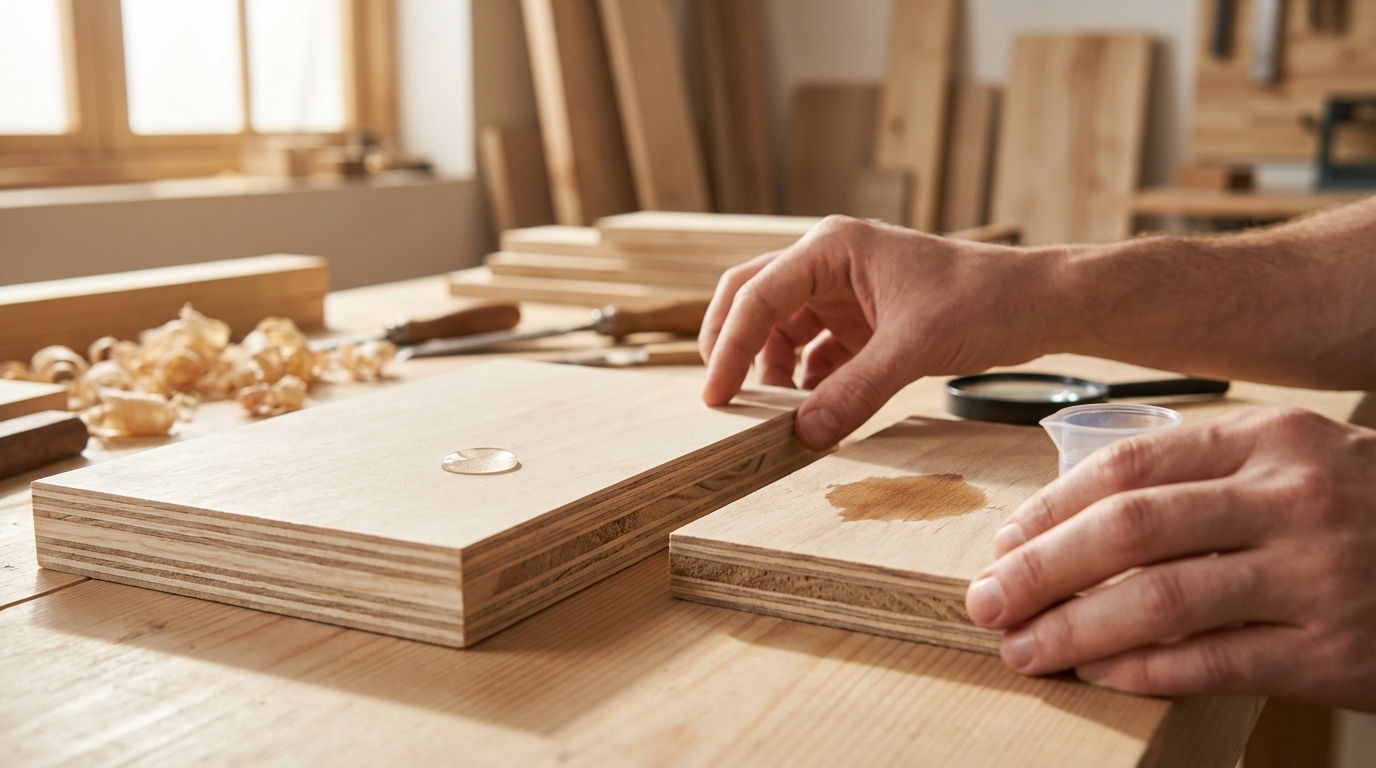
Place several drops of water on the plywood surface and observe behaviour over 30 minutes. Quality MR (moisture resistant) grade plywood shows minimal absorption—water beads on the surface rather than soaking in immediately. If water absorbs within minutes, leaving a dark patch, the plywood lacks adequate moisture resistance for any application involving humidity exposure.
After 30 minutes, wipe the surface dry and check for swelling, discoloration, or surface texture changes. Quality plywood shows no visible effect from this brief exposure. Surface roughening or colour change indicates the face veneer will deteriorate under humidity cycling, leading to finish failure in actual use.
The Edge Soak Test
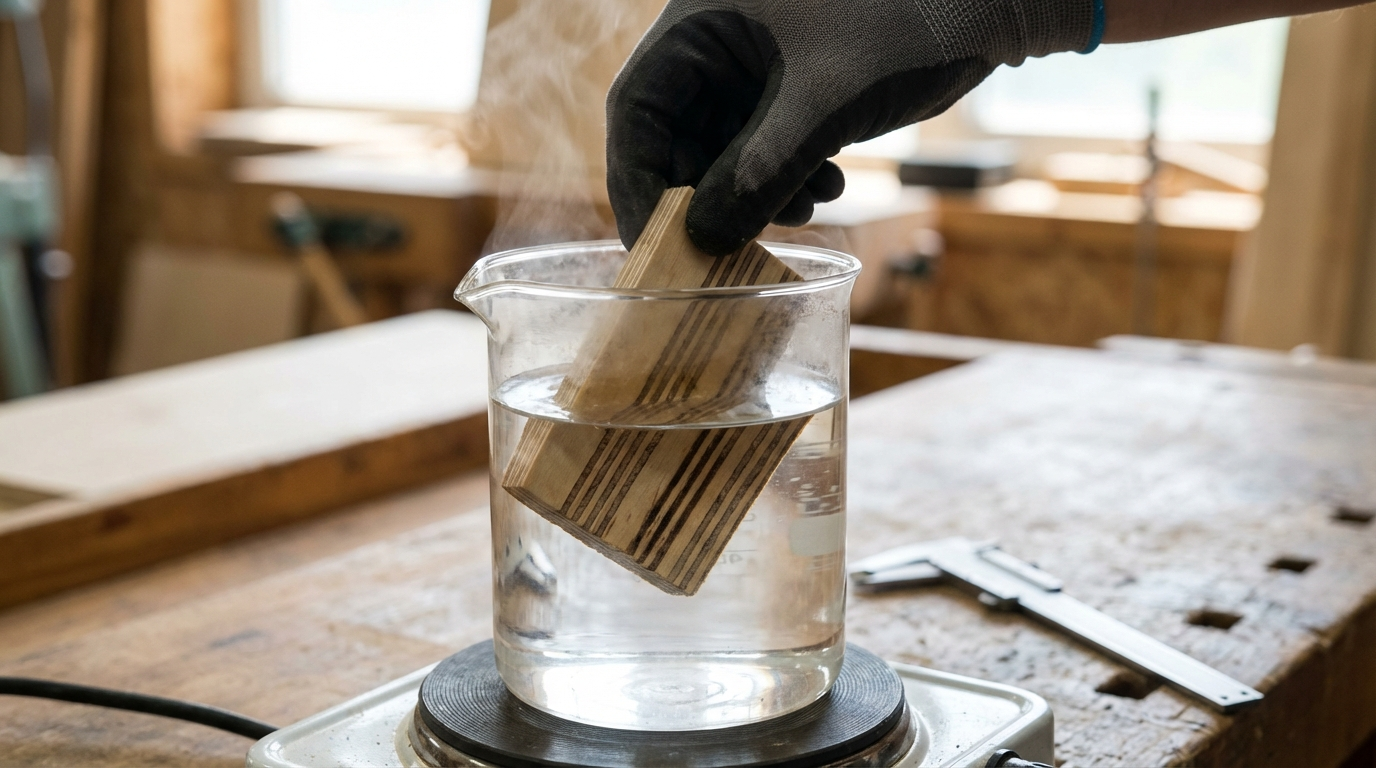
For critical applications like kitchen cabinets or bathroom vanities, perform an edge soak test on a sample piece. Submerge 2-3 inches of a plywood sample in water for 2 hours, then examine for swelling, ply separation, or softening. BWR (boiling water resistant) grade plywood should show minimal effect—slight swelling under 5% of original thickness is acceptable.
MR grade plywood will show some swelling in this test but should not delaminate or lose structural integrity. Significant swelling (more than 10%) or any layer separation indicates the plywood is unsuitable for moisture-exposed applications. Note that this test damages the sample, so use offcuts rather than testing sheets you plan to purchase.
Certification Verification for Water Resistance
Look for BIS certification stamps that indicate tested water resistance performance. IS 303 certification applies to MR grade plywood suitable for interior applications with limited moisture exposure. IS 710 certification applies to BWR and marine grade plywood suitable for high-moisture environments. The stamp should be clearly visible on the sheet surface, typically in the corner. Absence of stamps or illegible markings warrant scepticism about claimed specifications.
Core Quality Assessment
The core construction determines plywood strength, screw-holding capacity, and long-term stability. Face veneers contribute appearance but the core does the structural work. Indian plywood uses various core materials ranging from premium hardwood to fast-growing plantation timber to composites, each with different performance characteristics.
Examine the edge to identify core material. Hardwood cores appear dense with tight grain patterns and few visible pores. Softwood cores like poplar show larger pores and lighter colour. Mixed cores contain layers of different species, which isn't necessarily problematic if properly matched for density. MDF cores appear uniform without visible grain.
Identifying Core Problems
Core voids appear as dark gaps between or within plies. Even small voids compromise screw holding—fasteners driven into voids have nothing to grip. Bark inclusions—dark irregular patches of retained bark—create weak points that may lead to surface depressions or delamination. Knots in core layers don't necessarily indicate poor quality but should be small and tight rather than large and loose.
Check for consistent core ply thickness across the edge. Significant variation in individual ply thickness suggests the manufacturer used whatever material was available rather than maintaining specifications. Core plies should be uniform in colour and density within each layer, indicating consistent raw material sourcing.
Hardwood vs Softwood Cores
Hardwood cores from species like eucalyptus or gurjan provide superior screw-holding, density, and stability. They cost more but perform significantly better in structural applications and heavy-use furniture. Softwood cores from plantation poplar or similar species offer adequate performance for lighter applications at lower cost. The appropriate choice depends on application—a wardrobe back panel doesn't need hardwood core, but load-bearing shelves benefit substantially from the added density.
Comparison: Quality Indicators Across Plywood Grades
| Quality Parameter | Premium Grade | Commercial Grade | Economy Grade | How to Check |
|---|---|---|---|---|
| Face Veneer Thickness | 0.5mm - 0.8mm | 0.3mm - 0.5mm | Below 0.3mm | Edge examination under light |
| Core Voids | None visible | Minimal, small | Multiple, visible | Edge visual inspection |
| Thickness Variation | Under 0.3mm | 0.3mm - 0.8mm | Above 1mm | Multi-point measurement |
| Tap Test Sound | Uniform solid thud | Mostly consistent | Variable, hollow areas | Knuckle tap across surface |
| Surface Smoothness | Glass-smooth | Minor undulations | Visible waves/bumps | Palm sweep test |
| BIS Certification | Clear stamp, verifiable | Present but may be faint | Often missing/fake | Visual verification |
| Ply Count (19mm) | 9-13 plies | 7-9 plies | 5-7 plies | Edge count |
Common Mistakes to Avoid When Checking Plywood Quality
Understanding common errors helps buyers avoid pitfalls that lead to poor purchasing decisions. These mistakes occur at various stages from initial selection through delivery acceptance.
Trusting appearance alone: A smooth, attractive face veneer tells you nothing about core quality, adhesive integrity, or moisture resistance. Some of the worst-performing plywood has beautiful surfaces that mask fundamental construction problems. Always examine edges and perform tests regardless of surface appearance.
Checking only one sheet from a lot: Manufacturers and dealers sometimes place better quality sheets on top of stacks. Inspect at least three random sheets from different positions in the stack. Quality should be consistent throughout the lot, and significant variation warrants suspicion.
Ignoring certification verification: BIS stamps can be printed on any plywood, legitimate or not. The stamp itself means nothing without verification. Quality products include certification numbers that can be cross-referenced. Absent numbers or obviously photocopied stamps indicate counterfeit certification.
Accepting delivered plywood without inspection: Some buyers inspect at the dealer but accept delivery without checking. Substitution happens—intentionally or accidentally. Re-inspect all sheets upon delivery before signing acceptance. Returns become nearly impossible once delivery is acknowledged.
Skipping moisture content consideration: Freshly manufactured plywood may have elevated moisture content that causes later warping as it equilibrates to ambient conditions. Ask about manufacturing date and storage conditions. Plywood stored in covered, ventilated areas for at least 2-3 weeks post-manufacturing generally has stable moisture content.
Quick Inspection Checklist
- Count plies on at least two edges per sheet
- Check for voids by running eyes along all four edges
- Measure thickness at four corners and centre
- Tap test in grid pattern covering entire surface
- Verify BIS stamp legibility and number presence
- Surface palm test for smoothness
- Water drop test if moisture resistance claims are made
Price Guide: What Quality Costs in Indian Markets
Understanding price-quality relationships helps set realistic expectations and identify suspiciously cheap offerings. Prices vary significantly by city tier, with metros commanding 15-25% premiums over Tier-2 cities due to higher operating costs and different product mix preferences.
The following ranges represent retail prices for 8x4 feet sheets at the time of writing. Wholesale purchases of 50+ sheets typically receive 5-10% discounts. Transportation adds ₹15-40 per sheet depending on distance and order size.
| Plywood Type | Thickness | Budget Range (₹/sheet) | Mid-Range (₹/sheet) | Premium (₹/sheet) |
|---|---|---|---|---|
| Commercial MR | 19mm | ₹1,200 - ₹1,600 | ₹1,800 - ₹2,400 | ₹2,800 - ₹3,500 |
| Commercial MR | 12mm | ₹800 - ₹1,100 | ₹1,200 - ₹1,600 | ₹1,800 - ₹2,200 |
| BWR Grade | 19mm | ₹2,200 - ₹2,800 | ₹3,000 - ₹3,800 | ₹4,200 - ₹5,500 |
| BWR Grade | 12mm | ₹1,500 - ₹1,900 | ₹2,000 - ₹2,600 | ₹2,800 - ₹3,600 |
| Marine Grade | 19mm | ₹3,500 - ₹4,200 | ₹4,500 - ₹5,500 | ₹6,000 - ₹8,000 |
| Calibrated (CNC-ready) | 18mm | N/A | ₹3,200 - ₹4,000 | ₹4,500 - ₹6,000 |
Prices below the budget range almost certainly indicate compromised quality, counterfeit certification, or undersized sheets. The savings never justify the replacement costs and structural risks. Prices significantly above premium range typically reflect brand premiums rather than proportionally better construction.
Frequently Asked Questions
What is the easiest way to check plywood quality at home?
The easiest home quality check combines visual edge inspection with the tap test. Examine the plywood edge for voids, gaps, and ply count—more plies with no visible gaps indicate better quality. Then tap across the surface with your knuckles listening for hollow sounds that indicate internal voids. A consistent solid sound across the entire surface suggests proper bonding and dense core construction. These two tests take under a minute and catch most significant quality issues.
How to identify original plywood from duplicate products?
Original plywood from reputed manufacturers carries clear BIS certification stamps with readable certification numbers, consistent branding across all sheets, and quality that matches claimed specifications. Check that stamp printing appears professionally done rather than photocopied or hand-stamped. Many brands now include QR codes or unique identification numbers that can be verified through manufacturer apps or websites. When in doubt, purchase from authorised dealers who can provide proper invoices and warranty documentation.
Which is better: MR grade or BWR grade plywood?
BWR (Boiling Water Resistant) grade offers superior moisture resistance compared to MR (Moisture Resistant) grade, making it essential for kitchens, bathrooms, and humid climate installations. However, BWR costs 40-70% more than equivalent MR grade plywood. For dry interior applications like bedroom wardrobes or living room furniture in climate-controlled environments, quality MR grade plywood performs adequately and represents better value. The choice depends entirely on moisture exposure in the specific application.
What does the IS 710 mark on plywood mean?
IS 710 refers to the Bureau of Indian Standards specification for marine and boiling water resistant plywood. Plywood certified under IS 710 has been tested for resistance to boiling water, demonstrating that adhesive bonds withstand extreme moisture conditions without delamination. This certification indicates suitability for high-moisture applications including marine use, bathroom installations, kitchen cabinets, and exterior-adjacent applications. Genuine IS 710 certified products undergo standardised testing and quality control.
How many plies should good quality 19mm plywood have?
Quality 19mm plywood typically contains 9-13 plies depending on manufacturer and grade. More plies of thinner material generally indicate superior construction with better stability, reduced warping tendency, and improved screw-holding capacity. Budget variants often contain only 5-7 plies with thicker core layers that are more prone to internal movement and defects. Count plies by examining the edge—each distinct layer counts as one ply, including face and back veneers.
Why does plywood thickness vary from stated specifications?
Plywood thickness variation results from manufacturing tolerances, compression during hot pressing, and market conventions around trade sizes versus actual dimensions. Indian markets use nominal sizing where 19mm designation actually delivers 17.5mm-18.8mm finished thickness. This practice continues because of established trade conventions and cost pressures that discourage achieving full nominal thickness. Quality manufacturers maintain tighter tolerances with less variation, but no manufacturer in the Indian market consistently delivers full nominal thickness.
How to check if plywood is termite resistant?
Termite resistance cannot be verified through visual inspection or simple field tests—it depends on chemical treatment during manufacturing. Look for manufacturers' claims of termite treatment and corresponding certifications. The presence of treatment can sometimes be detected by slight colour variation in core layers or faint chemical odour in fresh plywood. For critical applications, request treatment certificates from the manufacturer through your dealer. Post-purchase, you can improve termite resistance by applying borate-based treatments to cut edges and exposed surfaces.
What causes plywood to warp after installation?
Plywood warping primarily results from moisture imbalance—either uneven moisture content at installation or subsequent exposure differences between faces. Plywood stored improperly absorbs atmospheric moisture unevenly, creating internal stresses released as warping. Installation where one face contacts moisture (like wall contact) while the other remains dry causes gradual cupping. Poor core quality with inconsistent density across the sheet amplifies these effects. Prevention includes proper storage, acclimatisation before installation, and sealing all surfaces including edges.
Disclaimer: This content is provided for general informational purposes based on industry practices and publicly available information. Product specifications, standards, prices, and availability may vary by manufacturer, region, and time. Readers should independently verify details with manufacturers, dealers, or qualified professionals before making purchase or construction decisions.Want Plywood Suggestions?
Share a few details and a Apple Ply specialist will suggest suitable brands and connect you to responsive dealers.