HDHMR Board and Sustainable Living: Eco-Friendly Interior Solutions
Learn how HDHMR board supports sustainable living. Eco-friendly interior solutions with recycled wood content and low emissions.
Quick Answer
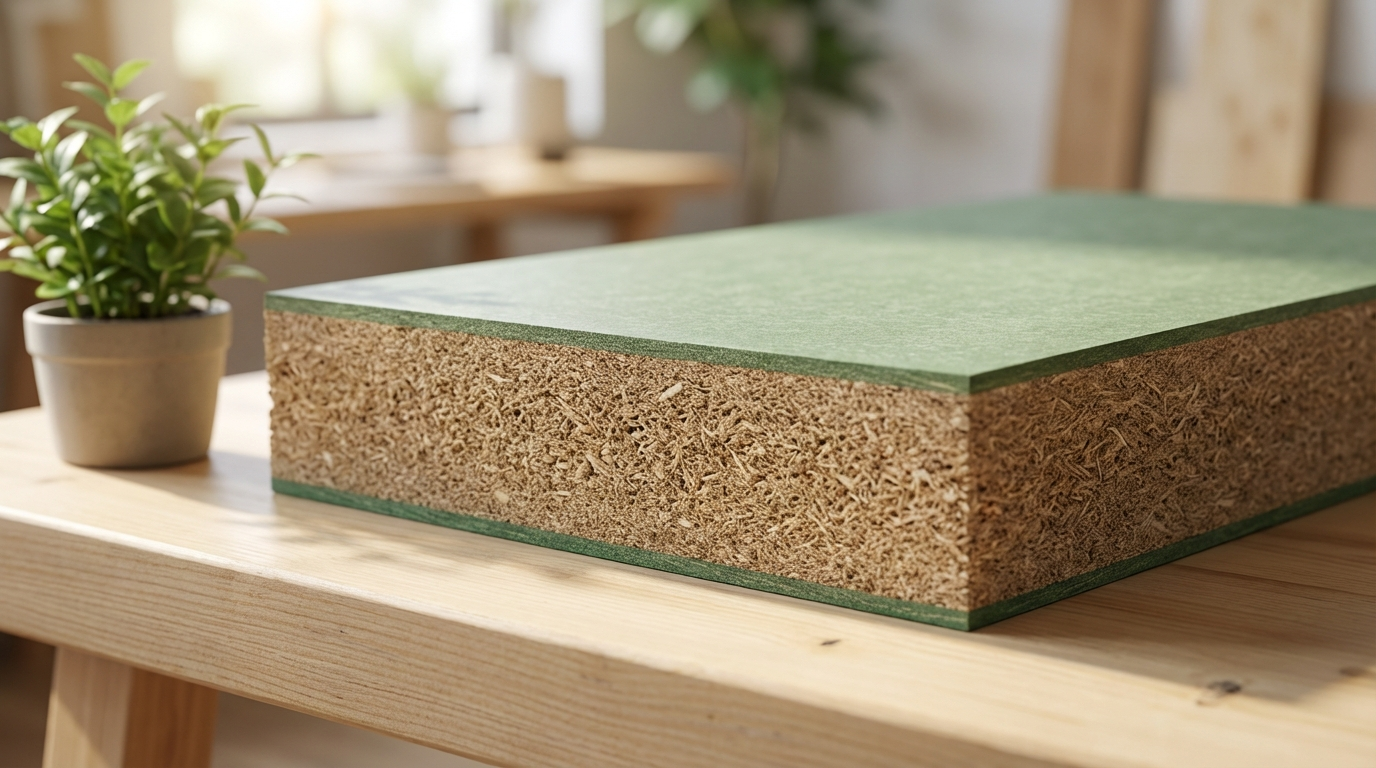
HDHMR board supports sustainable living by utilizing recycled wood fibres, agricultural waste, and low-emission resins in its manufacturing process. This eco-friendly interior solution reduces dependence on solid timber while offering superior moisture resistance, making it ideal for Indian homes seeking durable, environmentally responsible furniture and cabinet materials without compromising on performance.
At a Glance
- HDHMR contains 80-85% recycled wood content from forest waste and agricultural residues
- Low formaldehyde emission boards (E1/E0 grade) available from major Indian manufacturers
- Reduces solid timber consumption by utilizing wood chips and fibres otherwise destined for landfills
- Manufacturing uses approximately 40% less fresh timber compared to equivalent plywood production
- Termite-resistant properties eliminate need for chemical treatments in most applications
- Long service life (15-20 years with proper care) reduces replacement waste and overall environmental footprint
HDHMR Board and Sustainable Living: Understanding the Connection
The intersection of HDHMR board and sustainable living represents a significant shift in how Indian homeowners and designers approach interior materials. High Density High Moisture Resistance board emerged as a response to two pressing concerns: the depletion of natural forest resources and the need for moisture-resistant alternatives in India's humid climate conditions.
Traditional plywood manufacturing requires substantial quantities of mature trees, specifically large-diameter logs suitable for peeling into veneers. This demand has historically placed enormous pressure on both natural forests and plantation timber. HDHMR addresses this by utilizing wood fibres, chips, and agricultural waste that would otherwise be burned or left to decompose, contributing to emissions without any productive use.
The Raw Material Advantage
HDHMR production facilities in India source their raw materials from three primary streams. First, sawmill waste including offcuts, bark, and wood shavings that cannot be used for conventional lumber products. Second, plantation thinnings—smaller trees removed to allow larger specimens to mature properly. Third, agricultural residues like bagasse, rice husk, and cotton stalks that farmers would typically burn, causing significant air pollution problems across northern India.
This waste-to-product conversion creates a circular economy model where materials previously considered worthless now become valuable inputs. For environmentally conscious homeowners in metros like Bangalore, Mumbai, and Delhi, this represents a tangible way to reduce their household's ecological impact without sacrificing quality or durability in their furniture choices.
Manufacturing Process and Energy Considerations
The HDHMR manufacturing process involves chipping raw materials into uniform sizes, drying them to specific moisture content, mixing with resins, and pressing under high temperature and pressure. While this does require energy input, modern Indian facilities increasingly use biomass-fired boilers running on the same wood waste streams, creating a largely self-sustaining energy loop. Several manufacturers have also invested in solar installations to offset grid electricity consumption, further improving the environmental profile of their products.
Eco-Friendly Properties of HDHMR Board
Understanding what makes HDHMR genuinely eco-friendly requires examining several interconnected factors. The sustainability claim rests not on any single characteristic but on the cumulative effect of material sourcing, manufacturing efficiency, product longevity, and end-of-life considerations.
Recycled Content and Resource Efficiency
Quality HDHMR boards typically contain between 80-90% recycled or waste-derived content. This dramatically reduces the virgin resource extraction compared to solid wood furniture or even standard plywood. For a typical modular kitchen requiring approximately 200 square feet of board material, choosing HDHMR over equivalent plywood saves roughly the equivalent of two mature trees from being felled.
The uniform composition of HDHMR also means minimal waste during fabrication. Unlike plywood, which may have grain direction considerations and quality variations requiring careful cutting, HDHMR can be nested efficiently with cutting waste typically under 8-10%. CNC machining centres in Indian modular furniture factories report significantly better material utilization rates when working with HDHMR compared to plywood.
Formaldehyde Emission Standards
One of the most significant environmental and health considerations with any engineered wood product is formaldehyde emission. The resins used to bind wood fibres traditionally released formaldehyde gas, a known irritant and potential carcinogen. Modern HDHMR production has largely addressed this concern through two approaches.
First, the development of modified urea-formaldehyde and melamine-urea-formaldehyde resins that cross-link more completely during curing, leaving less free formaldehyde to off-gas. Second, the introduction of alternative resin systems based on MDI (methylene diphenyl diisocyanate) that contain no formaldehyde at all. Indian brands like Greenpanel and Century now offer E1 and E0 grade boards that meet stringent European emission standards, making them safe for bedroom wardrobes, children's furniture, and enclosed spaces where air quality matters.
Durability and Replacement Cycles
Perhaps the most overlooked sustainability factor is product longevity. A piece of furniture that lasts 20 years has half the environmental impact of one requiring replacement every 10 years, regardless of the materials used. HDHMR's inherent moisture resistance—achieved through the manufacturing process and moisture-resistant resins—means it genuinely outlasts standard MDF in Indian conditions, particularly in coastal cities and during monsoon seasons. This extended service life translates directly to reduced material consumption over time.
Types of Eco-Friendly HDHMR Grades Available in India
The Indian market offers several HDHMR variants, each with different environmental credentials and suitability for various applications. Understanding these distinctions helps in making informed sustainable choices.
Standard Moisture-Resistant HDHMR
The base-level HDHMR available across India meets moisture resistance standards adequate for most interior applications. These boards typically use modified UF resins and achieve E2 or E1 emission grades. While not the most stringent environmental specification, they represent a significant improvement over standard MDF and offer the recycled content benefits inherent to all HDHMR production.
Low-Emission Premium Grades
Brands like Century Ply (Premium Plus) and Greenpanel offer specific low-emission variants that meet E0 or CARB Phase 2 standards. These products use advanced resin formulations that virtually eliminate formaldehyde off-gassing. For indoor air quality conscious buyers, particularly those with family members suffering from respiratory conditions, these grades justify their 15-25% price premium through genuine health and environmental benefits.
Fire-Retardant Eco Variants
Some manufacturers now offer HDHMR with added fire-retardant properties achieved through non-toxic mineral additives rather than halogenated flame retardants. While these represent a smaller market segment, they demonstrate the industry's capacity to address multiple sustainability concerns simultaneously. These grades are particularly relevant for commercial interiors where fire safety codes apply.
| HDHMR Grade | Emission Standard | Recycled Content | Price Premium | Best Application |
|---|---|---|---|---|
| Standard MR | E2/E1 | 80-85% | Base price | General furniture, wardrobes |
| Low Emission | E0/CARB P2 | 80-85% | +15-25% | Bedrooms, children's rooms |
| Fire Retardant | E1 | 75-80% | +30-40% | Commercial spaces, kitchens |
| Pre-laminated Eco | E1 | 80-85% | +20-30% | Ready-to-use applications |
| Exterior Grade | E1 | 75-80% | +35-45% | Covered outdoor, high humidity |
Comparison: HDHMR vs Other Materials for Sustainable Interiors
Making genuinely sustainable choices requires comparing HDHMR against alternative materials across multiple environmental parameters. No single material excels in every category, and understanding these trade-offs enables better decision-making.
| Parameter | HDHMR Board | BWR Plywood | Standard MDF | Particle Board | Solid Wood |
|---|---|---|---|---|---|
| Recycled Content | 80-90% | 10-20% | 70-80% | 85-95% | 0% |
| Fresh Timber Use | Low | High | Medium | Very Low | Very High |
| Typical Lifespan | 15-20 years | 20-25 years | 8-12 years | 5-8 years | 30+ years |
| Formaldehyde Risk | Low-Medium | Low | Medium-High | High | None |
| Moisture Durability | Good | Very Good | Poor | Very Poor | Variable |
| End-of-Life Recyclability | Limited | Limited | Limited | Limited | Excellent |
| Carbon Footprint | Medium | Medium-High | Medium | Low-Medium | Low |
The Plywood Trade-Off
While BWR plywood offers superior durability and screw-holding strength, its reliance on large logs makes it fundamentally less sustainable from a resource perspective. For applications where HDHMR performs adequately—vertical panels, cabinet carcasses, and decorative surfaces—choosing HDHMR represents a clear environmental gain without significant performance sacrifice.
Why Standard MDF Falls Short
Standard MDF shares HDHMR's recycled content advantage but fails catastrophically in moisture resistance. In practical terms, this means MDF furniture in Indian conditions often requires replacement within 10 years due to swelling, particularly in coastal cities or poorly ventilated kitchens. This shorter lifecycle negates much of its environmental benefit.
Particle Board Considerations
Particle board offers the highest recycled content but the shortest lifespan, making it suitable only for temporary or budget applications. Its poor moisture performance and limited durability mean frequent replacement, generating more waste over time despite the sustainable raw material sourcing.
How to Choose Sustainable HDHMR Board
Selecting HDHMR that genuinely supports sustainable living requires looking beyond marketing claims to verifiable characteristics and certifications. The Indian market includes products ranging from genuinely eco-friendly to merely green-washed, and understanding how to differentiate matters.
Certification and Standards to Look For
The most reliable indicator of environmental performance is third-party certification. Look for boards carrying E1 or E0 emission certificates from recognized testing laboratories. Some manufacturers also obtain FSC (Forest Stewardship Council) certification for their raw material sourcing, though this is less common in India than in European markets. The ISI mark (IS 12406) confirms the board meets Indian standards but doesn't specifically address environmental parameters.
Buyer Checklist for Sustainable HDHMR
- Verify emission grade (E1 minimum, E0 preferred) through certificate, not just label claims
- Check manufacturer's stated recycled content percentage
- Confirm moisture resistance rating meets application requirements (avoid oversizing for sustainability)
- Request information on manufacturing facility's energy sources if available
- Choose appropriate thickness—18mm where 12mm suffices wastes material
- Prefer pre-laminated boards for simple applications to avoid separate laminate adhesives
- Consider transport distance—local manufacture reduces carbon footprint
When NOT to Choose HDHMR
Sustainability also means using the right material for each application. HDHMR is not the appropriate choice for structural applications where its lower load-bearing capacity compared to plywood would require thicker boards, negating material savings. Similarly, for furniture that will see extremely heavy use or outdoor exposure, choosing a more durable material that lasts longer may ultimately be more sustainable than HDHMR that requires premature replacement.
Also avoid HDHMR for heirloom-quality furniture intended to last generations. Solid wood, while using more virgin resources initially, can serve for 50+ years and be refinished multiple times, ultimately offering better lifetime environmental performance for such applications.
Common Mistakes When Choosing Eco-Friendly HDHMR
Well-intentioned buyers often make errors that compromise either the environmental benefit or the practical performance of their HDHMR selection. Understanding these pitfalls helps avoid them.
Ignoring Edge Sealing Requirements
HDHMR's core, while moisture-resistant, absorbs water more readily through cut edges than through laminated surfaces. Failing to properly edge-band all exposed cuts negates the moisture resistance advantage and can lead to premature failure. In kitchen applications, unsealed edges near sinks are particularly vulnerable during monsoon humidity spikes.
Oversizing Thickness for Brand Status
Some buyers specify 25mm HDHMR when 18mm would adequately serve the application, believing thicker equals better. This wastes material without providing meaningful benefit, undermining the sustainability advantage. Match thickness to actual structural requirements rather than perceived quality.
Choosing Unknown Brands Without Verification
Price pressure leads some buyers to unverified local brands claiming HDHMR specifications. These products may actually be standard MDF with moisture-resistant labelling, offering neither the performance nor the environmental characteristics of genuine HDHMR. The lower price often reflects lower quality raw materials and less stringent manufacturing controls.
Neglecting Installation Quality
Even genuinely sustainable HDHMR fails prematurely when installed poorly. Insufficient ventilation behind kitchen cabinets, direct floor contact in humid rooms, and inadequate fixing leading to stress cracks all reduce lifespan. Ensuring qualified installation protects your environmental investment.
Quick Inspection Checks
- Weigh the board—genuine HDHMR feels noticeably heavier than MDF of same size
- Check edge density—should appear uniform without visible layers or voids
- Look for manufacturer branding stamped on the board surface
- Request emission test certificate rather than trusting label claims
- Scratch the surface lightly—excessive powder indicates lower density product
Price Guide for Sustainable HDHMR Options
Eco-friendly interior solutions often carry a price premium, and HDHMR is no exception. However, understanding what drives pricing helps in making value-based decisions that balance sustainability with budget constraints.
Standard vs Premium Grade Pricing
In the current Indian market, standard HDHMR in 18mm thickness from established brands typically ranges from ₹55-75 per square foot, depending on city and dealer margins. Low-emission premium grades command ₹70-95 per square foot for equivalent thickness. Pre-laminated options, which eliminate separate laminate costs, range from ₹85-120 per square foot.
| HDHMR Type | Thickness | Metro City Range (₹/sq ft) | Tier-2 City Range (₹/sq ft) | Notes |
|---|---|---|---|---|
| Standard MR | 12mm | 40-52 | 38-48 | Economy brand to premium |
| Standard MR | 18mm | 55-75 | 52-70 | Most common furniture grade |
| Low Emission (E0) | 18mm | 70-95 | 68-90 | Premium brands only |
| Pre-laminated | 18mm | 85-120 | 80-115 | Finish quality varies |
| Fire Retardant | 18mm | 80-105 | Limited availability | Commercial applications |
Factors Affecting Sustainable HDHMR Pricing
Several factors influence the final cost of eco-friendly HDHMR. Brand positioning plays a significant role, with established names like Century, Greenpanel, and Action Tesa commanding premiums over regional manufacturers. Transport costs add ₹3-8 per square foot depending on distance from manufacturing facilities, with South Indian buyers often paying more for North Indian brands and vice versa. GST at 18% applies uniformly.
Thickness affects cost non-linearly—25mm boards cost approximately 30-35% more than 18mm, not the 39% that simple mathematics would suggest, due to manufacturing efficiencies. This makes thicker boards marginally better value per unit volume, though only relevant if the application genuinely requires the additional material.
Total Cost of Ownership Perspective
When evaluating HDHMR's value proposition, consider the full lifecycle cost rather than just purchase price. A ₹70 per square foot low-emission board lasting 18 years costs approximately ₹3.90 per square foot annually. A ₹45 per square foot particle board lasting 6 years costs ₹7.50 per square foot annually—nearly double despite the lower initial price. This calculation makes HDHMR's sustainability case even stronger when durability is properly valued.
Regional Considerations for HDHMR in India
India's diverse climate zones create different demands on interior materials, and sustainable HDHMR selection should account for these regional factors.
Coastal and High-Humidity Zones
Mumbai, Chennai, Kolkata, and Kerala experience humidity levels routinely exceeding 80% during monsoons. In these regions, HDHMR's moisture resistance becomes critical rather than merely desirable. Standard MDF or particle board would require more frequent replacement, making HDHMR the more sustainable choice despite higher initial cost. Ensure edge-banding quality is exceptional in these applications.
Northern Plains and Dry Regions
Delhi, Jaipur, and interior Maharashtra experience wide humidity swings between seasons. This cycling stress affects all engineered woods, but HDHMR's dimensional stability handles it better than alternatives. However, the extreme conditions may not require the highest moisture-resistance grades, allowing buyers to choose standard HDHMR rather than premium variants.
Availability and Logistics
Manufacturing facilities for quality HDHMR concentrate in specific regions—Gujarat, Maharashtra, Haryana, and Tamil Nadu host major plants. Buyers in distant states face higher transport costs and potential damage during shipping. Working with local dealers who maintain proper storage conditions, rather than direct factory purchases, often results in better product condition despite slightly higher prices. This availability factor should influence brand selection for sustainability-conscious buyers.
Frequently Asked Questions
What is the full form of HDHMR board?
HDHMR stands for High Density High Moisture Resistance board. It is an engineered wood product manufactured by compressing wood fibres under high pressure with moisture-resistant resins. The terminology can also appear as HDF-HMR (High Density Fibreboard - High Moisture Resistant) or HDMR (High Density Moisture Resistant), though these terms refer to essentially the same product category in the Indian market. The density typically exceeds 850 kg per cubic metre, distinguishing it from standard MDF.
Is HDHMR board environmentally friendly compared to plywood?
HDHMR offers significant environmental advantages over plywood in terms of raw material sourcing. While plywood requires large-diameter logs from mature trees, HDHMR utilizes 80-90% recycled wood waste, agricultural residues, and plantation thinnings. However, plywood typically lasts longer and offers better end-of-life recyclability. The sustainability balance favours HDHMR for applications where its performance matches plywood, but plywood may be the better environmental choice for high-stress applications requiring its superior durability.
Which is better for kitchen cabinets: HDHMR or BWR plywood?
For kitchen cabinet carcasses and internal shelving, HDHMR provides adequate performance with better sustainability credentials. Its smooth surface accepts laminates uniformly, and moisture resistance handles normal kitchen humidity. However, for areas directly exposed to water splashes near sinks or heavy-use sections like drawer boxes, BWR plywood's superior strength and moisture performance justify its higher resource footprint. A combination approach—HDHMR for panels and plywood for structural elements—often represents the optimal sustainable solution.
How do I verify if HDHMR board is genuinely eco-friendly?
Request emission certificates from the manufacturer or dealer showing E1 or E0 compliance from recognized testing laboratories. Check the board's density by weight—genuine HDHMR of 18mm thickness should weigh approximately 15-17 kg per 8x4 foot sheet. Look for manufacturer stamps on the board surface rather than relying solely on paper labels. Established brands like Century, Greenpanel, and Action Tesa publish their environmental specifications openly, making verification easier than with unknown regional brands.
What is HDHMR board price in India for sustainable grades?
Standard sustainable HDHMR in 18mm thickness ranges from ₹55-75 per square foot in metropolitan cities, depending on brand tier and dealer margins. Low-emission E0 grades command ₹70-95 per square foot, while pre-laminated sustainable options range from ₹85-120 per square foot. Tier-2 cities typically see prices ₹3-5 per square foot lower. Transport costs, GST at 18%, and local market conditions create significant variation. Always obtain multiple dealer quotes for accurate local pricing.
Does HDHMR board contain harmful chemicals?
Standard HDHMR boards use urea-formaldehyde resins that do release some formaldehyde gas, though significantly less than older-generation particle boards. Premium grades meeting E0 standards use modified resins or MDI-based formulations with minimal to zero formaldehyde emission. For bedrooms, children's furniture, and enclosed spaces, specifying E0 or CARB Phase 2 certified boards eliminates meaningful health concerns. Always ensure adequate ventilation during and immediately after installation regardless of grade selected.
Can HDHMR board be recycled at end of life?
Currently, HDHMR and other resin-bonded engineered wood products have limited recycling infrastructure in India. The boards cannot be composted due to resin content, nor easily separated into component materials. Some manufacturers accept production waste for reprocessing, but post-consumer recycling remains uncommon. The most practical end-of-life approach involves maximizing product lifespan through quality selection and proper maintenance, followed by responsible disposal through authorized waste handlers rather than burning or illegal dumping.
Is HDHMR board suitable for bathroom vanity applications?
HDHMR can serve effectively for bathroom vanity cabinets when properly specified and installed. Choose boards from the upper end of moisture-resistance specifications, ensure complete edge-banding on all cuts, and apply waterproof laminate or paint finishes. Avoid direct water contact by proper design—maintain clearance from floor level and ensure adequate ventilation. For areas inside shower enclosures or subject to direct water spray, marine plywood or PVC boards remain more appropriate choices despite higher resource intensity.
Disclaimer: This content is provided for general informational purposes based on industry practices and publicly available information. Product specifications, standards, prices, and availability may vary by manufacturer, region, and time. Readers should independently verify details with manufacturers, dealers, or qualified professionals before making purchase or construction decisions.Want Plywood Suggestions?
Share a few details and a Apple Ply specialist will suggest suitable brands and connect you to responsive dealers.