Flush Doors: Complete Guide to Types, Benefits & Installation
Everything about flush doors - meaning, types, benefits & price. Compare wooden doors vs flush doors and find the best option for your home.
Quick Answer
Flush doors are flat, smooth-surfaced doors constructed by sandwiching a core material between plywood or MDF face panels, offering a sleek, modern appearance at an economical price point. They are the most widely used interior door type in Indian homes and commercial spaces due to their versatility, ease of maintenance, and cost-effectiveness compared to traditional wooden panel doors.
At a Glance
- Flush doors have completely flat surfaces with no panels, grooves, or raised mouldings
- Available in three core types: solid core, hollow core, and cellular core
- Price range in India: ₹1,800 to ₹12,000 per piece depending on size, core type, and finish
- Ideal for bedrooms, bathrooms, offices, and modular interiors
- Require significantly less maintenance than traditional carved wooden doors
- Can be finished with laminates, veneers, paint, or membrane skins for varied aesthetics
Flush Doors Explained: What They Are and How They're Made
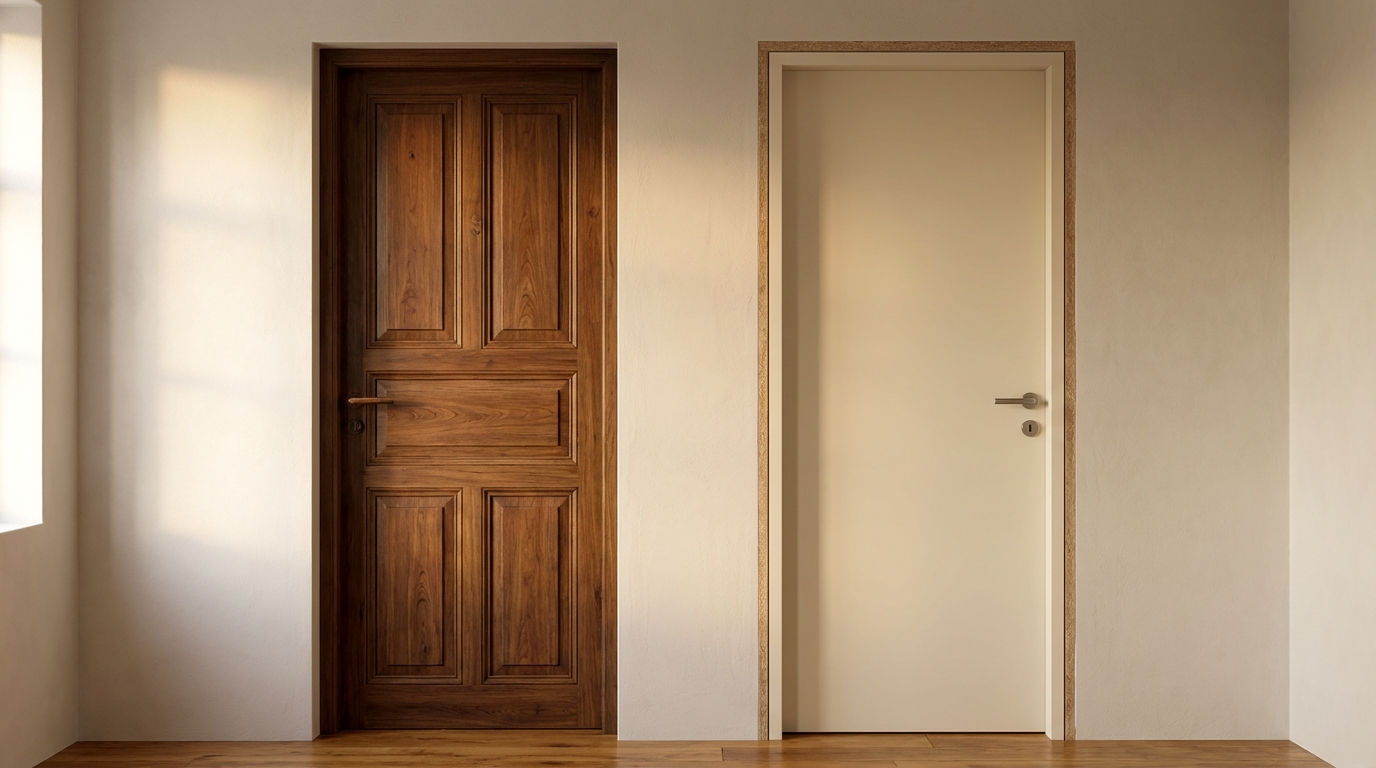
A flush door gets its name from the fact that its surface remains "flush" or level with the door frame when closed, creating a seamless, contemporary appearance. Unlike traditional wooden doors that feature panels, rails, and stiles with visible joints, flush doors present an unbroken flat surface on both faces.
The construction of a flush door follows a sandwich principle. A lightweight internal frame, typically made from softwood battens or hardwood strips, forms the skeleton. This frame includes vertical members called stiles on both edges, horizontal members called rails at the top and bottom, and intermediate supports depending on the core type. The space within this frame is then filled with the core material, which determines the door's weight, strength, and acoustic properties.
Once the core is in place, face panels—usually commercial plywood, MDF, or hardboard—are glued to both sides under high pressure. The resulting door slab can then receive various surface finishes including decorative laminates, natural wood veneers, PU paint, or textured membrane skins.
Why Flush Doors Dominate Indian Interiors
The popularity of flush doors in India stems from practical considerations that resonate with the Indian market. First, they cost substantially less than solid wood panel doors while delivering comparable functionality. Second, their smooth surfaces resist dust accumulation—a significant advantage in India's dusty urban environments. Third, they adapt well to modern modular kitchen and wardrobe systems that rely on uniform door profiles. Finally, they can be manufactured in standard sizes at scale, making them readily available through dealer networks across metros and smaller cities alike.
In practical Indian terms, flush doors represent the sensible middle ground between expensive solid wood doors and flimsy alternatives. They accommodate the country's growing preference for contemporary interiors while remaining accessible to middle-class budgets.
Types of Flush Doors: Understanding Your Options
Flush doors are categorized primarily by their core construction, which directly impacts their weight, durability, sound insulation, and price. Understanding these categories helps buyers match the door type to specific applications within their homes or commercial projects.
Solid Core Flush Doors
Solid core flush doors contain a dense, continuous core typically made from particleboard, MDF, or laminated timber blocks. This core fills the entire door slab, leaving minimal voids. The result is a heavy door—typically weighing 25 to 40 kg depending on size—that offers excellent sound insulation and durability. Solid core doors resist impact well and maintain dimensional stability better than lighter alternatives.
These doors are preferred for main entrances, bedroom doors in premium projects, and any location where noise reduction matters. Their weight, however, demands sturdy hinges and frames, adding to installation costs.
Hollow Core Flush Doors
Hollow core doors feature a frame with minimal internal support—often just a honeycomb cardboard structure or widely spaced timber battens—leaving the interior largely empty. This makes them extremely lightweight, typically under 15 kg, and significantly cheaper than solid core alternatives.
The trade-off is reduced durability and poor sound insulation. Hollow core doors dent easily, offer minimal acoustic privacy, and may not withstand heavy use over time. They're best suited for cupboard doors, storage room entrances, or temporary structures where cost matters more than longevity.
Cellular Core Flush Doors
Cellular core doors occupy the middle ground. Their cores consist of timber battens or blockboard strips arranged in a grid pattern with controlled void spaces not exceeding 25 cm. This provides better strength than hollow core while remaining lighter than solid core.
For most Indian residential applications—interior bedroom doors, bathroom entrances, and general room partitions—cellular core flush doors offer the best balance of cost, weight, and performance. They handle normal household use well without requiring the heavy hardware that solid core doors demand.
Comparison Table: Flush Door Types
| Feature | Solid Core | Cellular Core | Hollow Core |
|---|---|---|---|
| Weight (standard size) | 25–40 kg | 18–25 kg | 8–15 kg |
| Sound Insulation | Excellent | Moderate | Poor |
| Impact Resistance | High | Medium | Low |
| Price Range (per piece) | ₹5,000–₹12,000 | ₹2,500–₹6,000 | ₹1,800–₹3,500 |
| Typical Lifespan | 15–25 years | 10–15 years | 5–8 years |
| Best For | Main doors, premium bedrooms | Interior rooms, bathrooms | Cupboards, storage |
| Hardware Requirement | Heavy-duty hinges | Standard hinges | Light hinges |
| Moisture Resistance | Good (with BWP treatment) | Moderate | Poor |
Flush Doors vs Wooden Panel Doors: Which Should You Choose?
The debate between flush doors and traditional wooden panel doors extends beyond aesthetics to practical considerations that affect daily living, maintenance burden, and long-term value. Both have legitimate roles in Indian homes, and understanding where each excels helps make informed decisions.
Aesthetic Differences
Wooden panel doors carry inherent visual appeal through their carved designs, raised panels, and visible grain patterns. They suit traditional, heritage, or classic interior themes and can become statement pieces in a home's design. Flush doors, conversely, project minimalist modernity. Their clean lines complement contemporary interiors, modular furniture, and sleek architectural styles increasingly popular in urban Indian homes.
Maintenance Reality
This is where flush doors demonstrate clear practical advantage. Wooden panel doors with their grooves, carvings, and intricate joints become dust collectors. In Indian conditions—especially in cities with high pollution—keeping panel doors clean requires regular, time-consuming effort. Flush doors simply need a wipe with a damp cloth.
Additionally, wooden doors demand periodic refinishing. The carvings need careful attention during repainting or polishing. Flush doors accept fresh coats of paint or new laminate overlays with minimal preparation.
Cost Comparison
Quality wooden panel doors from reputable manufacturers typically cost ₹9,000 to ₹25,000 or more per piece depending on wood species and carving complexity. Equivalent-quality flush doors range from ₹3,000 to ₹10,000. For a typical 3BHK home requiring 8-10 interior doors, this difference translates to savings of ₹50,000 to ₹1,50,000—a significant budget factor.
| Parameter | Flush Doors | Wooden Panel Doors |
|---|---|---|
| Initial Cost | Lower (₹2,500–₹10,000) | Higher (₹9,000–₹25,000) |
| Aesthetic Appeal | Modern, minimalist | Traditional, ornate |
| Maintenance Effort | Minimal | Regular cleaning required |
| Dust Accumulation | Low | High in grooves |
| Refinishing Ease | Simple | Complex and costly |
| Best Interior Style | Contemporary, modular | Classic, traditional |
How to Choose the Right Flush Door for Your Home
Selecting flush doors involves more than picking a finish that matches your walls. The decision impacts functionality, durability, and long-term satisfaction. A systematic approach prevents common buying mistakes.
Assess the Application First
Before visiting dealers, categorize your door requirements by location and use intensity. Main entrance doors need solid core construction with waterproof treatment. Bedroom doors typically work well with cellular core. Bathroom doors in humid areas demand moisture-resistant cores and waterproof adhesives. Cupboard and storage doors can use economical hollow core options.
Buyer Checklist
- Verify the core type—ask dealers explicitly and check product documentation
- For bathrooms and kitchens, confirm BWP (Boiling Water Proof) or BWR (Boiling Water Resistant) grade adhesive
- Check face panel thickness—minimum 3mm plywood for durability
- Inspect edges for proper sealing or lip-ping to prevent moisture ingress
- Ensure standard thickness compatibility with available hardware (typically 30mm, 32mm, or 35mm)
- Request warranty documentation—reputable brands offer 5-10 year coverage
- Verify ISI marking where applicable (IS 2202 covers flush door specifications)
When NOT to Choose Flush Doors
Despite their versatility, flush doors aren't always the optimal choice. For homes seeking to preserve heritage character or match existing traditional woodwork, panel doors maintain aesthetic continuity. External doors facing direct rain and sun exposure require specialized treatment that solid wood handles better. Security doors for main entrances may need metal reinforcement that panel door construction accommodates more naturally. Finally, if your interior design theme emphasizes classical Indian aesthetics, forcing modern flush doors into that setting creates visual discord.
Common Mistakes to Avoid When Buying Flush Doors
The flush door market in India includes products across a wide quality spectrum. Without careful evaluation, buyers frequently end up with substandard doors that fail prematurely. Learning from common mistakes saves money and frustration.
Ignoring Core Construction
The biggest mistake is buying based solely on surface appearance. Two doors may look identical with the same laminate finish, yet one lasts a decade while the other warps within two years. The difference lies in core quality. Always inquire about core construction, and if the dealer cannot specify, consider it a warning sign.
Using Indoor Doors in Wet Areas
Standard commercial-grade flush doors use MR (Moisture Resistant) adhesive suitable for indoor dry areas. Installing these in bathrooms or kitchens exposed to steam and splashing water leads to delamination and swelling. Wet areas demand BWP-grade doors, which cost more but prevent costly replacements.
Overlooking Edge Protection
Flush door edges are vulnerable points where moisture enters the core. Quality doors feature hardwood lipping or proper edge banding. Budget products often leave exposed edges or use inadequate sealing. In India's humid climate, especially in coastal cities, poor edge protection guarantees premature failure.
Mismatched Hardware
Door thickness varies between manufacturers—some produce 30mm doors, others 32mm or 35mm. Buying locks, handles, and hinges without confirming door thickness leads to installation problems. Carpenters may force ill-fitting hardware, damaging the door's structural integrity.
Quick Inspection Checks
- Knock test: Hollow sounds across the surface indicate void areas in supposedly solid core doors
- Edge inspection: Look for gaps, unsealed areas, or visible core material at edges
- Flatness check: Sight along the door surface—any warping or bowing indicates manufacturing defects
- Weight test: Suspiciously light "solid core" doors may be hollow core mislabeled
- Face panel bond: Press firmly at various points—crackling sounds suggest poor adhesive bonding
Price Guide: Flush Door Costs in India
Flush door pricing in India varies substantially based on core type, face finish, brand reputation, and regional factors. Understanding price drivers helps set realistic budgets and identify fair deals versus overpriced products.
Price Ranges by Type and Finish
| Door Type | Economy Range | Mid-Range | Premium Range |
|---|---|---|---|
| Hollow Core (plain) | ₹1,800–₹2,500 | ₹2,500–₹3,000 | ₹3,000–₹3,500 |
| Cellular Core (plain) | ₹2,500–₹3,500 | ₹3,500–₹5,000 | ₹5,000–₹6,500 |
| Solid Core (plain) | ₹5,000–₹6,500 | ₹6,500–₹9,000 | ₹9,000–₹12,000 |
| Laminate Finish (add) | +₹500–₹800 | +₹800–₹1,500 | +₹1,500–₹3,000 |
| Veneer Finish (add) | +₹1,000–₹2,000 | +₹2,000–₹4,000 | +₹4,000–₹8,000 |
Prices based on standard 7' x 3' (2134mm x 914mm) door size in metro city dealer rates. Tier-2 and Tier-3 cities may see 10-15% lower prices. All prices exclude GST and installation.
What Drives Price Variation
Several factors explain the wide price range within each category:
Brand reputation: Established manufacturers like Greenply, Century, and regional leaders command premium pricing backed by quality consistency and warranty support. Unbranded or local production costs less but carries quality risks.
Face panel quality: Doors using calibrated commercial plywood faces cost more than those using thin hardboard. The face panel directly impacts durability and finish acceptance.
Core material grade: Within solid core category, particleboard cores cost less than block board or laminated timber cores. The latter offers superior screw-holding and dimensional stability.
Finish complexity: Plain doors ready for painting cost least. Factory-applied laminates add moderate cost. Premium natural wood veneers, especially teak or walnut, significantly increase prices.
Regional logistics: Transport costs from manufacturing hubs in Gujarat, Kerala, and Karnataka impact prices in distant markets. Local manufacturing presence reduces costs in those regions.
Installation and Maintenance: Ensuring Long-Term Performance
Even high-quality flush doors can fail prematurely with improper installation or neglected maintenance. Understanding the basics helps homeowners supervise carpenters effectively and maintain doors properly.
Installation Best Practices
Flush doors require flat, plumb door frames. Unlike panel doors that can mask minor frame irregularities, flush doors expose any misalignment through uneven gaps. Professional installation begins with frame verification using levels and squares.
Hinge placement matters significantly. Three hinges distribute weight better than two, especially for heavy solid core doors. Hinges should mount at consistent distances from top and bottom edges—typically 150mm—with the middle hinge equidistant. This prevents sagging over time.
Door clearance needs careful calibration. Indian standards suggest 6-8mm gap at sides and top, with 10-12mm at the bottom for airflow. Excessive clearance compromises privacy and acoustics; insufficient clearance causes binding as humidity fluctuates seasonally.
Maintenance Guidelines
Regular cleaning extends flush door life dramatically. Weekly wiping with a soft dry cloth removes dust before it embeds in the finish. Monthly cleaning with a damp cloth and mild soap addresses accumulated grime. Avoid abrasive cleaners or excessive water, especially near edges and bottom rails.
Inspect hinges annually and tighten screws as needed. Loose hinges stress door edges, leading to cracking. Apply light oil to hinges if squeaking develops.
In humid regions—particularly coastal Karnataka, Kerala, and West Bengal—check door edges quarterly for signs of swelling or delamination. Early detection allows localized repair before damage spreads.
Frequently Asked Questions
What is the full form of flush door?
Flush door doesn't have an abbreviated full form—"flush" describes the door's defining characteristic: its surface sits flush (level) with the surrounding frame when closed. The term originates from woodworking terminology where "flush" means two surfaces meeting evenly without projection. Unlike panel doors with raised or recessed sections, flush doors present a completely flat, uninterrupted surface on both faces, creating the seamless appearance that defines this door category.
Which is better: flush door or wooden door?
The choice depends on your priorities. Flush doors excel in modern interiors, require minimal maintenance, and cost significantly less—making them practical for most Indian homes. Wooden panel doors suit traditional aesthetics, heritage homes, and situations where ornate design matters more than convenience. For typical residential use across bedrooms, bathrooms, and internal passages, flush doors offer better value. Reserve wooden panel doors for statement areas like main entrances or formal living spaces where their visual impact justifies the higher cost and maintenance.
Are flush doors good for bathrooms?
Flush doors work well for bathrooms when you choose the correct specification. Standard MR-grade flush doors will fail in bathroom environments due to moisture exposure. For bathrooms, specifically select BWP (Boiling Water Proof) or BWR (Boiling Water Resistant) rated flush doors with properly sealed edges. Additionally, maintain adequate ventilation to prevent prolonged humidity exposure. With correct material selection and installation, flush doors provide years of reliable bathroom service while offering easy cleaning advantages over panel doors with moisture-trapping grooves.
What is the price of flush door in India?
Flush door prices in India range from approximately ₹1,800 to ₹12,000 per piece for standard residential sizes. Hollow core doors start around ₹1,800-₹3,500, cellular core doors range from ₹2,500-₹6,500, and solid core doors cost ₹5,000-₹12,000. These base prices increase with premium finishes—laminate adds ₹500-₹3,000, while quality veneer finishes add ₹1,000-₹8,000. Prices vary by brand, city, and dealer margins. Budget approximately ₹3,000-₹5,000 per door for good quality cellular core doors with laminate finish for typical home use.
How to check flush door quality before buying?
Start with the knock test—tap across the door surface listening for consistent sound; hollow spots in solid core doors indicate defects. Examine edges closely for gaps, exposed core material, or inadequate sealing. Sight along the door face to detect warping or bowing. Lift the door to assess weight—verify it matches the claimed core type. Check for ISI certification marks (IS 2202 covers flush doors). Request warranty documentation from reputable brands. Finally, inspect face panel bonding by pressing at multiple points—crackling sounds suggest poor adhesive application.
Can flush doors be used as main doors?
Yes, flush doors can serve as main entrance doors with proper specifications. Use solid core construction for strength and security. Select BWP-grade manufacturing to handle weather exposure. Ensure quality hardwood lipping on all edges. Consider adding a protective overhang if the door faces direct rain. For security enhancement, install multi-point locking systems compatible with solid core construction. While wooden panel doors traditionally dominate main entrances for their imposing appearance, quality solid core flush doors with premium veneer or membrane finishes provide a dignified modern alternative at lower cost.
How long do flush doors last in Indian conditions?
Flush door lifespan varies significantly by quality and application. Hollow core doors in moderate-use areas typically last 5-8 years. Cellular core doors from reputable manufacturers serve 10-15 years under normal residential use. Quality solid core flush doors can exceed 15-20 years with proper maintenance. These estimates assume appropriate door selection—using BWP grades in wet areas, protecting doors from direct weather exposure, and maintaining proper ventilation. In coastal humid regions, expect 20-30% shorter lifespans unless specifically treating for moisture resistance.
What is the difference between plywood door and flush door?
This comparison involves overlapping categories. Flush doors use plywood as face panels, so plywood is a component of most flush doors. The distinction typically refers to flush doors versus doors made entirely from thick plywood sheets without internal frame construction. Pure plywood doors (made from 18-25mm thick plywood) offer excellent strength but cost more and weigh significantly more than equivalent flush doors. Standard flush doors with plywood faces over lightweight cores provide similar appearance and adequate strength for most applications at lower cost and weight.
Disclaimer: This content is provided for general informational purposes based on industry practices and publicly available information. Product specifications, standards, prices, and availability may vary by manufacturer, region, and time. Readers should independently verify details with manufacturers, dealers, or qualified professionals before making purchase or construction decisions.Want Plywood Suggestions?
Share a few details and a Apple Ply specialist will suggest suitable brands and connect you to responsive dealers.