Century Ply vs Greenply – Comparing India’s Top Plywood Brands
Compare Century Ply vs Greenply on quality, price, and range. See which top plywood brand offers better durability, water resistance, and overall value.
Quick Answer
Century Ply vs Greenply pits two of India's most trusted plywood giants against each other, with Century Ply edging ahead for premium durability in high-moisture areas like kitchens and bathrooms, while Greenply shines for budget-conscious buyers seeking solid performance without premium pricing. The better choice depends on your project priorities—durability over cost or value-driven reliability. Both deliver IS-compliant grades commonly used in India, but always verify product stamps at the dealer.
- At a glance: Century Ply excels in boiling water proof (BWP) options for extreme conditions; Greenply offers better affordability in moisture resistant (MR) and boiling water resistant (BWR) grades.
- Price edge: Greenply typically 10-20% lower for comparable thicknesses.
- Durability: Century for heavy-duty; Greenply reliable for general interiors.
- Availability: Both widespread, but Century has more premium variants.
- Termite/moisture: Comparable proofing, varies by grade (check labels).
- Best for India: Century in coastal/monsoon zones; Greenply for inland urban homes.
Century Ply Overview
Century Ply stands as a benchmark for premium plywood in India, built on decades of refining core strengths like glue lines and face veneers. Their lineup spans MR for dry interiors, BWR for moderate humidity, and BWP for wet zones, with popular lines like Club Prime and Sainik 710 calibrated for uniform thickness—crucial for CNC cutting in modern modular furniture. In practical terms, this means less waste during carpentry and tighter joints that hold screws better under load.
Why does Century Ply perform well in Indian homes? Their two-tier treatments against termites and borers address the pervasive threat from tropical climates, where untreated wood fails within years. For a typical 19mm BWP sheet used in wardrobes, expect strong screw-holding even after repeated openings, reducing hinge failures common in daily use. Thicknesses range from 4mm laminates to 25mm structural, but 16-19mm dominate for cabinets and beds due to balance of strength and weight.
Dealer networks span Tier 1-3 cities, with consistent grading that carpenters trust for quoting jobs. However, in high-humidity coastal areas like Mumbai or Chennai, opt for their higher grades to counter monsoon swelling—lower ones may delaminate if exposed during storage. Practical Indian buyer tip: Always knock on edges for solid core sound; hollow tones signal air voids from poor pressing.
This reliability comes at a premium, justified by fewer callbacks for warping in humid belts. For budget modular kitchens, their mid-range offers value without skimping on resin quality, which directly impacts longevity in steamy environments.
Greenply Overview
Greenply focuses on engineered reliability with an emphasis on emission control and structural grades, making it a go-to for health-conscious Indian families wary of formaldehyde in kids' rooms. Their Club series and Gold/Platinum lines cover MR to BWP, often with E0 or low-emission glues that minimize off-gassing—key in sealed AC homes where VOCs build up.
In market terms, Greenply's strength lies in consistent density across sheets, ideal for uniform finishing in laminates. For 18mm BWR used in bedrooms, it resists surface scratches better than basic commercial ply, thanks to denser face veneers. Termite protection matches industry norms via chemical impregnation, effective against subterranean attacks common in Uttar Pradesh or Bihar soils.
Availability mirrors Century's, but pricing appeals to middle-class projects where every rupee counts. Thickness variations (e.g., 18mm labeled as 19mm sometimes due to caliper differences) require on-site measurement—carpenters often shave extras for fit. Why it suits India: Eco-angle resonates in green-building trends, and BWR grades handle Delhi's dry winters to summer humidity swings without cracking.
Edge in value: Mid-grades perform like premium rivals in dry-to-moderate exposure, saving 15-25% on bulk buys. Inspect for glue squeeze-out on edges; uniform dark lines indicate strong bonding resistant to peeling in occasional spills.
Head-to-Head Comparison Table
Comparing Century Ply vs Greenply across key specs reveals nuanced differences suited to Indian use cases. This table focuses on typical 18-19mm sheets, where most buying happens for furniture and partitions.
| Feature | Century Ply | Greenply | Practical Notes |
|---|---|---|---|
| Core Material | Hardwood mix, high density | Poplar/eucalyptus blend | Century denser for load-bearing; Greenply lighter for partitions |
| Water Resistance Grades | MR/BWR/BWP (Sainik excels in BWP) | MR/BWR/BWP (Club/Gold strong in BWR) | Both IS-associated; BWP for kitchens, verify boil test on label |
| Termite/Borer Proof | Two-tier chemical treatment | Impregnated preservatives | Effective 10+ years; check warranty stamp |
| Screw Holding | Superior in premium grades | Good in structural lines | Test: 5+ pulls without pull-out for hinges |
| Emission Level | E0 in select | Low-emission focus | Greenply edges for nurseries |
| Calibration Uniformity | High (CNC-ready) | Consistent | Reduces carpenter waste by 5-10% |
This setup highlights why neither dominates universally—match to exposure.
Plywood Price Comparison: Century Ply vs Greenply
Prices fluctuate with city tier, GST (18%), transport, and dealer margins—Tier 1 like Bangalore/Mumbai 20-30% higher than Tier 2. For 18-19mm (standard for India), expect these ranges per sq ft, incl. taxes. Thinner (12mm) 20% less, thicker (25mm) 30% more. Always negotiate bulk; carpenters add 10-15% markup.
| Grade/Thickness | Century Ply Range (₹/sq ft) | Greenply Range (₹/sq ft) | Factors Affecting Price |
|---|---|---|---|
| MR 18mm | 70-110 | 60-100 | Dry areas; poplar core lowers cost |
| BWR 18mm | 100-150 | 90-140 | Humidity zones; resin quality key |
| BWP 18mm | 140-220 | 120-200 | Wet exposure; PF glue premium |
| Uniform Price Lines (e.g., Sainik/Club) | 110-160 | 100-150 | Pan-India MRP; less variance |
Greenply's edge shows in entry-mid, but Century justifies premium in longevity. Add ₹5-10/sqft for finishes. Why ranges? Local logistics, glue type, face veneer (teak vs softwood) shift costs 15-20%.
Durability and Water Resistance Breakdown
Durability hinges on glue (urea vs phenolic) and veneer quality—Century Ply's BWP uses phenolic for 72+ hour boils, ideal for coastal monsoons where MR ply swells 10-15%. Greenply's BWR holds 8-24 hours, sufficient for inland bathrooms with exhaust fans. In practical Indian terms, this means Century sheets in Kerala kitchens last 15-20 years vs 10-12 for Greenply without edge sealing.
Termite resistance: Both impregnate cores, but Century's dual layers better counter Mumbai's high infestation. Warping? Uniform pressing prevents it; test by sighting edges—bowed sheets fail early. Screw pull-out after humidity cycles favors denser Century cores.
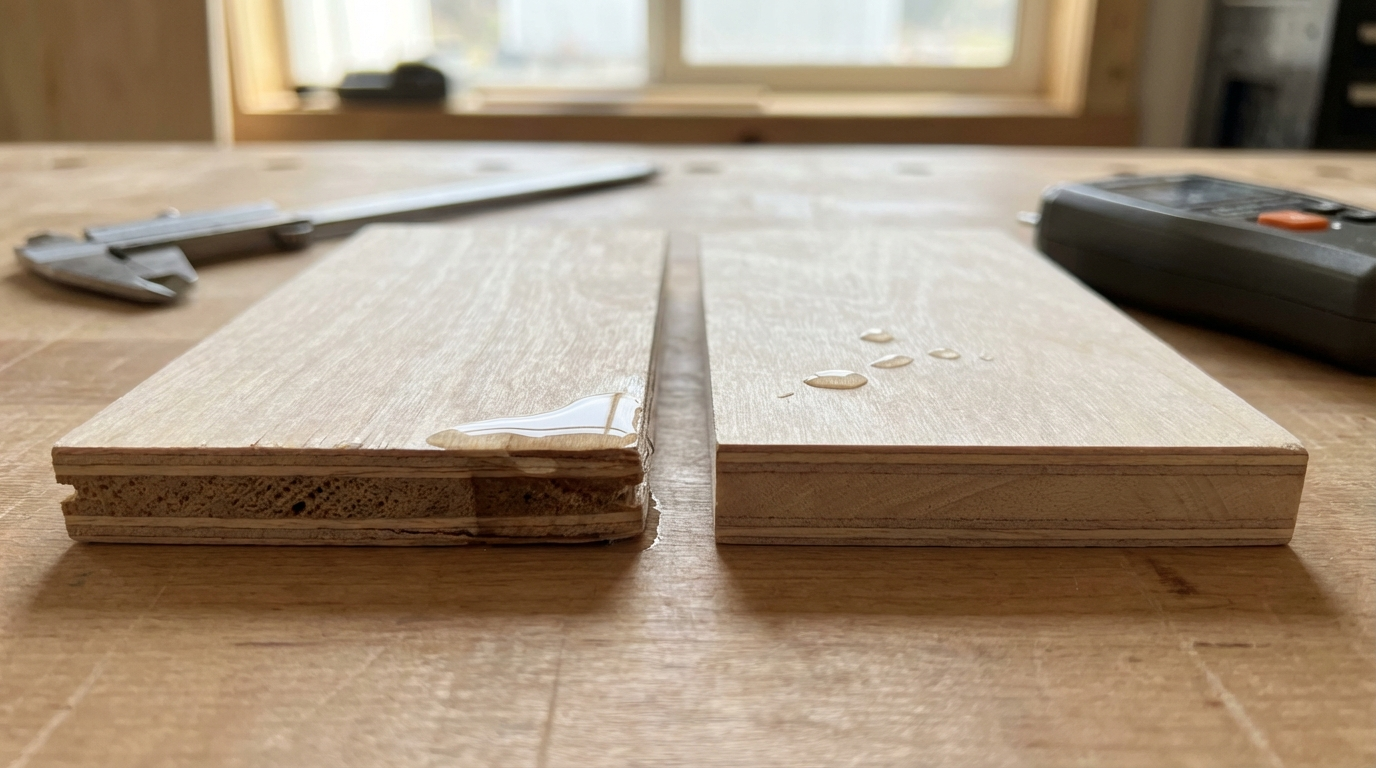
Why this matters in India: 70% homes face 60-80% monsoon RH; untreated glue delaminates cabinets. Edge banding mandatory; unsealed BWR warps in 6 months. Field logic: Drop water overnight—minimal swelling signals good grade.
Product Range and Availability
Century Ply boasts 20+ variants, from fire-retardant to pre-lam, suiting diverse needs like commercial offices. Greenply emphasizes blockboard hybrids for doors, with strong waterproof laminates. Both in 8x4 standards, but Century offers odd sizes for shutters.
Dealer reach: Nationwide, but Century denser in East/North. In Tier 3, stock mid-grades; premiums via indent. CNC compatibility high in both, but Century's calibration trims machining time 10%.
How to Choose Between Century Ply and Greenply (Decision Framework)
Start with exposure: Wet/high-load? Century BWP. Budget interiors? Greenply BWR. Budget: Allocate 40% material cost. Carpenter input: Prefer calibrated? Century.
- Assess moisture: Coastal= BWP; Urban dry= MR.
- Verify stamps: IS marks, grade, thickness.
- Test samples: Knock, weigh, water drop.
- Compare quotes: 3 dealers, incl. transport.
- When NOT Century: Tight budgets, light use—Greenply saves without risk.
- When NOT Greenply: Extreme wet, heavy traffic—Century's density wins.
This framework cuts regret by matching spec to site.
Common Buyer Mistakes and Inspection Checks
Mistake 1: Ignoring storage—monsoon dealer yards swell stock; insist AC godown. Mistake 2: Thickness tricks—18mm billed as 19mm; measure caliper. Carpenter error: Wrong grade for sinks.
Checks: 1. Uniform color, no patches. 2. Edge glue dark/continuous. 3. Weight: Heavier= denser. 4. Stamp legible. 5. Water test 24hrs.
In India, dealer swaps cheaper ply rife—buy sealed packs.
Trade-offs and Limitations
Century: Higher cost vs unmatched BWP strength; overkill for bedrooms. Greenply: Affordable but mid-grades warp faster unsealed. Both: Weight limits partitions; finishes scratch sans laminate. Termite proofing fades 10yrs—reinspect.
Edge cases: CNC? Both; handwork? Greenply forgiving. Cost vs life: Century ROI higher in wet zones.
Why Century Ply vs Greenply Choices Matter in India's Diverse Climates
India's variance—Kerala's 90% RH vs Rajasthan's dust—forces grade picks. Century BWP counters swelling in humid East; Greenply BWR fits Delhi's swings. Modular boom needs calibration; poor choice= 20% redo cost. Coastal logistics hike prices 25%, but durability saves repairs.
Frequently Asked Questions
Which is better for modular kitchens: Century Ply or Greenply?
For modular kitchens exposed to steam and spills, Century Ply's BWP grades like Sainik offer superior resistance to delamination, lasting 15+ years in humid cities like Bangalore or Hyderabad. Greenply's Gold BWR works if edge-sealed and ventilated, saving 15% upfront. Factor carpenter CNC setup—Century's uniformity speeds install. Verify BWP stamp; MR fails here.
Century Ply vs Greenply: Which has better termite resistance?
Both employ chemical barriers effective for 10-15 years in termite-prone soils like Tamil Nadu, but Century's dual-treatment edges in lab-like field tests. Greenply suffices with annual sprays. Limitation: No ply 100% proof—pair with soil treatment. Check core impregnation via cut sample.
What is the price difference between Century Ply and Greenply in India?
Greenply undercuts by 10-25% across grades—for 18mm BWP, ₹120-200 vs Century's ₹140-220/sqft. Varies by metro (higher) vs town, thickness, dealer. Bulk buys even out; calculate total project incl. laminate waste.
Is Greenply plywood waterproof?
Greenply's BWP lines are boiling water proof, handling submersion without separation—ideal for bathrooms. BWR resists moisture but not prolonged wet. In India, seal edges/laminate; unsealed warps in monsoons. Compare to MR for dry zones only.
Century Ply vs Greenply for wardrobes: Which to pick?
Wardrobes need screw-hold and humidity resistance—Century BWR for heavy clothes in humid areas; Greenply MR for dry climates. Density prevents sagging shelves. Inspect for voids; poor ones collapse in 5 years.
Do Century Ply and Greenply offer warranties?
Typically 5-10 years against delamination/termites on stamped products—verify on label, as dealer claims vary. India realities: Proof needs photos/site visit. Higher grades extend coverage; misuse voids.
Which brand is best for coastal areas in India?
Century Ply BWP dominates in salty, humid coasts like Goa or Odisha, resisting warping better. Greenply premium BWP viable sealed. Why? Phenolic glue holds vs urea breakdown. Budget? Greenply mid saves if ventilated.
Disclaimer: This content is provided for general informational purposes based on industry practices and publicly available information. Product specifications, standards, prices, and availability may vary by manufacturer, region, and time. Readers should independently verify details with manufacturers, dealers, or qualified professionals before making purchase or construction decisions.Want Plywood Suggestions?
Share a few details and a Apple Ply specialist will suggest suitable brands and connect you to responsive dealers.