BWP vs BWR Plywood: Understanding the Key Differences
Understand the difference between BWP and BWR plywood. Compare boiling water proof vs boiling water resistant grades for your next project.
Quick Answer
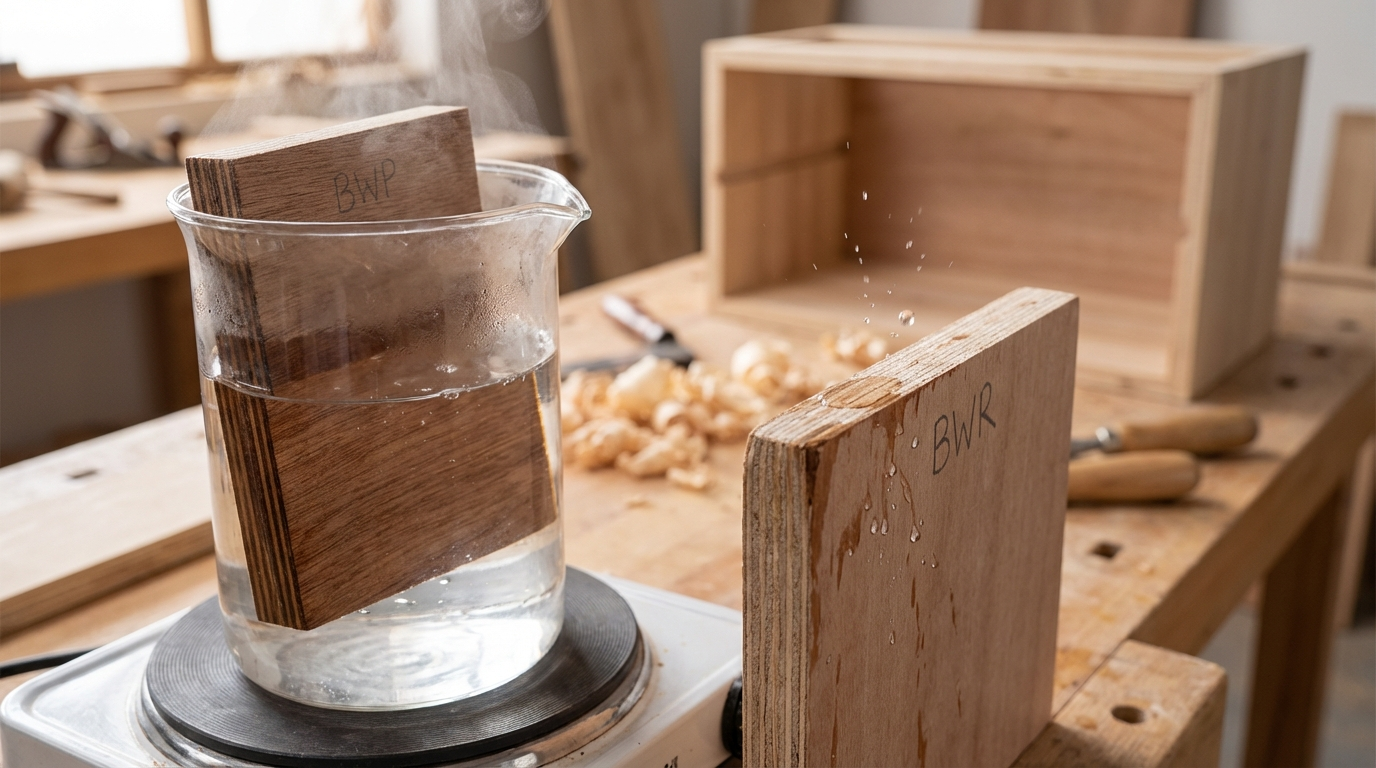
The key difference between BWP and BWR plywood lies in their water resistance levels. BWP (Boiling Water Proof) plywood offers complete waterproofing and can withstand continuous water exposure, conforming to IS:710 standards. BWR (Boiling Water Resistant) plywood provides resistance to moisture and humidity but cannot endure prolonged water contact, conforming to IS:303 standards. For bathrooms and kitchens with direct water exposure, BWP is essential; for general humid areas, BWR often suffices.
At a Glance: BWP vs BWR Plywood
- BWP Full Form: Boiling Water Proof — designed for continuous water exposure environments
- BWR Full Form: Boiling Water Resistant — suitable for occasional moisture and high humidity
- IS Standards: BWP follows IS:710, BWR follows IS:303
- Price Difference: BWP costs approximately 15-25% more than BWR grade
- Best Use: BWP for bathrooms, under-sink storage, outdoor furniture; BWR for kitchen cabinets, modular kitchens, semi-outdoor areas
- Resin Used: Both use phenol-formaldehyde resin, but BWP uses higher-grade formulations with superior bonding
BWP and BWR Plywood Explained: What Do These Grades Actually Mean?
In the Indian plywood market, waterproof grades often create confusion among buyers, carpenters, and even some dealers. Understanding what BWP and BWR grades truly signify requires looking beyond marketing terminology to the actual manufacturing specifications and testing standards these products must meet.
Understanding BWR Grade Plywood
BWR plywood, or Boiling Water Resistant plywood, is manufactured using synthetic phenol-formaldehyde resin that provides substantial resistance to moisture and humidity. The manufacturing process involves bonding multiple hardwood veneers under controlled heat and pressure, creating a panel that can handle humid conditions and occasional water splashes without immediate degradation.
The IS:303 standard governs BWR plywood production in India. To earn this certification, plywood samples must pass specific tests including resistance to boiling water for limited periods—typically around 8 hours—without showing signs of delamination. This makes BWR suitable for areas where humidity is constant but direct, prolonged water contact is uncommon. Think of modular kitchen cabinets where steam exposure is regular but direct water soaking is rare.
In practical Indian market terms, BWR grade represents the workhorse option for most residential furniture applications. It handles monsoon humidity well in coastal cities like Mumbai and Chennai, manages kitchen steam exposure adequately, and offers a reasonable balance between performance and cost.
Understanding BWP Grade Plywood
BWP plywood, or Boiling Water Proof plywood, represents the premium waterproofing tier in the Indian market. Manufactured with higher-grade phenol-formaldehyde resin formulations and superior hardwood veneers, BWP plywood undergoes more rigorous bonding processes that create panels capable of withstanding complete water immersion for extended periods.
The IS:710 standard defines BWP plywood specifications in India. This certification requires panels to survive boiling water tests for significantly longer durations—often 72 hours—without delamination or structural compromise. This extreme testing ensures the plywood can handle real-world scenarios like bathroom installations, outdoor furniture exposed to rain, and marine applications.
BWP plywood's manufacturing typically involves calibrated thickness control, resulting in more consistent panel dimensions. This becomes particularly important for CNC-machined modular furniture where precision matters. The superior bonding also provides better screw-holding capacity, making it more suitable for heavy-duty applications where fastener strength is critical.
Key Differences Between BWP and BWR Plywood
While both grades use phenol-formaldehyde resin and appear similar visually, several technical and practical differences distinguish BWP from BWR plywood. Understanding these distinctions helps buyers make informed decisions based on their specific application requirements rather than price alone.
Manufacturing and Bonding Differences
The resin concentration and bonding pressure differ significantly between these grades. BWP plywood uses undiluted or high-concentration phenolic resins that penetrate deeper into the wood fibres, creating molecular-level bonds that resist water infiltration. BWR plywood uses effective but comparatively diluted formulations that provide surface-level water resistance without the same depth of penetration.
Heat treatment during manufacturing also varies. BWP grades typically undergo longer curing cycles at higher temperatures, which polymerizes the resin more completely and creates stronger cross-linked bonds between veneers. This additional processing contributes to BWP's higher price point but also explains its superior longevity in wet environments.
Testing Standards and Certification
The IS:303 standard for BWR plywood requires resistance to boiling water for 8 hours without delamination. The IS:710 standard for BWP plywood demands survival in boiling water for 72 hours—nine times longer. This dramatic difference in testing requirements reflects the intended use cases for each grade.
When purchasing plywood in Indian markets, always verify the IS certification stamped on panels. Many dealers interchange these terms casually, and without physical verification of the stamp, buyers may receive BWR plywood marketed as BWP. Branded manufacturers typically stamp "IS:710" or "IS:303" along with the manufacturing date on each panel.
Weight and Density Variations
BWP plywood generally weighs more than equivalent-thickness BWR panels. This weight difference stems from the higher resin content and denser veneer selection used in BWP manufacturing. While the additional weight might seem negligible for individual panels, it becomes noticeable in large furniture installations and affects transportation costs—a practical consideration for buyers in Tier-2 and Tier-3 cities where transport from metro distribution centres adds to final costs.
BWP vs BWR Plywood Comparison Table
| Parameter | BWR Plywood | BWP Plywood | Practical Implication |
|---|---|---|---|
| Full Form | Boiling Water Resistant | Boiling Water Proof | BWP offers complete waterproofing, not just resistance |
| IS Standard | IS:303 | IS:710 | Check stamp on panel to verify grade authenticity |
| Boiling Water Test | 8 hours without delamination | 72 hours without delamination | BWP survives 9x longer in extreme water exposure |
| Water Resistance Level | Resists humidity and occasional splashes | Withstands continuous water immersion | Choose based on actual water exposure in application |
| Price Range (18mm, Metro) | ₹85–₹120 per sq ft | ₹110–₹150 per sq ft | BWP costs 15–25% more depending on brand tier |
| Primary Applications | Kitchen cabinets, wardrobes, modular furniture | Bathrooms, under-sink storage, outdoor, marine | Match grade to actual use environment |
| Termite Resistance | Available with treatment | Available with treatment | Both require additional treatment; not inherent |
| Typical Warranty | 5–7 years (brand-dependent) | 10–15 years (brand-dependent) | BWP manufacturers offer longer coverage |
How to Choose Between BWP and BWR Plywood
Selecting the appropriate waterproof grade requires honest assessment of your application environment rather than defaulting to the highest grade available. In many Indian homes, BWR plywood provides adequate performance at significantly lower cost, while specific areas genuinely demand BWP-grade protection.
Decision Framework: When to Choose BWR
BWR plywood makes practical sense for areas with high humidity but limited direct water contact. This includes most modular kitchen cabinetry where steam exposure is common but direct water soaking is rare. Wardrobes in coastal cities, TV units in humid environments, and office furniture in non-air-conditioned spaces all fall within BWR's capability range.
The cost savings from choosing BWR over BWP—typically ₹20–₹35 per square foot in metro markets—add up significantly across full-home furniture installations. For a typical 2BHK modular interior using approximately 400–500 square feet of plywood, this difference translates to ₹8,000–₹17,500 in material costs alone.
Decision Framework: When to Choose BWP
BWP becomes essential when furniture will face direct, repeated water contact. Bathroom vanities, under-sink cabinets, washing machine units, outdoor garden furniture, and any application in flood-prone ground-floor areas should use BWP grade without compromise. The premium paid upfront prevents expensive replacements within 3–5 years.
Coastal areas with salt-laden air, homes near water bodies, and properties in regions experiencing extended monsoons also benefit from BWP's superior protection. The combination of humidity, salt corrosion, and seasonal flooding creates conditions that quickly degrade BWR plywood.
Buyer Checklist: Making the Right Choice
- Assess actual water exposure: humidity alone favours BWR; direct water contact demands BWP
- Consider location: ground-floor installations in flood-prone areas need BWP regardless of room type
- Evaluate regional climate: extended monsoon regions benefit from BWP's additional protection
- Calculate total project cost: BWP savings matter at scale; evaluate full furniture requirement
- Verify IS standards on panels: demand physical stamp verification before purchase
- Check brand warranty terms: understand what's covered and claim procedures
- Consider resale value: premium plywood supports better furniture longevity claims
When NOT to Choose BWP
Specifying BWP for every application represents unnecessary expense in most Indian homes. Bedroom wardrobes, living room furniture, study tables, and entertainment units in climate-controlled environments gain no practical benefit from BWP's waterproofing. The premium paid delivers no additional performance where water exposure doesn't exist.
Similarly, false ceiling installations and wall panelling in air-conditioned spaces function perfectly with commercial MR-grade plywood, making even BWR overkill. Match the grade to the genuine environment rather than defaulting to maximum specifications.
Common Mistakes to Avoid When Buying BWP and BWR Plywood
The Indian plywood market's dealer-driven nature creates multiple opportunities for confusion, substitution, and well-intentioned but incorrect recommendations. Avoiding these common pitfalls requires informed verification rather than trust-based purchasing.
Mistake 1: Accepting Grade Claims Without Verification
Many dealers casually use "waterproof plywood" to describe any phenol-bonded panel, blurring the critical distinction between BWR and BWP grades. The only reliable verification involves checking the IS standard stamp directly on plywood panels. Reputable manufacturers mark "IS:710" (BWP) or "IS:303" (BWR) along with batch numbers and manufacturing dates. Absence of clear marking suggests ungraded or non-compliant material.
Mistake 2: Overspending on BWP for Non-Water Areas
Carpenters and interior designers sometimes specify BWP throughout a project to simplify ordering or because they've heard "it's better." While well-intentioned, this approach adds 15–25% to material costs without corresponding benefits in dry areas. Create separate specifications: BWP for wet zones, BWR for humid zones, and commercial grade for climate-controlled spaces.
Mistake 3: Ignoring Thickness Consistency
BWP plywood manufactured by established brands typically offers calibrated thickness—meaning an 18mm panel actually measures 18mm consistently across its surface. Some BWR manufacturers offer uncalibrated panels where "18mm" might measure 17mm to 19mm across different areas. This inconsistency creates problems for CNC-machined modular furniture where precision matters. Verify calibration claims, especially for modular kitchen projects.
Mistake 4: Assuming Waterproof Means Termite-Proof
Neither BWP nor BWR grades inherently resist termite or borer infestation. Waterproofing addresses moisture damage; pest resistance requires separate chemical treatment. When purchasing, confirm that plywood carries both waterproof grade certification and termite-borer treatment verification. In termite-prone regions across India, this dual protection becomes essential.
Mistake 5: Neglecting Edge Sealing
Even BWP plywood absorbs water through exposed edges where end-grain veneer remains unsealed. Professional furniture fabrication includes edge-banding or PU coating on all exposed edges. Buyers often blame plywood failure when the actual cause is improper edge treatment by carpenters. Specify edge-sealing requirements clearly in fabrication instructions.
Quick Inspection Checks at the Dealer
- Tap the panel surface: consistent sound indicates uniform core; hollow spots suggest voids
- Check edge visibility: even veneer layers without gaps indicate quality bonding
- Verify IS stamp: look for clear IS:710 or IS:303 marking with manufacturing details
- Assess weight: genuine BWP feels heavier than same-thickness BWR
- Request test certificates: established brands provide third-party test documentation on request
Price Guide: BWP and BWR Plywood in India
Plywood pricing in India varies significantly based on grade, thickness, brand tier, and geographic location. Understanding the factors driving these variations helps buyers budget accurately and evaluate quotations critically.
Current Price Ranges (2026 Estimates)
| Thickness | BWR Grade (₹/sq ft) | BWP Grade (₹/sq ft) | Premium Brands (₹/sq ft) |
|---|---|---|---|
| 6mm | ₹45–₹60 | ₹60–₹80 | ₹75–₹95 |
| 9mm | ₹60–₹75 | ₹80–₹100 | ₹95–₹120 |
| 12mm | ₹70–₹90 | ₹95–₹125 | ₹115–₹145 |
| 18mm/19mm | ₹85–₹120 | ₹110–₹150 | ₹140–₹185 |
| 25mm | ₹110–₹140 | ₹140–₹180 | ₹170–₹220 |
Note: Prices assume metro city dealers, mid-tier brands, and standard sheet sizes (8×4 feet). Tier-2/Tier-3 cities may see 5–15% higher prices due to transport costs. Premium brands like Greenply, Century, and Kitply command the higher end of ranges.
Factors Affecting Price Variation
Brand Tier: Established national brands with IS certification, third-party testing, and warranty support price 20–40% higher than regional manufacturers. This premium covers quality assurance and after-sales support rather than just branding.
Veneer Quality: Hardwood species used for face and core veneers significantly impact pricing. Gurjan-face plywood costs more than poplar-based alternatives. Premium BWP often uses superior hardwood throughout, contributing to both price and performance.
Geographic Location: Manufacturing concentration in states like Uttar Pradesh, Kerala, and Gujarat means buyers distant from these hubs pay additional transport costs. These costs get embedded in dealer pricing rather than appearing as separate line items.
GST Impact: Plywood attracts 18% GST, which adds substantially to final costs. Ensure quoted prices clearly indicate whether GST is included or additional—this common ambiguity creates budget overruns.
Budget vs Premium: What Makes Sense?
For wet-zone applications (bathrooms, under-sink, outdoor), premium BWP plywood from established brands justifies its cost through longer warranties, consistent quality, and genuine waterproofing. Saving ₹15–₹20 per square foot on bathroom vanity plywood makes little sense when replacement due to early failure costs significantly more.
For general humid-zone applications (kitchen cabinets, modular furniture), mid-tier BWR plywood offers acceptable value. The performance difference between premium and mid-tier BWR in non-submersion environments remains marginal for most practical purposes.
Regional Considerations: BWP vs BWR Across India
India's diverse climate zones create varying demands for waterproof plywood grades. What works perfectly in arid Rajasthan may prove inadequate in coastal Kerala or humid West Bengal. Understanding regional factors helps tailor specifications appropriately.
Coastal and High-Humidity Regions
Cities like Mumbai, Chennai, Kolkata, Kochi, and Goa experience extended monsoon periods, high humidity year-round, and salt-laden air in coastal areas. BWP plywood becomes the default recommendation for any furniture application in these regions, including areas traditionally considered "dry" like bedroom wardrobes. The ambient humidity alone accelerates degradation of lower-grade panels.
Ground-floor apartments and independent homes in flood-prone areas should specify BWP for all furniture regardless of room type. Even brief water exposure during flooding can permanently damage BWR plywood, requiring expensive replacements.
Inland and Semi-Arid Regions
Cities like Delhi, Jaipur, Ahmedabad, and Hyderabad experience lower humidity for most of the year, with seasonal spikes during monsoon. BWR plywood performs adequately for most applications in these regions, with BWP reserved specifically for bathrooms and under-sink installations.
The dry climate in these areas creates different challenges—primarily excessive moisture loss from plywood leading to shrinkage and cracking. Proper acclimatization before installation and maintaining reasonable indoor humidity through coolers or humidifiers becomes more important than waterproof grade selection.
Hill Stations and Cold Regions
Areas like Shimla, Darjeeling, Ooty, and northeastern states experience cold temperatures combined with moisture from fog, rain, and snow. BWP plywood proves essential here not just for water resistance but for its superior bonding that resists temperature-cycling stress. The freeze-thaw cycles common in these regions can delaminate weaker BWR bonding over time.
Frequently Asked Questions
What is the full form of BWP and BWR in plywood?
BWP stands for Boiling Water Proof, indicating plywood that can withstand complete water immersion for extended periods, typically tested under IS:710 standards. BWR stands for Boiling Water Resistant, meaning the plywood resists moisture and humidity but cannot endure prolonged water contact, tested under IS:303 standards. These acronyms specifically describe the level of water protection the plywood offers, not general quality grades. Understanding these full forms helps buyers specify correctly and verify that delivered materials match requirements.
Which is better for kitchen: BWP or BWR plywood?
For most modular kitchen cabinets, BWR plywood provides adequate protection against steam, humidity, and occasional water splashes at reasonable cost. However, under-sink cabinets, areas near dishwashers, and kitchen furniture in coastal cities benefit from BWP's superior waterproofing. The practical approach involves using BWP specifically for sink units and high-splash zones while specifying BWR for upper cabinets, tall units, and general kitchen furniture. This targeted specification balances performance with budget efficiency.
Can BWR plywood be used in bathrooms?
BWR plywood is not recommended for bathroom applications due to constant moisture exposure from steam, splashes, and potential water accumulation. Bathrooms create sustained humid conditions that exceed BWR's resistance capabilities, leading to swelling, delamination, and eventual structural failure within 3–5 years. BWP grade, conforming to IS:710 standards, remains the appropriate choice for bathroom vanities, cabinets, and any bathroom furniture. The cost premium for BWP becomes worthwhile when compared to replacement expenses.
How to check if plywood is genuine BWP or BWR grade?
Verify grade authenticity by checking the IS standard stamp directly on plywood panels. Genuine BWP plywood displays "IS:710" marking along with manufacturer details and batch information. BWR plywood shows "IS:303" certification. Reputable brands stamp each panel clearly—absence of marking or unclear stamps suggests non-certified material. Additionally, request test certificates from dealers for bulk purchases. Weight comparison also helps: genuine BWP feels noticeably heavier than same-thickness BWR due to higher resin content and denser veneers.
What is the price difference between BWP and BWR plywood?
BWP plywood typically costs 15–25% more than equivalent-thickness BWR plywood in Indian markets. For 18mm thickness, BWR ranges from ₹85–₹120 per square foot while BWP ranges from ₹110–₹150 per square foot in metro city dealers. Premium brands command the higher end of these ranges. Price differences vary by region, with Tier-2 and Tier-3 cities sometimes showing larger gaps due to limited BWP availability. Always compare identical thickness, brand tier, and sheet size when evaluating quotations.
Is marine plywood the same as BWP plywood?
Marine plywood and BWP plywood share similar waterproofing capabilities—both conform to IS:710 standards and can withstand prolonged water immersion. The term "marine plywood" traditionally indicates panels suitable for boat-building applications with additional requirements like fungal resistance and superior hardwood veneer selection. In practical Indian market usage, quality BWP plywood serves marine applications adequately. Some manufacturers use "marine grade" as marketing terminology for their BWP products. The key verification remains IS:710 certification rather than naming conventions.
How long does BWP plywood last compared to BWR?
In appropriate applications, BWP plywood typically lasts 15–20 years while BWR plywood delivers 8–12 years of service life. However, these estimates assume correct grade selection for the environment—BWR used in wet zones may fail within 3–5 years, while BWP in dry areas simply represents unnecessary expense without longevity benefits. Proper installation, edge-sealing, and maintenance significantly impact actual durability. Manufacturer warranties offer useful indicators: premium BWP products often carry 10–15 year coverage versus 5–7 years for BWR.
Can I use BWP plywood for outdoor furniture in India?
BWP plywood is suitable for outdoor furniture in India, provided additional protective measures are implemented. The plywood's waterproof bonding handles rain exposure and humidity, but exposed surfaces require protective coatings like marine varnish, PU finish, or exterior-grade paint to prevent UV damage and surface weathering. All edges must be sealed to prevent water ingress through end-grain. Even with BWP grade, completely exposed outdoor furniture requires periodic maintenance—annual recoating for coastal areas, bi-annual for inland regions. Semi-outdoor applications like covered balconies require less intensive maintenance.
Disclaimer: This content is provided for general informational purposes based on industry practices and publicly available information. Product specifications, standards, prices, and availability may vary by manufacturer, region, and time. Readers should independently verify details with manufacturers, dealers, or qualified professionals before making purchase or construction decisions.Want Plywood Suggestions?
Share a few details and a Apple Ply specialist will suggest suitable brands and connect you to responsive dealers.