Blockboard (Plyboard) vs Plywood: Key Differences & Uses
Blockboard or plywood? See how blockboard differs from standard plywood in construction, strength, cost, and the best uses for both in woodworking.
Understanding Blockboard (Plyboard)
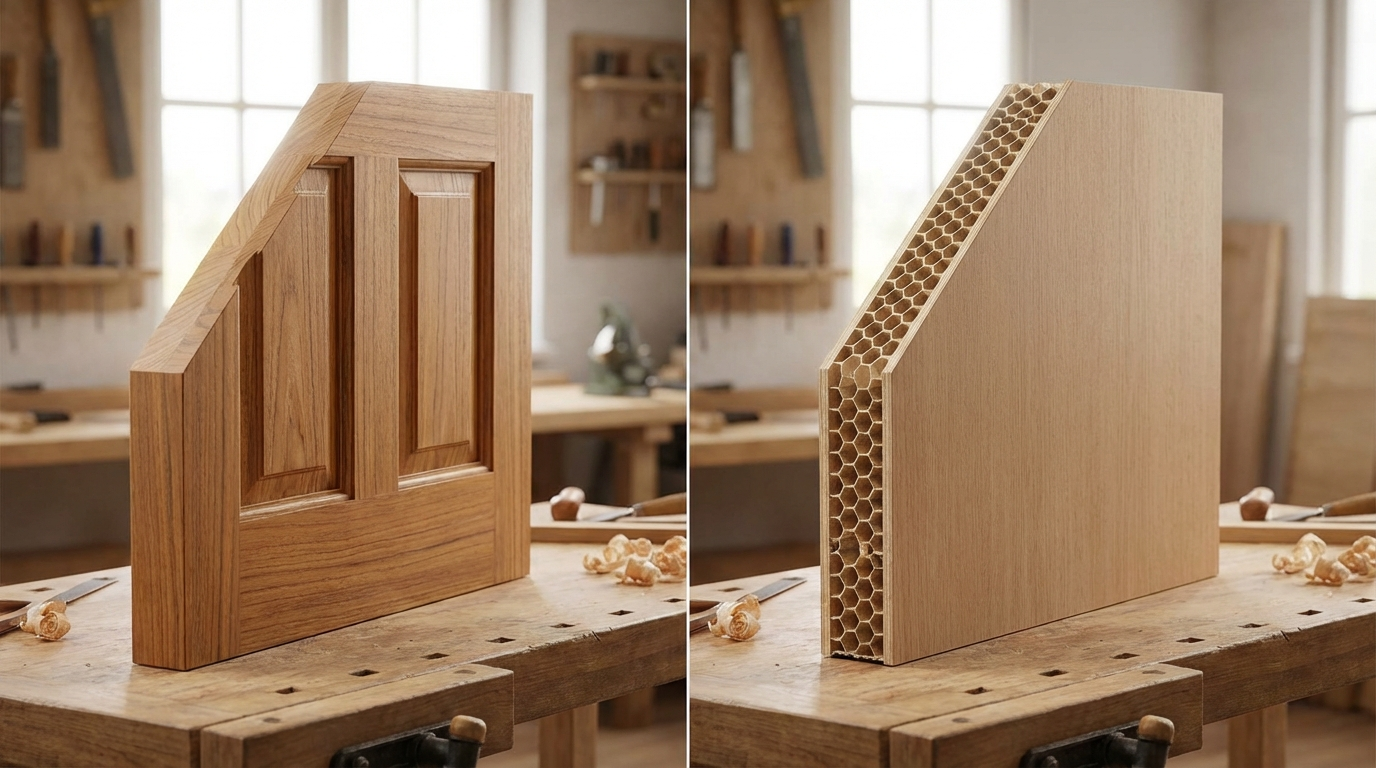
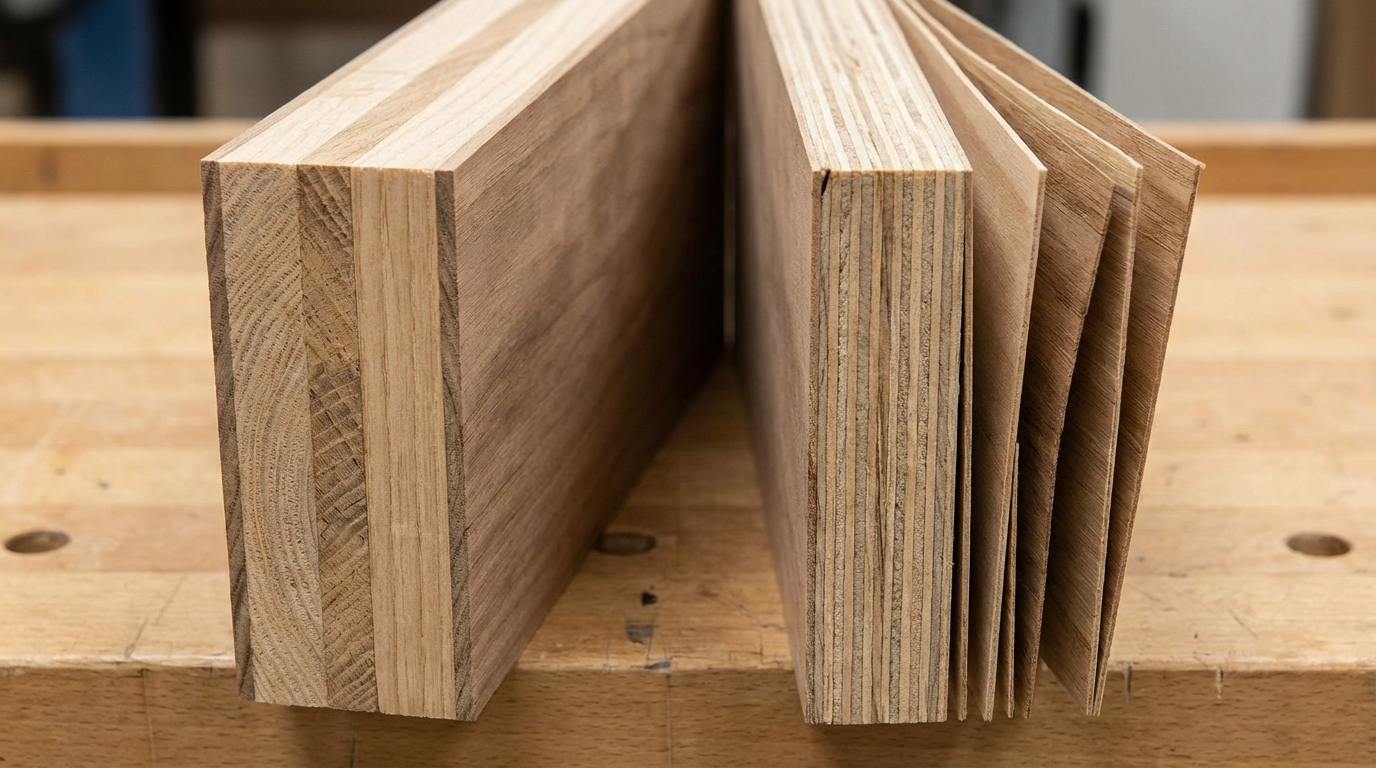
Blockboard, often called plyboard in everyday Indian carpentry circles, starts with a core made from strips of softwood like pine or poplar, glued together edge-to-edge to form a thick, lightweight panel. These core strips, typically 25-30mm wide, run parallel throughout the board's length, creating a solid yet economical inner structure. Thin plywood veneers, usually 2-3mm thick, are then glued on both faces under heat and pressure, sandwiching the core for a smooth, workable surface. This construction gives blockboard its distinctive look when edges are exposed—visible lines of those core strips set it apart from smoother alternatives.
In practice, this design excels where weight matters, as the softwood core keeps the board lighter than solid timber while offering decent rigidity for spans up to 600-800mm without excessive sagging. Indian carpenters favor it for furniture because screws and nails grip the dense core strips exceptionally well, reducing pull-out risks during assembly. However, the parallel grain in the core means it twists or bows under uneven loads if not perfectly sealed, a common issue in humid workshops. Thicknesses range from 12mm to 25mm, with 18mm being a staple for wardrobes and beds in urban homes. The glue line quality—MR for interiors or BWR for semi-exterior—dictates longevity, as poor bonds delaminate faster in steamy kitchens.
For South Indian buyers, blockboard's lightweight nature suits modular kitchen cabinets hauled up apartment stairs, but coastal exposure demands extra edge sealing to fend off termites drawn to softwood cores. Dealers often push 18mm plyboard for its balance of price and screw-holding, but always check core strip alignment visually—gaps signal weak glue jobs. This board's simplicity makes it a go-to for rapid prototyping in CNC shops, where routers slice through cores cleanly without chipping faces.
Overall, blockboard prioritizes economy and machinability over raw strength, making it ideal for non-structural furniture where appearance and assembly ease trump heavy-duty performance. Its core-strip method distributes weight evenly across parallels, but uneven moisture absorption can warp panels if left unpackaged in monsoon storage.
Understanding Plywood
Plywood builds strength through cross-laminated veneers: thin wood sheets (1-3mm each) peeled from logs, rotated 90 degrees per layer, and glued under high pressure. This orthogonal grain pattern—face, cross, core, cross, back—creates isotropic properties, meaning it resists bending equally from any direction. Commercial plywood uses hardwoods like eucalyptus or rubberwood for faces, with softer cores for affordability, resulting in boards from 3mm to 25mm thick. Marine-grade versions employ phenolic resins for boiling-water resistance, essential in wet zones.
The layered setup provides superior stiffness; an 18mm plywood sheet spans 900-1200mm without deflection under uniform loads, far outpacing blockboard's limits. In Indian homes, this translates to tabletops or shelves holding books and appliances without creaking. Edges show layered lines, sandable for seamless laminates, and CNC compatibility shines with minimal tear-out due to balanced grains. Glue grades—MR, BWR, BWP—align with exposure: MR for dry bedrooms, BWP for bathrooms soaking in humidity.
South India's modular kitchen trend leans on plywood for carcasses, as cross-grains handle repeated door slams and utensil weights without splitting. Coastal carpenters note plywood's edge-sealing ease prevents saltwater ingress, unlike blockboard's porous cores. Dealers stock more plywood varieties because its versatility fits flush doors, partitions, and formwork alike. Weight is higher per square foot due to dense veneers, but this adds stability for wall-mounted units.
Plywood's engineering mimics nature's plywood in tree branches, distributing stresses multidirectionally. This makes it forgiving in uneven installations, but thinner plies demand skilled pressing to avoid voids—tap edges to hear solid thuds, not hollow echoes. For Indian buyers juggling budgets, starting thicknesses like 6mm suit laminates, scaling to 19mm for heavy furniture frames.
Key Construction Differences: Blockboard vs Plywood
At its heart, blockboard's construction revolves around a monolithic core of sawn softwood strips, glued longitudinally, capped by plywood faces. This yields a board roughly 70-80% core by thickness, with strips 20-40mm wide ensuring lightweight bulk. Plywood, conversely, stacks 7-15 veneers entirely, each contributing to strength via perpendicular grains—no dominant core direction. Blockboard cores flex along strips but stiffen across; plywood remains uniform.
Dimensional stability follows: blockboard expands/contracts more parallel to strips (up to 8-10% in moisture swings), while plywood's cross-layers limit this to 2-4%. In Indian godowns, unpackaged blockboard warps faster during humid monsoons, demanding immediate edge banding. Plywood's thinner plies absorb glue better, reducing voids, but requires precise thickness control to prevent telegraphing.
| Aspect | Blockboard (Plyboard) | Plywood |
|---|---|---|
| Core Composition | Softwood strips (parallel) | Cross-laminated veneers |
| Weight (per sqm, 18mm) | Lighter (12-15kg) | Heavier (18-22kg) |
| Edge Appearance | Visible strip lines | Layered veneer lines |
| Screw Holding | Excellent in core | Good, face-dependent |
| Moisture Expansion | Higher along strips | Balanced, lower overall |
This table highlights why blockboard suits screw-heavy assemblies like bed frames, gripping softwood deeply. Plywood edges laminate smoothly for visible trims, vital in modular designs. South Indian CNC operators prefer plywood's predictability—blockboard strips snag bits if misaligned. Construction dictates tooling: blockboard saws cleanly across but binds along; plywood cuts multidirectionally. For dealer-driven buys, feel the core: blockboard yields softly, plywood resists evenly.
In humid coastal setups, plywood's glue penetration seals better, but blockboard's thicker faces handle surface sanding without core exposure. These differences stem from manufacturing logic—blockboard economizes scarce hardwoods, plywood maximizes strength from peels.
Strength and Durability: Head-to-Head Comparison
Strength metrics reveal plywood's edge: its cross-grains yield 2-3x higher modulus of elasticity, bending less under point loads like TV mounts. An 18mm plywood panel supports 50-70kg over 1m spans statically; blockboard manages 30-50kg before sagging, as parallel strips act like individual beams, sharing loads unevenly. Impact resistance favors blockboard slightly—cores absorb hammer blows without denting faces, useful for on-site adjustments.
Durability hinges on glue and faces: both delaminate in poor MR grades under 80% humidity, but BWR plywood outlasts blockboard by 20-30% in semi-wet areas. Termite resistance? Softwood cores invite attacks faster unless treated; plywood's hard veneers deter better. In cycling tests—wet-dry repeats—plywood stabilizes quicker due to balanced swelling.
Indian scenarios amplify this: North's dry winters suit both, but South monsoons warp blockboard cores if unsealed, cracking laminates. Coastal salt accelerates blockboard corrosion at glue lines. For heavy wardrobes, plywood frames prevent rail failures; blockboard excels in lightweight almirahs where screw shear dominates.
Carpenters test by loading centers—plywood rebounds elastically, blockboard fatigues plastically. Longevity: expect 15-20 years from quality plywood in homes, 10-15 from blockboard unless babycared. Edge cases like seismic zones favor plywood's ductility. Durability boils down to directional reinforcement—plywood wins uniformly, blockboard selectively.
Cost Breakdown in the Indian Market
Blockboard undercuts plywood by 20-40% for equivalent thickness: 18mm blockboard runs ₹50-80/sqft retail, plywood ₹70-120/sqft, varying by city and grade. Why? Softwood strips cost less than peeling multiple veneers, and simpler pressing cuts factory overheads. MR blockboard hits rock-bottom for bedrooms; BWP plywood premiums reflect resin and cycles.
Hidden costs emerge: blockboard's warping demands extra labor sealing (₹5-10/sqft), plywood's stability saves finishing time. Transport favors lighter blockboard—fewer truck trips for bulk buys. Dealer margins swell on plywood's demand, but negotiate bundles: 50-sheet blockboard lots shave 10-15%.
In South India, modular kitchen fabricators bulk plywood despite premiums, as waste is lower (5% vs blockboard's 10% from twists). Monsoon stockpiles plywood longer without losses. Tier-2 cities see blockboard dominate rentals—cheap, quick-repair. Budget math: 100sqft wardrobe in blockboard saves ₹2,000-4,000 upfront, but repaints sooner.
ROI tilts plywood for permanents: 5-7 year payback via durability. Carpenter insights: upcharge 15% for blockboard installs due to core alignment tweaks. Value lies in use—blockboard for temp partitions, plywood for heirlooms. Fluctuations track timber: eucalyptus spikes hit plywood harder.
Best Uses: Where Blockboard Shines, Where Plywood Dominates
Blockboard thrives in furniture prioritizing screw retention: wardrobes, beds, tables under 40kg/m² loads. Parallel cores grip fixings 30-50% tighter, ideal for knock-down designs shipped flat. Laminates adhere well to faces, hiding strips. Avoid structural beams—deflects under dynamics.
Plywood rules panels needing span: shelves, doors, partitions holding 60kg+. Cross-strength suits flush doors, false ceilings. CNC cuts precision parts without wander. Marine plywood for bathrooms, verandahs resisting splashes.
South Indian modular kitchens? Plywood carcasses withstand humidity, utensil bangs; blockboard shutters for cost. Coastal cabinets: plywood edges seal vapor-tight. Dealers push blockboard for pooja units—light, ornate.
Edge cases: blockboard prototypes fast; plywood finals endure. Trade shows highlight blockboard's paintability sans bubbles. Indian homes mix: plywood lofts, blockboard racks. Match to load, exposure, budget.
Common Mistakes Buyers and Carpenters Make
Top error: ignoring core quality. Buyers grab shiny faces, missing gappy blockboard strips leading to screw pops post-install. Carpenters skip tapping—hollow cores signal voids. Solution: slice sample edges onsite.
Moisture mismatch: MR blockboard in kitchens delams after monsoons, faces bubbling. South buyers overlook coastal salt eating softwoods. Always upspec BWR minimum.
Overloading blockboard shelves causes crashes—limit 20kg/m linear. Plywood faces scratched thin reveal weak inners; sand lightly. Dealers palm off MR as BWR—smell resins (phenolic sharp).
CNC pitfalls: blockboard strips vibrate routers, splintering; plywood feeds steady. No edge banding? Blockboard swells 15% dimensionally. Install green (moist) panels shrink, cracking joints.
Why prevalent in India? Dealer pressure for volume sales, rushed monsoons. Educate: demand specs, test loads. Savings bite back in callbacks—₹10,000 wardrobes redo ₹5,000 extra.
Trade-offs and Limitations: When Not to Choose Each
Blockboard's lightness trades screw strength for sag—never for tabletops or bridges. Warps in gradients, unfit uncoated outdoors. Porous cores suck moisture, bloating unless babycared thrice. Overkill for thin laminates; voids telegraph.
Plywood's uniformity costs more, weighs down hauls. Face veneers dent easier under impacts; thin plies telegraph knots. Glue-heavy, emits VOCs longer in sealed rooms. Overkill for simple frames—pay for unused strength.
India specifics: blockboard skips high-humidity South modulars (swells drawers); plywood burdens low-floor budgets. Monsoon: both fail unsealed, but plywood recovers. Termites feast blockboard first—treat extras.
Balance: hybrid panels (block core, ply faces) blend, but pure choices fit 90% cases. Limitations force smart picks—durability vs economy.
Decision Framework for Indian Homeowners and Builders
Step 1: Assess load—under 40kg/m²? Blockboard. Over? Plywood. Step 2: Exposure—dry interior? MR blockboard. Wet? BWR/BWP plywood. Step 3: Budget—save 30%? Blockboard. Value? Plywood.
Step 4: Assembly—screws heavy? Blockboard grips. Laminates/CNC? Plywood smooths. Step 5: Span/direction—short/parallel? Blockboard. Long/multi? Plywood.
| Project Type | Recommended | Why |
|---|---|---|
| Wardrobe Carcass | Blockboard | Screw hold, light |
| Modular Kitchen | Plywood | Humidity, slams |
| Flush Door | Plywood | Stability |
| Partition Wall | Blockboard | Cost, quick |
South India tweak: +1 humidity factor—up plywood 20%. Dealers? Verify grades. Test: load prototype. This framework cuts regrets 80%.
Frequently Asked Questions
Is blockboard stronger than plywood?
No, plywood generally outperforms blockboard in overall strength due to its cross-laminated veneers that distribute loads evenly in all directions. Blockboard's parallel softwood strips provide excellent screw-holding power for furniture assembly, making it feel robust in those applications, but it sags more under bending or spanning loads. For Indian homes, choose plywood for shelves or doors needing rigidity, and blockboard for lightweight cabinets where grip matters more than span. In practice, an 18mm plywood holds twice the center load of blockboard over 1m, a difference carpenters exploit for safety margins.
Can blockboard be used outdoors?
Blockboard struggles outdoors because its softwood core absorbs moisture rapidly along strips, leading to warping and delamination even with BWR grades. Seal edges meticulously and apply multiple waterproof coats, but expect 2-3 years max in covered verandahs. Plywood, especially BWP, fares better with phenolic bonds resisting boils. In South India's coastal rains, avoid blockboard entirely for exterior panels—opt for plywood or cement boards. Dealers may claim versatility, but real-world exposure reveals core rot quickly.
Which is better for wardrobes in humid areas?
Plywood edges out for humid wardrobes thanks to balanced moisture resistance and less warping. Blockboard works if BWR grade and fully banded, gripping hangers superbly, but monsoons swell cores, jamming drawers. South Indian apartments with poor ventilation demand 18mm BWR plywood carcasses lined internally. Trade-off: blockboard saves upfront, but callbacks for twists cost more. Ventilate wardrobes; both benefit, but plywood stabilizes faster.
How to check quality of blockboard or plywood?
Inspect visually: uniform faces sans bubbles, straight edges without gaps. Tap across—solid thuds mean no voids; hollows signal skips. For blockboard, eye core strips—tight, no cracks. Plywood: sand edge, check layer bonds. Weigh sample: too light hints low-density. Smell: acrid glue is suspect. Load-test center; measure sag. Indian tip: buy from certified mills, reject dealer repacks. Moisture meter under 12% ideal.
Is plyboard the same as blockboard?
Yes, plyboard is the common Indian trade name for blockboard, referring to its plywood-faced block core. No structural difference—just regional lingo. Dealers use interchangeably, but confirm construction: strips inside, not full laminates. Avoid confusion with particleboard-faced versions, weaker overall. In South markets, 'plyboard' stocks fly for furniture; know it means blockboard.
Which is best for modular kitchens?
Plywood dominates modular kitchens for its humidity tolerance, impact strength from door cycles, and CNC precision. 18mm BWR carcasses resist steam; blockboard suits budget shutters but warps in vapors. Coastal South: plywood seals better against brine. Costlier, but lasts 15+ years vs blockboard's 8-10. Framework: plywood if permanence; blockboard for rentals.
Does blockboard warp more than plywood?
Yes, significantly—blockboard's directional core expands 2-3x more along strips in humidity swings, cupping panels. Plywood's crosses balance this. Indian monsoons exacerbate: store flat, seal immediately. South humidity (80%+) hits blockboard hardest; plywood shrugs off with proper grade. Prevention: acclimate 48hrs, band edges fully.
What thickness to choose for furniture?
18mm standard for most furniture—balances strength, weight. Blockboard 18mm for wardrobes (screw-heavy); plywood 18mm for shelves (span). Thinner 12mm laminates, 25mm heavy tables. South modulars: 18mm plywood carcasses, 12mm shutters. Factor load: +25% thickness halves deflection. Dealers size by use; verify spans.
Disclaimer: This content is provided for general informational purposes based on industry practices and publicly available information. Product specifications, standards, prices, and availability may vary by manufacturer, region, and time. Readers should independently verify details with manufacturers, dealers, or qualified professionals before making purchase or construction decisions.Want Plywood Suggestions?
Share a few details and a Apple Ply specialist will suggest suitable brands and connect you to responsive dealers.