Block Board vs Plywood: Key Differences Every Buyer Should Know
Compare block board vs plywood - learn key differences in strength, weight, price & applications. Make informed decisions for your furniture project.
Quick Answer
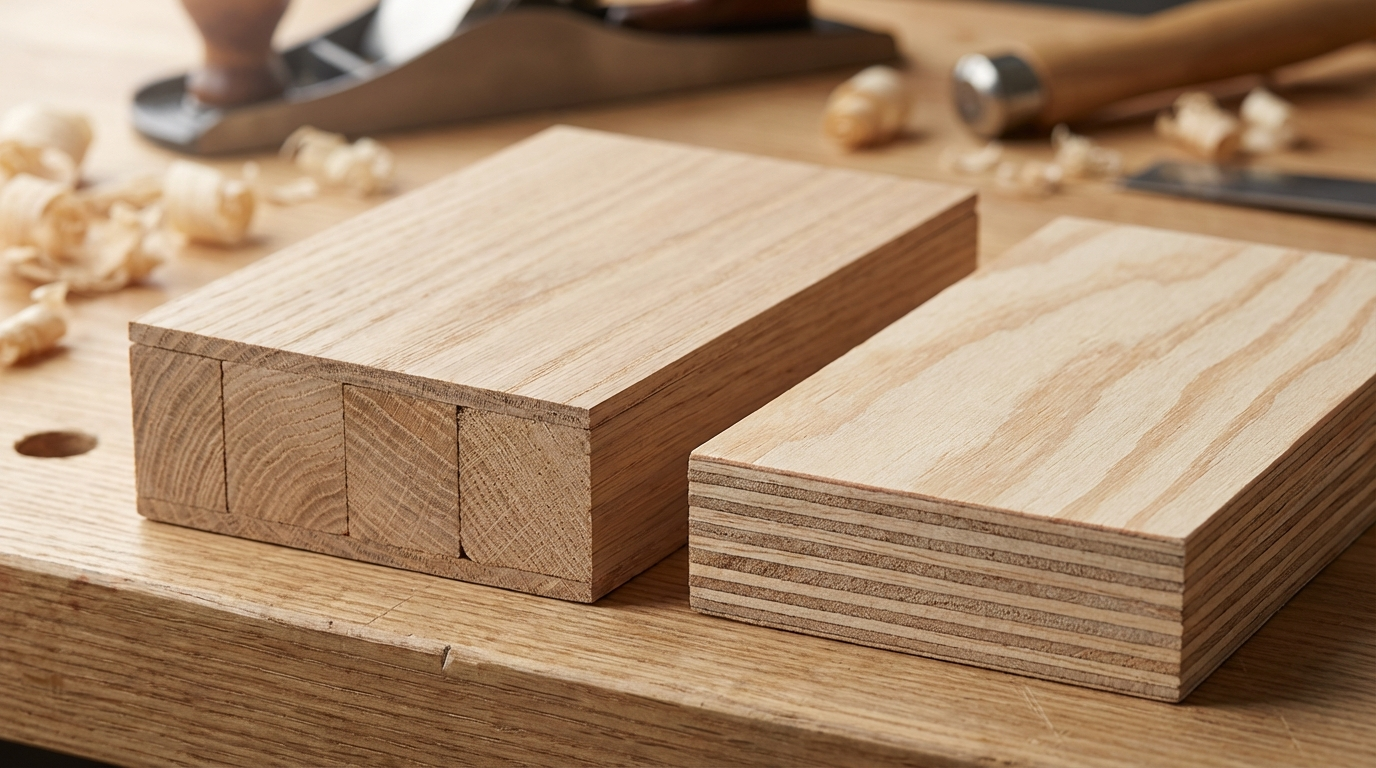
The key difference between block board and plywood lies in their core construction: block board uses solid softwood strips sandwiched between veneers, while plywood consists of multiple cross-laminated veneer layers. Block board excels for long, lightweight panels like doors and tables, while plywood offers superior all-round strength for furniture carcasses and load-bearing applications.
At a Glance
- Core structure: Block board has lumber core; plywood has cross-grained veneer layers
- Weight: Block board is 15-25% lighter than equivalent thickness plywood
- Best use: Block board for doors and long shelves; plywood for wardrobes and kitchen cabinets
- Screw holding: Plywood holds screws better across all orientations
- Price: Block board typically costs 10-20% less than comparable grade plywood
- Water resistance: Plywood available in superior moisture-resistant grades (BWR, Marine)
Block Board vs Plywood: Understanding the Fundamentals
Both block board and plywood fall under the engineered wood category, yet they serve distinctly different purposes in Indian furniture and construction applications. Understanding their fundamental differences helps buyers, carpenters, and interior designers make informed choices rather than relying solely on dealer recommendations.
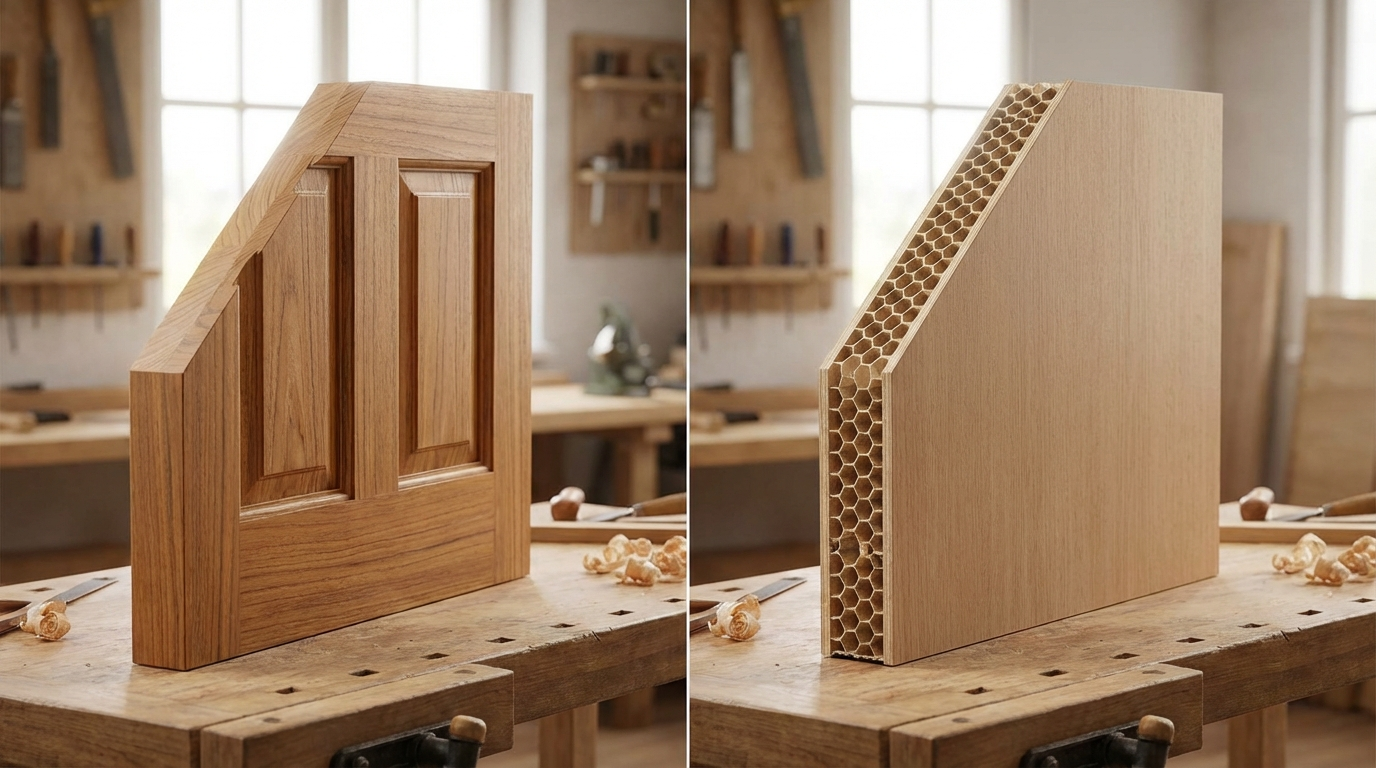
Block board construction begins with softwood strips—typically pine, poplar, or other fast-growing species—arranged edge-to-edge to form a solid lumber core. This core is then sandwiched between thin hardwood veneers on both faces, bonded under high pressure with adhesives. The result is a panel that behaves somewhat like solid timber, offering excellent rigidity along its length while remaining surprisingly lightweight.
Plywood, by contrast, is manufactured by layering multiple thin wood veneers with each successive layer's grain oriented perpendicular to the one below. This cross-lamination technique is the secret behind plywood's exceptional strength and dimensional stability. A typical 19mm plywood sheet contains 7 to 13 veneer layers, each contributing to the panel's overall resilience.
The manufacturing philosophy behind each product reflects its intended application. Block board was developed as a cost-effective alternative to solid timber for large, flat surfaces where sagging resistance matters most. Plywood evolved to maximize the structural potential of wood while minimizing waste—a single log yields far more plywood surface area than equivalent solid lumber.
In the Indian market, both products are available from national brands like Greenply, Century, Kitply, and regional manufacturers. However, quality consistency varies significantly, making it essential for buyers to understand what they're purchasing beyond just the material name.
Types and Grades Available in India
Block Board Classifications
Block board in India is primarily classified by its moisture resistance properties and core wood quality. The most common grades include MR (Moisture Resistant) for interior dry applications, BWR (Boiling Water Resistant) for areas with occasional moisture exposure, and BWP (Boiling Water Proof) for higher humidity environments. However, it's worth noting that block board's inherent construction makes it less suitable for prolonged water exposure regardless of grade, as the lumber core can absorb moisture through any gaps between strips.
Core wood quality significantly impacts block board performance. Premium block boards use kiln-dried, defect-free softwood strips with minimal gaps between them. Budget options often feature irregular strips with visible gaps, which compromise both strength and screw-holding capacity. When examining a block board edge, the uniformity of the core strips reveals much about its quality tier.
Plywood Varieties and Grades
Plywood classification in India follows a more standardized system. MR grade plywood suits interior furniture where moisture exposure is minimal—think bedroom wardrobes and study tables. BWR grade handles semi-wet areas like utility spaces and can withstand occasional water contact. Marine or BWP grade plywood is engineered for bathrooms, kitchens, and outdoor applications where water resistance is non-negotiable.
Beyond moisture grades, plywood is categorized by face veneer quality. Commercial grade features acceptable surface imperfections suitable for laminated or painted finishes. Decorative or furniture-grade plywood offers superior face veneers for polished or veneered finishes. Calibrated plywood maintains precise thickness uniformity essential for CNC machining and modular kitchen applications—a critical consideration as Indian interior design increasingly embraces factory-made components.
The IS/BIS standards associated with plywood (IS 303 for MR grade, IS 710 for BWR grade, IS 1328 for Marine grade) provide a verification framework, though buyers should physically check stamps on actual sheets rather than relying solely on dealer claims.
Detailed Comparison Table: Block Board vs Plywood
| Parameter | Block Board | Plywood | Best For |
|---|---|---|---|
| Core Construction | Softwood strips (lumber core) | Cross-laminated veneers | Plywood for uniform strength |
| Weight (19mm sheet) | 25-32 kg per 8x4 sheet | 35-45 kg per 8x4 sheet | Block board for lighter handling |
| Screw Holding | Good on face; variable on edges | Excellent on all surfaces | Plywood for hinge-heavy furniture |
| Sag Resistance (long spans) | Superior for horizontal spans | Good but may flex under load | Block board for 4ft+ shelves |
| Moisture Resistance | Limited even in BWR grade | Excellent in BWR/Marine grades | Plywood for kitchens/bathrooms |
| Price Range (₹ per sq ft) | ₹45-85 (19mm, Tier-1 cities) | ₹55-120 (19mm, Tier-1 cities) | Block board for budget projects |
| Warping Tendency | Low in vertical orientation | Excellent resistance all directions | Plywood for versatile use |
| Machinability | Easy cutting; edge finishing tricky | Clean cuts; excellent edge finishing | Plywood for CNC/modular work |
How to Choose Between Block Board and Plywood
The choice between block board and plywood should never be reduced to a simple "which is better" question. Each material excels in specific applications, and the right choice depends entirely on your project requirements, budget constraints, and long-term expectations.
Decision Framework for Buyers
Start by identifying your primary application. For flush doors, partition panels, long conference tables, and extended bookshelves, block board's lightweight nature and sag resistance make it the logical choice. The lumber core acts like a wooden beam, maintaining rigidity across spans where plywood might gradually flex under sustained load.
For furniture carcasses, kitchen cabinets, wardrobes with heavy shutters, and any application requiring reliable screw-holding across multiple surfaces, plywood is the superior option. The cross-laminated construction distributes stress evenly, ensuring hinges and fittings remain secure over years of use. This is particularly important for modular kitchens where soft-close hinges and drawer systems depend on consistent substrate performance.
Buyer Checklist
- Assess span requirements: Shelves exceeding 3 feet benefit from block board's rigidity
- Count the hinges: More hinges and hardware points favor plywood selection
- Check moisture exposure: Any wet-area proximity demands BWR or Marine plywood
- Evaluate weight concerns: Overhead installations and large doors suit lighter block board
- Consider edge treatments: Plywood accepts edge banding more reliably than block board
- Factor in carpenter skill: Block board edges require experienced handling to avoid core exposure
- Budget realistically: Include hardware costs—cheaper substrate with failing hinges costs more long-term
When NOT to Choose Block Board
Avoid block board for bathroom vanities, kitchen base units, areas near water sources, or any furniture requiring extensive edge-fastening. The softwood core, despite adhesive treatment, remains vulnerable to moisture ingress through edges and any surface damage. In coastal cities like Mumbai, Chennai, or Kochi, where ambient humidity exceeds 70% for extended periods, even interior block board applications can suffer swelling issues if not properly sealed.
Similarly, block board is unsuitable for furniture requiring curved elements or intricate CNC routing. The lumber core doesn't bend gracefully and can splinter during machining, unlike plywood which maintains integrity through complex cuts.
Common Mistakes to Avoid When Buying
The Indian plywood market presents unique challenges for buyers, with quality variation, misleading claims, and dealer-driven purchasing patterns creating multiple pitfalls. Understanding these common mistakes can save significant money and frustration.
Mistake 1: Ignoring Core Quality in Block Board
Many buyers focus exclusively on face veneer appearance while ignoring the lumber core that determines actual performance. Always examine the board edge before purchase. Quality block board shows uniform, tightly packed strips with minimal gaps. Budget products often feature irregular strips with visible voids—these gaps compromise screw-holding and create moisture pathways. Request that dealers cut a sample piece to expose the core rather than relying on edge displays.
Mistake 2: Assuming All BWR Grades Are Equal
The BWR label indicates adhesive quality, not overall board quality. A poorly manufactured board with BWR-grade adhesive still fails if veneer quality is substandard or pressing is inadequate. Check for delamination signs: tap the sheet surface and listen for hollow sounds indicating air pockets. Examine edges for veneer separation and core exposure.
Mistake 3: Using Block Board for Modular Applications
Modern modular kitchens and wardrobes rely on precision drilling for hardware installation. Block board's inconsistent core creates problems when drill bits encounter gaps versus solid strips, leading to uneven hole depths and unstable fittings. Calibrated plywood ensures consistent machining results essential for factory-made components.
Mistake 4: Overlooking Thickness Trade Conventions
Indian market thickness naming causes confusion. What's sold as "19mm" often measures 17-18mm actual thickness. Premium "19mm" plywood might be genuinely 18.5-19mm, while budget options barely reach 17mm. This matters for door frames, panel alignment, and hardware specifications. Carry a measuring tape and verify actual thickness before bulk purchase.
Quick Inspection Checks
- Flex test: Quality 8x4 plywood should show minimal flex when held from one end
- Weight check: Unusually light sheets indicate thinner veneers or poor compression
- Edge examination: Look for uniform veneer layers without gaps or bark inclusions
- Surface scratch test: Face veneer should resist light fingernail scratching
- Corner check: Delamination often begins at corners—inspect all four carefully
Price Guide: Block Board vs Plywood in India
Pricing for both materials varies significantly based on grade, brand tier, thickness, and regional factors including transport costs and local dealer margins. The following ranges assume standard 8x4 feet (2440x1220mm) sheets in Tier-1 cities as of 2024-25, with national brand products.
Block Board Price Ranges
| Grade | Thickness | Price Range (₹/sheet) | Price Range (₹/sq ft) |
|---|---|---|---|
| Commercial MR | 19mm | ₹1,400-2,200 | ₹44-69 |
| BWR Grade | 19mm | ₹1,800-2,800 | ₹56-88 |
| Premium BWR | 25mm | ₹2,400-3,500 | ₹75-109 |
Plywood Price Ranges
| Grade | Thickness | Price Range (₹/sheet) | Price Range (₹/sq ft) |
|---|---|---|---|
| Commercial MR | 19mm | ₹1,600-2,600 | ₹50-81 |
| BWR Grade | 19mm | ₹2,200-3,400 | ₹69-106 |
| Marine Grade | 19mm | ₹3,200-4,800 | ₹100-150 |
| Calibrated (CNC-ready) | 18mm | ₹2,800-4,200 | ₹88-131 |
Factors Affecting Price Variation
Brand positioning creates the widest price gaps—national brands command 30-50% premiums over regional manufacturers for comparable specifications. This premium reflects quality consistency, warranty backing, and resale value for completed furniture. Transport costs add ₹50-150 per sheet in Tier-2 and Tier-3 cities depending on distance from manufacturing hubs in Gujarat, Maharashtra, and South India.
Thickness impacts pricing disproportionately. Jumping from 12mm to 19mm increases cost by roughly 60-80%, not the simple 58% mathematical proportion, because thicker sheets require more raw material, longer pressing cycles, and face higher rejection rates. GST at 18% applies uniformly, though invoice practices vary across the organized and unorganized dealer segments.
Seasonal demand fluctuations affect pricing, with rates typically rising 5-10% during October-February when construction and interior work peak across India. Bulk purchases (50+ sheets) can secure 8-15% discounts from most dealers, though quality verification becomes more critical with large orders.
Regional Considerations Across India
India's geographic diversity creates varied requirements for engineered wood selection. What works perfectly in Jaipur may fail prematurely in Mangalore, making regional factors essential to the block board versus plywood decision.
Coastal and High-Humidity Regions
Cities along India's extensive coastline—Mumbai, Chennai, Kochi, Kolkata, Visakhapatnam—experience sustained humidity levels exceeding 70% for several months annually. In these environments, plywood's superior moisture resistance makes it the default choice for most applications. Block board, even in BWR grade, risks core swelling when ambient moisture penetrates through edges or surface scratches. Marine-grade plywood becomes essential for any furniture exposed to direct moisture or placed in bathrooms and kitchens.
Termite and borer activity also intensifies in humid coastal regions. While both materials are vulnerable without treatment, plywood's denser construction and fully bonded layers offer marginally better resistance than block board's lumber core, where pests can establish colonies within strip gaps.
Dry Interior Regions
In cities like Delhi, Jaipur, Ahmedabad, and Pune, lower humidity reduces moisture-related concerns, making block board a more viable option across broader applications. The primary consideration shifts to temperature cycling—extreme summer heat followed by winter cooling can stress adhesive bonds in lower-quality products. Premium BWR adhesives handle this cycling better than MR grades regardless of the base material.
Metro vs Tier-2/Tier-3 Availability
Major metros offer the full range of grades, thicknesses, and brands for both materials. Tier-2 and Tier-3 cities often stock limited varieties, with dealers pushing whatever inventory they carry. Buyers in smaller cities should consider ordering specific grades from distributors rather than accepting locally available alternatives that may not suit their requirements. Transport costs for specific orders typically add ₹80-150 per sheet but ensure appropriate material selection.
Carpenter's Perspective: Working with Both Materials
Speaking with experienced carpenters across India reveals practical insights that specifications and technical data don't capture. These perspectives help buyers understand real-world performance differences.
Handling and Installation Differences
Carpenters consistently prefer block board for large door panels and overhead applications simply because of weight. Maneuvering a 35-40kg plywood sheet onto a wardrobe top is physically demanding and risks damage during positioning. Block board's lighter weight (25-32kg for equivalent dimensions) reduces installation fatigue and improves precision during alignment.
However, edge treatment tells a different story. Plywood accepts edge banding adhesive uniformly across its layered edge. Block board edges expose the lumber core, which has varying porosity depending on strip arrangement. Experienced carpenters seal block board edges with wood filler or PU primer before edge banding—an extra step that adds time and cost but prevents premature banding failure.
Hardware Installation Realities
Screw-holding capacity matters enormously for furniture longevity. Carpenters report that plywood provides consistent resistance when driving screws anywhere on the panel. Block board performs well when screws enter the lumber strips but poorly when they hit gaps between strips. For hinge-heavy applications like kitchen shutters or wardrobe doors, this inconsistency creates problems—some hinges hold firmly while adjacent ones loosen within months.
The workaround for critical hardware points in block board involves pre-drilling and using longer screws that penetrate through the core into the opposite face veneer. This technique works but requires skill and adds installation time.
Long-Term Durability Observations
Carpenters who service furniture they built years earlier note distinct aging patterns. Quality plywood furniture typically shows wear at laminate edges and hardware points but maintains structural integrity for 15-20 years with normal use. Block board furniture of similar age often develops edge delamination where the face veneer separates from the core, particularly in humid environments or where liquid spills occurred.
Interestingly, both materials show similar vulnerability to termite damage if untreated, though carpenters observe that once termites establish in block board, damage progresses faster through the soft lumber core than through plywood's denser, adhesive-rich layers.
Frequently Asked Questions
What is the full form of BWR in plywood?
BWR stands for Boiling Water Resistant, indicating the adhesive used in plywood manufacturing can withstand exposure to boiling water for a specified duration without delaminating. In practical terms, BWR plywood suits areas with occasional moisture contact like kitchens, utility areas, and covered outdoor spaces. It's important to understand that BWR refers specifically to adhesive quality—the overall board quality depends equally on veneer selection and manufacturing standards. BWR plywood conforming to IS 303 standards is commonly recommended for interior furniture in Indian homes.
Which is better for kitchen cabinets: block board or plywood?
Plywood is significantly better for kitchen cabinets due to its superior moisture resistance and consistent screw-holding capacity. Kitchens experience regular humidity from cooking, water splashes near sinks, and temperature variations from cooking appliances. BWR or Marine-grade plywood handles these conditions reliably, while block board's lumber core is vulnerable to swelling and degradation despite water-resistant adhesive grades. Additionally, kitchen cabinets require multiple hinges, drawer slides, and fittings—plywood's uniform construction ensures all hardware points remain secure throughout the furniture's lifespan.
Is block board cheaper than plywood in India?
Block board is typically 10-20% cheaper than equivalent grade plywood in Indian markets. For a 19mm BWR-grade sheet in standard 8x4 dimensions, block board ranges from ₹1,800-2,800 while comparable plywood costs ₹2,200-3,400 depending on brand and city. However, total project cost should factor in application suitability—using block board where plywood is required may result in premature failure and replacement costs that exceed any initial savings. Block board offers genuine value for appropriate applications like doors, partitions, and long shelving where its properties are advantageous.
Can block board be used for wardrobes?
Block board can be used for wardrobe carcasses and shelves but is not recommended for shutter panels or any components with heavy hinge loads. The material's inconsistent screw-holding in edge areas causes hinge loosening over time, leading to sagging doors and misaligned shutters. If budget constraints necessitate block board use, restrict it to internal shelves and back panels while using plywood for structural frames and shutter panels. This hybrid approach balances cost savings with functional durability, though full plywood construction remains the professional recommendation for wardrobes.
How to check block board quality before buying?
Quality block board inspection involves examining the lumber core through the edge. Look for uniform, tightly packed softwood strips without visible gaps or voids between them. Premium products show strips of consistent width with minimal spacing. Tap the board surface across multiple points—hollow sounds indicate air pockets or delamination areas. Check all four corners for veneer separation, which typically begins at corners in poorly manufactured boards. Verify actual thickness with a measuring tape, as "19mm" products often measure 17-18mm in budget ranges. Finally, check for BIS marking and brand authenticity through packaging and invoice documentation.
Does block board warp over time?
Quality block board resists warping well when used in vertical orientations like door panels and partitions—its lumber core provides beam-like rigidity that maintains flatness. However, horizontal applications in humid environments can develop warping over time, particularly if edges are unsealed or if the core absorbs moisture through surface damage. Proper edge sealing, appropriate grade selection (BWR for humid areas), and avoiding direct water contact significantly reduce warping risk. Plywood's cross-laminated construction offers inherently better warp resistance across all orientations and conditions.
What thickness of block board is best for doors?
For interior flush doors, 30mm block board is the industry standard, providing adequate rigidity and heft for smooth operation while remaining lighter than equivalent solid core alternatives. Bathroom doors benefit from 35mm thickness for additional moisture resistance mass, though BWR plywood is often preferred for bathroom applications. Partition frames and lightweight doors can use 25mm block board. Commercial door manufacturers typically use 30-35mm block board with hardwood edge framing to protect the vulnerable lumber core exposure at door edges where handling wear is concentrated.
Why is Marine plywood more expensive than BWR?
Marine plywood commands premium pricing due to superior raw materials and stringent manufacturing requirements. It uses exclusively hardwood veneers with minimal defects, phenolic adhesives that exceed BWR specifications, and undergoes rigorous quality testing including extended boiling water immersion. Marine-grade products conforming to IS 710 standards must demonstrate zero delamination after 72 hours in boiling water versus 8 hours for BWR grade. The veneer selection alone adds significant cost—Marine plywood rejects material that would be acceptable in BWR production. For genuine waterproof applications, this premium delivers measurably longer service life.
Disclaimer: This content is provided for general informational purposes based on industry practices and publicly available information. Product specifications, standards, prices, and availability may vary by manufacturer, region, and time. Readers should independently verify details with manufacturers, dealers, or qualified professionals before making purchase or construction decisions.Want Plywood Suggestions?
Share a few details and a Apple Ply specialist will suggest suitable brands and connect you to responsive dealers.