Block Board: Complete Guide to Uses, Types & Prices
Everything about block board - construction, types, applications & prices. Learn when to use block board vs plywood for furniture.
Quick Answer
Block board is an engineered wood panel made by sandwiching softwood strips (battens) edge-to-edge between hardwood veneers under high pressure—ideal for long furniture spans like tables, shelves, and doors where sag resistance matters most. It's lighter than plywood, easier for carpenters to work with, and typically costs less for equivalent thickness in the Indian market.
At a Glance
- Construction: Softwood strips (core) sandwiched between two layers of hardwood veneers
- Best for: Long horizontal surfaces, doors, partitions, bookshelves, and wardrobe shutters
- Common thicknesses in India: 19mm and 25mm (also 16mm, 30mm, 35mm available)
- Grades: MR (Moisture Resistant/Commercial) and BWP (Boiling Water Proof)
- Price range: ₹75–150 per sq ft (commercial) and ₹100–200 per sq ft (waterproof), varying by brand and city
- BIS Standard: IS 1659:2004 governs quality specifications and is now mandatory
Block Board Explained: What It Is and How It Works
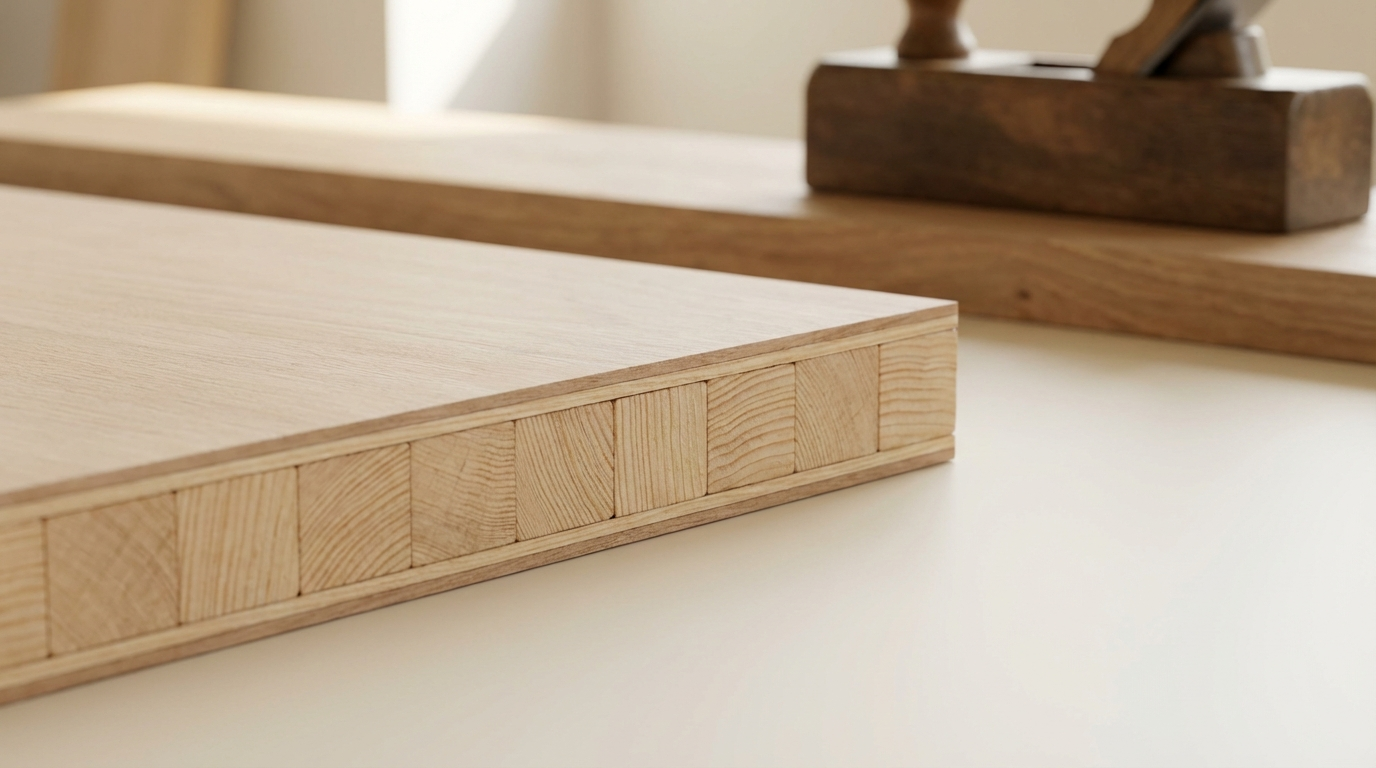
Blockboard consists of strips or blocks of wood called battens glued together side by side and then compressed between sheets of plywood. This unique construction gives block board its characteristic properties: excellent stiffness along its length, relatively light weight, and superior screw-holding capacity at the edges.
Block board is made by sandwiching softwood blocks between two layers of veneer. These blocks are typically placed edge to edge and run lengthwise. The battens inside are usually made from pine, poplar, or similar softwoods that are lightweight yet strong. The outer veneers can be hardwood species like gurjan, okoume, or teak, depending on the finish quality required.
The manufacturing process involves kiln-drying the timber strips to reduce moisture content, arranging them precisely edge-to-edge, and bonding them to the veneer faces using phenol-formaldehyde (for BWP grade) or urea-formaldehyde (for MR grade) adhesives under controlled heat and pressure. A key characteristic of blockboards is their resistance to warping and twisting, making them ideal for applications where dimensional stability is important.
Why Block Board Matters in Indian Furniture Making
It is stiffer than plywood and hence is less prone to bending. So, if the length of furniture is more than 6-7 ft., blockboard is preferred over plywood. This characteristic makes block board indispensable for Indian homes where custom-built wardrobes often span entire walls, and dining tables need to seat large joint families without sagging over time.
In practical Indian market terms, block board fills the gap between expensive solid wood and thinner plywood sheets. When your carpenter needs to build a 10-foot dining table or a floor-to-ceiling bookshelf, plywood of comparable thickness would either sag eventually or prove prohibitively heavy. Block board delivers the required span without the structural compromise.
Types of Block Board Available in India
IS 1659 classifies block boards into two grades: BWP Grade and MR Grade, each with decorative and commercial types. Understanding these classifications helps you specify the right product for your application.
MR Grade (Commercial) Block Board
Popularly known as MR grade block board, it is lightweight and used only in internal areas like door cores, furniture, panelling, ceilings, etc. It usually features a softwood core in its construction, and special moisture-resistant adhesives are applied to it. MR grade uses urea-formaldehyde resin that can withstand occasional humidity but not direct water exposure. This is the most commonly sold type in Tier-2 and Tier-3 cities, where cost sensitivity drives most purchasing decisions.
BWP Grade (Waterproof) Block Board
BWP (Boiling Water Proof) grade block board uses phenol-formaldehyde adhesives that resist prolonged moisture exposure. These products use a Phenol Formaldehyde Resin that is Boiling Water Resistant. This grade is suitable for humid environments but should still be laminated or veneered for best results. Coastal cities like Mumbai, Chennai, and Kochi see higher demand for BWP grade due to year-round humidity.
Based on Core Wood Species
Softwood Blockboard – In this Blockboard, hardwood veneers are sandwiched with battens or strips of softwood between them. Therefore, this variant is lightweight and also easy to work with. It is usually used in various indoor applications.
Hardwood Blockboard – In this type of blockboard, dense, hard, and expensive hardwood strips are bonded and pressed together under high pressure. Therefore, it is highly durable and moisture-resistant and is mostly used for high-stress applications. Hardwood core block boards command a premium but offer significantly better screw retention and load-bearing capacity—worth considering for kitchen shutters and office furniture.
Based on Finish Type
Blockboards come in various finishes: lacquered, laminated, veneered, or painted. They are also easier to maintain and can be quickly cleaned. Pre-laminated block boards are gaining popularity in metro markets as they reduce on-site finishing work, though availability remains patchy in smaller towns.
Block Board vs Plywood: Complete Comparison
Among the most popular choices in India are plywood and blockboard. Both are engineered wood products but differ significantly in structure, performance, and cost. The choice between them depends on your specific application, budget, and environmental conditions.
| Parameter | Block Board | Plywood | Best Choice For |
|---|---|---|---|
| Core Construction | Softwood strips (battens) placed edge-to-edge | Multiple thin veneer layers at 90° angles | Depends on structural need |
| Weight | Lighter (softwood core) | Heavier (dense veneer layers) | Block board for wall-mounted or tall furniture |
| Strength Direction | Strong along length; weaker across width | Uniform strength in all directions | Plywood for load-bearing horizontal surfaces |
| Sag Resistance | Excellent over long spans (6-10 ft) | Good for shorter spans; may sag over 6 ft | Block board for long tables and shelves |
| Screw Holding | Superior at edges; may split in middle | Consistent throughout | Plywood for modular/CNC furniture |
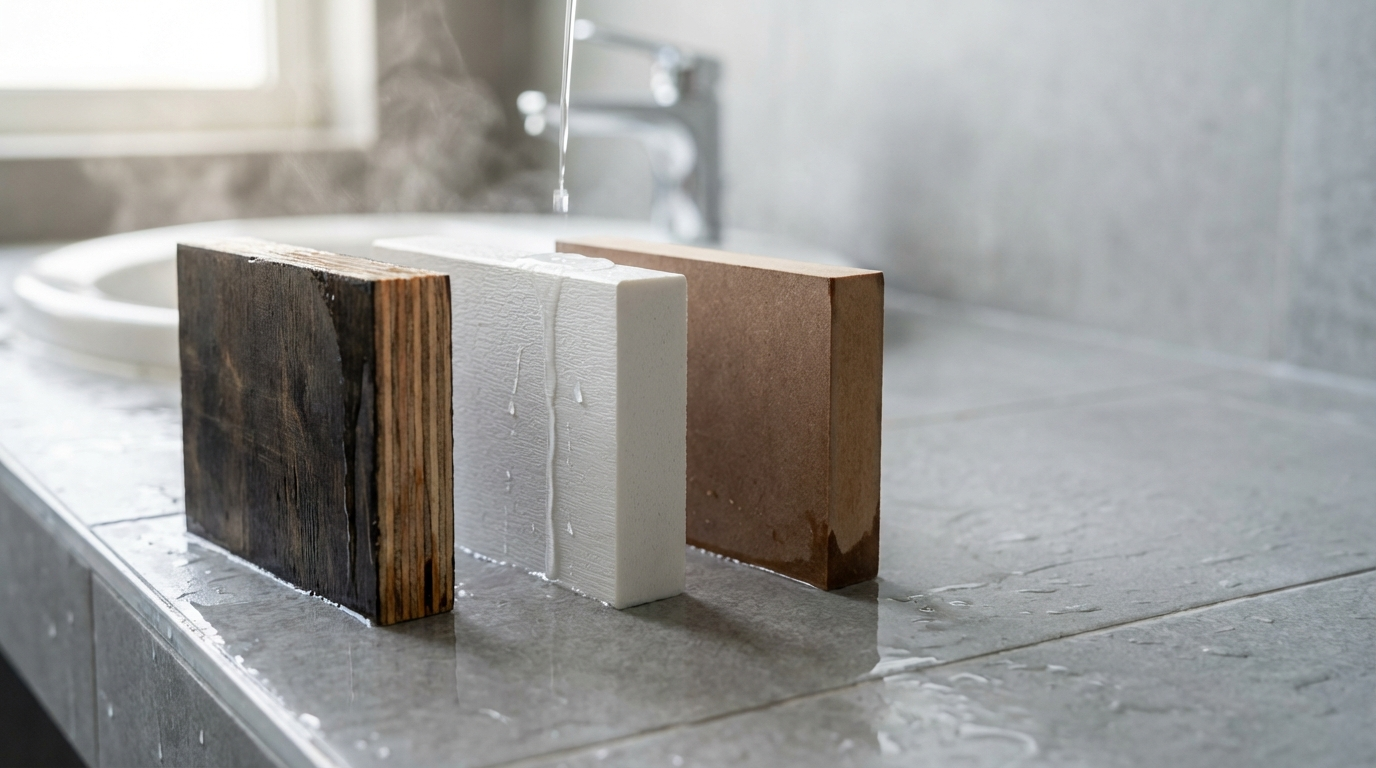
| Moisture Resistance | Moderate (even BWP grade absorbs if exposed) | Better, especially in BWR/Marine grades | Plywood for kitchens and bathrooms |
| Price (19mm, per sq ft) | ₹75–130 (commercial); ₹100–180 (BWP) | ₹90–160 (commercial); ₹130–250 (BWR) | Block board for budget-conscious projects |
| Workability | Easy to cut; doesn't splinter | Splinters more; needs careful cutting | Block board for faster carpentry work |
When to Choose Block Board Over Plywood
This is because blockboard is stiffer and less prone to bending, unlike plywood. Blockboard is generally used for building long book shelves, tables and benches, single and double beds, settees, and lengthy wall panels.
Here's where block board wins hands down. It's lighter. That's why many carpenters prefer it for making tall wardrobes, long tables, or panels that need to be moved or hung.
When to Choose Plywood Over Block Board
If you're building something that has to support a lot of weight—like a bookshelf, kitchen cabinet, or bed frame—plywood usually takes the lead. The criss-cross structure gives it more stability and strength across all directions.
In humid conditions, plywood, especially BWR or BWP grade, lasts longer than block board. It handles moisture and temperature changes better, making it more reliable in kitchens, coastal areas, and monsoon-prone regions.
Block Board Uses and Applications
Block boards are generally used for building long bookshelves, tables, benches, single beds, double beds, settees, and lengthy wall panels. It is light-weighted and is extensively used for the building's interior and exterior doors.
Interior Doors
Blockboard is lightweight and sturdy, which makes it ideal for easy-to-handle interior doors. Flush doors with block board cores are standard across Indian residential and commercial projects. The lightweight nature reduces hinge stress and makes handling during installation easier—particularly relevant for single carpenters working on residential sites.
Long Furniture Spans
It's used for desks, tables, and benches, preventing sagging. Conference tables, study tables, and dining tables benefit from block board's stiffness. For family dining tables exceeding 6 feet, experienced carpenters in India typically specify 25mm block board with hardwood battens.
Wardrobe and Cabinet Shutters
Doors, dividers, and wardrobes all benefit from blockboard. Large wardrobe shutters made from plywood tend to warp over time due to their weight. Block board maintains flatness better and reduces load on soft-close hinges—an important consideration for modular wardrobes.
Wall Panelling and Partitions
It's also used for smooth wall panels in dry spaces like living rooms. It is used for room dividers in dry areas with good sound insulation. Office cabins, retail stores, and residential accent walls commonly use block board as the substrate before laminate or veneer finishing.
Where NOT to Use Block Board
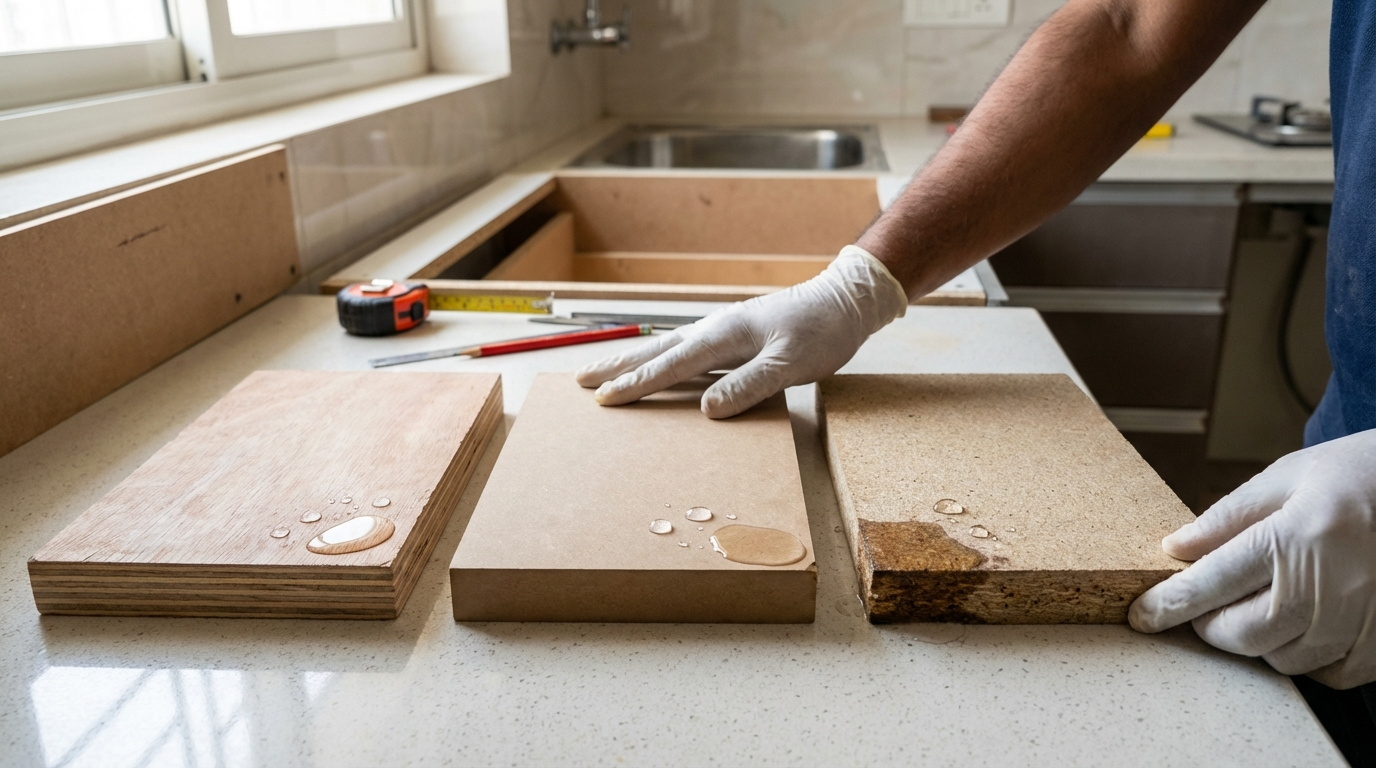
Kitchen cabinets, heavy-duty furniture, and any area where it might get wet are not the best places for it. Lower kitchen cabinets near sinks, bathroom vanities, and outdoor furniture should always use BWR plywood or marine-grade alternatives. Blockboard is not suitable for outdoors as it absorbs moisture and can warp.
How to Choose the Right Block Board
Selecting block board requires understanding your project requirements, local climate conditions, and the skill level of your carpenter. Here's a decision framework that works across Indian market realities.
Buyer Checklist
- Check for IS 1659 marking: Compliance with IS 1659:2004 is mandatory for manufacturers seeking BIS certification, as per the Wood Based Boards (Quality Control) Order, 2023. Look for the ISI mark on the board.
- Assess thickness needs: Typically, blockboard is available in 18mm, 25mm, and 30mm sizes. Thicker boards are stronger and better for large panels, whereas thinner boards are suitable for doors and smaller pieces.
- Specify grade based on location: MR grade for bedrooms and living areas; BWP grade for kitchens and humid climates
- Verify core material: Pine/poplar for standard applications; hardwood core for high-stress furniture
- Check for gaps in battens: Hold the board at eye level against light—visible gaps indicate poor quality
- Verify uniform thickness: Measure at multiple points with a caliper; variation exceeding 0.5mm indicates calibration issues
- Ask about face veneer species: Gurjan and okoume offer better finishing surfaces than generic hardwood
Thickness Selection Guide
| Thickness | Recommended Applications | Weight Bearing Capacity |
|---|---|---|
| 16mm | Interior doors, light partitions | Low to moderate |
| 19mm | Wardrobe shutters, standard furniture, shelves | Moderate |
| 25mm | Dining tables, conference tables, large doors | Good |
| 30–35mm | Heavy-duty tables, specialized applications | High |
When NOT to Choose Block Board
Inside blockboards, there are gaps between the wooden battens which give it low weight bearing capacity and may break if things get stored on them. Plywood is stronger and without gaps makes it a better option for horizontal construction.
Avoid block board for:
- Kitchen base units (sink area, under-counter storage)
- Bathroom furniture of any kind
- Modular furniture requiring CNC routing on edges
- Load-bearing horizontal surfaces exceeding 50 kg
- External applications or covered balconies
- Furniture exposed to termite-prone ground floors without treatment
Common Mistakes to Avoid When Buying Block Board
Understanding typical errors helps you avoid costly replacements and furniture failures down the line. These mistakes are commonly observed across Indian markets from metro dealers to small-town hardware stores.
1. Using MR Grade in Humid Areas
Commercial (MR) grade block board is not designed for kitchens, even in the relatively dry interiors of North Indian cities. The steam from cooking and occasional splashes will eventually delaminate MR-grade boards within 3-5 years. Always specify BWP grade for any kitchen application, regardless of whether it's a wall unit or base cabinet.
2. Ignoring Core Quality
Budget block boards often have poorly seasoned battens with excessive gaps. Duroboard blockboards are double-pressed ensuring no gaps or knots in joints and a wrap-free surface. It is made from kiln-dried seasoned timber which naturally resists termites. Boards with visible knots or gaps will show undulations after laminate application.
3. Assuming All Brands Offer Same Quality
Whether you want to select Blockboards, Plywood, or a combination of both depends on your contractor or the availability of good-grade Blockboards. In South and Western India, high-quality Blockboards are not readily available, and most contractors have found a way around this scarcity. Nonetheless, it is a compromise. Regional availability varies significantly; branded products available in Delhi may not reach Tier-3 towns in original form.
4. Using Block Board for Heavy Shelving
Despite its stiffness, block board has directional weakness. Shelves that will hold books or kitchenware should use plywood or have additional support battens underneath. The gaps between core strips can cause localized failure under concentrated loads.
5. Skipping Edge Banding
Exposed block board edges reveal the batten gaps and absorb moisture faster than face surfaces. Always specify edge banding with ABS or PVC strips—Indian carpenters often skip this step to save time, compromising durability significantly.
Quick Inspection Checks
- Tap test: Tap the board surface with knuckles; hollow sounds indicate voids in the batten arrangement
- Flex test: Apply gentle pressure at the center of an 8x4 sheet; excessive flex indicates thin core battens
- Edge inspection: Check cut edges for visible gaps between battens—should be less than 1mm
- Weight check: Compare similar-sized boards; unusually light weight suggests lower-density wood or excessive gaps
- Smell test: Strong chemical odor indicates high formaldehyde content—problematic for enclosed rooms
Block Board Price Guide 2026
The cost of a Blockboard depends on several factors, including the quality of the board, its brand, thickness, finish, durability, and overall build quality. Besides, the supply chain disruptions and transportation costs also affect the final price.
Price Ranges by Grade and Thickness
| Type/Grade | Thickness | Price Range (₹/sq ft) | Typical Brand Tier |
|---|---|---|---|
| Commercial (MR) | 19mm | ₹75–110 | Economy/Regional |
| Commercial (MR) | 19mm | ₹95–130 | National Brands |
| Commercial (MR) | 25mm | ₹90–140 | Economy/Regional |
| BWP/Waterproof | 19mm | ₹100–150 | National Brands |
| BWP/Waterproof | 25mm | ₹120–180 | National Brands |
| Premium/Marine | 19mm | ₹130–200 | Premium Brands |
Assumptions: Prices based on metro city dealers (Delhi, Mumbai, Bengaluru, Chennai) in January 2026. Add 10-20% for Tier-2 cities due to transport costs. Prices are for standard 8x4 feet sheets. GST at 18% applies additionally on most engineered wood products.
Factors Affecting Block Board Prices
Their price range may vary depending upon the type of inner core wood species used (softwood or hardwood), size and thickness of the sheet.
- Core wood species: Pinewood cores cost less than hardwood; Indian poplar sits in between
- Face veneer quality: Okoume and gurjan veneers command premiums over generic hardwood
- Adhesive grade: Phenol-formaldehyde (BWP) costs 15-25% more than urea-formaldehyde (MR)
- Calibration: Fully calibrated boards (uniform thickness across surface) cost more but are essential for laminate finishing
- Brand positioning: National brands like Greenply, Century, and Duro typically command 20-40% premium over regional manufacturers
- Transport distance: Most manufacturing is concentrated in Punjab, Haryana, and Gujarat; Southern and Eastern markets pay higher delivered costs
Budget vs Premium: Which Makes Sense?
For applications like interior bedroom doors or wardrobe backs (not visible), economy-grade block board works adequately. However, for dining tables, visible cabinet shutters, or anything in a humid area, investing in branded BWP-grade products typically pays off through longer service life and fewer warping complaints. The 20-30% premium often saves multiple times that amount in replacement costs over a 10-year furniture lifecycle.
Carpenter's Perspective on Block Board
Carpenters find block boards easy to work with. Enhanced ability to hold screws in place. Understanding how skilled carpenters view this material helps homeowners make better decisions.
Working Characteristics
It is a little difficult to cut as compared to blockboard and will also splinter badly when cut. It is easy to work with and can be cut using regular wood work tools. (Referring to plywood being harder to cut, while block board cuts cleaner.) This ease of cutting reduces labour time and tool wear—important considerations for carpenters working on fixed-price contracts.
Block board accepts nails and screws better at the edges than plywood does, though screwing into the middle (between battens) requires pilot holes and may not hold as firmly. Experienced carpenters plan their joinery to place screws near the batten lines where holding power is maximum.
Edge Finishing Reality
Unlike plywood's layered edge which shows a decorative pattern, block board edges reveal the raw batten arrangement. This makes edge banding non-negotiable for visible edges. In metro cities, factory-applied edge banding on pre-cut panels is increasingly available. In Tier-2 and Tier-3 markets, on-site edge banding using portable machines or manual application remains standard.
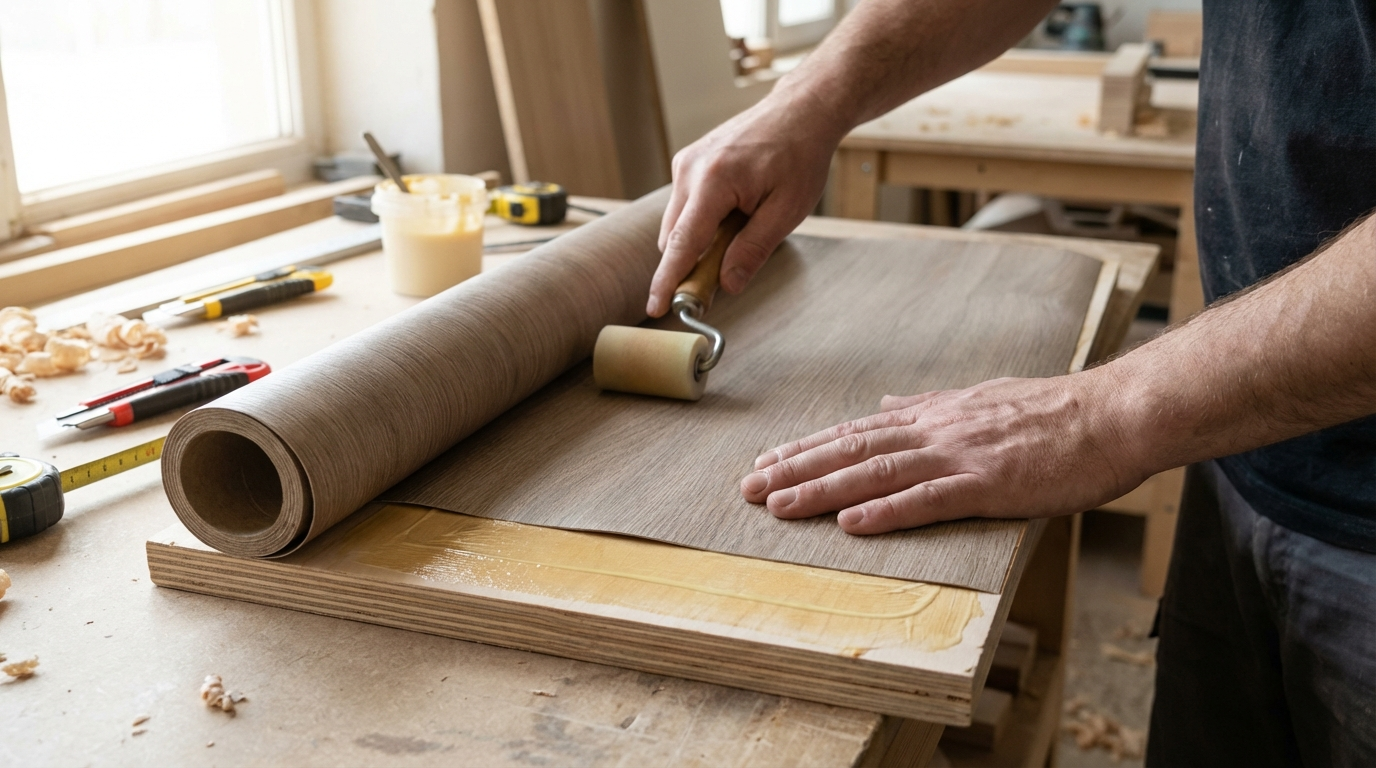
Laminate and Veneer Application
Blockboards are recognized for their ease of finishing and machining, which allows them to be easily cut, routed and shaped, making them suitable for complex patterns and customization. Their outer veneer layers provide a smooth and attractive surface that readily accepts various treatments, such as paint, varnish, or laminates.
For high-pressure laminate (HPL) application, fully calibrated block boards are essential. Non-calibrated boards create uneven laminate surfaces that are visible under certain lighting angles—a common complaint with budget furniture.
Regional Considerations Across India
Block board performance varies significantly based on regional climate conditions. Here's what to consider based on your location.
Coastal Regions (Mumbai, Chennai, Kochi, Kolkata)
Year-round humidity exceeding 70% stresses even BWP-grade block boards. Use marine-grade where available, ensure proper lamination on all surfaces including backs, and specify anti-fungal treatments. Block board furniture in coastal homes typically shows first signs of edge swelling within 3-4 years if not properly sealed.
Humid Northern Plains (Bihar, Eastern UP, Bengal)
Monsoon humidity combined with winter condensation creates challenging conditions. BWP grade is recommended for all applications; MR grade should be limited to well-ventilated upper floor rooms only.
Dry Northern/Western Regions (Rajasthan, Gujarat, Punjab)
Lower humidity benefits block board longevity. MR grade performs adequately for most interior applications. However, extreme temperature variations can cause checking (surface cracks) in inferior-quality boards.
Southern Plateau (Bengaluru, Hyderabad)
Whether you want to select Blockboards, Plywood, or a combination of both depends on your contractor or the availability of good-grade Blockboards. In South and Western India, high-quality Blockboards are not readily available. This availability challenge means Southern buyers often pay premiums for quality block board shipped from Northern manufacturing hubs, or rely more heavily on plywood alternatives.
5-Year Durability Outlook
Understanding realistic lifespan expectations helps you budget appropriately and plan maintenance schedules.
Best-Case Scenarios (10-15 years)
- BWP-grade block board in dry interior applications
- Properly laminated and edge-banded on all surfaces
- Air-conditioned environments with controlled humidity
- Wall-mounted furniture (no floor contact)
Typical Performance (5-8 years)
- MR-grade block board in moderately humid areas
- Kitchen upper cabinets (away from cooking steam)
- Bedrooms and living rooms in most Indian cities
Potential Problem Areas (3-5 years before issues)
- MR-grade in coastal/humid regions
- Improperly sealed edges near sinks or water sources
- Ground-floor furniture in termite-prone areas without treatment
- Non-calibrated boards under HPL (shows waviness)
Frequently Asked Questions
What is the full form of BWP grade in block board?
BWP stands for Boiling Water Proof, indicating that the block board uses phenol-formaldehyde adhesive that can withstand prolonged exposure to boiling water during testing. In practical terms, BWP-grade block board resists humidity and occasional water splashes far better than MR (Moisture Resistant) grade. However, it's important to understand that BWP doesn't mean fully waterproof—prolonged submersion or continuous water contact will still damage the wood core eventually. For Indian conditions, BWP grade is recommended for kitchens, humid coastal areas, and any location prone to monsoon humidity.
Which is better for wardrobes: block board or plywood?
Block board is suitable for wardrobes, doors, and shelves where lightweight panels are needed. For wardrobe shutters and doors, block board typically performs better due to its lighter weight (reducing hinge stress) and better sag resistance over long spans. However, for internal shelves that will bear heavy loads, plywood is preferred. Plywood is better for furniture that needs higher strength, such as beds, sofas, and kitchen cabinets. The ideal approach in Indian carpentry practice is using block board for shutters and plywood for carcass sides and heavily-loaded shelves.
Is block board good for kitchen cabinets?
A block board can be used in kitchen cabinets only in dry, low-moisture areas. For sinks, lower cabinets, or spaces exposed to steam and spills, plywood is the safer and longer-lasting choice. Upper kitchen cabinets away from the cooking area can use BWP-grade block board with proper laminate finishing. However, base cabinets near sinks, the area behind cooktops, and cabinets below gas hobs should always use BWR plywood due to higher moisture exposure. In practical Indian kitchen conditions, many interior designers now specify plywood throughout for consistency and reduced failure rates.
What is block board price in India per sheet?
Block board prices in India vary significantly based on grade, thickness, and brand. For a standard 8x4 feet (32 square feet) sheet, expect: Commercial/MR grade 19mm: ₹2,400–₹3,500 per sheet; BWP grade 19mm: ₹3,200–₹5,000 per sheet; Commercial grade 25mm: ₹3,000–₹4,500 per sheet; BWP grade 25mm: ₹4,000–₹6,000 per sheet. The price approximately ranges for commercial blockboard from 90 to 150 Rs/Sq.ft. and for water proof blockboard from 120 to 200 Rs/Sq.ft. These ranges apply to metro cities; Tier-2 and Tier-3 markets may see 10-20% higher prices due to transport costs.
How to check block board quality before buying?
Start with visual inspection: check for the ISI mark indicating IS 1659 compliance. The standard sets out requirements for the dimensional accuracy, strength, durability, and resistance to environmental changes such as humidity and temperature. Hold the board at eye level to check for surface undulations. Examine cut edges—gaps between battens should be minimal (under 1mm). Tap the surface at multiple points; hollow sounds indicate voids. Check thickness uniformity using a caliper at corners and center. Finally, verify the brand reputation through local carpenter feedback—they work with these materials daily and know which brands perform reliably.
What thickness of block board is best for doors?
Due to its stability and strength, these Blockboards are popularly used for indoor applications like partition walls, cabinetry, and furniture. Besides, this warp-resistant, durable material is often used to make shelves, doors, and other structural elements. For interior flush doors, 19mm thickness is standard and adequate. External-facing bedroom or bathroom doors benefit from 25mm for better sound insulation and sturdiness. Commercial establishments often specify 30mm for main entry doors. The thickness should also account for your door frame rebate—consult your carpenter to ensure compatibility with existing frames if you're replacing doors in renovation projects.
Can block board be used for bed frames?
Block board can be used for bed headboards, footboards, and side panels where the material serves a structural enclosure role rather than direct load-bearing function. However, for the central platform or slats that directly support mattress weight, plywood is the better choice due to its consistent strength across all directions. Block board is strong, but mostly in one direction. Since the wooden blocks inside run parallel, it handles vertical loads well. But it may not be as sturdy as plywood when it comes to horizontal stress or bending. A practical approach is using block board for the visible frame structure and plywood for the hidden load-bearing platform.
What is the difference between block board and particle board?
Block board and particle board are fundamentally different products. Block board consists of solid wood battens sandwiched between veneers—it retains much of solid wood's structural characteristics. Particleboards or chipboards are engineered wood products made using wooden products like sawmill remains and general wood. These wooden raw materials are first sent to a wood chipping machine to chip them into smaller flakes; these flakes are then filtered to various sizes and mixed with adhesives and resins to form a board. Block board offers superior screw holding, moisture resistance, and longevity compared to particle board. However, particle board costs significantly less and is suitable for budget furniture in dry conditions. For Indian homes, block board is appropriate for long-term furniture while particle board suits temporary or rental accommodations.
Disclaimer: This content is provided for general informational purposes based on industry practices and publicly available information. Product specifications, standards, prices, and availability may vary by manufacturer, region, and time. Readers should independently verify details with manufacturers, dealers, or qualified professionals before making purchase or construction decisions.Want Plywood Suggestions?
Share a few details and a Apple Ply specialist will suggest suitable brands and connect you to responsive dealers.