Best Plywood for Kitchen: Complete Selection Guide
Choose the best plywood for your kitchen - compare BWP, marine & waterproof options. Expert guide to kitchen cabinet plywood selection.
Quick Answer
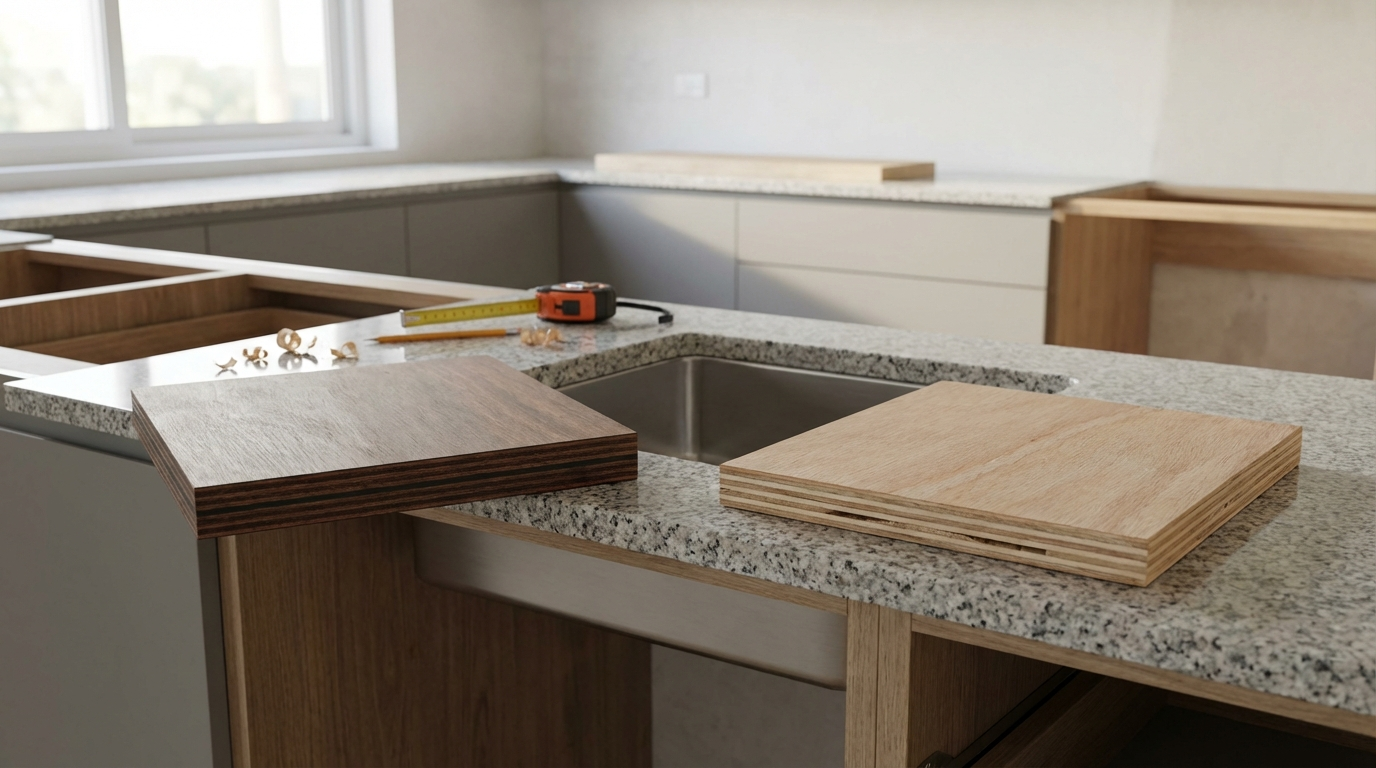
The best plywood for kitchen applications in India is BWP (Boiling Water Proof) grade plywood, also known as marine-grade plywood conforming to IS 710 standards. This waterproof plywood withstands continuous moisture exposure from sinks, steam, and spills—making it essential for kitchen cabinet carcasses, under-sink units, and countertop bases where water contact is unavoidable.
At a Glance:
- BWP/Marine grade (IS 710) is the recommended standard for all wet kitchen zones
- BWR grade works for upper cabinets and dry storage areas at lower cost
- 18mm thickness is standard for cabinet carcasses; 12mm for backs and partitions
- Calibrated plywood ensures precision fit in modular kitchen installations
- Price ranges from ₹85–150 per sq ft depending on brand tier and city
- Always verify ISI marking and conduct the boiling water test before bulk purchase
Understanding Kitchen Plywood Requirements
Kitchen environments present the harshest conditions for any wood-based material in residential interiors. Unlike bedroom wardrobes or living room furniture that experience minimal moisture, kitchen plywood faces a relentless assault from multiple water sources—steam rising from cooking, splashes near sinks, condensation from refrigerators, and occasional flooding from plumbing failures. This constant moisture cycling demands plywood engineered specifically for wet conditions.
The Indian kitchen context adds unique challenges. Most homes experience significant humidity variations between monsoon and summer months, with coastal cities like Mumbai, Chennai, and Kolkata seeing humidity levels exceeding 80% for extended periods. Traditional open kitchens in older homes lack proper ventilation, trapping moisture inside cabinets. Even modern modular kitchens with chimneys and exhausts cannot eliminate the fundamental moisture exposure that occurs during daily cooking activities.
Why Standard Commercial Plywood Fails in Kitchens
MR (Moisture Resistant) grade plywood, commonly sold as "commercial ply," uses urea-formaldehyde adhesive that provides only surface-level moisture resistance. When exposed to sustained humidity or direct water contact, this adhesive breaks down within 6–18 months, causing the veneer layers to separate—a failure known as delamination. Once delamination begins, the plywood rapidly loses structural integrity, leading to sagging shelves, warped cabinet doors, and eventual collapse of entire units.
The false economy of using MR plywood in kitchens becomes apparent when replacement costs are factored in. A modular kitchen built with inappropriate plywood typically requires partial or complete reconstruction within 3–5 years, whereas properly specified BWP plywood installations routinely last 15–20 years with basic maintenance.
Types of Plywood Suitable for Kitchen Applications
Selecting the right plywood grade for different kitchen zones requires understanding the moisture exposure levels each area faces. Not every cabinet needs the highest-grade waterproofing—strategic grade allocation optimizes both performance and budget.
BWP Grade Plywood (Boiling Water Proof)
BWP plywood represents the gold standard for kitchen applications in India. Manufactured using phenol-formaldehyde resin under high pressure, this grade withstands immersion in boiling water for extended periods without delamination. The IS 710 specification governs BWP plywood manufacturing, ensuring consistent quality when purchased from certified sources. This grade is essential for sink cabinets, dishwasher surrounds, and any unit below countertop level where water accumulation is possible.
BWR Grade Plywood (Boiling Water Resistant)
BWR plywood offers intermediate moisture protection using phenolic or melamine-fortified resins. While not fully waterproof, quality BWR plywood resists moisture penetration for 8+ hours under testing conditions. This grade suits upper kitchen cabinets, tall units away from water sources, and pantry storage where humidity rather than direct water contact is the primary concern. BWR typically costs 15–25% less than equivalent BWP panels, making it a practical choice for dry zones.
Marine Plywood
True marine plywood exceeds standard BWP specifications with superior core veneer selection and more stringent quality control. Originally designed for boat building, marine plywood uses hardwood throughout with minimal core gaps and defect-free veneers. For residential kitchens, standard BWP plywood meeting IS 710 provides adequate protection—marine grade is typically specified only for commercial kitchens with industrial-level water exposure or homes in flood-prone areas.
Calibrated Plywood for Modular Kitchens
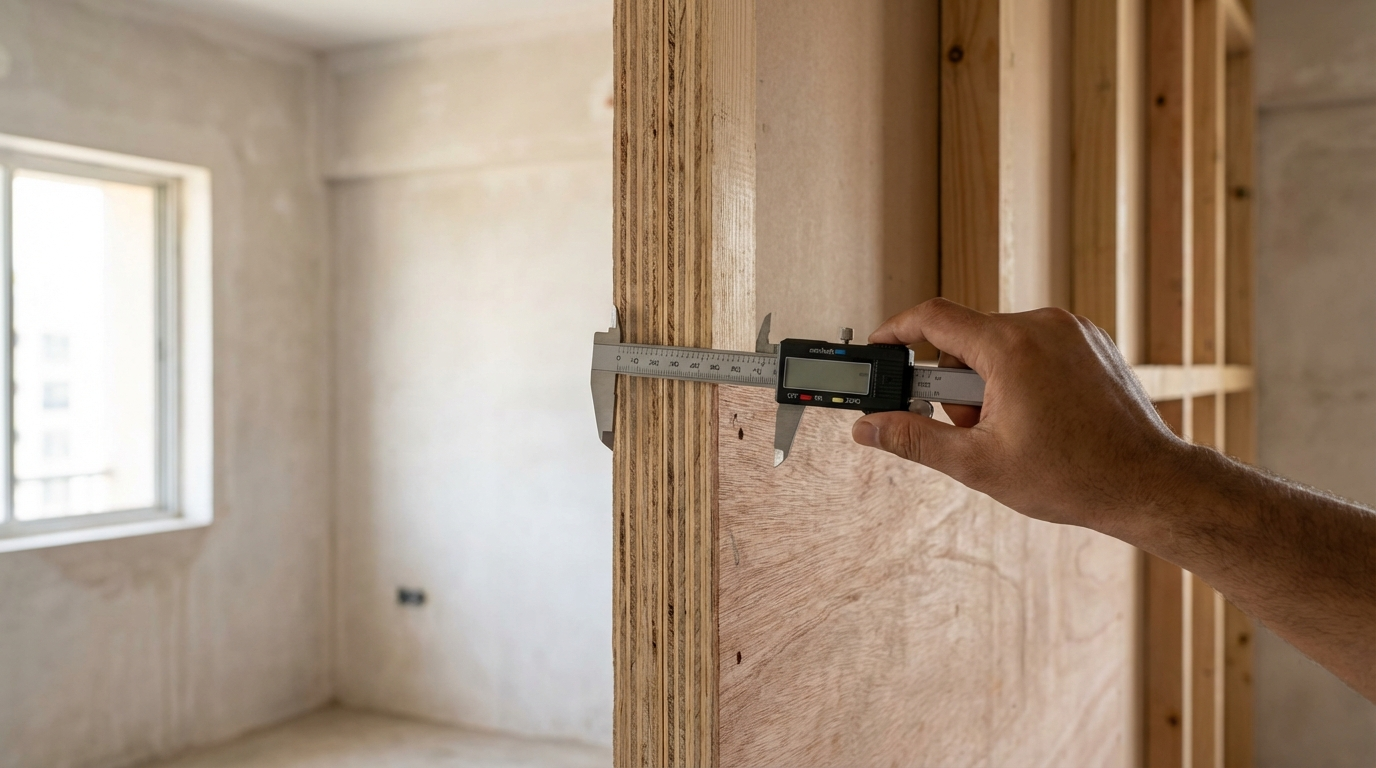
Modern CNC-cut modular kitchens require plywood with precise, uniform thickness across the entire sheet. Calibrated plywood undergoes additional sanding to achieve thickness consistency within ±0.2mm tolerance. This precision prevents the gaps, misalignments, and fitting issues that plague non-calibrated installations. Most branded modular kitchen manufacturers mandate calibrated BWP plywood to maintain warranty validity.
Kitchen Plywood Comparison Table
| Plywood Grade | Water Resistance | Typical Price (₹/sq ft) | Best Kitchen Applications | Expected Lifespan |
|---|---|---|---|---|
| MR Grade (IS 303) | Low—surface moisture only | ₹45–65 | Not recommended for kitchens | 1–3 years in kitchen use |
| BWR Grade (IS 303) | Moderate—resists humidity | ₹65–90 | Upper cabinets, pantry units, dry storage | 8–12 years |
| BWP Grade (IS 710) | High—fully waterproof | ₹85–120 | Sink units, base cabinets, countertop bases | 15–20 years |
| Marine Grade (IS 710) | Very High—submersion resistant | ₹110–150 | Commercial kitchens, flood-prone areas | 20+ years |
| Calibrated BWP | High—fully waterproof | ₹100–140 | CNC-cut modular kitchens | 15–20 years |
Note: Prices reflect 18mm thickness in Tier-1 cities from mid-range branded manufacturers. Actual prices vary by location, brand, and market conditions.
How to Choose the Best Plywood for Your Kitchen
Selecting kitchen plywood involves balancing water resistance requirements, budget constraints, and practical installation considerations. This decision framework helps navigate the options systematically.
Zone-Based Grade Selection
Divide your kitchen into moisture zones before specifying plywood grades. High-moisture zones—under sink, around dishwasher, near cooking range, below countertops—require BWP grade without exception. Medium-moisture zones—upper cabinets, tall units, breakfast counter bases—can use BWR grade safely. Dry zones—pantry interiors, storage above refrigerator—technically allow MR grade, though using BWR throughout simplifies procurement and provides safety margin.
Thickness Selection Guide
Cabinet carcasses (sides, top, bottom panels) require 18mm thickness for structural stability and adequate screw-holding capacity. Shelves exceeding 600mm span should also use 18mm to prevent sagging under load. Back panels and internal partitions can use 12mm or even 9mm plywood since they bear minimal weight. Drawer components typically use 12mm for sides and 6mm for bottoms. Specifying appropriate thickness for each component prevents both over-engineering and structural weakness.
Buyer's Checklist for Kitchen Plywood
- Verify ISI marking with valid license number on every sheet
- Check for IS 710 stamp on BWP plywood—IS 303 indicates lower grade
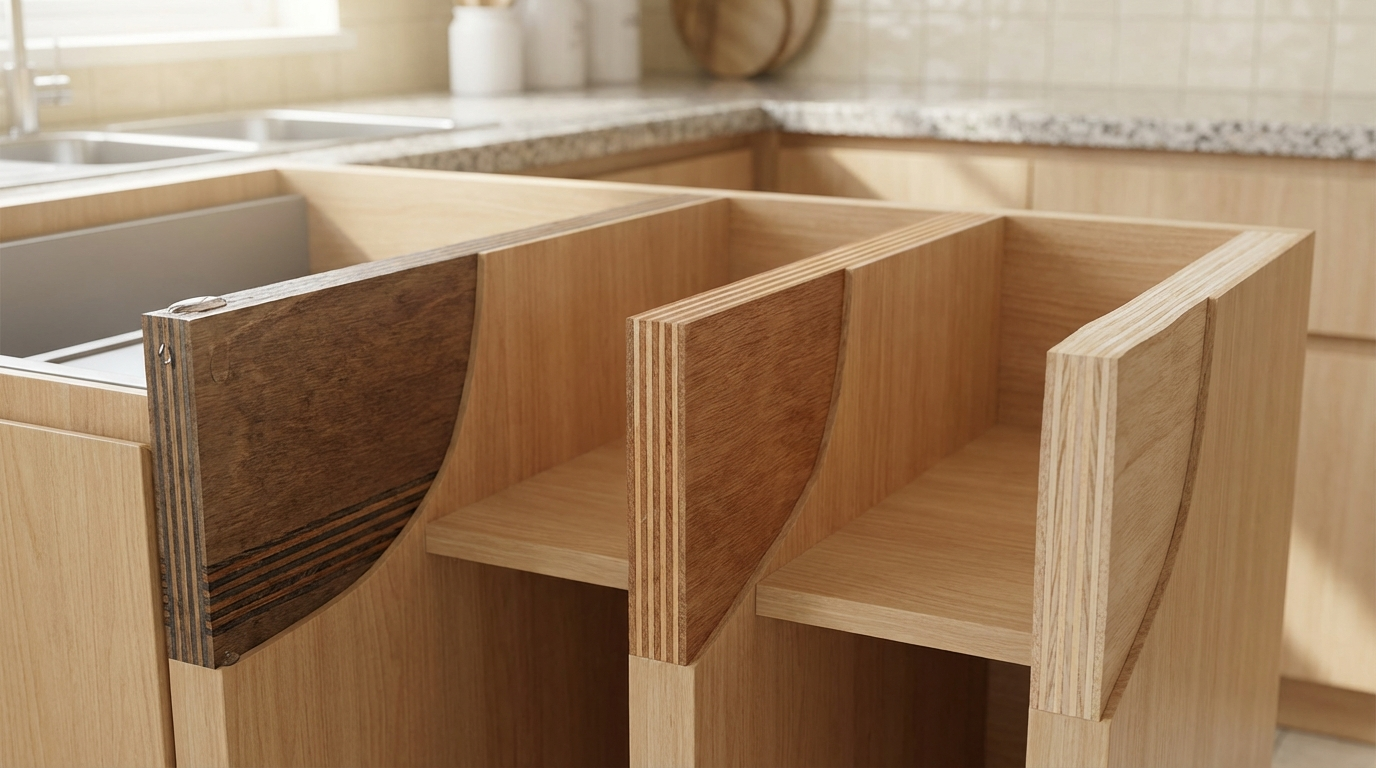
- Inspect sheet edges for core voids and gaps between veneers
- Request boiling water test certificate or conduct visual test on sample
- Confirm calibrated thickness if intended for CNC machining
- Verify termite and borer treatment certification for added protection
- Compare pricing across 3–4 dealers—significant variation indicates grey market stock
When NOT to Choose BWP Plywood
BWP plywood represents unnecessary expense for certain applications. Internal drawer components rarely contact water directly—BWR suffices. Decorative panels and fascia boards that receive laminate or veneer finishing derive most moisture protection from the surface layer rather than the substrate. Pantry interiors storing dry goods experience humidity levels similar to bedrooms. Allocating BWP exclusively to high-risk zones and BWR elsewhere can reduce material costs by 15–20% without compromising durability.
Common Mistakes to Avoid When Selecting Kitchen Plywood
Years of observing kitchen installations reveal predictable patterns of failure—most stemming from specification shortcuts rather than manufacturing defects. Understanding these mistakes helps buyers and contractors make better decisions.
Trusting Labels Without Verification
The Indian plywood market contains significant volumes of mislabeled product. BWR plywood sold as BWP, MR plywood marketed as "waterproof," and non-ISI stock carrying fake certification marks represent common frauds. The boiling water test—submerging a small sample in boiling water for 72 hours—reveals adhesive quality definitively. Legitimate manufacturers welcome this test; resistance to testing suggests questionable product.
Specifying Single Grade Throughout
Using MR plywood everywhere (common in budget projects) guarantees premature failure. Conversely, specifying marine grade throughout wastes money on overkill. Zone-based specification optimizes the cost-performance equation. Experienced contractors know this; those pushing single-grade solutions either lack knowledge or seek procurement simplicity over client benefit.
Ignoring Edge Treatment
Plywood edges absorb moisture faster than faces, making proper edge-banding critical in kitchens. Many installations seal faces with laminate or membrane while leaving edges exposed—these untreated edges become moisture entry points that cause internal delamination even in BWP plywood. Specify PVC edge-banding on all exposed edges, including shelf fronts and cabinet interiors.
Skipping the Acclimatization Period
Plywood delivered from godowns requires 48–72 hours to acclimatize to site humidity before cutting. Immediate fabrication causes post-installation warping as the material adjusts to ambient moisture levels. This issue intensifies during monsoon months when godown and site humidity levels differ significantly.
Quick Inspection Checks
- Weight Test: Lift the sheet—properly bonded plywood feels heavy and solid; lightweight sheets indicate poor core density
- Flex Test: Bend a corner gently—quality plywood flexes without cracking; brittle response indicates weak bonding
- Tap Test: Knock on the surface—solid, uniform sound indicates good bonding; hollow sounds reveal internal voids
- Edge Inspection: Examine edges for gaps between veneer layers—gaps indicate moisture vulnerability
- Smell Test: Strong chemical odor suggests high formaldehyde emissions—prefer E1 or E0 certified products
Kitchen Plywood Price Guide for Indian Buyers
Plywood pricing in India varies considerably based on multiple factors. Understanding these variables helps buyers interpret quotes accurately and identify suspicious pricing.
Price Determinants
Brand tier creates the largest price variation—premium brands like Greenply, Century, and Kitply command 30–50% premiums over regional manufacturers for equivalent specifications. This premium reflects consistent quality control, wider dealer networks, and warranty support rather than fundamentally different materials. For buyers unable to verify quality independently, branded plywood reduces risk.
City location affects pricing through transport costs and dealer margins. Tier-1 cities with multiple dealers see competitive pricing; Tier-2 and Tier-3 cities with limited dealers often charge 10–20% premiums. Proximity to manufacturing clusters (Yamunanagar, Perumbavoor, Gandhidham) reduces transport cost component.
Thickness directly impacts price—18mm plywood costs approximately 40% more than 12mm of equivalent grade. Calibrated plywood adds 10–15% over non-calibrated equivalent. Fire-retardant and zero-emission certifications add further premiums.
Expected Price Ranges (2024–2026)
| Specification | Economy Brands (₹/sq ft) | Mid-Range Brands (₹/sq ft) | Premium Brands (₹/sq ft) |
|---|---|---|---|
| BWR 12mm | ₹45–55 | ₹55–70 | ₹70–85 |
| BWR 18mm | ₹65–80 | ₹80–95 | ₹95–115 |
| BWP 12mm | ₹60–75 | ₹75–90 | ₹90–110 |
| BWP 18mm | ₹85–100 | ₹100–125 | ₹125–150 |
| Calibrated BWP 18mm | ₹95–115 | ₹115–140 | ₹140–170 |
Note: Prices assume Tier-1 city procurement with GST. Actual prices vary by dealer, quantity, and market conditions.
Budget Allocation Strategy
For a typical 100 sq ft modular kitchen, plywood constitutes 20–30% of total project cost. Allocating 60% of plywood budget to BWP for base units and 40% to BWR for upper cabinets optimizes expenditure. Attempting to save by substituting MR plywood typically results in replacement costs exceeding the initial savings within 3–5 years.
Regional Considerations for Kitchen Plywood in India
India's diverse climate zones create varying demands on kitchen plywood. Specifications appropriate for dry inland cities may prove inadequate for coastal or high-rainfall regions.
Coastal and High-Humidity Regions
Cities like Mumbai, Chennai, Kochi, and Kolkata experience sustained high humidity combined with salt-laden air. This environment accelerates adhesive breakdown in lower-grade plywood and promotes fungal growth. Specifying BWP grade throughout the kitchen—not just wet zones—provides necessary protection. Additionally, requesting anti-fungal treatment adds defense against mold that thrives in coastal humidity.
Northern Plains and Dry Regions
Delhi NCR, Rajasthan, and other northern regions experience extreme temperature variations but lower humidity. Here, zone-based grade allocation works well—BWP for wet zones, BWR elsewhere. However, summer temperatures exceeding 45°C can cause laminate delamination if adhesive quality is compromised, making brand selection important even in dry climates.
Heavy Monsoon Areas
Kerala, coastal Karnataka, and northeastern states receive intense rainfall for extended periods. Ground-floor kitchens in these regions face flooding risks during exceptional monsoons. Specifying marine-grade plywood for base cabinets provides insurance against occasional water ingress that would destroy standard BWP installations.
Frequently Asked Questions
What is the full form of BWP plywood?
BWP stands for Boiling Water Proof plywood. This grade is manufactured using phenol-formaldehyde resin that creates waterproof bonds between veneer layers, allowing the plywood to withstand prolonged water exposure without delamination. BWP plywood conforms to IS 710 standards set by the Bureau of Indian Standards. The "boiling water" reference comes from the standard quality test where samples must survive 72 hours in boiling water without separating.
Which is better for kitchen: BWR or BWP plywood?
BWP plywood is definitively better for kitchen base cabinets, sink units, and any area with direct water exposure. BWR plywood offers adequate protection for upper cabinets and dry storage zones where humidity rather than liquid water is the concern. Using BWP throughout provides maximum protection but increases cost by 20–30%. A practical approach combines BWP for lower sections and BWR for upper cabinets, optimizing both durability and budget.
Is marine plywood necessary for residential kitchens?
Standard BWP plywood meeting IS 710 specifications provides sufficient water resistance for most residential kitchens. Marine plywood—designed for boat construction and submersion conditions—offers marginal additional protection at significant cost premium. Reserve marine grade for commercial kitchens with industrial water exposure, flood-prone ground floor installations, or outdoor kitchen applications. For typical Indian homes, quality BWP plywood delivers 15–20 years of reliable service.
What thickness of plywood is best for kitchen cabinets?
18mm thickness is the standard specification for kitchen cabinet carcasses (sides, top, bottom panels) as it provides adequate structural strength and screw-holding capacity. Shelves spanning more than 600mm should also use 18mm to prevent sagging. Back panels can use 12mm or 9mm plywood. Drawer sides typically use 12mm while drawer bottoms use 6mm plywood. Thicker plywood increases cost without proportional benefit for most applications.
How to check if plywood is genuine BWP grade?
Verify the ISI marking shows IS 710 (not IS 303, which indicates lower MR/BWR grades). Check that the license number on the stamp corresponds to a valid BIS licensee. Request a sample piece and conduct the boiling water test—submerge in boiling water for 72 hours and check for delamination. Reputable dealers provide test certificates; resistance to testing suggests questionable authenticity. Edge inspection should reveal dense, void-free core layers with tight veneer bonding.
What is the price of BWP plywood in India?
BWP plywood prices range from ₹85–150 per square foot for 18mm thickness, depending on brand tier and city. Economy brands from regional manufacturers start around ₹85–100 per sq ft. National brands like Greenply, Century, and Kitply typically price between ₹100–125 per sq ft. Premium products with additional certifications (calibrated, zero-emission, fire-retardant) reach ₹125–150 per sq ft. Always compare quoted prices against prevailing market rates—significantly lower pricing often indicates compromised quality or mislabeled grades.
Can MR plywood be used in kitchen cabinets?
MR (Moisture Resistant) plywood should not be used for any kitchen cabinet application despite its lower cost. The urea-formaldehyde adhesive in MR plywood cannot withstand the sustained humidity and occasional water exposure present in kitchens. Typical failure occurs within 1–3 years, manifesting as swelling, delamination, and structural collapse. The replacement cost invariably exceeds the initial savings from using MR instead of appropriate BWR or BWP grades.
What is calibrated plywood and is it necessary for kitchens?
Calibrated plywood undergoes precision sanding to achieve uniform thickness across the entire sheet, typically within ±0.2mm tolerance. This consistency is essential for CNC-cut modular kitchens where precise measurements ensure seamless assembly. Non-calibrated plywood varies in thickness across the sheet, causing fitting issues, gaps, and alignment problems in modular installations. If using traditional carpenter-built cabinets with manual cutting, standard plywood suffices. For factory-manufactured modular kitchens, calibrated plywood is typically mandatory.
Disclaimer: This content is provided for general informational purposes based on industry practices and publicly available information. Product specifications, standards, prices, and availability may vary by manufacturer, region, and time. Readers should independently verify details with manufacturers, dealers, or qualified professionals before making purchase or construction decisions.Want Plywood Suggestions?
Share a few details and a Apple Ply specialist will suggest suitable brands and connect you to responsive dealers.