Saburi Plywood: Brand Review, Products & Quality Analysis
Complete Saburi Plywood review - product range, quality standards, price & customer feedback. Is Saburi a good plywood brand?
Quick Answer
Saburi Plywood is a Kolkata-based plywood manufacturer with over two decades of industry presence, offering a range of plywood, block boards, flush doors, and engineered panels. The brand positions itself in the mid-to-premium segment with products featuring imported Gurjan and hardwood core veneers, making it a practical choice for furniture, interior, and construction applications across India.
At a Glance
- Brand Heritage: Established in 1990 by Mr. Gajanand Munka in Kolkata, operating for over 30 years
- Core Strength: Imported Gurjan and hardwood veneers with termite and borer resistance
- Product Range: BWR/Marine plywood, block boards, flush doors, flexi ply, shuttering plywood, WPC, and PVC panels
- Manufacturing: Automated production with in-house quality control and recycling processes
- Market Positioning: Mid-to-premium tier, stronger dealer network in Eastern India
- Certifications: CVI certified for sustainability; products claim recyclability and eco-friendly processing
Saburi Plywood: Brand Overview and History
Understanding a plywood brand's background helps gauge its reliability and long-term market commitment. Saburi Ply emerged from the traditional plywood manufacturing hub of Kolkata, which historically housed several prominent panel product manufacturers due to proximity to raw material sources and port access for imported veneers.
The company was founded in 1990 under the leadership of Chairman Mr. Gajanand Munka. Over three decades, Saburi has expanded from a regional player to a pan-India supplier, though its strongest presence remains in Eastern and North-Eastern states. The parent entity, Saburi Panels Pvt. Ltd., handles the complete product ecosystem including plywood, laminates, doors, WPC, and PVC products.
Manufacturing Philosophy
Saburi operates with an automated manufacturing setup that emphasizes consistency across production batches. Their process flow includes log sectioning, rotary peeling, clipping, controlled drying, moisture testing, core composing, hot pressing, calibrated sanding, and preservative treatment before final inspection.
In practical Indian market terms, this level of process documentation typically indicates a mid-to-premium manufacturer rather than a small-scale or semi-organized player. The brand claims dual-calibrated surfaces for thickness consistency—an important factor for CNC machining and modular kitchen applications where precision matters.
Sustainability Claims
Saburi emphasizes environmental responsibility through several measures. Their in-house recycling process aims to maximize raw material utilization, and they source wood from managed forest farms rather than natural forests. The brand holds CVI certification for producing recyclable, non-polluting products using energy-efficient processes. For environmentally conscious buyers, these credentials place Saburi above unorganized manufacturers, though verification through physical product inspection remains advisable.
Saburi Plywood Product Range Explained
Saburi offers a diversified product portfolio spanning traditional plywood to modern engineered panels. Understanding each product line helps match the right material to your specific application requirements.
Perennial Plywood
Positioned as their flagship offering, Perennial Plywood targets high-moisture and long-term durability applications. This grade typically features enhanced bonding and treatment for extended service life. Best suited for premium residential furniture and areas requiring superior structural integrity.
Club H+ Plywood
The Club H+ range represents Saburi's enhanced MR (Moisture Resistant) grade with additional treatment for improved performance. This product fills the gap between standard commercial plywood and full marine-grade specifications, making it suitable for bedroom and living room furniture in moderately humid conditions.
Gold 710 Marine Plywood
Saburi's BWR (Boiling Water Resistant) offering carries the Gold 710 branding. The "710" designation commonly references IS:710 specification in Indian plywood trade, indicating boiling water resistance suitable for kitchen cabinets, bathroom vanities, and areas with high moisture exposure. This grade uses phenolic resin bonding that can withstand water immersion without delamination.
Fire Retardant Plywood
For commercial projects, public buildings, and applications requiring fire safety compliance, Saburi offers fire retardant treated plywood. This product undergoes chemical treatment to resist ignition and slow flame spread. Increasingly specified in office interiors, hospitality projects, and healthcare facilities where fire safety codes mandate such materials.
Specialty Products
Beyond core plywood, Saburi manufactures Gold 710 Block Boards for door shutters and large panels, Gold 710 Flush Doors for ready-to-install door solutions, Flexi Plywood for curved furniture applications, Shine Platinum Film Face Shuttering Plywood for construction formwork, and Modwud Particle Boards for budget applications. Their Smart Panels division covers WPC and PVC boards, frames, and doors for moisture-proof alternatives in wet areas.
Saburi Plywood Quality Analysis
Evaluating plywood quality requires examining multiple parameters from raw materials to finished product characteristics. Saburi's quality proposition centers on several key factors.
Core Material Quality
Saburi claims to use imported Gurjan and hardwood core veneers across their product range. Gurjan (Dipterocarpus) veneer is considered premium in the Indian plywood industry due to its density, straight grain, and natural durability. Products manufactured from genuine Gurjan cores typically exhibit better screw-holding strength, reduced warping tendency, and improved load-bearing capacity compared to softwood or plantation timber cores.
Bonding and Glue Quality
The glue line determines plywood's resistance to moisture and delamination—the most common failure mode. Saburi's marine grade products use phenolic (PF) resin while MR grades employ urea-formaldehyde (UF) adhesives. Their automated glue spreading and hot pressing with numerically controlled temperature and pressure parameters suggests consistent bonding across sheets, reducing batch-to-batch variation that plagues smaller manufacturers.
Surface and Calibration
For furniture applications, surface smoothness and thickness consistency directly impact finishing quality and fitting precision. Saburi emphasizes dual-calibrated sanding that delivers uniform thickness—particularly important for modular kitchen manufacturers using CNC routers where thickness variation causes machining errors and fitting issues.
Treatment and Preservation
Saburi products claim termite and borer resistance through preservative treatment. In the Indian context, where termite damage causes significant furniture losses especially in ground-floor and older buildings, this treatment adds practical value. However, treatment depth and chemical concentration vary across manufacturers, so physical verification through product stamps and certificates remains prudent.
Saburi Plywood Product Comparison Table
| Product | Grade Type | Moisture Resistance | Best Applications | Price Tier |
|---|---|---|---|---|
| Perennial Plywood | Premium BWR | High (Boiling Water Resistant) | Premium furniture, high-end interiors | Premium |
| Club H+ Plywood | Enhanced MR | Moderate-High | Bedroom wardrobes, living room units | Mid-Premium |
| Gold 710 Marine | BWR/Marine | High (IS:710 compliant) | Kitchen cabinets, bathroom vanities | Mid-Premium |
| Fire Retardant | Special Purpose | Moderate-High | Commercial interiors, offices, hospitals | Premium |
| Gold 710 Block Board | BWR Block Board | High | Door shutters, large tabletops, partitions | Mid |
| Flexi Plywood | Flexible Grade | Moderate | Curved furniture, arches, pillars | Mid-Premium |
| Shine Platinum Shuttering | Film Faced | Very High | Construction formwork, concrete shuttering | Mid |
| Modwud Particle Board | Particle Board | Low | Budget furniture, office workstations | Economy |
How to Choose the Right Saburi Plywood Product
Selecting the appropriate Saburi product requires matching application requirements with product specifications. This decision framework simplifies the selection process.
Application-Based Selection
For kitchen and bathroom applications where water exposure is frequent, Gold 710 Marine Plywood is the appropriate choice. The BWR grade ensures the panel withstands humidity, splashes, and occasional water contact without delamination. For bedroom and living room furniture with minimal moisture exposure, Club H+ or standard commercial grades offer adequate performance at lower cost.
Commercial and institutional projects requiring fire safety compliance need Fire Retardant Plywood. Always verify fire rating certificates for projects requiring statutory compliance. For construction applications like concrete formwork, Shine Platinum Film Face Shuttering Plywood provides the durability and release properties needed for multiple reuse cycles.
Buyer Checklist
- Verify ISI mark and IS standard number on physical product (IS:303 for MR, IS:710 for BWR)
- Check for consistent thickness across the sheet—variation beyond 0.5mm indicates poor calibration
- Inspect core for gaps, voids, or overlapping veneers that weaken structure
- Confirm termite treatment certificate for ground-floor or termite-prone area installations
- Request physical samples before bulk ordering for large projects
- Verify dealer authorization to avoid counterfeit products
- Check face veneer quality—patches, repairs, and defects affect finishing
When NOT to Choose Saburi
Every brand has positioning limitations. Saburi may not be ideal if you require ultra-premium imported plywood with exotic face veneers—brands with specialized veneer divisions offer better options. In regions where Saburi's dealer network is sparse, after-sales support and warranty claims become challenging. For extreme coastal applications with direct salt spray exposure, specialized marine-grade products from manufacturers with coastal testing facilities may offer better assurance. If your budget is strictly economy-tier, Saburi's positioning means you may find lower-cost alternatives from regional manufacturers, though quality consistency becomes uncertain.
Common Mistakes to Avoid When Buying Saburi Plywood
Understanding common purchasing and usage errors helps maximize your investment and avoid premature product failures.
Grade Mismatch with Application
The most frequent mistake is using MR grade plywood in wet areas to save costs. Even quality MR plywood like Club H+ will eventually fail in kitchen cabinets exposed to water and steam. The price difference between MR and BWR grades is typically ₹10-15 per sq ft—negligible compared to furniture replacement costs after delamination.
Ignoring Thickness Specifications
Trade thickness naming causes confusion across Indian markets. Nominal 18mm plywood often measures 17-17.5mm actual, while 19mm trade size typically delivers true 18mm thickness. For modular kitchen applications where carcass dimensions are pre-calculated, ordering the wrong trade size creates fitting problems. Always confirm actual measured thickness, not just nominal specifications.
Skipping Physical Inspection
Even established brands have quality variation between production batches. Never order bulk quantities based solely on samples or past experience. Inspect the actual lot being delivered for core gaps, surface defects, and thickness consistency. Major projects warrant visiting the dealer godown to physically verify stock quality.
Overlooking Edge Quality
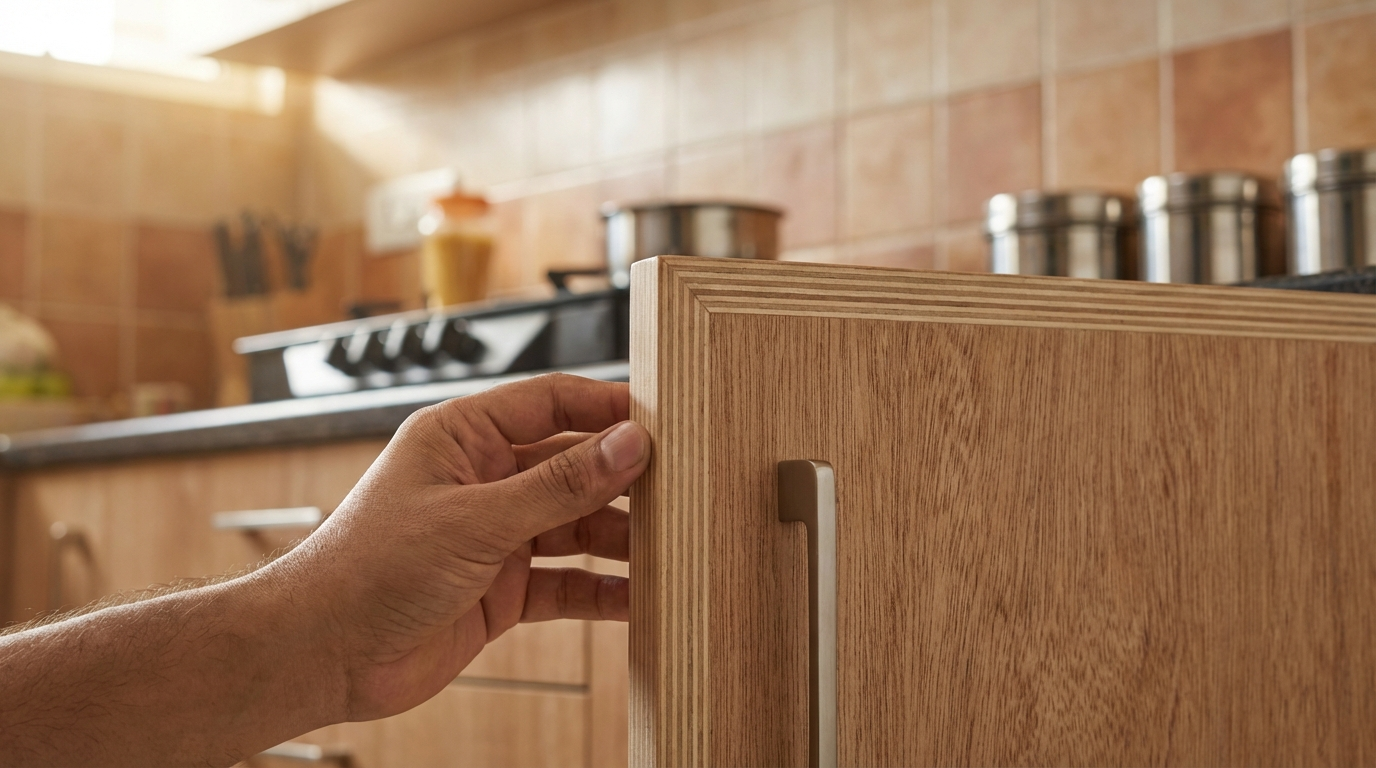
For furniture with exposed edges requiring edge-banding, check the plywood's edge quality carefully. Poor veneer layering at edges causes edge-band adhesion failure over time. Saburi's calibrated products generally offer clean edges, but damaged sheets during transport or storage compromise edge integrity.
Quick Inspection Checks
- Tap Test: Tap across the sheet surface—hollow sounds indicate core voids or delamination
- Flex Test: Gently flex a corner—excessive flexibility suggests thin or poor-quality veneers
- Edge Check: Examine edges for veneer overlap, gaps, or uneven layering
- Weight Comparison: Compare sheets from the same batch—significant weight variation indicates density inconsistency
- Surface Inspection: Run your hand across the face for roughness, undulations, or sanding marks
Saburi Plywood Price Guide
Plywood pricing in India varies significantly based on multiple factors. These indicative ranges help budget planning while acknowledging that actual prices depend on local market conditions.
Price Range by Product Category
| Product | Thickness | Price Range (₹/sq ft) | Price Range (₹/sheet 8x4) | Key Price Factors |
|---|---|---|---|---|
| Club H+ (MR Grade) | 18mm | ₹55-75 | ₹1,750-2,400 | City tier, dealer margin |
| Gold 710 Marine | 18mm | ₹70-95 | ₹2,240-3,040 | Core quality, certification |
| Perennial Premium | 18mm | ₹85-115 | ₹2,720-3,680 | Veneer grade, finish quality |
| Fire Retardant | 18mm | ₹95-130 | ₹3,040-4,160 | Treatment level, certification |
| Block Board | 19mm | ₹50-70 | ₹1,600-2,240 | Core timber species |
| Particle Board | 18mm | ₹25-40 | ₹800-1,280 | Density, surface finish |
Note: Prices indicative for 2025-26, based on metro/Tier-1 city dealer rates. Tier-2/3 cities may show 5-10% variation due to transport costs. GST @18% applicable. Bulk orders may attract 3-8% discount.
What Drives Price Variation
Core veneer origin significantly impacts pricing—imported Gurjan commands premium over domestic hardwood or plantation timber. Calibration quality and surface finishing add cost but deliver value through reduced wastage and better finishing results. Dealer margins in organized retail networks run higher than wholesale timber markets but include service and warranty backing. Transport costs create regional variations, with Kolkata and Eastern states typically seeing lower Saburi prices due to manufacturing proximity.
Regional Considerations for Saburi Plywood
India's diverse climate and market conditions necessitate region-specific product selection and sourcing strategies.
Coastal and High-Humidity Zones
In coastal cities like Mumbai, Chennai, Kolkata, and Kerala, humidity levels consistently exceed 70-80% during monsoons. Standard MR plywood struggles under these conditions regardless of brand reputation. For such regions, insist on Saburi's BWR products (Gold 710 Marine or Perennial) even for applications that might use MR grade in drier climates. The additional cost prevents premature warping and delamination commonly seen in coastal furniture after 2-3 monsoon seasons.
Termite-Prone Regions
Older buildings, ground-floor installations, and certain geographical zones face elevated termite risk. While Saburi claims termite-resistant treatment, additional precautions remain advisable. Ensure treated plywood bears proper certification, apply termite-resistant primers before installation, and maintain regular pest control schedules. North Indian plains and older construction zones require particular vigilance.
Dealer Network and Availability
Saburi maintains stronger dealer networks in Eastern India (West Bengal, Odisha, Bihar, Jharkhand, Northeast states) and select metros. In regions with sparse dealer presence, product availability becomes inconsistent, and warranty support may require shipping products to distant service centers. Before specifying Saburi for projects outside their primary markets, verify local dealer presence and service capabilities.
Carpenter's Perspective on Saburi Plywood
Understanding how plywood performs during fabrication provides practical insights beyond specification sheets.
Experienced carpenters generally report that Saburi's calibrated products machine well, producing clean cuts without excessive chipping or tear-out. The consistent thickness allows predictable carcass dimensions—particularly valuable for modular kitchen fabricators working with standardized designs. Screw-holding capacity in their Gurjan core products rates comparable to other premium brands in the segment.
For edge-banding applications, the laminated edges on Saburi sheets typically accept adhesive well, though pre-sanding remains advisable for optimal bond strength. Flexi Plywood bends smoothly for curved applications when heated appropriately, with reasonable recovery from forming stresses.
However, carpenters note that as with any brand, batch variation exists. Sheets from different production runs may show subtle differences in core density or surface texture. For visible furniture components, sourcing all sheets from a single lot ensures consistent appearance after finishing.
Frequently Asked Questions
What is the full form of Saburi Ply?
Saburi Ply is the brand name of Saburi Panels Pvt. Ltd., a plywood manufacturing company headquartered in Kolkata. The name "Saburi" itself is the brand identity rather than an abbreviation. The company operates under this name for its complete range of plywood, block boards, laminates, doors, WPC, and PVC products marketed across India.
Is Saburi Plywood good for kitchen cabinets?
Saburi Gold 710 Marine Plywood is suitable for kitchen cabinet applications due to its BWR (Boiling Water Resistant) grade construction. The phenolic resin bonding withstands moisture, steam, and occasional water exposure typical in Indian kitchens. However, always verify the IS:710 mark on physical sheets and avoid using their MR grades (like Club H+) for kitchen wet areas, as moisture resistance differs significantly between grades.
Which is better, Saburi or Century Plywood?
Century Ply enjoys larger pan-India presence and brand recognition, while Saburi offers competitive quality at often lower price points, particularly in Eastern India. Century maintains more extensive dealer networks nationwide with easier warranty access. Saburi's strength lies in value-for-money positioning and strong regional service in their core markets. Product-to-product comparison matters more than brand labels—compare specific grades rather than overall brands.
What is Saburi Plywood price in India?
Saburi Plywood prices range from approximately ₹55-75 per sq ft for 18mm MR grade to ₹85-115 per sq ft for premium BWR variants in metro cities. An 8x4 feet sheet costs between ₹1,750-3,600 depending on grade and specification. Prices vary by city tier, dealer margins, and order quantity. Eastern India typically offers lower prices due to manufacturing proximity, while Western and Southern markets may show 5-10% premium due to transport costs.
How to check Saburi Plywood quality at the shop?
Perform these checks before purchase: examine edges for void gaps or veneer overlapping; tap the surface across multiple points listening for hollow sounds indicating delamination; check thickness with a caliper at corners and center; inspect face veneer for patches, cracks, or roughness; verify ISI mark with correct IS number (303 for MR, 710 for BWR); and compare weight across sheets—significant variation suggests inconsistent core density. Request test certificates for high-value orders.
Is Saburi Plywood termite-proof?
Saburi claims termite and borer resistance through preservative treatment during manufacturing. Their products undergo chemical treatment designed to deter termite attack. However, "termite-proof" is technically imprecise—all wood products face termite risk under extreme conditions. The treatment provides resistance, not absolute immunity. For ground-floor installations or termite-prone areas, supplement with proper installation practices, apply anti-termite primers, and maintain periodic pest control.
Where is Saburi Plywood manufactured?
Saburi Plywood is manufactured in India with headquarters and primary manufacturing operations based in Kolkata, West Bengal. The company sources imported Gurjan and hardwood veneers processed through their automated manufacturing facility. Kolkata's historical importance as a plywood manufacturing hub provides advantages including skilled labor availability, port access for imported materials, and established supply chains for the Eastern Indian market.
Does Saburi Plywood offer warranty?
Saburi products carry manufacturer warranty against manufacturing defects, though specific warranty terms vary by product category and dealer. BWR and premium grades typically include longer coverage than commercial MR grades. Always obtain proper invoices with warranty cards from authorized dealers—purchases from unauthorized channels may void warranty claims. Document product details including batch numbers for any future claims, and verify local service center availability before finalizing purchases.
Disclaimer: This content is provided for general informational purposes based on industry practices and publicly available information. Product specifications, standards, prices, and availability may vary by manufacturer, region, and time. Readers should independently verify details with manufacturers, dealers, or qualified professionals before making purchase or construction decisions.Want Plywood Suggestions?
Share a few details and a Apple Ply specialist will suggest suitable brands and connect you to responsive dealers.