Plywood Furniture Pros and Cons: Complete Analysis
Complete analysis of plywood furniture advantages and disadvantages. Compare with solid wood, MDF & particle board for informed decisions.
Quick Answer
Plywood furniture offers an excellent balance of strength, affordability, and versatility for Indian homes. Plywood's layered construction makes it dimensionally stable, strong, and less prone to warping—ideal for load-bearing furniture. The main advantages include cost-effectiveness compared to solid wood, moisture resistance in BWR/BWP grades, and excellent compatibility with laminates and veneers. Key disadvantages include the need for edge finishing, inability to achieve the natural beauty of solid wood, and potential quality issues with low-cost variants.
At a Glance
- Plywood is popular in Indian furniture because it balances affordability, versatility, and durability.
- BWR and BWP grade plywood resists humidity—perfect for Indian kitchens, bathrooms, and balconies.
- Edge retention and machinability make plywood ideal for CNC work, edge banding, and hardware fittings.
- MDF is initially less expensive; however, due to fewer repairs, plywood is more cost-effective in the long run.
- Since plywood is made of veneer layers, it cannot be sanded and polished more than once or twice unlike solid wood.
- Price typically ranges from ₹40–₹170 per sq ft depending on grade, thickness, and brand tier
Plywood Furniture Pros and Cons Explained
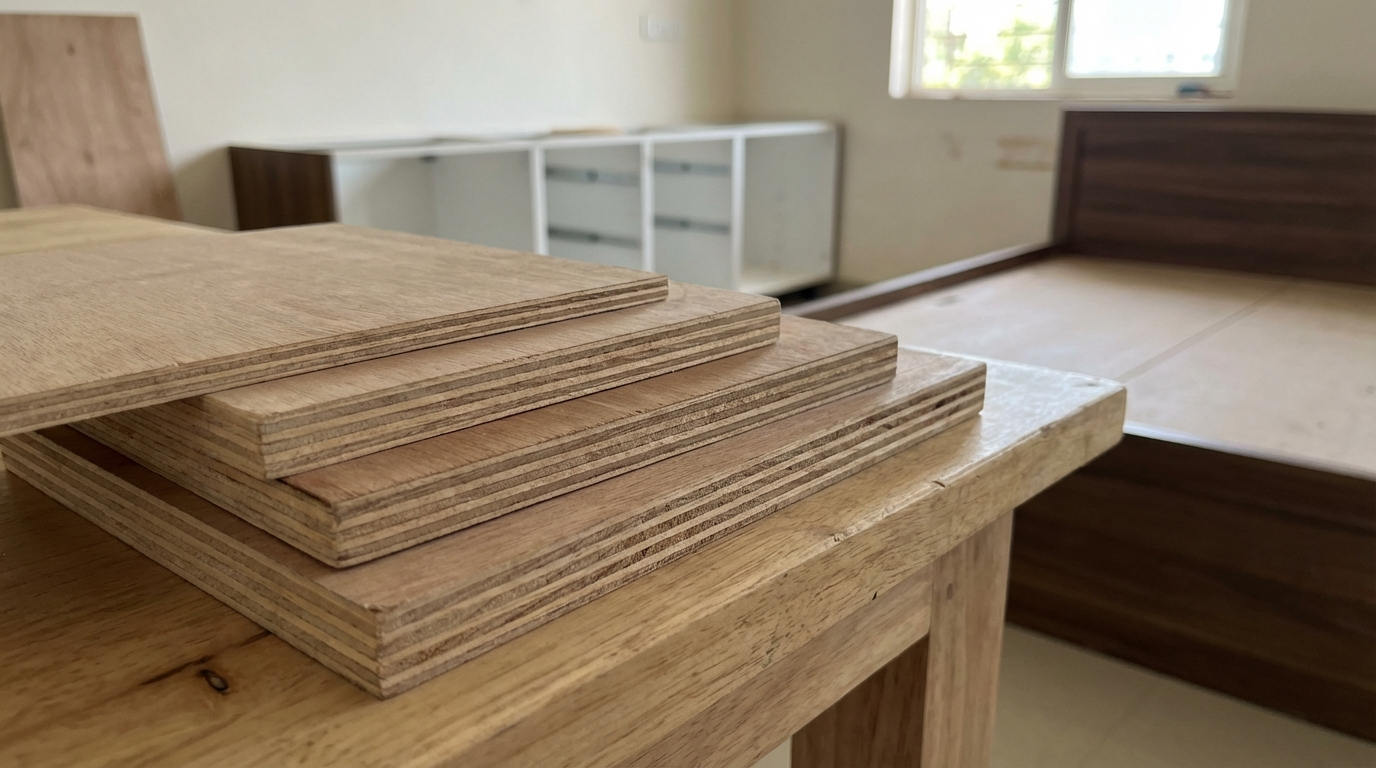
Plywood is made by stacking thin sheets of wood veneer, with each layer's grain oriented perpendicular to the one below it. This cross-grain construction enhances strength and stability, reducing the risk of warping or splitting. This fundamental engineering principle is what makes plywood furniture a practical choice for Indian households where climate variations can be significant.
In practical Indian market terms, plywood furniture has become the backbone of modular construction for several compelling reasons. Made by bonding thin layers of wood veneers with adhesive, plywood offers a stable, durable surface that resists warping, cracking, and shrinking, even in India's varying climate conditions. Its ability to hold screws, nails, and laminates makes it ideal for a wide range of furniture, from wardrobes and cabinets to beds and modular kitchens.
Why Plywood Works for Indian Homes
The Indian market presents unique challenges for furniture materials—monsoon humidity, extreme summer heat, and termite prevalence across many regions. Plywood is known for its stability; it resists warping and cracking, making it ideal for humid conditions. This makes plywood particularly well-suited for coastal cities like Mumbai, Chennai, and Kolkata where humidity levels remain consistently high throughout the year.
Plywood comes in various grades, thicknesses, and types, such as commercial, marine, or BWP (Boiling Water Proof), tailored to different uses in Indian furniture. This variety allows homeowners and carpenters to select the appropriate grade based on specific application requirements and budget constraints.
Advantages of Plywood Furniture
Understanding the full range of benefits helps buyers make informed decisions about their furniture investments. Here are the key advantages that make plywood a preferred choice:
Cost-Effectiveness
Cost is a major reason why plywood is popular in Indian furniture. Solid hardwoods like teak or rosewood can be prohibitively expensive, especially for large pieces like wardrobes or dining tables. Plywood offers a budget-friendly alternative without sacrificing strength.
Dimensional Stability
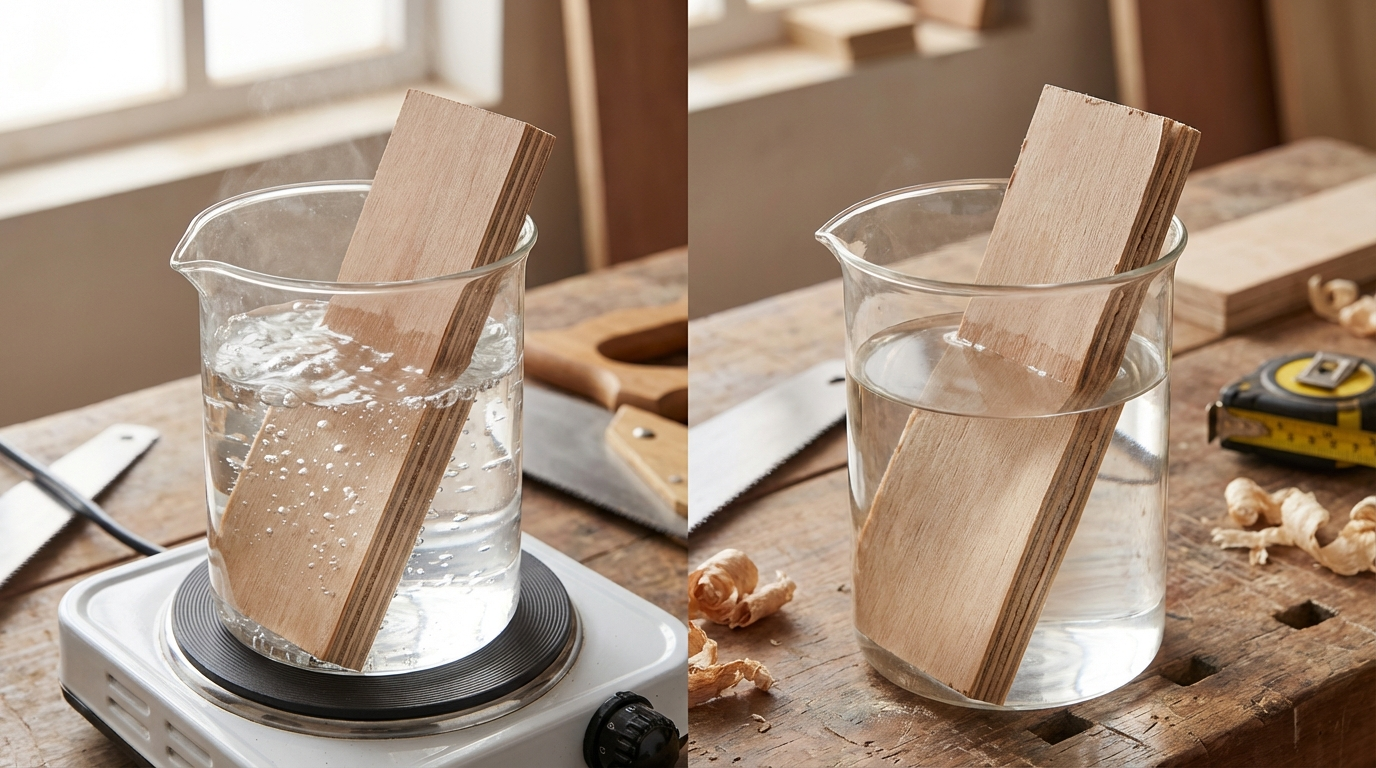
Plywood is created by stacking thin wood veneers and gluing them together using adhesive. By minimizing wood movement through the cross-graining process, the likelihood of warping, cracking, or shrinking is decreased. This stability is particularly valuable in India where seasonal humidity changes can cause solid wood to expand and contract significantly.
Finish Versatility
Plywood's ability to accept various finishes, like laminates, veneers, or paints, is another reason why plywood is popular in Indian furniture. It can mimic the look of premium woods at a fraction of the cost. Homeowners can achieve a high-end look, like rosewood or oak, without the hefty price tag.
Strength and Load-Bearing Capacity
Thicker plywoods are more durable than some solid woods and, depending on the application, can be the better option for furniture building, especially for dresser drawers or heavy-duty furniture frames. For wardrobes with heavy clothing loads or kitchen cabinets supporting countertops, quality plywood delivers reliable performance.
CNC and Modern Manufacturing Compatibility
For modular furniture production, plywood's uniform composition makes it ideal for precision cutting. The material responds well to CNC machinery, router work, and edge-banding processes that are essential for contemporary modular kitchens and wardrobes.
Disadvantages of Plywood Furniture
While plywood offers numerous benefits, understanding its limitations is equally important for making balanced purchasing decisions.
Aesthetic Limitations
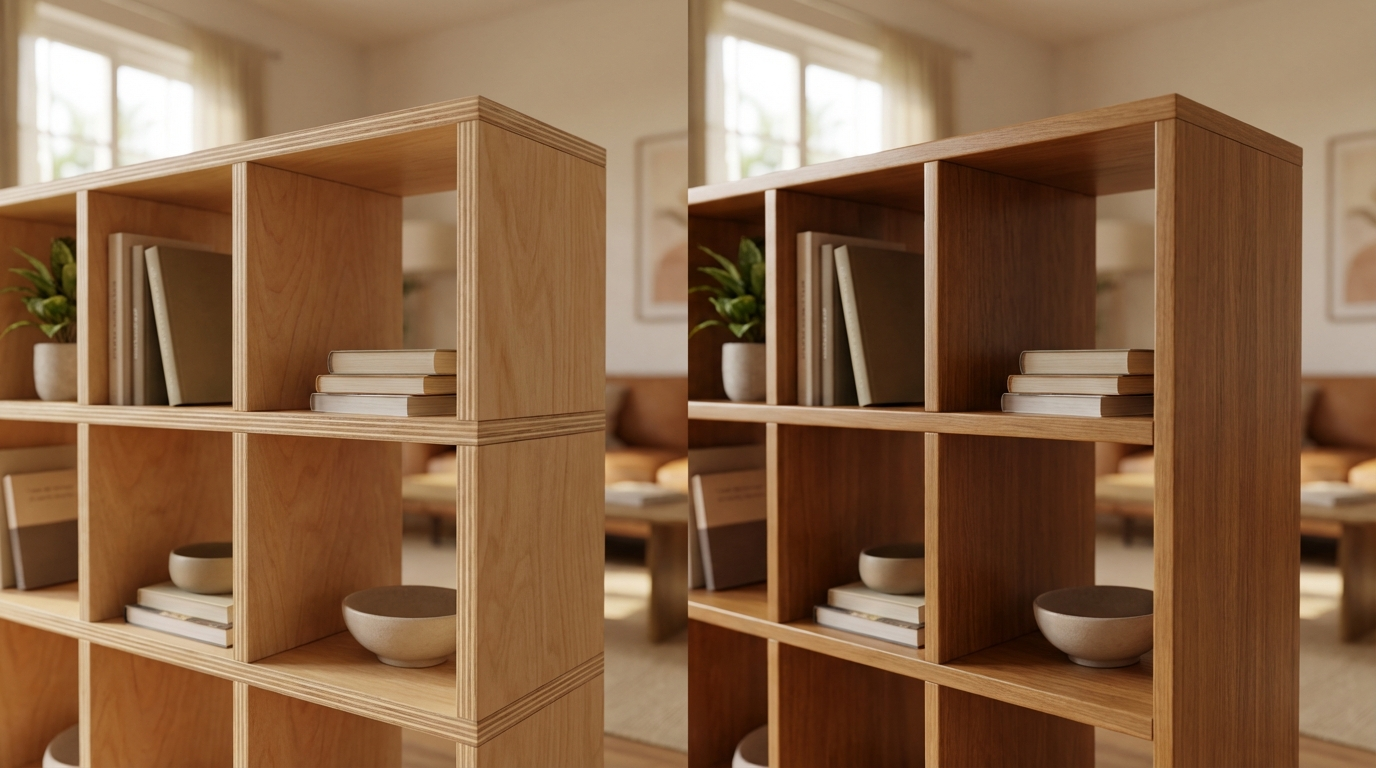
Plywood, even with high-quality veneers, can't fully replicate the natural beauty of solid wood. Plywood's layered construction may show edges or seams, especially in low-grade versions, lacking the rich grain of solid teak or rosewood.
Edge Finishing Requirements
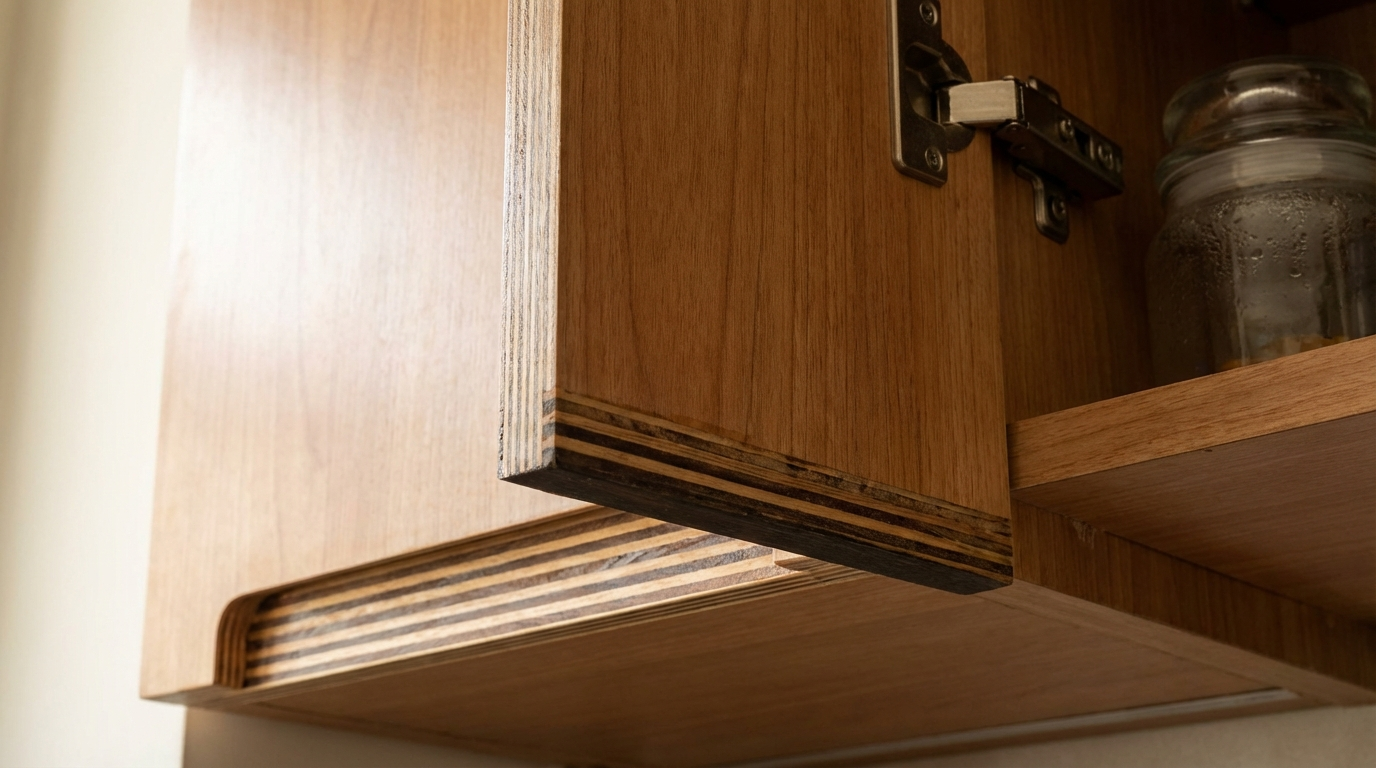
Unlike MDF, raw plywood needs to be laminated or finished for aesthetics and protection. The exposed edges reveal the layered construction, requiring edge-banding or solid wood lipping for a finished appearance. This adds to both material cost and labour time.
Quality Variance Issues
Low-cost plywood may contain voids, weak bonding, or uneven thickness, leading to poor performance. The Indian market has a wide quality spectrum, and budget options often compromise on core materials and adhesive quality, leading to premature failures.
Limited Refinishing Options
Since plywood is made of veneer layers, it cannot be sanded and polished more than once or twice unlike solid wood which can be done again and again. This limits the furniture's lifespan for pieces that may need periodic refinishing.
Design Constraints
Plywood isn't suitable for intricate carving or flowing forms—MDF works better in those cases. Traditional carved furniture designs that require detailed ornamentation are not achievable with plywood.
Comparison: Plywood vs Solid Wood vs MDF vs Particle Board
Selecting the right material requires understanding how each option performs across different parameters. The following comparison helps buyers evaluate alternatives based on their specific requirements.
| Parameter | Plywood | Solid Wood | MDF | Particle Board |
|---|---|---|---|---|
| Strength | High (cross-grain structure) | Very High | Medium | Low |
| Moisture Resistance | Good to Excellent (grade dependent) | Variable (wood species dependent) | Poor | Very Poor |
| Price Range (₹/sq ft) | ₹40–₹170 | ₹200–₹600+ | ₹25–₹50 | ₹18–₹35 |
| Screw Holding | Excellent | Excellent | Poor (edge) | Very Poor |
| Surface Finish | Requires laminate/veneer | Natural grain beauty | Smooth, paint-ready | Requires laminate |
| Weight | Medium-Heavy | Heavy | Heavy | Light |
| Durability | 15–25 years | 50+ years | 8–12 years | 5–8 years |
| Best For | Modular furniture, kitchens, wardrobes | Heirloom furniture, doors | Painted cabinets, decorative panels | Budget furniture, temporary use |
Plywood is the strongest and most durable of the three materials, followed by MDF and then particle board. When comparing engineered wood options, MDF is a good choice for indoor furniture due to its smooth finish and affordability, whereas plywood stands out for its strength, durability, and capacity to handle daily use.
Types and Grades of Plywood for Furniture
The Indian market offers various plywood grades, each suited for specific applications. Understanding these distinctions helps buyers select appropriately.
MR Grade (Moisture Resistant) / Commercial Plywood
Commercial plywood is the most common and affordable variety. It is suitable for general furniture, shelves, wardrobes, and partitions. The commercial plywood price generally falls between ₹40–₹60 per sq ft. This grade uses urea-formaldehyde resin and works well for bedroom furniture and living room applications where water exposure is minimal.
BWR Grade (Boiling Water Resistant)
Also known as BWR (Boiling Water Resistant) plywood, this type resists moisture and humidity. It's best for kitchen and bathroom furniture where exposure to water is frequent. The waterproof plywood price ranges between ₹60–₹90 per sq ft.
BWP Grade (Boiling Water Proof) / Marine Grade
Marine plywood is a premium quality plywood that offers maximum strength and water resistance. It is widely used for kitchen cabinets, outdoor furniture, and construction that requires high durability. The marine plywood price usually starts from ₹90 and can go up to ₹150 per sq ft.
Grade Selection Guide
| Application | Recommended Grade | Typical Thickness | Price Range (₹/sq ft) |
|---|---|---|---|
| Bedroom Wardrobe | MR Grade | 18mm/19mm | ₹60–₹100 |
| Modular Kitchen Carcass | BWR/BWP Grade | 18mm/19mm | ₹90–₹150 |
| Bathroom Vanity | BWP/Marine Grade | 18mm | ₹120–₹170 |
| Living Room TV Unit | MR Grade | 18mm | ₹60–₹100 |
| Partition/Wall Panel | MR Grade | 12mm | ₹45–₹75 |
| Shelving (Light Load) | MR Grade | 12mm | ₹45–₹60 |
| Heavy-Duty Shelving | BWR Grade | 18mm/19mm | ₹80–₹120 |
How to Choose Plywood Furniture: Buyer's Checklist
Making the right plywood furniture choice requires evaluating multiple factors. Use this decision framework to guide your selection process.
Assessment Criteria
- Application Environment: Determine if the furniture will be in moisture-prone areas (kitchen, bathroom) or dry zones (bedroom, living room)
- Load Requirements: Heavy wardrobes and kitchen cabinets need 18mm or thicker plywood; light shelving can use 12mm
- Budget Alignment: Balance initial cost with long-term durability expectations
- Finish Preference: Decide between laminate, veneer, or paint finish before selecting plywood grade
- Carpenter Skill Level: Higher-grade plywood is more forgiving of workmanship variations
- Climate Conditions: Coastal and high-humidity cities benefit from BWR grade even for bedroom furniture
- Termite Risk: Areas with known termite problems should opt for treated plywood or brands with anti-termite treatment
When NOT to Choose Plywood Furniture
Despite its versatility, plywood is not the ideal choice in certain scenarios:
- Outdoor Furniture: Even marine plywood requires protective finishing for outdoor use; solid teak or treated wood performs better
- Traditional Carved Designs: Intricate carving is not possible on plywood; solid wood is essential for such aesthetics
- Heritage/Heirloom Pieces: Solid wood is renowned for its durability and longevity. It can withstand wear and tear over the years, making it a preferred choice for heirloom furniture.
- Extremely Tight Budgets: If budget is the primary constraint and durability expectations are low, pre-laminated particle board may suffice for temporary furniture
- Premium Visible Surfaces: Dining tabletops and showcase cabinets where natural wood grain is desired
Common Mistakes to Avoid with Plywood Furniture
Understanding common pitfalls helps buyers and homeowners avoid costly errors in their furniture projects.
Mistake 1: Using MR Grade in Wet Areas
One of the most frequent errors is using commercial/MR grade plywood in kitchens or bathrooms. Within 2–3 years, edges begin to swell, laminate peels off, and structural integrity is compromised. Always specify BWR or BWP grade for moisture-prone areas.
Mistake 2: Ignoring Core Quality
The core of plywood is what gives it strength and lets it hold screws. Plywood created from just hardwood trees, like Eucalyptus or Gurjan, lasts longer and is more stable than plywood made from a mix of softwood and hardwood woods. Many buyers focus solely on face veneer quality while ignoring the core material.
Mistake 3: Skipping Edge Finishing
Exposed plywood edges absorb moisture readily, even in BWR grade. Proper edge-banding or solid wood lipping is essential for longevity, especially in kitchen environments.
Mistake 4: Thickness Confusion
The Indian market commonly refers to 18mm and 19mm interchangeably, but actual measured thickness can vary between brands. Always verify actual thickness, not just nominal size, especially for modular kitchen systems where hardware dimensions are precise.
Mistake 5: Overlooking Calibration
Calibrated plywood ensures that the whole sheet is the same thickness. This provides a surface that is absolutely flat, which is vital for constructing furniture that looks well, fits together well, and is easy to put together.
Quick Inspection Checks
- Weight Test: Heavier plywood typically indicates denser core and better quality
- Edge Examination: Look for voids, gaps, or uneven layers on cut edges
- Flex Test: Quality plywood should resist bending; excessive flex indicates poor core density
- Tap Test: Solid, consistent sound when tapped indicates uniform construction; hollow sounds suggest voids
- Certification Check: Look for ISI mark and BIS certification stamps on the sheet
Price Guide: Plywood Furniture Costs in India
Plywood pricing in India varies significantly based on grade, thickness, brand tier, and geographic location. The plywood rate per sq ft in India can start as low as ₹40 and go beyond ₹150 depending on quality. For most household furniture and interior work, plywood in the range of ₹60–₹100 per sq ft is commonly used.
Price by Grade and Thickness
| Plywood Type | 6mm | 12mm | 18mm | 19mm |
|---|---|---|---|---|
| Commercial/MR Grade | ₹30–₹50 | ₹45–₹75 | ₹60–₹100 | ₹65–₹105 |
| BWR Grade | ₹40–₹60 | ₹60–₹90 | ₹80–₹120 | ₹85–₹130 |
| BWP/Marine Grade | ₹55–₹80 | ₹90–₹120 | ₹130–₹160 | ₹140–₹170 |
Note: Prices are indicative for metro cities as of 2025. Tier-2/Tier-3 cities may have 5–15% variation due to transportation costs. GST (18%) typically applies to branded plywood.
Factors Affecting Price
- Brand Tier: INR 80-94 per Sq. Ft. dominates with a share of 21% in 2025, representing the mid-premium category preferred by quality-conscious consumers.
- Face Veneer Quality: Face veneers are graded AA, A, B, C, D, and E. Superior-quality face veneers are thicker and more expensive than inferior veneers.
- Core Material: The primary cause for the variation in plywood board prices is the type of wood used to form the core. A better grade of wood used in plywood will result in greater pricing.
- Certification: ISI-certified products command 10–20% premium over uncertified alternatives
- City Location: Prices vary depending on your location, with cities like Mumbai generally commanding higher rates.
Budget vs Premium: What Makes Sense?
For high-use furniture like kitchen cabinets and daily-use wardrobes, investing in premium BWR or BWP grade plywood delivers better value over a 10–15 year furniture lifecycle. Budget options work acceptably for guest bedrooms, temporary furniture, or rental properties where longevity expectations are modest.
Regional Considerations for Indian Buyers
India's diverse climate and market conditions require location-specific material choices.
Coastal and High-Humidity Regions
Cities like Mumbai, Chennai, Kolkata, Kochi, and Visakhapatnam experience high humidity levels year-round. Even bedroom furniture benefits from BWR grade plywood in these locations. Marine-grade is strongly recommended for kitchen carcasses.
Termite-Prone Areas
To keep termites, borers, and other wood-eating creatures away, the best plywood is treated with particular chemicals at the factory. If you want your furniture to last for decades, you need to do this. Regions with historical termite problems should prioritize brands offering factory-applied treatment.
Metro vs Tier-2/Tier-3 Availability
Premium plywood brands and specialized grades (calibrated, pre-laminated, fire-retardant) are readily available in metro cities through organized dealer networks. Tier-2 and Tier-3 cities may have limited premium brand availability, making quality verification even more critical. Consider ordering from metro dealers with delivery services for premium requirements.
Frequently Asked Questions
Is plywood good for furniture in India?
Yes, plywood is excellent for furniture in Indian conditions. Plywood furniture offers an unbeatable balance of strength, finish flexibility, and long-term value—especially in Indian households where durability matters. The key is selecting the appropriate grade: MR/commercial grade for dry areas like bedrooms, BWR grade for kitchens with moderate moisture exposure, and BWP/marine grade for bathrooms and high-humidity environments. With proper grade selection and quality plywood, furniture can last 15–25 years with minimal maintenance.
Which is better: plywood or solid wood furniture?
Choosing between solid wood and plywood depends on your specific needs and preferences. Solid wood offers unmatched beauty and durability, while plywood provides versatility and cost-effectiveness. Solid wood excels for heirloom furniture, traditional carved designs, and visible surfaces where natural grain is desired. Plywood is superior for modular construction, moisture-prone areas, and budget-conscious projects. In humid Indian conditions, plywood's dimensional stability often outperforms solid wood for wardrobe and kitchen carcass applications.
What is the full form of MR, BWR, and BWP plywood?
MR stands for Moisture Resistant, indicating plywood suitable for dry interior applications. BWR means Boiling Water Resistant, designed to withstand humidity and occasional water exposure. BWP stands for Boiling Water Proof, the highest water-resistance grade suitable for kitchens, bathrooms, and outdoor applications. These designations relate to Indian Standards IS 303 (MR grade) and IS 710 (BWR/BWP grades) that specify adhesive bonding requirements and water resistance performance.
Is plywood furniture good for kitchen cabinets?
Plywood is the recommended material for kitchen cabinet carcasses in India. Beds, kitchen cabinets, wardrobes, and storage units benefit from plywood's strength and longevity. MDF can be used for upper kitchen cabinets if kept away from steam, but plywood is safer for base cabinets and sink areas. Use BWR grade minimum for upper cabinets and BWP/marine grade for base cabinets near sinks and under-counter units. Combine with quality hardware and proper edge-banding for optimal longevity.
How long does plywood furniture last in India?
Quality plywood furniture typically lasts 15–25 years in Indian conditions when the correct grade is used for the application. Kitchen cabinets made with BWP grade can exceed 20 years with proper maintenance. Commercial/MR grade bedroom furniture generally delivers 12–18 years of service life. Factors reducing lifespan include using wrong grade for the environment, poor edge finishing, and exposure to direct water splashing. Plywood can be more expensive, but is a durable and long-lasting solution for your furniture.
What is the price of 18mm plywood per sq ft in India?
18mm Commercial Plywood costs ₹60–₹100 per square foot. These prices are indicative and can vary based on the brand, region, and quality of the plywood. The 18mm BWP plywood price typically ranges between ₹130 to ₹160 per square foot. Metro cities like Mumbai, Delhi, and Bangalore command 5–10% premium over smaller cities. Premium brands with ISI certification and warranty coverage are typically at the higher end of these ranges.
How to check plywood quality before buying?
Physical inspection is essential for quality verification. Check for ISI mark and BIS certification on the sheet surface. Examine cut edges for voids, gaps between layers, and uneven ply thickness. Perform a weight test—quality plywood feels heavier due to denser core. The tap test reveals internal voids through hollow sounds. Consider these points if you receive a higher price on the same type of plywood from another vendor. Does plywood indeed have a higher quality wood core and a higher grade face veneer?
Can plywood furniture be used in bathrooms?
Yes, plywood can be used in bathrooms, but only with the right grade and proper finishing. Marine-grade plywood is resistant to moisture and can be used in bathrooms and kitchens. Use BWP/marine grade plywood for all bathroom furniture. Ensure complete edge-banding on all exposed edges, and apply waterproof sealant or primer on back surfaces. Provide adequate ventilation to prevent moisture accumulation. Even with these precautions, maintain some distance between furniture and direct water sources like shower areas.
Disclaimer: This content is provided for general informational purposes based on industry practices and publicly available information. Product specifications, standards, prices, and availability may vary by manufacturer, region, and time. Readers should independently verify details with manufacturers, dealers, or qualified professionals before making purchase or construction decisions.Want Plywood Suggestions?
Share a few details and a Apple Ply specialist will suggest suitable brands and connect you to responsive dealers.