Top 7 Particle Board Companies in India: Complete Guide
Discover the best particle board manufacturers in India. Compare top companies by quality, price, product range & customer reviews.
Quick Answer
The top particle board companies in India include Action Tesa, Century Ply, Greenply Industries, Apple Ply, Associate Decor, Rushil Decor, and Durian Industries. These manufacturers dominate the Indian market with products ranging from standard-grade boards to moisture-resistant and pre-laminated variants suitable for furniture, modular kitchens, and interior applications.
At a Glance: Key Takeaways
- Action Tesa leads in pre-laminated particle board with the widest dealer network across India
- Prices range from ₹22–₹55 per sq ft depending on grade, thickness, and lamination
- Moisture-resistant (MR) grades essential for humid regions and kitchen applications
- Most brands offer IS 12823 certified boards—verify BIS marking before purchase
- Pre-laminated boards cost 40–60% more than raw boards but save lamination labour
- Metro cities have better brand availability; Tier-2/3 towns often stock limited grades
Understanding Particle Board: What Indian Buyers Need to Know
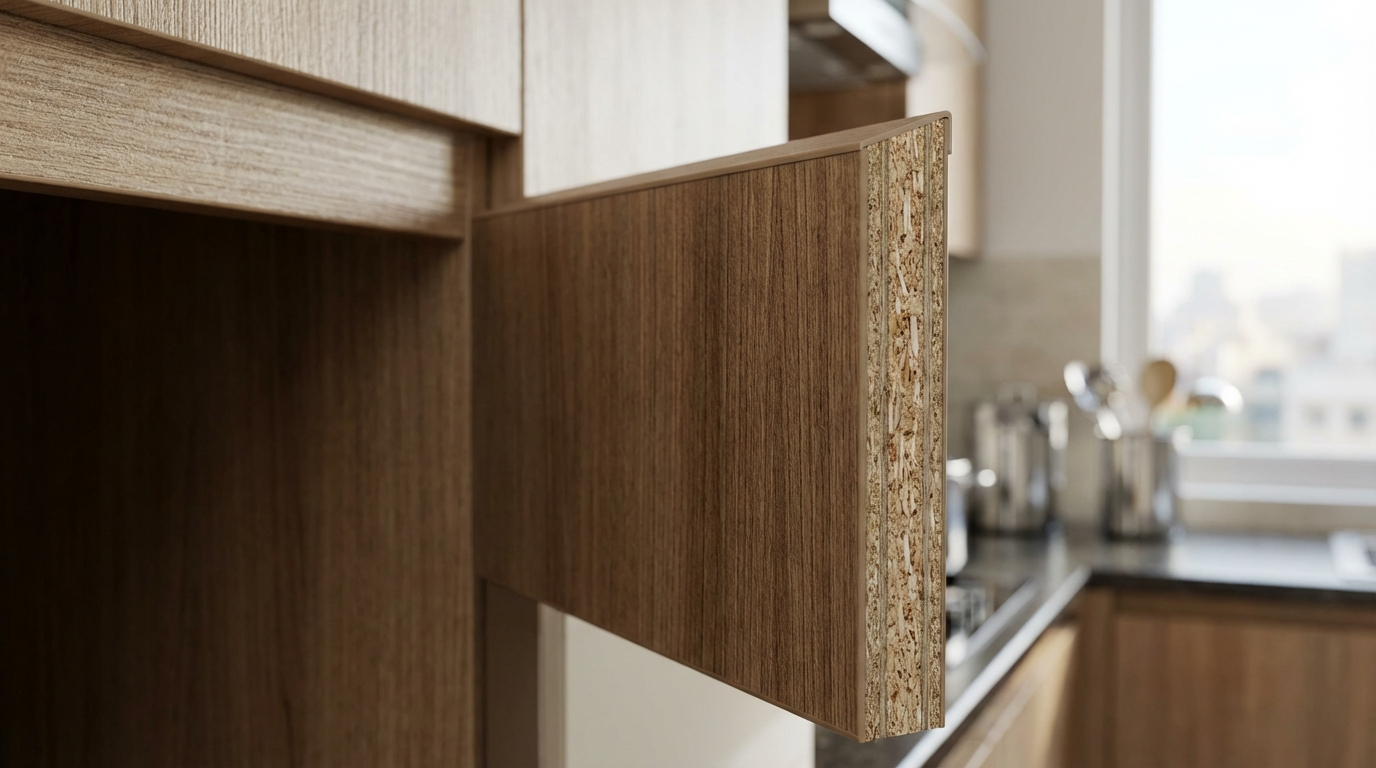
Particle board, known locally as chipboard in some regions, is an engineered wood product manufactured by compressing wood chips, sawmill shavings, and synthetic resin under high pressure and temperature. In the Indian context, particle board has become the backbone of the modular furniture industry, offering a cost-effective alternative to plywood and MDF for applications where structural load-bearing capacity is not critical.
The manufacturing process involves collecting wood waste from timber mills, chipping it into uniform particles, mixing with urea-formaldehyde or melamine-formaldehyde resins, and pressing into sheets of standard dimensions. Indian manufacturers typically produce boards in 8×4 feet size, with thicknesses ranging from 9mm to 25mm. The 18mm thickness dominates the furniture market, though trade sizes often measure 17.5mm to 18.5mm—a common source of confusion for buyers specifying exact cabinet dimensions.
What makes particle board particularly relevant for Indian homes is its dimensional stability in controlled environments. Unlike solid wood, it doesn't warp or twist with seasonal humidity changes when used indoors with proper edge protection. However, this advantage becomes a liability in moisture-prone areas. Raw particle board absorbs water rapidly, causing irreversible swelling—a critical consideration for coastal cities like Chennai, Mumbai, and Kolkata where ambient humidity exceeds 70% for several months.
The Indian particle board market has matured significantly since the 2000s. Today's offerings include standard boards for general furniture, moisture-resistant (MR) grades with wax emulsion treatment, and fire-retardant variants for commercial installations. Pre-laminated particle boards (also called laminated chipboard or melamine-faced boards) have gained substantial market share, eliminating the need for separate laminate application and reducing on-site labour dependency.
Top 7 Particle Board Companies in India: Detailed Profiles
Action Tesa
Action Tesa has established itself as the dominant force in India's particle board segment, particularly for pre-laminated products. Their manufacturing facilities employ advanced European technology, producing boards that meet stringent emission standards. The company's strength lies in its extensive dealer network spanning metro cities and Tier-2 towns alike, ensuring consistent availability that many competitors struggle to match. Their product range includes standard particle boards, high moisture-resistant (HMR) grades, and an extensive collection of pre-laminated finishes exceeding 300 design options.
Century Ply
Century Ply, one of India's oldest plywood manufacturers, entered the particle board segment to offer integrated interior solutions. Their particle boards are recognised for consistent surface smoothness, which matters significantly for lamination quality. The company leverages its established dealer relationships across India, making procurement straightforward for contractors working on multiple projects. Their focus remains on the premium segment, with boards priced 10–15% above market average but offering better screw-holding strength in practical tests.
Greenply Industries
Greenply Industries brings its manufacturing expertise from the plywood sector into particle board production. Their boards exhibit excellent dimensional stability, attributed to controlled moisture content during manufacturing. Greenply's distribution is strongest in North and East India, with relatively sparser presence in Southern states. The company has invested in reducing formaldehyde emissions, positioning their boards as healthier alternatives for bedroom furniture and children's rooms where indoor air quality concerns are paramount.
Apple Ply (AK Apple)
Apple Ply, operating under AK Group, has carved a niche in South India, particularly Kerala and Karnataka. Their particle board products emphasise tropical climate suitability, with MR-grade boards forming the bulk of their sales. The company's vertical integration—producing plywood, doors, and boards under one umbrella—allows dealers to source multiple products from a single vendor, simplifying logistics for furniture manufacturers. Their particle boards are commonly specified for institutional projects in educational and healthcare facilities across South India.
Associate Decor Limited
Associate Decor Limited has decades of presence in the Indian wood panel market, building a reputation for reliable quality across price points. Their particle board range spans economy grades for budget furniture to premium variants competing with MDF in surface quality. The company's strength lies in consistent board thickness—a parameter that matters immensely when fitting into standardised hardware systems designed for 18mm panels. Their distribution network favours Western and Central India, with strong presence in Maharashtra and Gujarat markets.
Rushil Decor Limited
Rushil Decor has positioned itself as a sustainability-conscious manufacturer, utilising recycled wood waste and agricultural residues in their particle board production. This approach resonates with architects and builders seeking green building certifications for their projects. Their product range includes standard and MR-grade boards, with particular strength in the pre-laminated segment. The company's manufacturing facility in Gujarat serves Western India efficiently, though availability in Eastern states requires longer lead times.
Durian Industries Limited
Durian Industries approaches particle board as part of a complete furniture solution rather than a standalone product. Their boards are engineered specifically for modular furniture applications, with optimised screw-holding capacity at standardised hardware mounting points. This specialisation makes Durian a preferred choice for modular kitchen and wardrobe manufacturers who value consistency across production runs. Their premium positioning means limited presence in price-sensitive market segments but strong brand recognition in urban retail furniture.
Comparison Table: Top Particle Board Manufacturers in India
| Company | Key Strength | Price Range (₹/sq ft, 18mm) | Best Product Line | Primary Market | MR Grade Available |
|---|---|---|---|---|---|
| Action Tesa | Widest distribution, design variety | ₹28–₹48 | Pre-laminated boards | Pan-India | Yes |
| Century Ply | Surface smoothness, brand trust | ₹32–₹52 | Furniture-grade raw boards | Pan-India | Yes |
| Greenply Industries | Low emission, dimensional stability | ₹30–₹50 | Standard and HMR grades | North and East India | Yes |
| Apple Ply (AK Apple) | Tropical climate suitability | ₹26–₹45 | MR-grade boards | South India | Yes |
| Associate Decor | Consistent thickness, price range | ₹24–₹44 | Economy to premium range | West and Central India | Yes |
| Rushil Decor | Eco-friendly manufacturing | ₹26–₹46 | Pre-laminated sustainable boards | West India | Yes |
| Durian Industries | Modular furniture optimisation | ₹34–₹55 | Modular kitchen boards | Metro cities | Yes |
How to Choose the Right Particle Board Company for Your Project
Selecting the appropriate particle board manufacturer extends beyond price comparison. The decision involves evaluating product availability in your region, the specific application requirements, and the after-sales support that matters for bulk orders. Indian market realities—where dealer relationships often determine product access—make this choice particularly nuanced.
Decision Framework for Buyers
Start by identifying your application. Kitchen cabinets demand MR-grade boards due to proximity to water sources, while bedroom wardrobes can use standard grades if humidity remains controlled. For CNC-machined modular furniture, board density uniformity becomes critical—inconsistent density causes routing bit deflection and poor edge finish. Manufacturers like Action Tesa and Durian specifically address this requirement in their premium grades.
Next, assess local dealer availability. A technically superior product becomes impractical if your carpenter cannot source replacement boards for repairs. In Tier-2 and Tier-3 cities, stick with brands having established dealer networks—Action Tesa, Century Ply, and Greenply typically have the broadest reach. For South Indian projects, Apple Ply's regional network often provides better support than nationally distributed brands.
Buyer Checklist: What to Verify Before Purchase
- BIS certification mark (IS 12823 for particle boards)—present on board edge or packaging
- Moisture content specification (should be 8–12% for Indian conditions)
- Formaldehyde emission class (E1 or E0 for indoor applications)
- Actual thickness measurement (trade 18mm may vary from 17.5mm to 18.5mm)
- Edge condition—check for chips, voids, or inconsistent density at board edges
- Dealer's ability to supply matching boards for future repairs
- Warranty terms, particularly exclusions for moisture damage
When NOT to Choose a Particular Brand
Avoid premium brands for concealed applications like cabinet backs and internal partitions—the quality premium doesn't justify the cost for non-visible surfaces. Conversely, never choose economy brands for exposed kitchen shutters or bathroom vanities where moisture contact is inevitable. If your local dealer stocks only one brand but another suits your requirement better, consider sourcing from the nearest city rather than compromising on specification. Transport costs add ₹3–₹5 per sq ft but prevent costly failures.
Common Mistakes to Avoid When Buying Particle Board
The Indian particle board market presents numerous pitfalls for uninformed buyers. Understanding these mistakes prevents costly replacements and project delays that frustrate both homeowners and contractors.
Mistake 1: Ignoring Edge Sealing Requirements
Raw particle board edges absorb moisture aggressively. Every exposed edge requires either laminate edge banding, PVC tape, or paint sealing. Carpenters sometimes skip this step on concealed edges to save time, but kitchen cabinet interiors with unsealed edges swell within months in humid climates. Insist on complete edge sealing, including the bottom edges of base units.
Mistake 2: Using Standard Grade in Moisture-Prone Areas
Standard particle board costs 15–20% less than MR-grade, tempting cost-conscious buyers. This economy proves false when kitchen base units swell from floor mopping water or bathroom cabinets deteriorate from ambient humidity. For any application within three feet of a water source, MR-grade is non-negotiable.
Mistake 3: Specifying Exact Thickness Without Measuring
Trade sizes vary between manufacturers. If your cabinet design requires precisely 18mm for hardware mounting, verify the actual thickness of available boards. A 17.5mm board throws off European hinge boring distances, causing alignment problems across an entire kitchen installation.
Mistake 4: Overlooking Formaldehyde Emission Standards
Budget particle boards sometimes exceed safe formaldehyde emission levels, releasing irritating gases for months after installation. For bedrooms, children's rooms, and poorly ventilated spaces, specify E1-rated boards at minimum. The price premium is marginal compared to health implications.
Quick Inspection Checks at the Dealer
- Press thumbnail into board face—it shouldn't leave a permanent indentation on quality boards
- Examine edge cross-section for uniform particle distribution (no large voids or chips)
- Check for surface undulation by placing a straight edge across the board
- Verify colour consistency across stacked boards (indicates consistent resin distribution)
- Request the latest test certificate if buying for commercial projects
Particle Board Price Guide for India
Particle board pricing in India varies significantly based on grade, thickness, lamination, and regional factors. Understanding these variables helps buyers budget accurately and identify unreasonably high dealer margins.
Price Ranges by Category
| Product Type | Thickness | Metro City Price (₹/sq ft) | Tier-2 City Price (₹/sq ft) | Key Price Drivers |
|---|---|---|---|---|
| Standard Raw Board | 18mm | ₹22–₹30 | ₹25–₹34 | Brand, density, surface quality |
| MR-Grade Raw Board | 18mm | ₹28–₹38 | ₹32–₹42 | Wax treatment quality, certification |
| Pre-laminated Standard | 18mm | ₹38–₹48 | ₹42–₹52 | Laminate quality, design, texture |
| Pre-laminated MR-Grade | 18mm | ₹45–₹58 | ₹50–₹65 | Premium finishes, anti-scratch layers |
| Standard Raw Board | 25mm | ₹30–₹40 | ₹34–₹45 | Less common, limited availability |
What Causes Price Variation
Board density significantly impacts pricing—higher density boards (650+ kg/m³) cost more but offer better screw-holding. Surface quality grades also create price tiers; boards meant for visible lamination undergo additional sanding, adding ₹2–₹4 per sq ft. Regional pricing reflects transport costs from manufacturing hubs in Gujarat, Uttarakhand, and South India. Tier-2 cities typically pay 10–15% premiums due to lower dealer competition and smaller order volumes.
GST at 18% applies uniformly, but dealers sometimes offer pre-GST pricing to confuse comparison shopping. Always clarify whether quoted prices include GST. Bulk orders (50+ boards) typically attract 5–8% discounts, while single-board purchases for repairs may carry 10–15% premiums due to handling costs.
Budget vs Premium: Which Makes Sense
For concealed applications—cabinet backs, drawer bottoms, internal shelves—economy boards deliver adequate performance. Spend the savings on premium grades for visible surfaces and moisture-exposed areas. A hybrid specification approach optimises project budgets: premium MR-grade pre-laminated boards for kitchen shutters, standard raw boards with laminate application for wardrobe carcasses, and economy boards for concealed panels.
Regional Considerations for Particle Board Selection
India's climatic diversity demands region-specific particle board selection. What works in Rajasthan's dry climate fails spectacularly in Kerala's monsoon humidity. Understanding these regional factors prevents premature furniture failure.
Coastal and High-Humidity Regions
Mumbai, Chennai, Kolkata, Kerala, and Goa experience humidity levels exceeding 75% for extended periods. Standard particle board in these regions absorbs ambient moisture even without direct water contact, causing gradual swelling over two to three years. MR-grade boards are mandatory for all applications, including wardrobes and study tables. Edge sealing quality becomes critical—use hot-melt PVC edge banding rather than self-adhesive tapes that peel in humidity.
Northern Plains and Dry Regions
Delhi, Punjab, Rajasthan, and Madhya Pradesh experience extreme humidity variation—dry winters and monsoon humidity spikes. This cycling stresses particle board joints differently than constant humidity. Prioritise boards with consistent internal moisture content (8–10%) to minimise seasonal movement. Standard grades perform adequately for most applications, with MR-grade reserved for kitchen and bathroom proximity.
Dealer Landscape Realities
Metro cities offer multiple brand choices with competitive pricing. In contrast, Tier-2 and Tier-3 towns often have one or two dominant dealers stocking limited brands. Building relationships with these dealers matters—they control access to specific grades and can expedite orders during supply constraints. For large projects in underserved areas, consider sourcing directly from brand distributors in nearby metros, accepting transport costs for specification compliance.
Carpenter's Perspective on Particle Board Brands
Experienced carpenters develop strong preferences for specific brands based on practical workshop characteristics that don't appear in product specifications. Understanding these preferences helps buyers make informed choices.
Cutting behaviour varies significantly between manufacturers. Some boards produce excessive dust while others cut cleanly with minimal tearout. Edge quality after cutting affects edge banding adhesion—boards that chip during cutting require additional filling before banding. Carpenters generally prefer boards with consistent density that don't dull saw blades quickly. Action Tesa and Century Ply boards are frequently cited for clean cutting characteristics.
Screw-holding capacity matters for hinge mounting and drawer runner installation. Boards with higher density and uniform particle distribution hold screws better, especially for the soft-close hinges common in modular kitchens. Inferior boards strip out during hinge adjustment, forcing repair with dowels and adhesive—a time-consuming process that adds project cost.
Surface lamination adhesion depends on board surface preparation. Some brands have surface treatments that resist laminate bonding unless properly sanded. Carpenters working with pre-laminated boards prefer brands with consistent laminate adhesion across batches, preventing peeling at edges during machining.
Frequently Asked Questions
What is the full form of MR in particle board?
MR stands for Moisture Resistant in particle board terminology. MR-grade particle boards undergo treatment with wax emulsion during manufacturing, reducing their water absorption rate compared to standard boards. However, "moisture resistant" doesn't mean waterproof—prolonged water exposure still damages MR boards. These boards are suitable for areas with occasional moisture contact like kitchens but not for direct wet area installation like bathroom shower zones. The IS 12823 standard specifies water absorption limits for MR-grade classification.
Which is better: particle board or plywood for kitchen cabinets?
Plywood offers superior moisture resistance, screw-holding strength, and impact durability compared to particle board, making it technically better for kitchen cabinets. However, particle board costs 30–40% less and provides perfectly adequate performance when MR-grade boards are used with proper edge sealing. Pre-laminated particle board eliminates surface finishing costs, narrowing the total cost difference. For budget-conscious projects in dry climates, MR-grade particle board works well. For humid coastal areas or premium kitchens, BWR-grade plywood remains the safer choice despite higher cost.
How to check particle board quality before buying?
Quality assessment involves visual and physical inspection. Check edge cross-section for uniform particle distribution without large voids or wood chips. Press your thumbnail firmly into the board surface—quality boards resist indentation while poor boards show permanent marks. Place a straight edge across the board to detect surface undulation. Verify BIS marking (IS 12823) on the board edge or packaging. Request the manufacturer's test certificate for bulk purchases, particularly checking moisture content (8–12%) and formaldehyde emission class (E1 or better).
What is particle board price in India per square foot?
Particle board prices in India range from ₹22 to ₹65 per square foot depending on grade, thickness, and lamination. Standard 18mm raw boards cost ₹22–₹34 per sq ft, while MR-grade boards range from ₹28–₹42 per sq ft. Pre-laminated boards command significant premiums, ranging from ₹38–₹65 per sq ft depending on laminate quality and surface texture. Metro cities typically offer lower prices due to dealer competition, while Tier-2 and Tier-3 cities add 10–15% premium for transport and lower volumes. Prices exclude GST at 18%.
Is particle board good for wardrobes?
Particle board works well for wardrobes in climate-controlled environments with proper edge sealing. Its dimensional stability prevents the warping and twisting common in solid wood wardrobes during humidity changes. For wardrobe carcasses and shelves, standard-grade particle board suffices since moisture exposure is minimal. Use MR-grade for base sections that might contact floor mopping water. Pre-laminated particle board provides ready-to-use interior surfaces without additional finishing. The main limitation is screw-holding for frequent hinge adjustments—use 32mm system hardware designed for particle board rather than wood screws.
How long does particle board furniture last in India?
Properly constructed particle board furniture lasts 8–15 years in typical Indian conditions. Lifespan depends critically on edge sealing quality, moisture exposure, and hardware quality rather than the board alone. Kitchen cabinets with MR-grade boards and proper edge banding typically survive 10–12 years before requiring replacement. Wardrobes in air-conditioned bedrooms can exceed 15 years. Failures typically occur at joints and hinges before the board itself deteriorates. Regular maintenance—wiping spills immediately, ensuring edge banding integrity, and avoiding direct water contact—significantly extends service life.
Can particle board be used in bathrooms?
Particle board is generally unsuitable for bathroom applications due to constant humidity exposure. Even MR-grade boards eventually absorb moisture in bathroom environments, leading to swelling and disintegration within 2–4 years. For bathroom vanities and cabinets, marine-grade plywood, HDHMR, or PVC foam boards are appropriate alternatives. If particle board must be used due to budget constraints, restrict it to wall-mounted cabinets away from direct splash zones, use MR-grade exclusively, ensure complete edge sealing including bottom edges, and apply additional moisture barrier coating.
What is the difference between particle board and MDF?
The key difference lies in particle size and density. Particle board uses coarse wood chips with visible grain structure, while MDF (Medium Density Fibreboard) uses fine wood fibres creating a smooth, uniform surface. MDF offers better surface finish for painting and CNC machining, superior edge quality without edge banding, and more consistent screw-holding. However, MDF costs 40–60% more than particle board and is heavier. Particle board suits applications requiring lamination, while MDF excels for painted finishes, intricate routing, and exposed-edge designs. Both materials share similar moisture sensitivity.
Disclaimer: This content is provided for general informational purposes based on industry practices and publicly available information. Product specifications, standards, prices, and availability may vary by manufacturer, region, and time. Readers should independently verify details with manufacturers, dealers, or qualified professionals before making purchase or construction decisions.Want Plywood Suggestions?
Share a few details and a Apple Ply specialist will suggest suitable brands and connect you to responsive dealers.