Waterproof Plywood Price List 2026: BWP Grade Costs
Current waterproof plywood prices in India for 2026. Compare BWP marine plywood rates by thickness, brand & city for best deals.
Quick Answer
Waterproof plywood price in India for 2026 typically ranges from ₹130 to ₹220 per square foot for genuine BWP (Boiling Water Proof) grade, depending on thickness, core wood species, brand tier, and city. An 18mm BWP plywood sheet in standard 8×4 feet size costs approximately ₹4,200 to ₹7,000 in metro cities, with premium brands commanding higher rates.
At a Glance:
- BWP 18mm plywood: ₹150–₹220 per sq ft (branded, metro rates)
- BWP 12mm plywood: ₹110–₹160 per sq ft
- Marine grade plywood commands 15–25% premium over standard BWP
- Tier-2 cities typically see 8–12% lower prices than metros
- Eucalyptus and gurjan cores cost more than poplar-based alternatives
- Always verify IS 710 marking on actual sheets—not just invoice claims
Waterproof Plywood Price List 2026: Understanding BWP Grade Costs
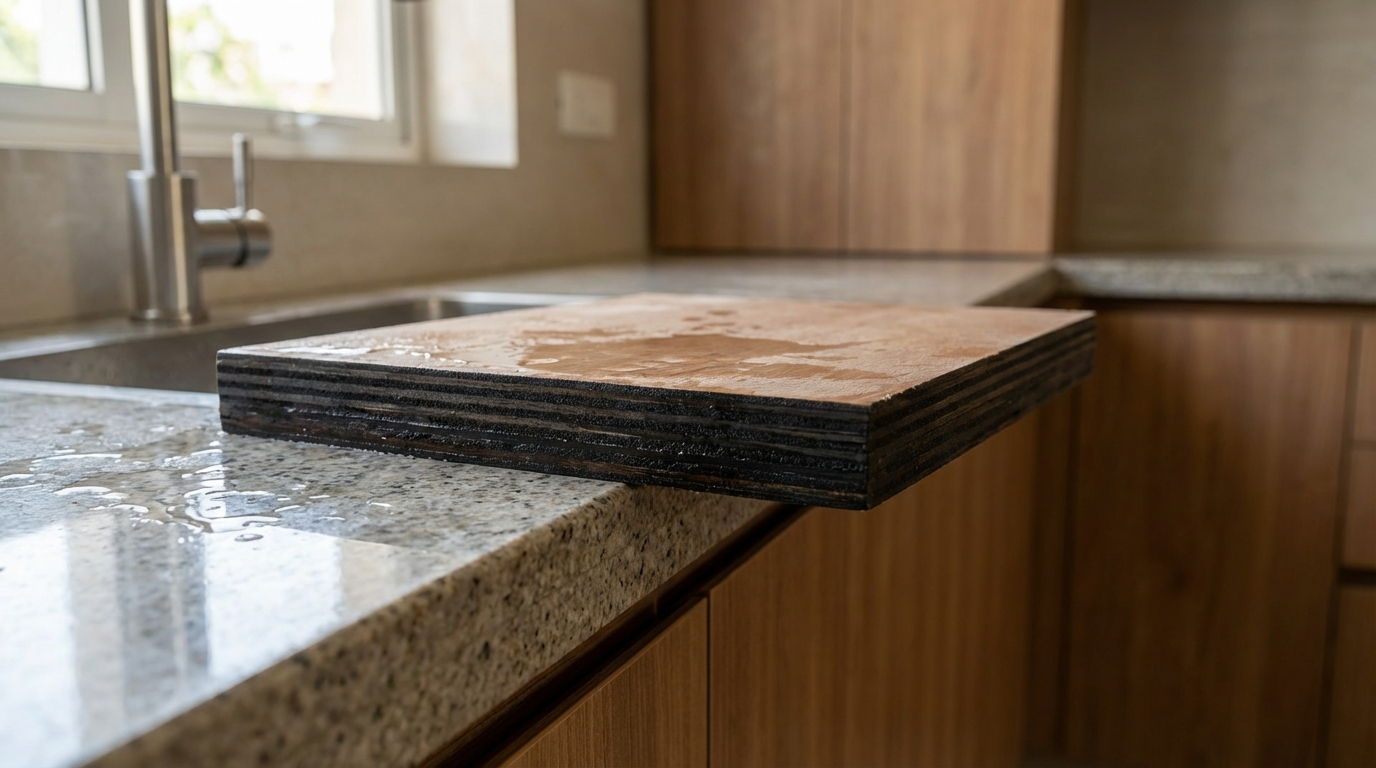
BWP plywood represents the highest water resistance grade available in the Indian market, engineered specifically for applications demanding complete moisture impermeability. The "Boiling Water Proof" designation indicates the plywood has been manufactured using phenol formaldehyde resin adhesive, which creates bonds capable of withstanding prolonged water exposure without delamination or structural failure.
In practical Indian market terms, BWP grade plywood is tested by immersing samples in boiling water for extended periods—commonly 72 hours—to verify adhesive integrity. This makes it fundamentally different from BWR (Boiling Water Resistant) grade, which uses melamine urea formaldehyde resin and tolerates only intermittent moisture contact.
Why BWP Commands Premium Pricing
The price differential between BWP and lower grades stems from three primary factors. First, phenolic resin costs significantly more than melamine-based alternatives. Second, BWP manufacturing requires stricter quality control during pressing, with higher temperatures and longer curing times. Third, the core veneers used in genuine BWP plywood typically come from denser, more moisture-resistant timber species.
For Indian buyers, understanding this pricing logic helps distinguish between genuine BWP products and dealer claims. Many commercially available products marketed as "waterproof" are actually BWR grade, which costs 20–30% less but offers inferior water resistance. The IS 710 standard specifically governs marine and waterproof plywood, while IS 303 covers MR and BWR grades—checking these markings on the actual sheet edge remains the most reliable verification method.
Market Positioning in 2026
The 2026 market reflects continued price consolidation after raw material fluctuations of previous years. Timber costs, particularly for hardwood species like gurjan and eucalyptus, have stabilized somewhat, though import duties and forest regulations continue influencing supply. GST at 18% applies uniformly, but transport costs create substantial regional variations—coastal manufacturing hubs like Kerala and Gujarat offer marginally lower prices than landlocked northern markets.
BWP Plywood Price Comparison by Thickness
Thickness selection directly impacts both pricing and application suitability. Indian buyers commonly encounter confusion between trade sizes and actual measurements—18mm and 19mm are often used interchangeably by dealers, though they refer to the same product category. Similarly, 12mm may actually measure 11.5mm or 12.5mm depending on calibration standards.
| Thickness | Economy Brand (₹/sq ft) | Mid-Range Brand (₹/sq ft) | Premium Brand (₹/sq ft) | Primary Applications |
|---|---|---|---|---|
| 6mm BWP | ₹65–₹85 | ₹85–₹110 | ₹110–₹140 | Wall paneling, backing boards |
| 9mm BWP | ₹80–₹100 | ₹100–₹130 | ₹130–₹160 | Ceiling work, light shelving |
| 12mm BWP | ₹95–₹120 | ₹120–₹150 | ₹150–₹185 | Cabinet carcasses, partitions |
| 18mm/19mm BWP | ₹130–₹160 | ₹160–₹190 | ₹190–₹220 | Kitchen shutters, furniture frames |
| 25mm BWP | ₹180–₹220 | ₹220–₹270 | ₹270–₹320 | Heavy-duty shelving, countertops |
These ranges assume standard 8×4 feet sheet dimensions, applicable for metro and large Tier-1 cities in January 2026. Tier-2 and Tier-3 markets typically see 8–15% lower pricing, though availability of premium brands becomes inconsistent.
Calibrated vs Non-Calibrated Pricing
Calibrated BWP plywood, sanded to uniform thickness across the entire sheet surface, commands a 10–15% premium over non-calibrated alternatives. For modular kitchen installations and CNC machining work, this premium proves worthwhile—inconsistent thickness creates fitting problems, edge banding failures, and visible gaps in finished furniture. Most premium brands offer factory calibration, while economy products require additional sanding at the carpenter's workshop.
City-Wise Price Variations Across India
Geographic location significantly impacts waterproof plywood pricing, driven by proximity to manufacturing clusters, transport logistics, and local demand patterns. Understanding these variations helps buyers negotiate more effectively and identify overpriced dealer quotes.
| City/Region | 18mm BWP Range (₹/sq ft) | Price Factor | Market Notes |
|---|---|---|---|
| Delhi NCR | ₹155–₹210 | High demand, competitive | Yamuna Nagar proximity benefits pricing |
| Mumbai | ₹165–₹220 | Premium urban market | Higher real estate costs reflected in dealer margins |
| Bengaluru | ₹160–₹215 | Strong demand, moderate supply | Good availability of South Indian brands |
| Chennai | ₹150–₹200 | Manufacturing hub proximity | Coastal humidity drives genuine BWP preference |
| Kolkata | ₹145–₹195 | Eastern market rates | Myanmar timber routes historically beneficial |
| Ahmedabad | ₹150–₹200 | Gujarat manufacturing access | Kandla port import benefits |
| Tier-2 Cities | ₹140–₹185 | Lower overheads | Limited premium brand availability |
Transport and GST Impact
Plywood pricing includes transport costs that vary dramatically based on distance from major manufacturing centers. Yamuna Nagar in Haryana, Perumbavoor in Kerala, and parts of Gujarat form the primary production clusters. A Delhi buyer purchasing from a Yamuna Nagar manufacturer saves significantly compared to shipping the same product to Chennai or Guwahati.
GST at 18% applies uniformly across India, but the landed cost structure differs. Buyers in remote northeastern states or island territories face 15–25% higher effective prices purely from logistics. For large projects, direct manufacturer purchases with arranged transport often prove more economical than dealer-channel buying.
How to Choose the Right BWP Plywood
Selecting appropriate waterproof plywood involves balancing budget constraints against application requirements. Not every moisture-exposed application demands the highest-grade product, and overspending on premium BWP for dry-zone furniture wastes money without functional benefit.
Decision Framework by Application
For kitchen base units and sink cabinets, genuine BWP grade proves essential—these areas face direct water contact, steam exposure, and high humidity. Kitchen wall units, receiving only indirect moisture, may function adequately with BWR grade at 20–25% lower cost. Bathroom vanity units and areas adjacent to wet zones require BWP minimum, while bedroom furniture and living room installations rarely justify the premium.
Modular kitchen manufacturers typically default to BWP across all components as a quality assurance measure and marketing differentiator. Custom carpenter work allows more selective grade allocation, potentially reducing material costs by ₹15,000–₹25,000 for an average kitchen without compromising durability where it matters.
Buyer Checklist
- Verify IS 710 marking stamped on sheet edge—not just dealer claims or invoices
- Check for calibration if planning laminate or veneer application
- Assess core wood species—eucalyptus and gurjan offer superior stability
- Request sample piece for weight check—genuine BWP feels notably heavier
- Compare at least three dealer quotes for identical specifications
- Confirm warranty terms in writing—reputable brands offer 10–20 year guarantees
- Inspect for voids by tapping surface—hollow sounds indicate internal gaps
When NOT to Choose BWP Grade
BWP plywood becomes unnecessary and wasteful for several common applications. Dry bedroom wardrobes, study tables, living room TV units, and office furniture face negligible moisture exposure—MR or BWR grades serve identically at lower cost. Temporary structures, exhibition setups, and rental property basic furnishing rarely justify premium waterproofing. Additionally, if budget constraints force choosing between premium-brand BWR and economy-brand BWP, the premium BWR typically delivers better overall quality and consistency.
Common Mistakes When Buying Waterproof Plywood
Indian buyers frequently encounter preventable problems through common purchasing errors. Understanding these pitfalls protects both investment and long-term furniture durability.
Trusting Invoice Claims Over Physical Verification
Dealers sometimes bill higher grades while supplying lower-grade products—intentionally or through inventory mix-ups. The only reliable verification is checking IS markings stamped directly on plywood edges. IS 710 indicates genuine marine/BWP grade; IS 303 indicates MR/BWR. Absence of markings or illegible stamps should trigger immediate concern.
Ignoring Core Wood Quality
BWP certification addresses adhesive water resistance, not core wood durability. Economy BWP plywood using plantation poplar cores may pass boiling water tests but warp or deteriorate faster than hardwood-core alternatives. Premium pricing for gurjan or eucalyptus cores delivers meaningful long-term benefits, particularly in high-humidity coastal regions.
Overlooking Thickness Calibration
Non-calibrated plywood creates cascading problems during furniture fabrication. Uneven thickness causes visible gaps after edge banding, laminate bubbling, and misaligned joints. Carpenters compensate through additional sanding—adding labor costs while reducing effective sheet thickness. Specifying calibrated plywood upfront eliminates these issues.
Buying Based on Brand Name Alone
Established brands maintain quality consistency, but their economy product lines sometimes differ substantially from premium offerings. A brand's lowest-tier BWP may underperform a lesser-known manufacturer's premium grade. Evaluate specific product specifications rather than assuming brand-wide quality uniformity.
Quick Inspection Checks
- Weight test: Genuine BWP feels noticeably heavier than BWR of identical dimensions
- Edge inspection: Look for void-free, dense veneer layers without gaps
- Tap test: Knock across surface—consistent solid sound indicates good bonding
- Bend test: Slight flex should spring back without cracking sounds
- Smell check: Strong chemical odor may indicate formaldehyde issues
BWP vs Marine Plywood: Price and Performance Differences
Buyers frequently confuse BWP and marine plywood as interchangeable terms. While both fall under IS 710 standards and offer high water resistance, meaningful differences exist in construction, pricing, and appropriate applications.
| Parameter | BWP Grade Plywood | Marine Grade Plywood |
|---|---|---|
| Adhesive | Phenol formaldehyde | Phenol formaldehyde (higher resin content) |
| Core Construction | Standard veneer layering | Void-free, denser veneer selection |
| Price Range (18mm) | ₹150–₹220/sq ft | ₹180–₹280/sq ft |
| Price Premium | Baseline | 15–30% higher |
| Best Applications | Kitchens, bathrooms, humid interiors | Boat building, exterior use, water tanks |
| Overkill For | Dry interior furniture | Standard kitchen installations |
When Marine Grade Justifies Premium
Marine plywood's additional cost proves worthwhile for genuine exterior applications—outdoor furniture, balcony installations in coastal cities, bathroom flooring in direct wet zones, and structural applications near water bodies. For typical kitchen and bathroom furniture in Indian homes, standard BWP grade delivers adequate performance without marine-grade pricing.
Coastal city residents—Mumbai, Chennai, Kochi, Visakhapatnam—may lean toward marine grade for kitchen applications given higher ambient humidity and salt air exposure. Inland city buyers rarely need this premium for indoor installations.
Budget vs Premium BWP: Which Makes Sense?
The ₹50–70 per square foot gap between economy and premium BWP plywood translates to ₹8,000–₹12,000 difference for an average modular kitchen. Understanding where this premium delivers value helps buyers allocate budgets intelligently.
Premium Brand Advantages
Established manufacturers like Greenply, Century, Kitply, and others maintain stricter quality control, consistent calibration, and reliable warranty support. Premium products typically use higher-density hardwood cores, better face veneers, and more uniform resin distribution. For visible furniture components and long-term installations, these factors translate to superior durability and appearance.
Economy Brand Considerations
Economy BWP products serve adequately for concealed applications—cabinet carcasses hidden behind shutters, backing boards, and internal partitions. Here, water resistance matters more than surface finish or long-term aesthetics. Strategic mixing of premium plywood for visible surfaces and economy grade for hidden structures optimizes overall project costs.
5-Year Durability Outlook
Premium BWP plywood in properly ventilated kitchens shows minimal degradation over five years under normal Indian household conditions. Economy alternatives may exhibit edge swelling near water sources, minor surface delamination, and faster wear at stress points. The premium investment typically proves justified for sink base units, dishwasher adjacent cabinets, and areas receiving direct steam exposure.
Regional Considerations for Indian Buyers
India's diverse climate zones create varying demands for waterproof plywood performance. Selection strategies should account for local environmental challenges.
Coastal and High-Humidity Regions
Mumbai, Chennai, Kochi, Kolkata, and other coastal cities experience consistently high humidity exceeding 70% for extended periods. Here, genuine BWP grade proves essential even for applications that might tolerate BWR inland. Salt air accelerates degradation of inferior adhesives, making IS 710 certification particularly important. Marine grade plywood becomes a reasonable choice for ground-floor apartments and seafront properties.
Northern Plains and Dry Zones
Delhi, Jaipur, Ahmedabad, and similar regions experience extreme seasonal variation—monsoon humidity followed by dry winters. BWP grade handles monsoon exposure while remaining dimensionally stable during dry months. However, the extreme summer heat in these regions can cause issues with poorly manufactured plywood regardless of grade classification.
Termite and Borer Considerations
Beyond water resistance, Indian buyers must consider pest vulnerability. Most branded BWP plywood includes borer and termite treatment, but verification through physical inspection remains important. Ground-floor installations and properties in termite-prone areas benefit from additional chemical treatment regardless of plywood grade.
Frequently Asked Questions
What is the full form of BWP in plywood?
BWP stands for Boiling Water Proof in plywood terminology. This grade indicates the plywood has been manufactured using phenol formaldehyde resin adhesive capable of withstanding prolonged water immersion without delamination. BWP plywood is tested by boiling samples for 72 hours and checking for bond failure. It represents the highest water resistance grade for interior plywood applications in India and falls under IS 710 standards alongside marine grade plywood.
Which is better, BWP or BWR plywood?
BWP offers superior water resistance compared to BWR and is better for wet areas like kitchen sink zones and bathrooms. BWR (Boiling Water Resistant) uses melamine urea formaldehyde adhesive that handles intermittent moisture but fails under prolonged water exposure. For applications receiving only occasional humidity or steam—like kitchen wall units or dining room furniture—BWR provides adequate protection at 20–30% lower cost. Direct water contact zones always warrant BWP selection.
What is the price of 18mm waterproof plywood in India?
The 18mm BWP waterproof plywood price in India ranges from ₹130 to ₹220 per square foot in 2026, depending on brand tier, core wood species, and city location. A standard 8×4 feet sheet costs approximately ₹4,200 to ₹7,000 in metro cities. Premium brands with hardwood cores occupy the higher end, while economy alternatives using plantation timber cost less. Transport costs add 5–15% for locations distant from manufacturing hubs in Haryana, Kerala, and Gujarat.
Is BWP plywood good for kitchen cabinets?
BWP plywood is ideal for kitchen cabinet construction, particularly for base units, sink cabinets, and areas near dishwashers or cooking zones. Its phenolic adhesive withstands steam, cooking humidity, and occasional water splashes without delaminating. For wall-mounted units receiving only indirect moisture exposure, BWR grade may suffice at lower cost. Premium branded BWP with hardwood cores delivers optimal long-term performance for Indian kitchen environments, where humidity levels fluctuate significantly between seasons.
How can I check if plywood is genuine BWP?
Verify genuine BWP plywood by checking for IS 710 marking stamped directly on the sheet edge—not just invoice claims or dealer assurances. The stamp should be clearly legible and include manufacturer identification. Additionally, genuine BWP feels noticeably heavier than lower grades due to denser resin content. Tap the surface across multiple points—consistent solid sounds indicate proper bonding. Request manufacturer warranty documentation and verify brand authenticity through official distributor channels if purchasing significant quantities.
What is the difference between waterproof and water-resistant plywood?
Waterproof plywood (BWP/Marine grade under IS 710) withstands prolonged water immersion and direct wet conditions without adhesive failure. Water-resistant plywood (BWR under IS 303) tolerates humidity and occasional moisture but degrades under continuous water exposure. The distinction lies in adhesive chemistry—phenolic resins create permanent waterproof bonds while melamine-based adhesives offer temporary resistance. For practical selection, use waterproof grades near water sources and wet zones; water-resistant grades suffice for dry areas with occasional humidity.
Why is marine plywood more expensive than BWP?
Marine plywood commands 15–30% premium over standard BWP due to stricter manufacturing requirements. Marine grade mandates void-free core construction with carefully selected, defect-free veneers. Higher phenolic resin content ensures superior bonding under extreme conditions. Additionally, marine plywood undergoes more rigorous quality testing and typically uses premium hardwood species throughout. For standard Indian kitchen and bathroom applications, regular BWP provides sufficient performance—marine grade proves worthwhile primarily for actual marine use, exterior applications, and premium installations in coastal environments.
Does BWP plywood need termite treatment?
Most branded BWP plywood includes factory-applied termite and borer treatment, but this varies by manufacturer and product line. The waterproofing adhesive itself does not prevent termite attack—separate chemical treatment is required. Verify treatment inclusion through product specifications and warranty documents. For ground-floor installations, termite-prone regions, and long-term projects, consider additional post-purchase treatment regardless of factory claims. Budget plywood may skip treatment despite marketing claims, making branded products with documented treatment protocols safer choices.
Disclaimer: This content is provided for general informational purposes based on industry practices and publicly available information. Product specifications, standards, prices, and availability may vary by manufacturer, region, and time. Readers should independently verify details with manufacturers, dealers, or qualified professionals before making purchase or construction decisions.Want Plywood Suggestions?
Share a few details and a Apple Ply specialist will suggest suitable brands and connect you to responsive dealers.