Plywood Sheet: Standard Sizes, Thickness & Price Chart 2026
Complete plywood sheet guide covering standard sizes in India, thickness options & current prices. Compare 8x4, 7x4, 6x4 sheet rates.
Quick Answer
A standard plywood sheet in India comes in the 8x4 feet (2400 x 1200 mm) size, with thicknesses ranging from 6mm to 25mm. Prices typically range from ₹40 to ₹150 per square foot depending on grade, thickness, and brand—with commercial MR grade at the lower end and BWP/marine grade at the higher end. Understanding these specifications helps you budget accurately and select the right sheet for wardrobes, kitchens, or structural work.
At a Glance:
- Most common plywood sheet size in India: 8 feet × 4 feet (32 sq ft per sheet)
- Other available sizes: 7×4 ft, 6×4 ft, 8×3 ft, 7×3 ft, 6×3 ft
- Standard thickness options: 6mm, 9mm, 12mm, 16mm, 18mm, 19mm, 25mm
- Price range: ₹40–₹60/sq ft (commercial) to ₹150–₹300/sq ft (BWP/marine)
- 18mm and 19mm are the most popular thicknesses for furniture in India
- Always verify ISI marks and actual thickness at the dealer—trade sizes can vary slightly
Standard Plywood Sheet Sizes in India
Plywood sheets in India follow standardized dimensions governed by Indian Standards (IS: 303:1989 and IS: 10701:2012), though the trade continues to operate predominantly in feet and square feet rather than metric units. This practical reality means you'll encounter sizing discussions at dealers almost exclusively in feet.
Common Sheet Dimensions
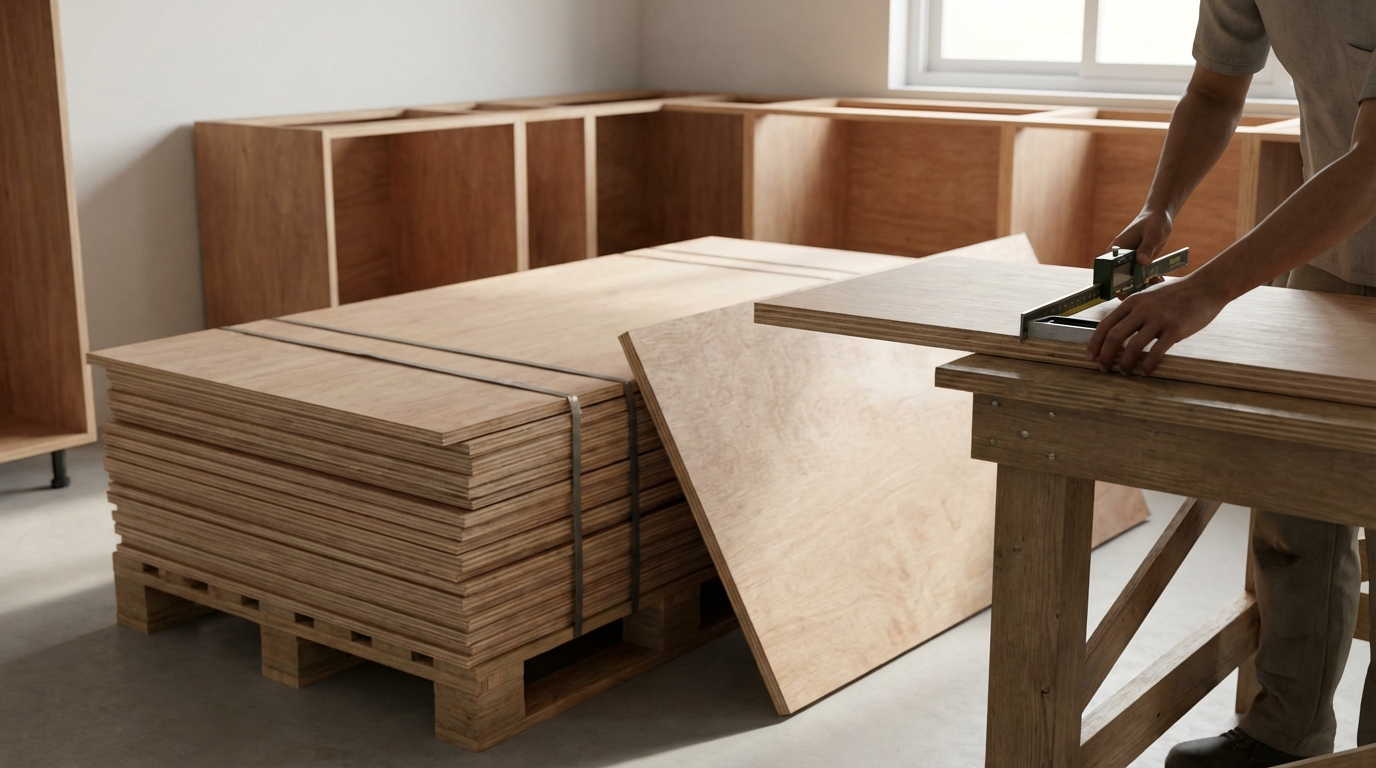
The 8×4 feet sheet remains the industry workhorse across India. This size offers optimal material utilization for most furniture and interior applications—wardrobes, modular kitchens, and partition work typically derive maximum efficiency from this dimension. However, smaller sizes serve specific purposes and can reduce wastage for targeted applications.
| Size (Feet) | Size (mm) | Area (Sq Ft) | Common Applications |
|---|---|---|---|
| 8 × 4 | 2400 × 1200 | 32 | Wardrobes, modular kitchens, large furniture, construction |
| 8 × 3 | 2400 × 900 | 24 | Customized furniture, narrow panels, small construction projects |
| 7 × 4 | 2100 × 1200 | 28 | Door panes, wardrobes, standard height furniture |
| 7 × 3 | 2100 × 900 | 21 | Compact furniture, shutters, partitions |
| 6 × 4 | 1800 × 1200 | 24 | Kitchen cabinets, office furniture, smaller wardrobes |
| 6 × 3 | 1800 × 900 | 18 | Shelving, backing panels, packing |
Why 8×4 Dominates the Indian Market
The 8×4 format has become universal in India for several practical reasons. Standard room heights in residential construction align well with 8-foot lengths for floor-to-ceiling wardrobes. CNC machines and modular kitchen manufacturing lines are calibrated for this dimension. Additionally, the 32 square feet area creates pricing convenience—dealers can quote per-sheet or per-square-foot rates with straightforward calculations.
However, in Tier-2 and Tier-3 cities, you may find 7×4 and 6×4 sheets more readily available, particularly from regional manufacturers. Transport economics play a role here—smaller sheets fit standard tempo sizes better and incur lower handling damage. Always confirm availability with your local dealer before finalizing designs that assume 8×4 sheet availability.
Plywood Thickness Options Explained
Thickness directly determines a plywood sheet's structural capability, weight, cost, and suitability for specific applications. In India, commercial plywood ranges from 4mm to 19mm, while waterproof grades extend to 25mm for heavy-duty requirements. Understanding which thickness works for which application prevents both over-engineering (wasting money) and under-specification (structural failures).
Thickness Categories by Application
The choice between 12mm and 18mm alone can mean a 30-40% difference in material cost. Here's how thickness aligns with practical furniture and construction needs:
| Thickness | Number of Plies (Typical) | Best Applications | Load Capacity |
|---|---|---|---|
| 4mm – 6mm | 3-5 plies | Back panels, drawer bottoms, decorative veneering, wall paneling | Minimal—no load-bearing |
| 9mm | 5-7 plies | Ceiling panels, internal partitions, cabinet backs with some rigidity | Light |
| 12mm | 7-9 plies | Wardrobe shutters, sliding doors, shelving with support, office furniture | Moderate |
| 16mm | 9-11 plies | Kitchen shutters, wall cladding, medium-duty shelving | Good |
| 18mm – 19mm | 11-13 plies | Wardrobe carcasses, kitchen cabinets, beds, tables, countertops | High—furniture standard |
| 25mm | 13-15 plies | Heavy-duty flooring, commercial fixtures, structural applications, staircases | Maximum—industrial grade |
The 18mm vs 19mm Confusion
One persistent source of confusion in the Indian plywood market involves the 18mm and 19mm thickness designations. Technically, 19mm is the nominal thickness that accounts for sanding and calibration, while 18mm represents the actual measured thickness after finishing. Many dealers use these terms interchangeably, and different brands may label identical thicknesses differently.
For practical purposes, when a carpenter or interior designer specifies "18mm plywood for wardrobe carcass," they're referring to the standard furniture-grade thickness—whether the label reads 18mm or 19mm. Always verify by measuring a sample sheet at the dealer's shop, especially for modular kitchen work where CNC machining tolerances matter.
Plywood Grades and Their Price Impact
Plywood grading in India primarily follows moisture resistance classifications: MR (Moisture Resistant), BWR (Boiling Water Resistant), and BWP (Boiling Waterproof/Marine). Each grade uses different adhesive formulations and manufacturing processes, resulting in significant price variations.
Understanding Grade Classifications
MR Grade (Commercial Plywood): Uses urea-formaldehyde adhesive. Suitable for dry indoor applications—bedrooms, living rooms, study tables. Cannot withstand prolonged moisture exposure. Most economical option for general furniture.
BWR Grade: Uses phenol-formaldehyde adhesive. Resists moisture and humidity better than MR grade. Appropriate for kitchens, bathroom vanities, and areas with intermittent water exposure. The practical choice for most Indian homes where humidity fluctuates seasonally.
BWP/Marine Grade: Uses superior phenolic adhesives with waterproof core construction. Designed for continuous water exposure—boats, outdoor furniture, garden structures. Overkill for most residential interiors unless you're in a high-humidity coastal zone.
Grade Selection by Room Type
| Application Area | Recommended Grade | Reasoning |
|---|---|---|
| Bedroom wardrobes | MR Grade | Minimal moisture exposure, cost-effective |
| Living room furniture | MR Grade | Dry environment, decorative focus |
| Kitchen cabinets (base units) | BWR or BWP | Sink proximity, steam, spills |
| Bathroom vanities | BWP Grade | Direct water contact, humidity |
| Balcony furniture (covered) | BWP Grade | Rain splashes, outdoor humidity |
| Study tables, bookshelves | MR Grade | Controlled indoor environment |
Plywood Sheet Price Chart 2026
Plywood pricing in India operates on a per-square-foot basis, though dealers often quote per-sheet prices for convenience. The figures below represent typical metro city rates for branded plywood with ISI certification. Tier-2 and Tier-3 city prices may be 10-15% lower for the same grade, while premium brands command 20-30% premiums over these ranges.
Price Range by Grade and Thickness
| Grade | Thickness | Price per Sq Ft (₹) | Price per 8×4 Sheet (₹ approx) |
|---|---|---|---|
| Commercial MR | 6mm | 40 – 55 | 1,280 – 1,760 |
| Commercial MR | 12mm | 55 – 75 | 1,760 – 2,400 |
| Commercial MR | 18mm/19mm | 70 – 95 | 2,240 – 3,040 |
| BWR Grade | 6mm | 55 – 75 | 1,760 – 2,400 |
| BWR Grade | 12mm | 75 – 100 | 2,400 – 3,200 |
| BWR Grade | 18mm/19mm | 95 – 130 | 3,040 – 4,160 |
| BWP/Marine | 12mm | 110 – 160 | 3,520 – 5,120 |
| BWP/Marine | 18mm/19mm | 150 – 220 | 4,800 – 7,040 |
| BWP/Marine | 25mm | 180 – 280 | 5,760 – 8,960 |
What Causes Price Variation?
Several factors create the wide price bands you'll encounter when shopping for plywood:
- Brand tier: Premium national brands (Greenply, Century, Kitply) command 20-40% premiums over regional manufacturers
- Core wood species: Gurjan-faced plywood costs more than eucalyptus or poplar alternatives
- Calibration quality: Fully calibrated sheets (uniform thickness across surface) cost more than semi-calibrated or uncalibrated
- Distance from manufacturing hub: South Indian plywood tends to be cheaper in peninsular cities due to proximity to manufacturing clusters
- GST and transport: The 18% GST applies uniformly, but transport costs add ₹3-8 per sq ft depending on distance
- Dealer margins: Authorized dealers may offer better prices than general hardware stores
How to Choose the Right Plywood Sheet
Selecting plywood involves balancing application requirements, budget constraints, and long-term durability expectations. A systematic approach prevents both overspending on unnecessary specifications and under-specifying for critical applications.
Buyer Decision Framework
- Identify the application environment: Is it a dry bedroom, humid kitchen, or moisture-prone bathroom?
- Determine load requirements: Will it support heavy items (wardrobe carcass) or just face decorative use (shutter)?
- Check carpenter skill level: Premium calibrated plywood matters more for CNC work than traditional carpentry
- Assess regional climate: Coastal and high-humidity zones benefit from BWR minimum, even for bedrooms
- Calculate total project cost: Factor in laminates, edge banding, hardware—plywood is typically 30-40% of furniture cost
Quick Selection Checklist
- Wardrobe carcass and sides: 18mm/19mm BWR or MR grade
- Wardrobe shutters (hinged): 18mm MR grade
- Wardrobe shutters (sliding): 12mm MR grade
- Wardrobe back panel: 6mm MR grade
- Kitchen base cabinets: 18mm/19mm BWR or BWP grade
- Kitchen wall cabinets: 16mm or 18mm BWR grade
- Bathroom vanity: 18mm BWP grade mandatory
- Study table tops: 18mm MR grade with laminate
- Bed base: 18mm or 19mm MR/BWR grade
When NOT to Choose Standard Plywood
Certain applications demand alternatives to conventional plywood:
- Very long unsupported shelves (over 90cm): Consider blockboard instead—plywood tends to sag over time regardless of thickness
- Outdoor applications with direct sun exposure: Use marine plywood with proper finishing or consider WPC/composite alternatives
- Tight budgets for non-structural work: MDF or particle board may suffice for backs and bases where strength isn't critical
- Curved furniture elements: Flexible plywood (3mm-5mm) or bent lamination required—standard sheets won't curve
Common Mistakes to Avoid When Buying Plywood
The plywood market in India involves significant quality variation, dealer upselling, and genuine confusion about specifications. Understanding common pitfalls helps you negotiate better and avoid costly mistakes.
Specification Mistakes
Using MR grade in kitchens: The single most common failure in Indian homes. MR plywood near sinks and cooking zones absorbs moisture over 2-3 years, leading to swelling, delamination, and fungal growth. Kitchen base units need BWR minimum, BWP for under-sink cabinets.
Over-specifying for dry areas: Conversely, using BWP marine plywood throughout a bedroom wardrobe wastes 40-50% on material cost with no functional benefit. Match grade to environment.
Ignoring calibration for modular work: CNC-cut modular kitchens require fully calibrated plywood with consistent thickness (±0.5mm tolerance). Uncalibrated sheets cause fitting problems, uneven doors, and hardware alignment issues.
Dealer-Related Mistakes
Accepting verbal grade claims: Always verify the ISI mark stamp on the plywood sheet itself—not just the dealer's word. The stamp should show IS: 303 (for commercial) or IS: 710 (for marine) along with grade classification.
Buying "alternate" or "economy" grades without understanding: These euphemisms often mean non-ISI-certified plywood made with inferior adhesives. The 20-30% price saving can result in delamination within 18-24 months.
Not checking for core voids: Tap the sheet surface—hollow sounds indicate internal voids where plies haven't bonded properly. Reject such sheets; they'll fail under screw pressure.
Quick Inspection Checks at the Dealer
- Edge inspection: Look at the cut edge—plies should be visible, tightly bonded, with no gaps or overlaps
- Surface check: Run your hand across the face—it should be smooth without undulations or rough patches
- Flatness test: Place the sheet on a flat surface—any warping or bowing indicates moisture damage or poor storage
- Weight comparison: For the same size and thickness, heavier sheets generally indicate denser core wood and better quality
- Stamp verification: ISI mark, grade, thickness, and manufacturer details should be stamped or printed on the sheet
Regional Considerations for Indian Buyers
India's diverse climate zones and regional manufacturing clusters create meaningful variations in plywood selection and pricing that buyers should understand.
Coastal and High-Humidity Zones
Mumbai, Chennai, Kolkata, Kochi, and other coastal cities experience year-round humidity levels that stress standard MR plywood even in bedroom applications. In these regions, consider upgrading to BWR grade as your baseline for all furniture—the marginal cost increase (₹15-25 per sq ft) prevents premature failure.
Additionally, termite treatment becomes critical in humid zones. Many premium brands offer termite-resistant plywood with chemical treatment—worth the 5-10% premium in high-risk areas.
North Indian Plains and Monsoon Considerations
Delhi-NCR, UP, Bihar, and adjoining states experience extreme temperature variation and concentrated monsoon humidity. Here, MR grade works for 10-11 months, but monsoon months stress the material. For furniture expected to last 10+ years, BWR provides better insurance.
Manufacturing Hub Advantages
Plywood manufacturing clusters in Karnataka (Mangalore-Udupi belt), Kerala, West Bengal, and Gujarat mean buyers in nearby regions often access fresher stock at lower transport costs. South Indian buyers, in particular, benefit from competitive pricing due to multiple regional manufacturers.
Conversely, northeastern and remote Himalayan regions face 15-25% price premiums purely from transport costs. In such areas, exploring local timber alternatives or planning bulk purchases during construction becomes economically sensible.
Frequently Asked Questions
What is the full form of MR, BWR, and BWP plywood?
MR stands for Moisture Resistant, BWR means Boiling Water Resistant, and BWP represents Boiling Waterproof (also called Marine grade). These classifications indicate the adhesive type and water resistance capability. MR uses urea-formaldehyde glue suitable for dry interiors, BWR uses phenol-formaldehyde for moderate moisture exposure like kitchens, and BWP uses superior waterproof adhesives for continuous water contact applications like bathrooms and boats.
Which plywood size is best for wardrobes in India?
The 8×4 feet sheet size works best for standard floor-to-ceiling wardrobes in India, offering optimal material utilization with minimal wastage. For thickness, use 18mm or 19mm for the wardrobe carcass and sides, 12mm to 18mm for shutters depending on whether they're sliding or hinged, and 6mm for back panels. If your ceiling height is below 8 feet, a 7×4 feet sheet may reduce cutting waste.
Is BWP plywood necessary for kitchen cabinets?
BWP (Marine) grade is recommended but not always mandatory for kitchen cabinets. For base units near sinks where water spills occur regularly, BWP provides the best protection. For wall-mounted upper cabinets away from direct water contact, BWR grade typically suffices and saves 30-40% on material cost. The critical factor is proper edge sealing and laminate application—even BWP plywood fails if edges remain exposed to moisture.
What is the price of 18mm plywood per 8×4 sheet in India?
An 18mm plywood sheet (8×4 feet) typically costs between ₹2,240 and ₹4,500 depending on grade and brand. Commercial MR grade ranges from ₹2,240-₹3,040, BWR grade costs ₹3,040-₹4,160, and BWP/Marine grade ranges from ₹4,800-₹7,040 per sheet. Premium branded plywood may exceed these ranges by 20-30%. Always confirm current rates with local dealers as prices fluctuate with timber costs and transport.
How do I check plywood quality before buying?
Inspect the sheet edges to verify tightly bonded plies without gaps or voids. Tap the surface—hollow sounds indicate internal bonding failures. Check for the ISI mark stamp showing IS: 303 (commercial) or IS: 710 (marine) with grade and thickness specifications. Verify flatness by placing the sheet on a level surface—any warping suggests moisture damage. Compare weight across same-thickness sheets; heavier generally indicates better density and quality.
Why is there a price difference between 18mm and 19mm plywood?
In most cases, 18mm and 19mm refer to the same product—the difference is nominal versus actual thickness after calibration and sanding. Dealers may use these terms interchangeably. Any price difference typically reflects brand, grade, or core wood species rather than a true 1mm thickness variation. For practical purposes, both serve identical applications. Always measure actual thickness at the dealer rather than relying on labels.
Which plywood thickness is best for modular kitchen shutters?
For modular kitchen shutters, 16mm to 18mm thickness in BWR grade is the industry standard. Hinged door shutters benefit from 18mm for rigidity and hinge screw holding, while some designers use 16mm for lighter handling. Ensure the plywood is fully calibrated (uniform thickness) for proper CNC machining and hinge alignment. Avoid going below 16mm—thinner shutters warp over time with temperature cycling from cooking.
How much plywood do I need for a standard 6-foot wardrobe?
A standard 6×7 feet (width × height) three-door wardrobe typically requires 4-5 sheets of 8×4 feet 18mm plywood for the carcass and shutters, plus 1-2 sheets of 6mm plywood for back panels. The exact requirement depends on internal configuration (drawers, shelves, hanging space) and cutting efficiency. A skilled carpenter achieves 85-90% material utilization; factor 10-15% wastage into your estimates. For precise calculation, share your design with the carpenter before purchasing.
Disclaimer: This content is provided for general informational purposes based on industry practices and publicly available information. Product specifications, standards, prices, and availability may vary by manufacturer, region, and time. Readers should independently verify details with manufacturers, dealers, or qualified professionals before making purchase or construction decisions.Want Plywood Suggestions?
Share a few details and a Apple Ply specialist will suggest suitable brands and connect you to responsive dealers.