Plywood Price List 2026: Complete Price Guide for All Types & Grades
Complete plywood price guide for 2026 covering MR, BWR, BWP grades. Compare prices per sq ft & 8x4 sheet rates for all thicknesses.
Quick Answer
Plywood prices in India for 2026 range from approximately ₹35 to ₹210 per square foot depending on grade, thickness, brand tier, and city location. For a standard 8×4 sheet (32 sq ft), expect to pay between ₹1,100 and ₹6,700 across commercial, MR, BWR, BWP, and marine grades. Metro cities typically command 10–15% higher prices than Tier-2 towns due to transport, dealer margins, and demand patterns.
At a Glance: Plywood Price List 2026
- Commercial Grade: ₹35–55 per sq ft (₹1,100–1,800 per 8×4 sheet)
- MR Grade (Moisture Resistant): ₹50–100 per sq ft (₹1,600–3,200 per sheet)
- BWR Grade (Boiling Water Resistant): ₹85–160 per sq ft (₹2,700–5,100 per sheet)
- BWP/Marine Grade: ₹130–210 per sq ft (₹4,200–6,700 per sheet)
- Calibrated Plywood: ₹100–170 per sq ft (₹3,200–5,400 per sheet)
- GST (18%) typically extra unless dealer quotes inclusive rates
Plywood Price List 2026: Understanding the Indian Market
The Indian plywood market operates through a complex dealer network where prices fluctuate based on multiple interconnected factors. Unlike standardized commodities, plywood pricing involves negotiations, quantity discounts, and regional variations that can confuse first-time buyers and even experienced contractors.
In 2026, the plywood industry continues to see price adjustments driven by raw material costs, particularly hardwood timber procurement, resin prices, and manufacturing overheads. The shift toward calibrated plywood for modular kitchen applications has also created a distinct pricing tier that didn't exist prominently a decade ago.
Why Plywood Prices Vary So Widely
The difference between a ₹35 per sq ft commercial sheet and a ₹210 marine-grade sheet isn't arbitrary—it reflects genuine material and manufacturing differences. Core veneer quality, adhesive grade, pressing cycles, face veneer species, and certification compliance all contribute to final pricing. A BWP sheet uses phenol-formaldehyde resin requiring longer pressing times and higher temperatures compared to urea-formaldehyde in MR grades.
Regional timber availability also impacts pricing significantly. Mills in plywood manufacturing hubs like Yamunanagar (Haryana), Perumbavoor (Kerala), and parts of Gujarat and Assam enjoy lower input costs compared to manufacturers sourcing timber from distant regions. These savings sometimes—but not always—reach end consumers depending on dealer margins.
The GST Factor in Plywood Pricing
Plywood attracts 18% GST in India, which significantly impacts your final cost. When dealers quote prices, always clarify whether the rate is GST-inclusive or exclusive. A ₹100 per sq ft quote becomes ₹118 after GST, adding ₹576 to an 8×4 sheet cost. For project budgeting, assume GST-exclusive quotes unless explicitly stated otherwise, as this is the common trade practice.
Types of Plywood Grades and Their 2026 Prices
Indian plywood grades follow Bureau of Indian Standards (BIS) specifications, though market naming conventions often use shorthand that can confuse buyers. Understanding these grades is essential before evaluating any price list.
Commercial Grade Plywood
Commercial plywood represents the entry-level category, manufactured with urea-formaldehyde adhesive and typically softer core veneers. Priced between ₹35–55 per sq ft in 2026, it suits temporary structures, backing panels, and low-stress interior applications where moisture exposure is negligible. An 18mm commercial sheet typically costs ₹1,500–1,800. However, its limited durability makes it unsuitable for furniture expected to last beyond 3–5 years.
MR Grade Plywood (Moisture Resistant)
MR-grade plywood, conforming to IS:303, handles indoor humidity better than commercial grades but isn't designed for direct water contact. Priced at ₹50–100 per sq ft depending on thickness and brand, it remains India's most commonly used furniture-grade plywood. For bedrooms, living room furniture, and dry-zone applications, MR grade offers adequate performance. An 18mm MR sheet from mid-tier brands like Kitply or Austin typically costs ₹2,200–2,800 in metro markets.
BWR Grade Plywood (Boiling Water Resistant)
BWR plywood uses phenol-formaldehyde resin, offering significantly better moisture resistance than MR grades. Conforming to IS:303 with BWR-grade adhesive, it withstands steam exposure and occasional water contact—making it suitable for kitchen cabinets, bathroom vanities in semi-dry zones, and humid coastal environments. 2026 prices range from ₹85–160 per sq ft, with 18mm sheets costing ₹2,700–4,500 depending on brand positioning. Premium brands like Century Club Prime or Greenply Club command the higher end of this range.
BWP/Marine Grade Plywood
BWP (Boiling Water Proof) and marine-grade plywood, conforming to IS:710, represent the highest water-resistance category. These sheets use superior phenolic resins and denser core construction, withstanding 72+ hours of boiling water exposure. Priced between ₹130–210 per sq ft in 2026, marine plywood is essential for bathroom wet zones, outdoor furniture, boat interiors, and under-sink cabinet construction. Premium marine sheets from established brands cost ₹4,500–6,700 for an 18mm 8×4 sheet.
Plywood Price Comparison Table by Grade and Thickness
| Plywood Grade | Thickness | Price per Sq Ft (₹) | 8×4 Sheet Price (₹) | Best Application |
|---|---|---|---|---|
| Commercial | 12mm | 35–45 | 1,100–1,450 | Temporary partitions, backing |
| Commercial | 18mm | 45–55 | 1,450–1,800 | Low-cost furniture frames |
| MR Grade | 12mm | 50–70 | 1,600–2,250 | Wardrobe backs, shelving |
| MR Grade | 18mm | 65–100 | 2,100–3,200 | Bedroom furniture, TV units |
| BWR Grade | 12mm | 85–120 | 2,700–3,850 | Kitchen wall units |
| BWR Grade | 18mm | 100–160 | 3,200–5,100 | Kitchen base units, humid areas |
| BWP/Marine | 12mm | 130–170 | 4,200–5,450 | Bathroom cabinets |
| BWP/Marine | 18mm | 150–210 | 4,800–6,700 | Outdoor, wet zones, boats |
| Calibrated | 18mm | 100–170 | 3,200–5,450 | Modular kitchens, CNC work |
Note: Prices reflect mid-tier to premium brand ranges in metro cities. Tier-2/3 cities may see 5–12% lower rates. All prices exclude GST unless with inclusive dealers.
How to Choose the Right Plywood Grade for Your Project
Selecting plywood isn't merely about budget—it's about matching material performance to application requirements. Overspending on marine plywood for bedroom furniture wastes money, while using MR grade in bathroom cabinets invites premature failure.
Decision Framework by Application
Dry interior zones (bedrooms, living rooms, study areas) perform well with MR-grade plywood. Humidity exposure remains limited, and the cost savings over BWR grades—often ₹30–50 per sq ft—add up significantly in large projects. For a typical 3BHK interior requiring 200+ sq ft of plywood, MR grade saves ₹6,000–10,000 without compromising functionality.
Semi-wet zones (kitchens, dining areas, utility rooms) demand BWR-grade minimum. Steam exposure from cooking, occasional spills, and higher ambient humidity stress adhesive bonds. BWR's phenolic resin handles these conditions reliably for 15+ years. For kitchen base cabinets near sinks, upgrading to BWP provides additional insurance.
Wet zones (bathrooms, balconies, outdoor furniture) require BWP or marine-grade plywood without exception. The price premium—typically ₹50–80 per sq ft over BWR—prevents costly replacements within 5–7 years that inferior grades would necessitate.
Buyer Checklist: 7 Points Before Purchase
- Verify ISI certification mark and standard number (IS:303 for MR/BWR, IS:710 for BWP/Marine)
- Check core construction by examining sheet edges—no voids, consistent veneer thickness
- Confirm thickness with a measuring tape (18mm trade size may measure 17.5–18.5mm)
- Request brand warranty documentation, not just verbal assurances
- Calculate GST-inclusive total before comparing dealer quotes
- For modular kitchens, specify calibrated plywood requirement explicitly
- Inspect for surface defects: patches, knots, and face veneer repairs
When NOT to Choose Plywood
Plywood isn't always the optimal choice. For kitchen shutters in modular setups, HDHMR boards (priced ₹60–130 per sq ft for plain variants) offer superior routing, consistent density, and better laminate adhesion than plywood. For structural applications requiring exceptional screw-holding in thin sections, particle board or MDF may underperform, but HDHMR presents a viable alternative. Additionally, for extremely high-moisture commercial applications like food processing areas, marine plywood works but PVC boards may offer better long-term value despite higher initial costs.
Common Mistakes to Avoid When Buying Plywood
Years of dealer interactions and site visits reveal consistent patterns of buyer errors that lead to project failures, cost overruns, and premature furniture degradation.
Mistake 1: Choosing Grade Based on Price Alone
The ₹30–50 per sq ft saved by using MR instead of BWR in kitchen applications typically results in swelling, delamination, and cabinet replacement within 4–6 years. For a modular kitchen using 80 sq ft of plywood, the ₹2,400–4,000 initial savings translates to ₹25,000+ replacement costs later. Always match grade to moisture exposure, not budget constraints.
Mistake 2: Ignoring Calibration Requirements
Standard plywood varies ±0.5–1mm in thickness across a sheet. For manual carpentry, this is manageable. For CNC-routed modular furniture with precise edge-banding, uncalibrated sheets create visible gaps and uneven surfaces. Calibrated plywood, priced 15–25% higher, ensures consistent thickness essential for modern manufacturing processes prevalent in Indian modular kitchen factories.
Mistake 3: Accepting Dealer Grade Claims Without Verification
The Indian market unfortunately includes mislabeled products where commercial-grade sheets are sold as MR, or MR as BWR. Always verify the ISI stamp on the sheet itself—not just packaging or invoices. Genuine IS:303 or IS:710 certification appears permanently marked on plywood sheets.
Mistake 4: Overlooking Transport and Handling Damage
Plywood sheets damaged during transport—corner impacts, moisture exposure during monsoon delivery, improper stacking—often go unnoticed until installation. Inspect every sheet upon delivery, checking edges for delamination and surfaces for impact marks. Damaged sheets should be rejected immediately.
Quick Inspection Checks at Purchase
- Tap test: Hollow sounds indicate voids in the core
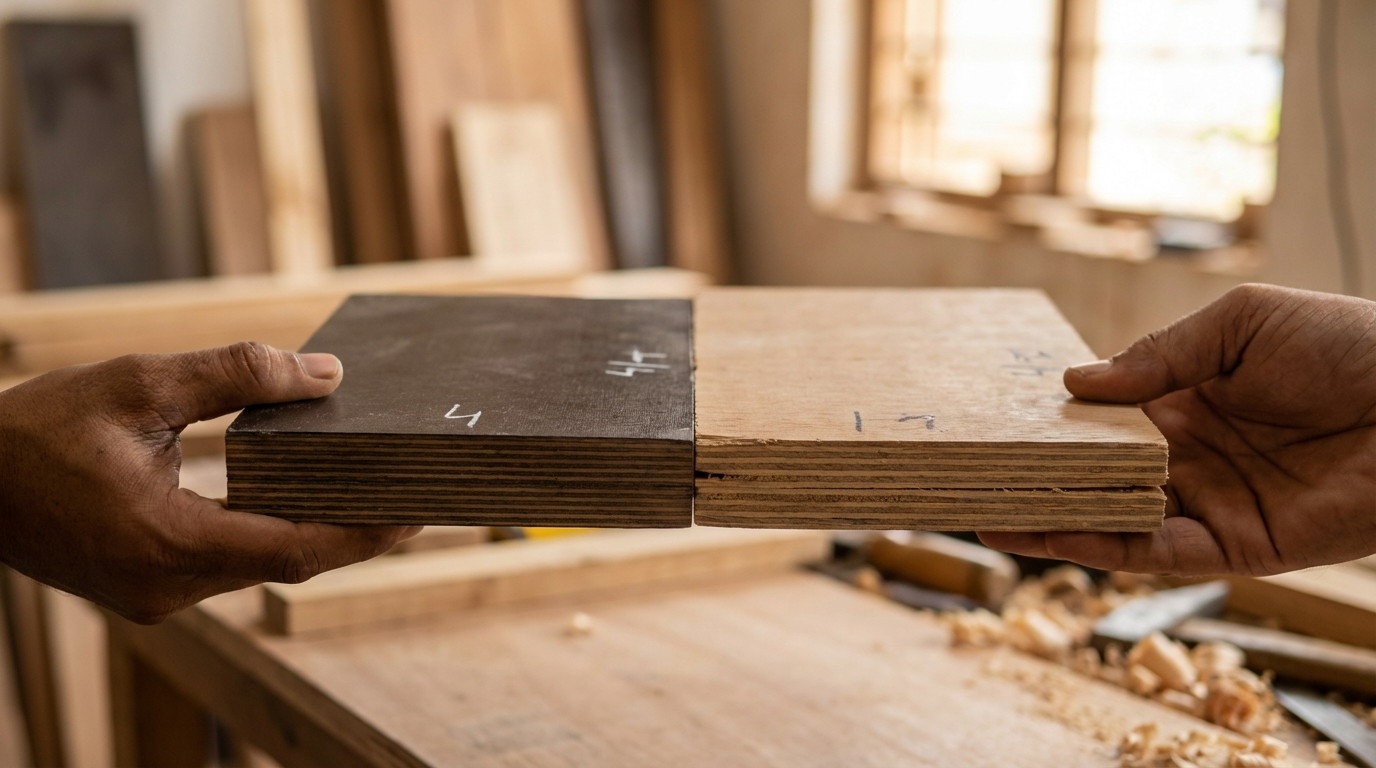
- Edge examination: Gaps between veneers suggest poor bonding
- Flex test: Slight bending shouldn't produce cracking sounds
- Weight comparison: Significantly lighter sheets of same dimension suggest inferior core density
- Surface scratch: Face veneer shouldn't lift with light fingernail pressure
Regional Price Variations Across India
Plywood prices in India aren't uniform—geography significantly impacts what you pay at the dealer counter.
Metro vs Tier-2 City Pricing
Delhi, Mumbai, Bangalore, and Chennai typically show 10–15% higher prices than cities like Lucknow, Jaipur, or Coimbatore. This premium reflects higher dealer rents, transport costs from manufacturing hubs, and stronger demand. However, metro dealers often stock wider brand and grade selections, reducing the need to compromise on specifications.
Coastal Region Considerations
Kerala, coastal Karnataka, Goa, and coastal Andhra Pradesh experience elevated humidity year-round. Local dealers often recommend BWR as minimum for applications that might use MR grade in drier regions like Rajasthan or interior Maharashtra. This isn't upselling—it's practical advice, as MR plywood in coastal homes frequently shows edge swelling within 2–3 monsoon cycles.
Manufacturing Hub Advantages
Buyers near plywood manufacturing clusters—Yamunanagar in Haryana, Perumbavoor in Kerala—sometimes access factory-direct pricing or reduced transport costs. These savings range from 5–10% compared to distant markets. However, verifying quality becomes critical, as seconds and factory rejects also circulate more freely near manufacturing areas.
Brand Tier Impact on Plywood Pricing
The Indian plywood market segments clearly into budget, mid-tier, and premium brand categories, each commanding different price points for ostensibly similar specifications.
| Brand Tier | Example Brands | Price Premium vs Budget | Key Differentiators |
|---|---|---|---|
| Budget/Regional | Local mills, unbranded | Baseline | Lower consistency, limited warranty |
| Mid-Tier | Kitply, Austin, Archid | +15–25% | Better QC, regional warranty support |
| Premium | Century, Greenply, Durian | +30–50% | National presence, longer warranties |
| Super-Premium | Century Club Prime, Greenply Club | +50–70% | Extended warranties, superior face veneers |
Premium brands justify higher prices through consistent thickness calibration, better face veneer selection, documented warranty programs, and wider dealer networks for post-purchase support. For visible furniture surfaces, the ₹20–40 per sq ft premium often delivers noticeably better finishing results.
Carpenter's Perspective on Plywood Selection
Experienced carpenters develop strong preferences based on working characteristics that don't appear in specification sheets.
Screw-holding matters practically. Cheaper plywood with low-density cores strips screw threads easily, especially near edges. For hinge installations in wardrobe doors or kitchen shutters, this means premature sagging. Better-grade plywood with denser cores accepts screws reliably, reducing callbacks.
Edge quality affects finishing. Plywood with consistent veneer layup sands cleanly and accepts edge-banding adhesive uniformly. Sheets with voids or misaligned veneers require extensive filling, adding labor time and compromising aesthetics.
Calibration saves time. Carpenters working with calibrated plywood report 15–20% faster cutting and assembly because pieces fit predictably. With uncalibrated sheets, every joint requires adjustment, slowing production.
Frequently Asked Questions
What is the full form of BWR and BWP in plywood?
BWR stands for Boiling Water Resistant, indicating plywood that withstands steam and occasional water contact using phenol-formaldehyde adhesive. BWP stands for Boiling Water Proof, representing superior water resistance suitable for continuous moisture exposure. Both terms describe adhesive performance rather than the wood itself. BWR conforms to IS:303 standards while BWP/Marine grade follows IS:710 specifications in India.
Which is better: MR plywood or BWR plywood for kitchen cabinets?
BWR plywood is categorically better for kitchen cabinets due to steam exposure from cooking and potential water contact near sinks. MR plywood will likely swell and delaminate within 3–5 years in kitchen environments, while BWR grade handles these conditions for 12–15+ years. The ₹30–50 per sq ft premium for BWR represents essential investment for kitchen applications, not optional upgrading. Only use MR grade in completely dry kitchen storage areas away from cooking and water sources.
What is the 18mm plywood price per square foot in India?
In 2026, 18mm plywood prices range from ₹45–55 per sq ft for commercial grade, ₹65–100 for MR grade, ₹100–160 for BWR grade, and ₹150–210 for BWP/Marine grade. These ranges reflect mid-tier to premium brands in metro cities. An 18mm 8×4 sheet therefore costs between ₹1,450 and ₹6,700 depending on grade and brand. Always add 18% GST to quoted prices unless explicitly inclusive.
How do I check plywood quality before buying?
Verify the ISI certification stamp directly on the sheet surface—genuine BIS marking includes the IS standard number and manufacturer code. Examine sheet edges for gaps between veneer layers, indicating poor bonding. Tap the surface listening for hollow sounds that reveal internal voids. Check thickness with a measuring tape at multiple points; variations exceeding 1mm suggest poor calibration. Finally, ensure the sheet is flat without warping when placed on a level surface.
Is marine plywood necessary for bathroom furniture?
Marine-grade plywood (BWP, IS:710) is strongly recommended for bathroom furniture due to consistent high humidity and direct water splash exposure. BWR grade may suffice for bathroom areas away from showers and sinks, but marine grade provides significantly better long-term performance. The 30–40% price premium over BWR prevents cabinet replacement cycles and water damage issues common with lower grades in bathroom environments, particularly in humid Indian climates.
What is calibrated plywood and why does it cost more?
Calibrated plywood undergoes additional sanding processes to achieve consistent thickness across the entire sheet surface, typically within ±0.2mm tolerance. This precision is essential for CNC routing, modular furniture manufacturing, and applications requiring flush laminate finishing. Calibrated sheets cost 15–25% more than standard plywood because the calibration process removes material and requires specialized equipment. For hand-carpentry projects, calibration isn't necessary, but for modern modular kitchens, it's practically mandatory.
Why do plywood prices differ between cities in India?
Plywood prices vary between cities due to transport costs from manufacturing hubs, local dealer competition levels, demand patterns, and storage costs. Metro cities like Mumbai and Delhi show 10–15% higher prices than Tier-2 cities due to elevated real estate costs affecting dealer margins. Proximity to manufacturing clusters (Yamunanagar, Perumbavoor) can reduce prices by 5–10%. Additionally, coastal cities often see higher BWR/BWP demand, affecting supply-demand dynamics and pricing for these grades.
What is the difference between plywood and HDHMR board pricing?
HDHMR (High Density High Moisture Resistant) board prices range from ₹60–130 per sq ft for plain variants and ₹105–160 for pre-laminated options in 2026. This positions HDHMR between MR plywood and BWR plywood price points. However, HDHMR offers superior routing capability, consistent density, and better laminate adhesion compared to plywood—making it preferred for modular kitchen shutters despite similar or slightly higher costs. Plywood remains preferred for structural carcass construction where screw-holding in edges matters more than routing precision.
Disclaimer: This content is provided for general informational purposes based on industry practices and publicly available information. Product specifications, standards, prices, and availability may vary by manufacturer, region, and time. Readers should independently verify details with manufacturers, dealers, or qualified professionals before making purchase or construction decisions.Want Plywood Suggestions?
Share a few details and a Apple Ply specialist will suggest suitable brands and connect you to responsive dealers.