Plywood Name List: All Types of Plywood Explained
Complete plywood name list with all types explained - MR, BWP, BWR, marine, film faced & more. Understand each type and its best application.
Quick Answer
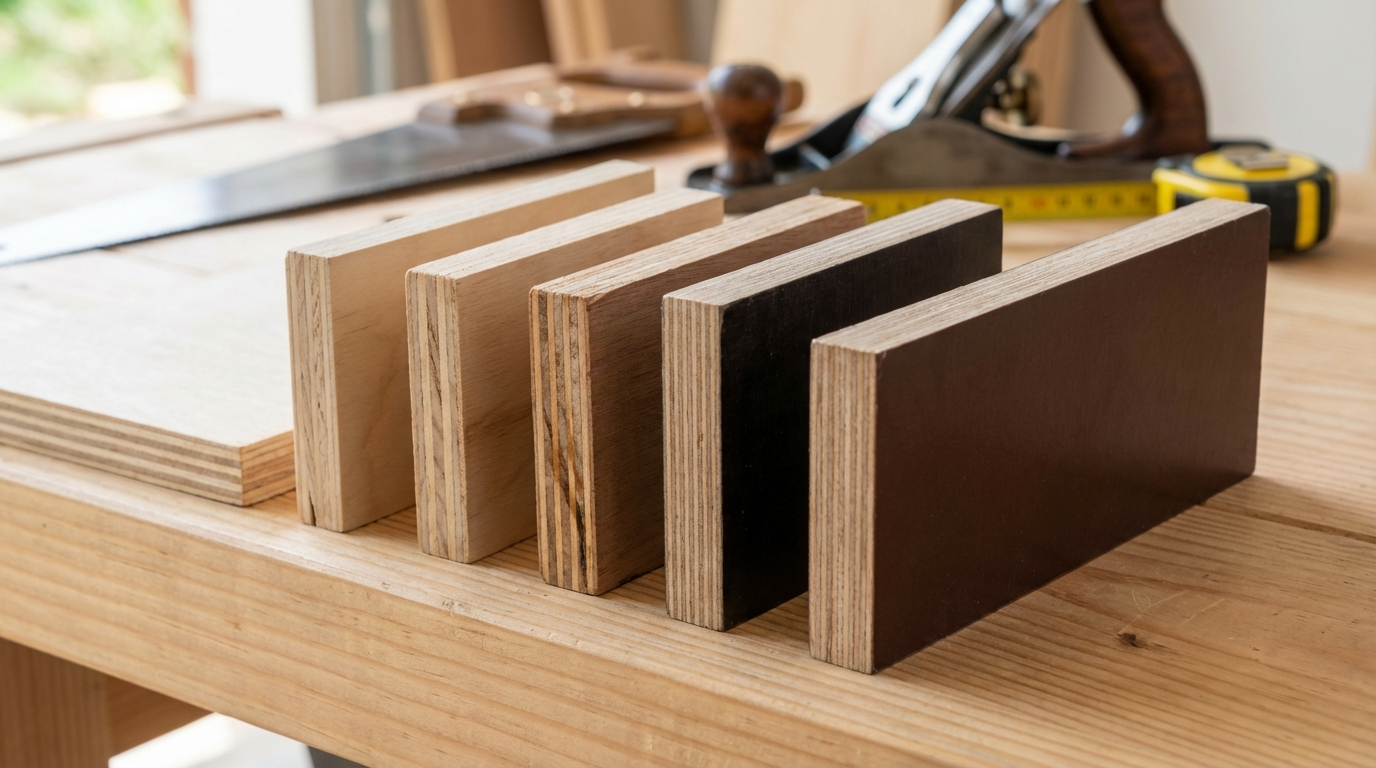
A complete plywood name list includes MR (Moisture Resistant), BWR (Boiling Water Resistant), BWP (Boiling Water Proof), Marine, Commercial, Calibrated, Film Faced, Flexible, and Decorative plywood—each designed for specific moisture exposure levels and applications. Understanding these types helps you select the right plywood for furniture, kitchens, bathrooms, or construction projects in Indian conditions.
At a Glance:
- MR plywood suits dry interior furniture like wardrobes and TV units
- BWR plywood handles moderate moisture—ideal for kitchen cabinets
- BWP/Marine plywood is fully waterproof for bathrooms and outdoor use
- Commercial plywood is the basic economy-grade option for temporary work
- Calibrated plywood ensures uniform thickness for CNC and modular applications
- Film Faced plywood serves concrete formwork in construction sites
Plywood Name List: Understanding the Complete Classification System
Navigating a plywood dealer's showroom in India can feel overwhelming when you encounter terms like MR grade, BWR, BWP, marine, calibrated, and commercial—all seemingly describing similar wooden panels. However, each name in this plywood name list represents a specific manufacturing standard, adhesive type, and intended application. The classification system exists because different environments demand different moisture resistance levels, and using the wrong grade leads to premature failure.
In practical Indian market terms, plywood classification primarily revolves around water resistance capability. The adhesive (glue) used to bond veneer layers determines how the panel behaves when exposed to moisture, humidity, or direct water contact. Secondary classifications address thickness consistency (calibrated), surface treatment (film faced, decorative), and flexibility characteristics.
The Indian Standards Framework
Bureau of Indian Standards (BIS) governs plywood grading through two primary specifications. IS 303 covers general-purpose plywood including MR and BWR grades, while IS 710 specifically addresses marine-grade or BWP plywood designed for permanent water exposure. When purchasing plywood, checking for these IS marks on the panel edge helps verify genuine grade compliance rather than relying solely on dealer claims.
The naming convention sometimes creates confusion because manufacturers and dealers use terms interchangeably. BWP and Marine are often treated as synonyms, though technically marine plywood follows stricter IS 710 specifications with superior core veneers. Similarly, "commercial plywood" in trade parlance typically means basic MR-grade material, though the term isn't an official BIS classification.
Types of Plywood by Water Resistance Grade
Water resistance forms the primary axis for plywood classification in India, and understanding these grades prevents costly mistakes when selecting material for different rooms and applications.
MR Plywood (Moisture Resistant)
MR plywood uses urea-formaldehyde resin as the bonding adhesive, providing resistance to ambient humidity but not direct water contact. This makes it suitable for completely dry interior applications—bedroom wardrobes, study tables, bookshelves, TV units, and wall panelling in climate-controlled spaces. The adhesive can handle normal indoor humidity fluctuations but fails when exposed to water splashes or prolonged dampness.
In Indian conditions, MR plywood works well in air-conditioned bedrooms and living rooms but proves risky near windows exposed to monsoon rain ingress. Dealers commonly stock this as the default "furniture plywood" due to its lower cost compared to water-resistant grades.
BWR Plywood (Boiling Water Resistant)
BWR plywood represents a significant upgrade, using phenol-formaldehyde or melamine-based resins that withstand steam and occasional water contact. The standard boiling water resistance test requires the panel to survive 8 hours of boiling water immersion without delamination. This makes BWR suitable for modular kitchens (except under-sink areas), wardrobes adjacent to bathrooms, and furniture in high-humidity cities like Mumbai, Chennai, or Kolkata.
For most Indian homes, BWR plywood offers the optimal value-for-money proposition—handling real-world moisture exposure without the premium pricing of fully waterproof grades.
BWP Plywood (Boiling Water Proof)
BWP plywood, manufactured under IS 710 specifications, uses high-grade phenolic resin ensuring complete waterproofing. Quality BWP panels survive 24-72 hours of boiling water exposure depending on adhesive quality, making them ideal for kitchen sink cabinets, bathroom vanities, outdoor furniture, and coastal applications where salt-laden moisture accelerates deterioration.
The term "Marine plywood" is commonly used interchangeably with BWP in Indian markets, though true marine-grade material follows stricter quality control with superior hardwood veneers suitable for boat building and prolonged submersion.
Commercial Plywood
Commercial plywood represents the economy segment—basic interior-grade material with minimal moisture resistance, suitable only for temporary structures, packing cases, and cost-constrained projects where longevity isn't critical. Many dealers stock this as the lowest-price option, but using commercial grade for permanent furniture results in early warping and delamination, especially in humid Indian conditions.
Types of Plywood by Special Properties
Beyond water resistance grades, several plywood types address specific manufacturing or application requirements that buyers encounter in modern construction and furniture projects.
Calibrated Plywood
Calibrated plywood undergoes precision sanding to achieve uniform thickness across the entire panel surface. Standard plywood may have thickness variations of 0.5-1mm across the sheet, which creates problems in CNC routing, modular kitchen installations, and laminate applications where flush surfaces are essential. Calibrated panels maintain ±0.2mm tolerance, ensuring seamless edge-banding and consistent joint alignment.
For modular kitchen fabricators and CNC-based furniture manufacturers, calibrated plywood has become a necessity rather than a luxury. The small price premium pays off through reduced fitting problems and professional finish quality.
Film Faced Plywood
Film faced plywood features phenolic or melamine film coating on both surfaces, creating water-resistant, smooth-release surfaces ideal for concrete formwork. Construction contractors use this for shuttering applications where the plywood must withstand repeated wet concrete contact while releasing cleanly without surface damage. Quality film faced plywood survives 15-20 reuse cycles with proper handling.
This type isn't meant for furniture applications but dominates construction site requirements across commercial building projects.
Flexible Plywood
Flexible plywood (flexi ply) is manufactured with specific grain orientations allowing the panel to bend into curved shapes without breaking. Designers use this for curved headboards, reception counter facades, cylindrical columns, and architectural elements requiring smooth radius bends. The material comes in various flexibility grades, with tighter bend radii requiring thinner sheets.
Decorative Plywood
Decorative plywood features real wood veneer facing—oak, walnut, teak, or other premium species—bonded to a standard plywood core. This provides the aesthetic appeal of solid wood with plywood's dimensional stability and cost efficiency. Interior designers specify decorative plywood for visible furniture surfaces where natural wood grain appearance adds value without solid timber's price or warping tendencies.
Pre-laminated Plywood
Pre-laminated plywood comes with factory-applied decorative laminate surfaces, eliminating the need for separate lamination during furniture fabrication. This saves finishing time and ensures consistent laminate adhesion, making it popular for ready-to-assemble furniture and projects with tight timelines.
Plywood Classification by Ply Count
Beyond grade and special properties, plywood is also classified by the number of veneer layers, which directly affects thickness, strength, and suitable applications.
| Ply Count | Typical Thickness | Common Applications | Strength Level |
|---|---|---|---|
| 3-Ply | 3mm to 6mm | Drawer bottoms, wardrobe backs, panelling | Light-duty |
| 5-Ply | 9mm to 12mm | Shelving, internal partitions, backing boards | Medium-duty |
| 7-Ply | 15mm to 18mm | Furniture carcasses, wardrobe structures | Heavy-duty |
| 9-Ply and above | 19mm to 25mm | Commercial fixtures, industrial applications | Extra heavy-duty |
More plies generally mean better strength and screw-holding capacity, assuming veneer quality remains consistent. However, ply count alone doesn't indicate quality—a 7-ply panel with poor-quality softwood veneers may underperform a well-made 5-ply hardwood panel.
Comparison Table: All Plywood Types at a Glance
| Plywood Type | Water Resistance | IS Standard | Price Range (₹/sq ft) | Best Applications |
|---|---|---|---|---|
| MR Grade | Low (humidity only) | IS 303 | ₹45–₹75 | Dry bedrooms, living rooms, studies |
| BWR Grade | Moderate (steam, splashes) | IS 303 | ₹70–₹110 | Kitchens, humid zones, coastal homes |
| BWP/Marine | High (waterproof) | IS 710 | ₹100–₹180 | Bathrooms, sink units, outdoor furniture |
| Commercial | Very Low | Basic IS 303 | ₹35–₹55 | Temporary work, packing, budget projects |
| Calibrated | Varies by grade | Grade-dependent | ₹85–₹150 | CNC work, modular kitchens, laminates |
| Film Faced | High (coated) | Construction spec | ₹90–₹160 | Concrete shuttering, formwork |
| Flexible | Varies | Application-specific | ₹120–₹200 | Curved furniture, architectural elements |
| Decorative | Varies by core | Grade-dependent | ₹150–₹350 | Premium furniture, visible surfaces |
Price ranges reflect 18mm thickness, standard brand tier, metro city dealer rates. Actual prices vary by brand, city tier, and market conditions.
How to Choose the Right Plywood Type
Selecting appropriate plywood requires matching the grade to your specific application environment, budget constraints, and quality expectations. Following a structured decision framework prevents both overspending on unnecessary grades and underspecifying material that fails prematurely.
Decision Framework by Room
Bedrooms: MR grade suffices for wardrobes, beds, and study furniture in air-conditioned or well-ventilated rooms. Upgrade to BWR if the room faces monsoon rain exposure or lacks proper ventilation.
Kitchens: BWR grade minimum for all cabinet carcasses and shutters. BWP grade mandatory for under-sink cabinets and areas near the dishwasher or wet zone. Calibrated BWR ensures proper CNC routing for modular systems.
Bathrooms: BWP/Marine grade exclusively. MR or BWR plywood in bathroom vanities guarantees early failure due to constant humidity and water splashes.
Living Areas: MR grade for TV units, display shelves, and wall panelling. Consider BWR in coastal cities or ground-floor homes with dampness issues.
Buyer Checklist
- Verify IS mark on panel edge (IS 303 for MR/BWR, IS 710 for BWP/Marine)
- Check core veneers for gaps, voids, and filler materials
- Confirm thickness matches stated specification (18mm vs 17.5mm trade variations exist)
- Request calibrated panels if using CNC or modular kitchen systems
- Assess face veneer quality—uniform grain, no patches or repairs visible
- Enquire about termite treatment, especially for humid regions
- Compare at least three brands before finalizing purchase
When NOT to Choose Certain Types
Avoid MR plywood for any application near water sources, in coastal cities, ground-floor homes with dampness, or rooms without proper ventilation. The cost savings disappear when furniture swells and delaminates within 2-3 years.
Avoid Commercial plywood for any permanent furniture. Its use should be strictly limited to temporary construction needs, packing, or projects with under 1-year lifespan expectations.
Avoid standard plywood for CNC work when thickness consistency matters. Non-calibrated panels create uneven edges and routing problems that even skilled carpenters cannot fully correct.
Common Mistakes to Avoid When Buying Plywood
Even informed buyers make preventable errors that result in furniture failure, budget overruns, or quality disappointments. Understanding these common mistakes helps you navigate dealer interactions more effectively.
Mistake 1: Trusting Verbal Grade Claims
Dealers sometimes sell MR plywood as BWR or lower-grade BWR as marine-grade, relying on buyers' inability to verify claims. Always check the IS mark physically stamped on the panel edge. Genuine BWP/Marine plywood carries IS 710 marking—not just a sticker or label that can be easily applied.
Mistake 2: Ignoring Core Quality
Face veneers may look identical across grades, but core quality determines structural integrity. Request to see a cut edge or ask the dealer to cut a small sample. Look for gaps, voids, bark inclusions, or excessive filler putty in the core layers. Quality plywood shows tight, uniform veneer layers without visible defects.
Mistake 3: Using Single Grade Throughout
Budget-conscious buyers sometimes use MR grade everywhere to save costs, including kitchen and bathroom applications. This false economy results in replacement expenses within 3-5 years. Conversely, using BWP grade in dry bedrooms wastes money on unnecessary water resistance. Match grade to actual moisture exposure for optimal value.
Mistake 4: Overlooking Thickness Variations
Indian market commonly sees "18mm" plywood actually measuring 17.5mm or even 17mm. This creates problems with hardware fitting, edge-banding, and modular system compatibility. Measure actual thickness with calipers before purchase, especially for precision applications.
Mistake 5: Skipping Termite Treatment Verification
In humid Indian conditions, untreated plywood invites termite and borer infestation that destroys furniture from inside. Quality brands incorporate anti-termite treatment during manufacturing—verify this claim and prefer brands with documented pest resistance.
Quick Inspection Checks
- Tap test: Solid sound indicates dense core; hollow sound suggests voids
- Edge inspection: Check for gaps, delamination, or filler materials
- Flexibility test: Quality plywood shows controlled flex without cracking sounds
- Surface check: Run hand across face—quality veneer feels smooth without rough patches
- Weight comparison: Heavier panels (same size/thickness) generally indicate denser, better-quality wood
Price Guide for Different Plywood Types in India
Plywood pricing in India varies significantly based on grade, brand tier, thickness, and geographic location. Understanding these variables helps set realistic budget expectations and identify fair pricing during dealer negotiations.
Price Influencing Factors
Grade premium: Moving from MR to BWR typically adds 40-60% to the price. BWP/Marine grade commands 80-120% premium over basic MR. This reflects adhesive costs and manufacturing process differences.
Brand positioning: Premium brands (Greenply, Century, Kitply tier) price 30-50% higher than regional or economy brands for equivalent grades. The premium reflects better quality control, consistent specifications, and warranty support.
Thickness impact: Standard 18-19mm panels cost roughly double the 12mm equivalent in the same grade. Thicker panels use more raw material and involve higher manufacturing costs.
City tier variation: Metro city prices run 10-20% higher than Tier-2/Tier-3 markets due to real estate costs, logistics, and dealer margins. However, metro markets often stock better brand variety and calibrated options.
GST and transport: The 18% GST on plywood significantly impacts final pricing. Transport costs add another layer, especially for non-metro locations where direct brand distribution is limited.
Indicative Price Ranges (18mm thickness, 8x4 sheet)
| Plywood Type | Economy Brand | Standard Brand | Premium Brand |
|---|---|---|---|
| Commercial | ₹900–₹1,200 | ₹1,100–₹1,400 | ₹1,300–₹1,600 |
| MR Grade | ₹1,200–₹1,600 | ₹1,500–₹2,000 | ₹1,900–₹2,500 |
| BWR Grade | ₹1,800–₹2,400 | ₹2,200–₹3,000 | ₹2,800–₹3,800 |
| BWP/Marine | ₹2,600–₹3,400 | ₹3,200–₹4,200 | ₹4,000–₹5,500 |
| Calibrated BWR | ₹2,400–₹3,000 | ₹2,800–₹3,600 | ₹3,400–₹4,500 |
Prices reflect 2025-2026 metro city dealer rates. Actual prices vary by specific brand, dealer margins, purchase quantity, and market conditions. Always obtain multiple quotations before purchase.
Regional Considerations for Plywood Selection
India's diverse climate zones demand different plywood strategies. What works in dry Rajasthan may fail in humid Kerala, making regional adaptation essential for furniture longevity.
Coastal and High-Humidity Regions
Cities like Mumbai, Chennai, Kolkata, Kochi, and Visakhapatnam experience year-round high humidity combined with salt-laden air in coastal zones. Here, BWR grade becomes the minimum standard even for bedroom furniture, with BWP mandatory for any moisture-prone area. Termite treatment verification is critical, as humid conditions accelerate pest activity.
Monsoon-Prone Areas
During monsoon months, even interior spaces experience elevated humidity that challenges MR-grade plywood. Ground-floor apartments and independent houses face additional dampness risks. Upgrading to BWR throughout and ensuring proper ventilation extends furniture life significantly.
Dry Climate Regions
North Indian cities like Delhi, Jaipur, and Ahmedabad experience dry conditions for most of the year. MR-grade plywood performs adequately for interior furniture, with BWR reserved for kitchen applications. However, monsoon months still warrant caution for furniture near windows or in poorly ventilated spaces.
Frequently Asked Questions
What is the full form of MR, BWR, and BWP plywood?
MR stands for Moisture Resistant, indicating plywood that handles ambient humidity but not direct water contact. BWR stands for Boiling Water Resistant, meaning the panel survives boiling water exposure for approximately 8 hours without delamination. BWP stands for Boiling Water Proof, representing fully waterproof plywood that withstands prolonged water exposure and follows the higher IS 710 manufacturing standard. These terms describe the adhesive quality and water resistance capability of each grade.
Which plywood is best for kitchen cabinets in India?
BWR-grade plywood serves as the minimum standard for kitchen cabinet carcasses and shutters, handling steam, humidity, and occasional splashes effectively. For under-sink cabinets and areas near dishwashers, BWP/Marine grade is strongly recommended due to direct water exposure risks. Using calibrated plywood ensures proper fitting in modular kitchen systems. Avoid MR grade entirely in kitchens, as cooking steam and moisture will cause swelling and delamination within few years.
Is marine plywood and BWP plywood the same thing?
In Indian market practice, marine plywood and BWP plywood are commonly used interchangeably, and both follow IS 710 specifications for waterproof performance. However, technically, true marine plywood manufactured for boat building applications uses superior hardwood veneers with stricter quality control beyond standard BWP requirements. For home furniture applications including bathrooms and kitchens, IS 710 certified BWP plywood provides adequate waterproofing without requiring the additional marine-grade premium.
What is calibrated plywood used for?
Calibrated plywood undergoes precision sanding to achieve uniform thickness (±0.2mm tolerance) across the entire panel surface. This consistency is essential for CNC routing operations, modular kitchen manufacturing, and any application where laminate or veneer application requires perfectly flat surfaces. Standard plywood may have 0.5-1mm thickness variations that create visible edge-banding gaps and uneven surfaces. Modular kitchen fabricators increasingly specify calibrated panels as standard practice.
How to check plywood quality before buying?
Verify the IS mark stamped on the panel edge—IS 303 for MR/BWR grades and IS 710 for BWP/Marine. Inspect cut edges for core quality, checking for voids, gaps, bark inclusions, or excessive filler material. Perform a tap test across the surface—consistent solid sound indicates dense core while hollow sounds suggest internal voids. Measure actual thickness with calipers to verify stated specifications. Compare panel weight between brands—denser panels typically indicate better quality hardwood veneers.
What is the price difference between MR and BWP plywood?
BWP/Marine plywood typically costs 80-120% more than equivalent MR-grade plywood from the same brand and thickness. For an 18mm, 8x4 sheet, if MR grade costs approximately ₹1,500-2,000 from standard brands, the equivalent BWP grade ranges between ₹3,200-4,200. This premium reflects the higher-quality phenolic adhesive, stricter manufacturing processes, and IS 710 compliance requirements. The additional cost is justified for moisture-prone applications where MR-grade failure would necessitate expensive replacement.
Can commercial plywood be used for home furniture?
Commercial plywood should be avoided for permanent home furniture due to its basic adhesive quality and minimal moisture resistance. It is suitable only for temporary structures, packing applications, or projects with under one-year lifespan expectations. Using commercial grade for wardrobes, beds, or kitchen furniture results in premature warping, delamination, and structural failure—especially in humid Indian conditions. The initial cost savings are negated by early replacement requirements and poor furniture performance.
Which plywood type is best for bathroom vanity units?
BWP/Marine grade plywood following IS 710 specifications is the only appropriate choice for bathroom vanity units. Bathrooms experience constant humidity, water splashes, and steam exposure that rapidly deteriorate lower-grade materials. Even BWR grade, while handling occasional moisture, proves insufficient for bathroom's continuous exposure conditions. Additionally, ensure edges are properly sealed with waterproof edge-banding or paint to prevent moisture penetration through exposed surfaces. Using MR or commercial grade guarantees swelling and failure within 1-2 years.
Disclaimer: This content is provided for general informational purposes based on industry practices and publicly available information. Product specifications, standards, prices, and availability may vary by manufacturer, region, and time. Readers should independently verify details with manufacturers, dealers, or qualified professionals before making purchase or construction decisions.
Want Plywood Suggestions?
Share a few details and a Apple Ply specialist will suggest suitable brands and connect you to responsive dealers.