Top Plywood Dealers & Companies Near You: Location Guide
Find authorized plywood dealers and companies near you. Get genuine products, best prices & expert advice from ApplePly's dealer network.
Quick Answer
Finding reliable plywood dealers and companies near you requires understanding the dealer ecosystem in India, verifying authorized partnerships, and knowing what separates genuine suppliers from opportunistic traders. The best plywood dealers offer authentic branded products, proper documentation, competitive pricing, and post-sale support for warranty claims.
At a Glance: Finding Quality Plywood Dealers
- Authorized dealers carry genuine products with valid BIS certification stamps and proper invoicing
- Metro cities typically have 15-30% more dealer options compared to Tier-2/Tier-3 towns
- Established dealers maintain consistent stock across multiple grades and thicknesses
- Price variations of 10-20% between dealers for the same product are common and legitimate
- Dealer relationships matter significantly for warranty processing and replacement claims
- Wholesale markets offer volume discounts but may lack technical guidance and after-sales support
Understanding the Plywood Dealer Network in India
The plywood distribution system in India operates through a multi-tier network that significantly impacts product availability, pricing, and service quality in your locality. Unlike Western markets where big-box retailers dominate, the Indian plywood trade remains largely dealer-driven, with relationships between manufacturers, distributors, and local dealers shaping what reaches your neighbourhood.
At the top of this chain sit manufacturers and their regional distributors, who appoint authorized dealers based on territory, sales potential, and existing trade relationships. These authorized dealers receive direct shipments, marketing support, and crucially, the backing needed to process warranty claims. Below them operate sub-dealers and smaller hardware shops that source from distributors or even from other dealers, adding their margins along the way.
The Difference Between Authorized and Unauthorized Dealers
An authorized dealer maintains a formal relationship with the manufacturer, complete with authorization certificates, dedicated territory rights, and access to the full product range. They receive training on product specifications, participate in promotional schemes, and can escalate quality complaints directly to company representatives.
Unauthorized dealers or traders, by contrast, source products through parallel channels—sometimes from other dealers, sometimes from clearance sales, occasionally from questionable sources. While their products might be genuine, warranty support becomes problematic. Without proper invoicing from an authorized source, manufacturers often refuse replacement claims, leaving buyers stranded with defective material.
Regional Distribution Patterns
In metropolitan areas like Mumbai, Delhi, Bangalore, and Chennai, you'll find dedicated plywood markets—Mangolpuri in Delhi, Kirti Nagar for timber and plywood, Crawford Market surroundings in Mumbai. These concentrated markets offer competitive pricing through intense local competition but require navigating numerous shops to find the best deal.
In Tier-2 cities, the network thins considerably. Major brands maintain presence through one or two authorized dealers, while smaller brands may have no formal representation. This scarcity affects both price negotiation leverage and product variety availability.
Types of Plywood Dealers and Companies You'll Encounter
Not all plywood sellers operate identically. Understanding these distinctions helps you choose the right source for your specific requirements, whether you're furnishing a single room or executing a large project.
Brand-Exclusive Showrooms
Major manufacturers like Century, Greenply, and Kitply operate exclusive showrooms in metro cities. These outlets stock only that brand's products across their complete range—from basic commercial plywood to marine-grade and fire-retardant variants. Staff here typically possess better product knowledge, and warranty processing is straightforward. However, you lose the ability to compare across brands, and prices tend to be closer to MRP without significant negotiation room.
Multi-Brand Authorized Dealers
The most common dealer type in India stocks multiple brands, allowing price and quality comparisons within a single visit. Established multi-brand dealers often maintain authorized status with 3-5 major brands simultaneously, giving them inventory depth and negotiating flexibility. These dealers serve contractors, interior designers, and retail customers alike.
Hardware Stores with Plywood Sections
General hardware stores in residential areas often stock basic plywood grades—typically commercial MR grade and perhaps one or two BWP options. While convenient for small purchases, their limited variety, lower turnover leading to aged stock, and minimal technical expertise make them unsuitable for significant furniture projects.
Wholesale Markets and Mandis
Every major city has wholesale timber and plywood markets operating on bulk-sale models. Prices here run 15-25% below retail, but minimum order quantities apply, typically starting at 50-100 sheets. These markets suit contractors and large project requirements but offer minimal guidance for inexperienced buyers.
Dealer Comparison: What to Expect Across Different Types
| Dealer Type | Price Level | Product Range | Technical Support | Warranty Handling | Best For |
|---|---|---|---|---|---|
| Brand Showroom | MRP or Near-MRP | Complete Single Brand | Excellent | Smooth Processing | Premium Projects, Brand-Specific Needs |
| Multi-Brand Dealer | 10-15% Below MRP | Wide Multi-Brand | Good to Excellent | Good with Proper Invoice | Most Residential Projects |
| Hardware Store | MRP to 5% Below | Limited Basic Grades | Minimal | Often Problematic | Emergency Small Purchases |
| Wholesale Market | 15-25% Below MRP | Variable by Vendor | Minimal to None | Depends on Source | Contractors, Large Projects |
| Online Platforms | Variable | Curated Selection | Remote Only | Platform-Dependent | Research, Price Comparison |
How to Choose the Right Plywood Dealer Near You
Selecting a plywood dealer isn't merely about finding the lowest price—it's about establishing a relationship that serves you through your project's duration and beyond, particularly when quality issues arise requiring warranty support.
Key Evaluation Criteria
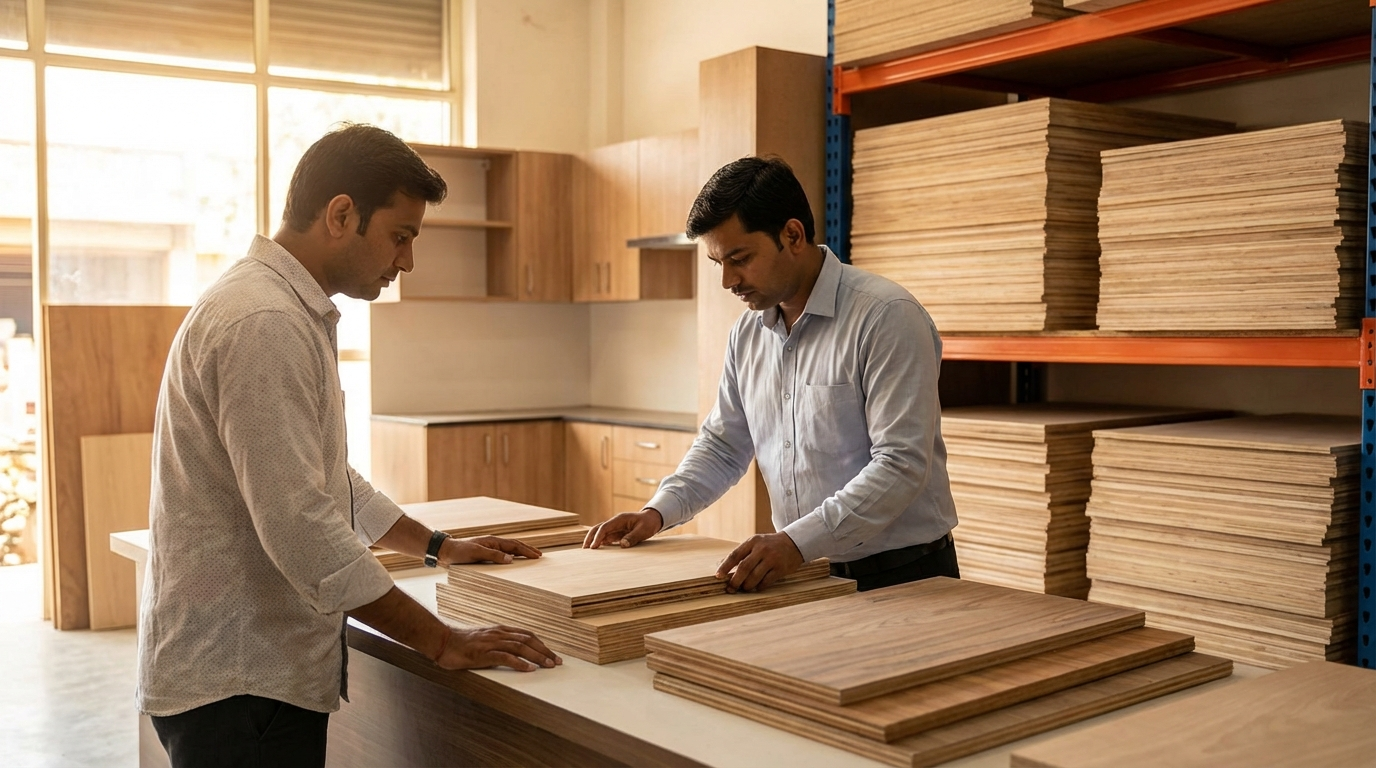
Start by verifying authorization status. Ask directly: "Are you an authorized dealer for this brand?" Request to see authorization certificates if they claim formal status. Genuine dealers display these certificates prominently or produce them without hesitation.
Examine their stock freshness and storage conditions. Plywood stored in damp conditions or exposed to direct sunlight deteriorates significantly. Well-maintained dealers keep stock in covered, ventilated warehouses. Check edges of displayed sheets—yellowing, warping, or visible delamination signals poor storage.
Assess their technical knowledge. Ask specific questions: "What's the difference between BWR and BWP grades?" or "Which thickness suits a kitchen cabinet carcass?" Competent dealers explain clearly; poorly informed ones deflect or provide vague answers.
Buyer Checklist Before Committing
- Verify GST registration and insist on proper tax invoices mentioning product grade and brand
- Confirm return and exchange policies for defective material discovered during fabrication
- Ask about delivery charges and whether cutting services are available
- Inquire about credit terms if your project spans multiple months
- Request sample pieces to show your carpenter before ordering full quantities
- Check if they stock matching laminates, edge bands, and accessories
- Ask for references from recent customers, particularly interior designers they supply
When NOT to Choose a Dealer
Walk away from dealers who refuse to provide proper invoices or offer significant discounts for cash-only transactions without documentation. This not only creates tax compliance issues but eliminates your warranty rights entirely.
Avoid dealers with limited stock who promise delivery "from godown" without letting you inspect sheets beforehand. Such arrangements frequently result in receiving lower-grade material than ordered, with disputes becoming your word against theirs.
Be cautious with dealers pushing unknown brands aggressively while discouraging established options. Higher margins on obscure brands motivate such recommendations, not your project's best interests.
Common Mistakes to Avoid When Dealing with Plywood Companies
Years of observing the Indian plywood trade reveal recurring buyer mistakes that lead to project delays, budget overruns, and quality disappointments. Understanding these patterns helps you navigate dealer interactions more effectively.
Prioritizing Price Over Documentation
The most damaging mistake involves accepting significant discounts in exchange for incomplete paperwork. Without proper invoices mentioning brand, grade, thickness, and BIS certification numbers, warranty claims become impossible. When that "discounted" plywood delaminates in your kitchen within two years, you'll have no recourse—the savings disappear, replaced by complete replacement costs.
Ignoring Physical Inspection
Many buyers order over phone based on quoted prices, receiving material without prior inspection. Skilled traders know which sheets have defects—edge damage, core gaps, surface imperfections—and these move first to uninspecting buyers. Always inspect sheets before delivery, even at wholesale quantities. Check at least 20% of sheets randomly across the stack.
Confusing Grade Terminology
Commercial grade, MR grade, BWR grade, BWP grade—dealers sometimes use these interchangeably or inaccurately. Commercial and MR (Moisture Resistant) are identical, suitable for dry interior use. BWR (Boiling Water Resistant) handles humidity better but isn't waterproof. BWP (Boiling Water Proof) or Marine grade suits wet areas. Confirm grade by checking ISI marks on sheets, not just dealer claims.
Quick Inspection Checks at the Dealer
- Tap the sheet surface—hollow sounds indicate core voids or delamination
- Sight along the edge for warping or bowing
- Check the ISI stamp matches claimed grade (IS 303 for MR, IS 710 for BWR/BWP)
- Examine corners for damage—these weaken structural integrity
- Smell the sheet—strong chemical odours indicate high formaldehyde, potentially affecting indoor air quality
Ordering Exact Quantities Without Buffer
Material gets damaged during transport, cutting errors happen, carpentry mistakes occur. Ordering exactly calculated quantities means returning to the dealer mid-project, often finding that lot exhausted. Order 10-15% extra, particularly for consistent-grain sheets where batch matching matters for visible surfaces.
Price Guide: What to Expect from Plywood Dealers
Plywood pricing in India varies based on grade, thickness, brand positioning, and significantly, your city's location in the supply chain. Understanding these factors helps you evaluate whether quoted prices represent fair deals or inflated margins.
Indicative Price Ranges (Per 8x4 ft Sheet)
| Grade/Type | Thickness | Budget Brands | Mid-Tier Brands | Premium Brands |
|---|---|---|---|---|
| Commercial/MR | 18mm | ₹45-55/sq ft | ₹55-70/sq ft | ₹70-90/sq ft |
| BWR Grade | 18mm | ₹65-80/sq ft | ₹80-100/sq ft | ₹100-130/sq ft |
| BWP/Marine | 18mm | ₹90-110/sq ft | ₹110-140/sq ft | ₹140-180/sq ft |
| Calibrated (CNC Grade) | 18mm | Rarely Available | ₹95-120/sq ft | ₹120-160/sq ft |
| Fire Retardant | 18mm | Limited Availability | ₹130-160/sq ft | ₹160-220/sq ft |
Note: Prices reflect metro city rates as of early 2024. Tier-2 cities may see 5-10% higher prices due to transport costs. Tier-3 locations often experience 15-20% premiums with limited brand availability.
Factors Causing Price Variation
Transport costs significantly impact pricing, particularly for southern and eastern states where major manufacturing clusters in Gujarat, Madhya Pradesh, and the Northeast dictate logistics expenses. A sheet costing ₹2,400 at the factory gate might reach ₹2,800 at a Tier-3 Kerala dealer after transport and handling.
GST at 18% applies uniformly, but dealers operating in grey markets offer "without bill" rates roughly 10-15% lower. These savings evaporate when quality issues arise, as no legitimate recourse exists without proper documentation.
Quantity matters substantially. Single-sheet purchases command retail rates, while 50+ sheet orders typically unlock 8-12% discounts. Contractors purchasing 200+ sheets regularly negotiate 15-20% below MRP with established dealer relationships.
Regional Considerations for Finding Dealers
India's geographic and climatic diversity means plywood requirements—and dealer expertise—vary significantly by region. Understanding local factors helps you ask the right questions and make appropriate choices.
Coastal Areas: Mumbai, Chennai, Kerala, Odisha Coast
High humidity and salt-laden air accelerate plywood degradation dramatically. Dealers in coastal cities should emphasize BWP/Marine grade products and brands with proven performance in humid conditions. Ask specifically about borer and termite treatment—endemic in these regions. Good dealers here stock borer-treated options prominently and can advise on additional protective measures.
Northern Plains: Delhi NCR, Punjab, UP, Bihar
Extreme temperature variations—scorching summers and cold winters—stress plywood differently. The primary concern shifts to dimensional stability rather than moisture. Dealers here typically stock wider MR grade ranges since humidity concerns are seasonal. However, the proliferation of dealers also means higher variation in quality standards. Verification becomes particularly important in crowded markets like Kirti Nagar.
Western India: Gujarat, Rajasthan, MP
Proximity to major manufacturing hubs means better availability and competitive pricing. However, termite risks remain significant in these regions. Established dealers maintain termite-treated stock as standard, while newer entrants may not. Always confirm treatment status, particularly for ground-floor installations.
Southern Markets: Karnataka, Andhra, Tamil Nadu
The modular kitchen revolution hit southern cities early, creating sophisticated dealer networks with expertise in calibrated plywood, edge-banding services, and coordination with modular kitchen companies. Dealers here often offer value-added services uncommon elsewhere—CNC cutting, edge finishing, and even installation coordination.
Carpenter's Perspective on Choosing Dealers
Experienced carpenters develop dealer preferences over years of working with different suppliers. Their insights reveal practical considerations beyond price and brand.
Consistency matters more than occasional quality. A carpenter notes: "I'd rather work with a dealer whose stock is reliably average than one where some sheets are excellent and others terrible. Planning becomes impossible with inconsistent material."
Exchange policies for defective sheets discovered during cutting differentiate good dealers from poor ones. Mid-project, finding a core void or delamination in an otherwise good sheet happens occasionally. Dealers who accept returns for genuine manufacturing defects build lasting relationships; those who argue and blame carpenter handling lose repeat business.
Cutting services save significant time. Dealers offering precision cutting to specified dimensions—particularly relevant for CNC-grade calibrated plywood—add value beyond the material itself. This matters especially for modular kitchen carcasses where dimensional accuracy determines fitment quality.
Frequently Asked Questions
How do I find authorized plywood dealers near me?
The most reliable method involves visiting manufacturer websites and using their dealer locator features, which major brands like Century, Greenply, Kitply, and Apple Ply maintain. Alternatively, call the brand's customer service number printed on product sheets to request nearby authorized dealer details. Local interior designers and established carpenters also provide reliable dealer recommendations based on their professional experience with different suppliers in your area.
What is the difference between plywood dealer and plywood distributor?
Distributors operate at wholesale level, receiving material directly from manufacturers and supplying to multiple dealers across a defined territory. They typically don't sell directly to end consumers and deal in large quantities. Dealers, conversely, maintain retail presence and sell to individual customers, contractors, and carpenters. Distributors set territorial pricing; dealers add their margins. For most buyers, interacting with authorized dealers provides better service experience than approaching distributors directly.
How can I verify if a plywood dealer is selling genuine products?
Check the ISI mark stamped on each sheet—it should include the license number, IS standard number, and manufacturer details. Cross-verify this license number on the BIS website if suspicious. Genuine dealers provide GST invoices mentioning brand name, grade, IS standard, and thickness clearly. Additionally, examine product consistency across sheets; counterfeit operations struggle to maintain uniform quality. When in doubt, contact the brand's customer service with the dealer's name and your invoice details for authentication.
Why are plywood prices different at different dealers?
Legitimate price variations occur due to dealer purchase quantities, payment terms with distributors, overhead costs including rent and staff, and competitive positioning in their local market. Dealers buying in bulk secure better margins. Additionally, location matters—dealers in prime commercial areas face higher overheads reflected in pricing. Variations of 10-15% between authorized dealers for identical products are normal. However, differences exceeding 20% warrant investigation—either the cheaper source isn't authorized, or the expensive one is overcharging significantly.
Do plywood dealers offer home delivery services?
Most established dealers provide delivery services, though policies vary considerably. Some include delivery within city limits for orders above certain values—typically ₹10,000-15,000. Others charge per-trip delivery fees ranging from ₹300-800 depending on distance and quantity. Wholesale market dealers often expect buyers to arrange their own transport. Always clarify delivery terms, unloading assistance, and whether stairs-carry charges apply before finalizing orders. Material damage during delivery—who bears responsibility—should be explicitly discussed.
Is it better to buy plywood from local dealers or online platforms?
Local dealers offer advantages in physical inspection before purchase, immediate availability, easier exchange for defective pieces, and relationship-based pricing for repeat customers. Online platforms provide convenience, sometimes competitive pricing through direct manufacturer partnerships, and broader brand access. However, plywood's bulky nature makes returns problematic online, and quality verification happens only post-delivery. For significant projects, local authorized dealers remain preferable. Online platforms work better for researching prices and specifications before negotiating locally.
What documents should I receive from a plywood dealer?
Every legitimate purchase should include a GST invoice mentioning seller GSTIN, your details if registered, product description including brand, grade (MR/BWR/BWP), IS standard number, thickness, quantity, and per-unit rate. For warranty-covered products, obtain the warranty card with serial numbers if applicable, or at minimum, ensure invoice mentions warranty terms. Some premium products include authenticity certificates. Retain all documents—warranty claims without proper invoices face rejection universally, regardless of how genuine the product appears.
How much discount can I negotiate with plywood dealers?
Negotiation outcomes depend on order quantity, payment terms, dealer competition in your area, and your relationship history. For retail purchases of 10-20 sheets, expect 5-10% below MRP with established dealers. Project quantities of 50-100 sheets typically secure 10-15% discounts. Cash payments with proper billing shouldn't attract additional discounts—that signals grey market practices. Long-term customers and those referred by architects or interior designers often receive preferential pricing. Avoid accepting unusually high discounts, as these frequently indicate compromised product authenticity or grade substitution.
Disclaimer: This content is provided for general informational purposes based on industry practices and publicly available information. Product specifications, standards, prices, and availability may vary by manufacturer, region, and time. Readers should independently verify details with manufacturers, dealers, or qualified professionals before making purchase or construction decisions.Want Plywood Suggestions?
Share a few details and a Apple Ply specialist will suggest suitable brands and connect you to responsive dealers.